
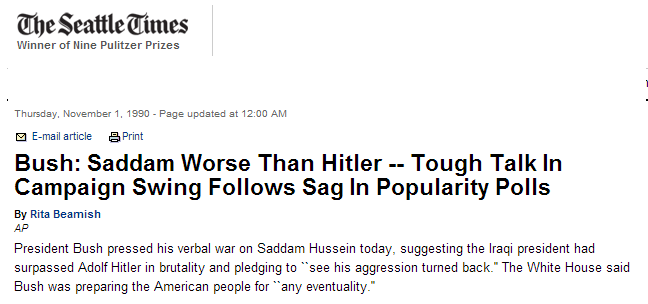
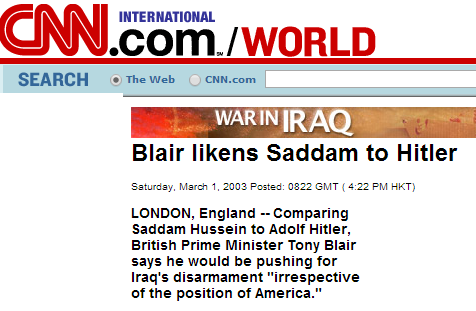
Associated Press, December 1, 1990:
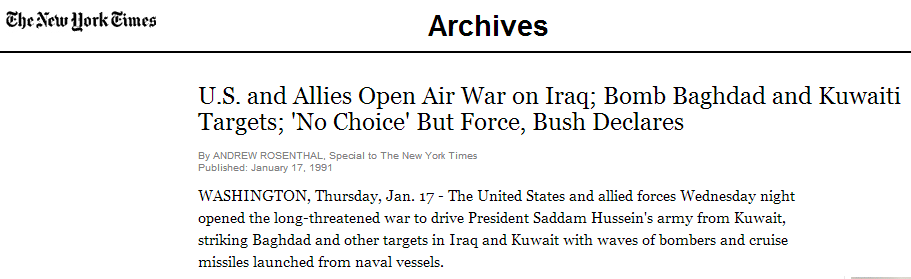
New York Times, January 17, 1991:
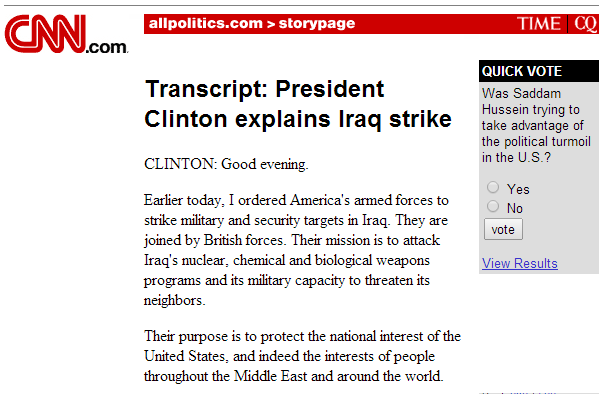
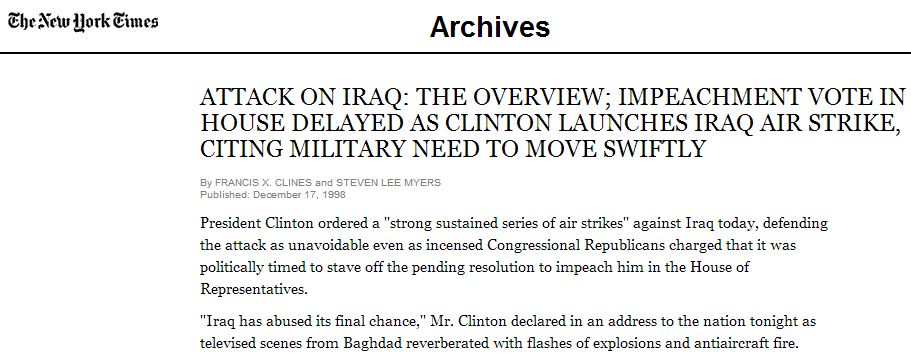
New York Times, December 17, 1998:
Time, John Dickerson, January 28, 2003:
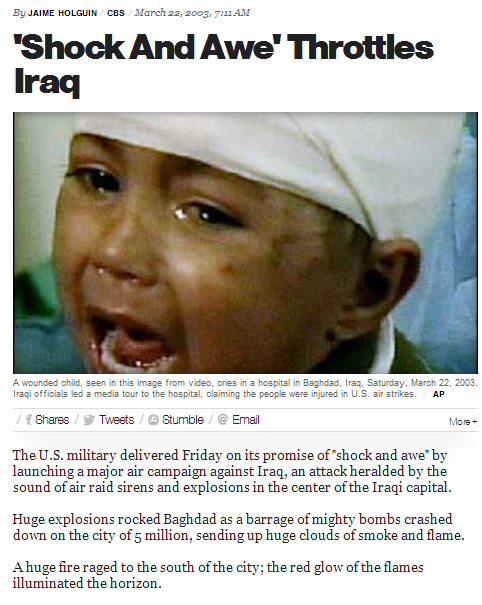
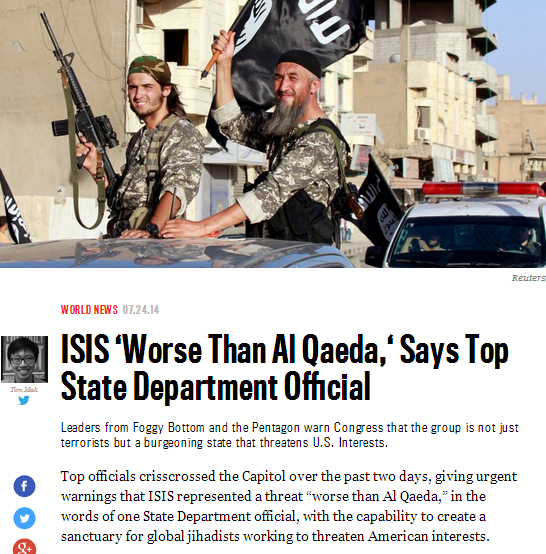
The Daily Beast, July 24, 2014:
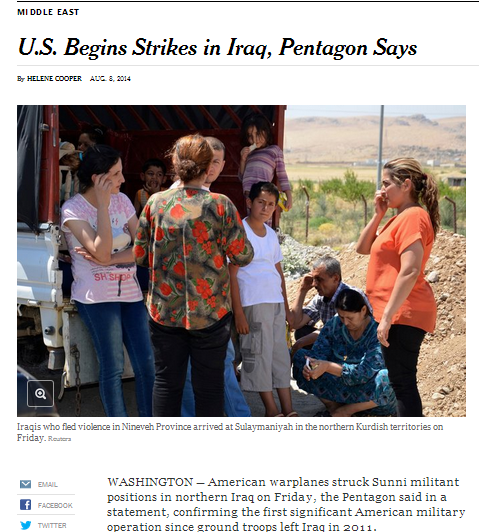
International Business Times, January 2, 2014:

There are several brief points worth noting about all of this:
(1) For those who ask “what should be done?,” has the hideous aftermath of the NATO intervention in Libya – hailed as a grand success for “humanitarian interventions” – not taught the crucial lessons that (a) bombing for ostensibly “humanitarian” ends virtually never fulfills the claimed goals but rather almost always makes the situation worse; (b) the U.S. military is not designed, and is not deployed, for “humanitarian” purposes?; and (c) the U.S. military is not always capable of “doing something” positive about every humanitarian crisis even if that were really the goal of U.S. officials?
The suffering in Iraq is real, as is the brutality of ISIS, and the desire to fix it is understandable. There may be some ideal world in which a superpower is both able and eager to bomb for humanitarian purposes. But that is not this world. Just note how completely the welfare of Libya was ignored by most intervention advocates the minute the fun, glorious, exciting part – “We came, we saw, he died,” chuckled Hillary Clinton – was over.
(2) It is simply mystifying how anyone can look at U.S. actions in the Middle East and still believe that the goal of its military deployments is humanitarianism. The U.S. government does not oppose tyranny and violent oppression in the Middle East. To the contrary, it is and long has been American policy to do everything possible to subjugate the populations of that region with brutal force – as conclusively demonstrated by stalwart U.S. support for the region’s worst oppressors. Or, as Hillary Clinton so memorably put it in 2009: “I really consider President and Mrs. Mubarak to be friends of my family.”
How can anyone believe that a government whose overt, explicit policy is “regime continuity” for Saudi Arabia, and who continues to lend all sorts of support to the military dictators of Egypt, is simultaneously driven by humanitarian missions in the region?
(3) “Humanitarianism” is the pretty packaging in which all wars – even the most blatantly aggressive ones – are wrapped, but it is almost never the actual purpose. There are often numerous steps the U.S. could take to advance actually humanitarian goals, but those take persistence and resources, and entail little means of control, and are thus usually ignored in favor of blowing things and people up with Freedom Bombs.
(4) Note how even the pretenses of constitutional democracy are now dispensed with: there is a reasonable legal debate over legality, but in essence: the President has the power to order bombing of Iraq because he decides it should happen.
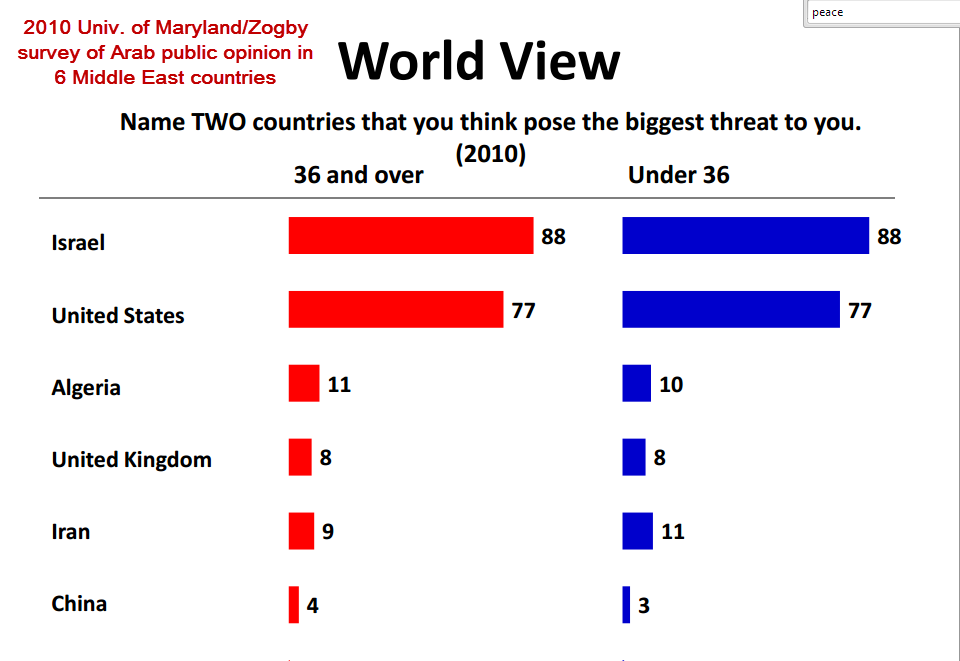
(5) Perhaps having Israel and the U.S. simultaneously bombing Arabs in different countries – yet again – will create some extremely negative consequences?
(6) This above-documented parade of “Saddam-is-worse-than-Hitler” campaigns was surrounded by stints of U.S. arming and funding of the very same Saddam (the same, of course, was true of the Taliban precursors, Gadhaffi, Iran, Manuel Noriega, and virtually every other Latest Villain who needed to be bombed; the US was roughly allied with ISIS allies in Syria and American allies fund ISIS itself). The propaganda has gone from “pulling babies from incubators: as bad as Hitler” to “rape rooms: worse than Hitler” to the new slogan: “worse than al-Qaeda!” What’s left?
For quite some time, it was Mahmoud Ahmadinejad – the democratically elected president of Iran who left office peacefully at the end of his term and who never actually invaded anybody – who was The New Hitler. As all of this demonstrates, there certainly are some heinous, violent people in the world: often including America’s closest allies and the ones who unleash the violence documented here, as well as those at whom that violence is directed. But perhaps some perspective and serious skepticism is warranted the next time we’re relentlessly bombarded with messaging about The New Greatest Villainous Threat in History – and especially manipulative accusations that opposition to U.S. military attack is indicative of support for those New Villains – as a means to secure acquiescence to the next bombing campaign.
(7) Maybe this and this, rather than humanitarianism, is a more significant influence in this new bombing campaign? Targeted strikes against ISIS is obviously not remotely the same as a full-scale invasion of Iraq, but whatever else is true, and whatever one’s opinions are on this latest bombing, it is self-evidently significant that, as the NYT’s Peter Baker wrote today, “Mr. Obama became the fourth president in a row to order military action in that graveyard of American ambition” known as Iraq.
IT’S EVEN WORSE THAN WE THOUGHT.
What we’re seeing right now from Donald Trump is a full-on authoritarian takeover of the U.S. government.
This is not hyperbole.
Court orders are being ignored. MAGA loyalists have been put in charge of the military and federal law enforcement agencies. The Department of Government Efficiency has stripped Congress of its power of the purse. News outlets that challenge Trump have been banished or put under investigation.
Yet far too many are still covering Trump’s assault on democracy like politics as usual, with flattering headlines describing Trump as “unconventional,” “testing the boundaries,” and “aggressively flexing power.”
The Intercept has long covered authoritarian governments, billionaire oligarchs, and backsliding democracies around the world. We understand the challenge we face in Trump and the vital importance of press freedom in defending democracy.
We’re independent of corporate interests. Will you help us?
IT’S BEEN A DEVASTATING year for journalism — the worst in modern U.S. history.
We have a president with utter contempt for truth aggressively using the government’s full powers to dismantle the free press. Corporate news outlets have cowered, becoming accessories in Trump’s project to create a post-truth America. Right-wing billionaires have pounced, buying up media organizations and rebuilding the information environment to their liking.
In this most perilous moment for democracy, The Intercept is fighting back. But to do so effectively, we need to grow.
That’s where you come in. Will you help us expand our reporting capacity in time to hit the ground running in 2026?
We’re independent of corporate interests. Will you help us?

I’M BEN MUESSIG, The Intercept’s editor-in-chief. It’s been a devastating year for journalism — the worst in modern U.S. history.
We have a president with utter contempt for truth aggressively using the government’s full powers to dismantle the free press. Corporate news outlets have cowered, becoming accessories in Trump’s project to create a post-truth America. Right-wing billionaires have pounced, buying up media organizations and rebuilding the information environment to their liking.
In this most perilous moment for democracy, The Intercept is fighting back. But to do so effectively, we need to grow.
That’s where you come in. Will you help us expand our reporting capacity in time to hit the ground running in 2026?
We’re independent of corporate interests. Will you help us?
Contact the author:

Latest Stories

Voices
ICE Raid on Ilhan Omar Shows How Dangerous Two Years of Flailing Trump Could Get
With his popularity tanking and his grip on power growing tenuous, Trump is becoming a decrepit tyrant — and the checks to stop him are failing.

Midterms 2026
Susan Collins-Aligned Super PAC Buys Attack Ads in Portland... Oregon
The group Defending Main Street, long associated with Susan Collins, spent thousands attacking Troy Jackson in the wrong state.

Pentagon Finally Counts an Iran War Death — Six Months Late
After months of questions from The Intercept, the U.S. military finally acknowledged the March death of Maj. Sorffly Davius.