

Chris Christie took a trip to New Hampshire this week, where he explained it would be a horrendous mistake for Congress to impose new restrictions on the National Security Agency. What he said may sound to you like standard, boring politican-speak, but read it anyway:
We lost a friend of ours in our parish [on September 11, 2001]. My oldest son’s kindergarten teacher lost her brother, who was a New York City firefighter. And my son Andrew’s best friend lost his father that morning in the trade center. …
I’m the only person who will come before you and talk to you who has actually used those tools as a prosecutor, used the Patriot Act, used Section 215, had to review those applications and approve them, and brought two major terrorist cases while I was U.S. attorney. Both resulting in convictions, one of them against six radical Islamic terrorists who were planning to attack Fort Dix and our soldiers at Fort Dix, New Jersey. We got the intelligence, we interceded and prevented the attack, and now those six folks are serving their time in federal prison because we did. …
The thing that’s demoralizing to me is that I really think there are so many sectors in our country who … have forgotten what 9/11 felt like. …
What did it feel like to us? …
You know, you can’t enjoy your civil liberties if you’re in a coffin.
There’s nothing special about that, you’ve heard it a million times before.
But now take a look at this 2002 description of Al Manar, the Lebanese satellite station run by Hezbollah, quoting its news director Hassan Fadlallah. (Hezbollah literally means “Party of God” and has been called the “A-Team of Terrorists” by former deputy secretary of state Richard Armitage.)
Al Manar is “trying to keep the people in the mood of suffering,” [said Fadallah]. … “In Spite of the Wounds” portrays as heroes men who were wounded fighting Israel in South Lebanon. … Al Manar also has a weekly program called “Terrorists.” … The show “Terrorists,” he told me, airs vintage footage of what it terms “Zionist crimes.” …
So note these similarities:
• Most importantly, Christie and Hezbollah are worried their potential followers may stop focusing on traumatic events of the past. In other words, it’s a bad thing if people no longer feel intense sorrow and fear.
• Specifically, Christie and Hezbollah want us to be scared of religion-based terrorism.
• Both want to associate themselves with heroes who are protecting us from the scary, religion-based terrorism.
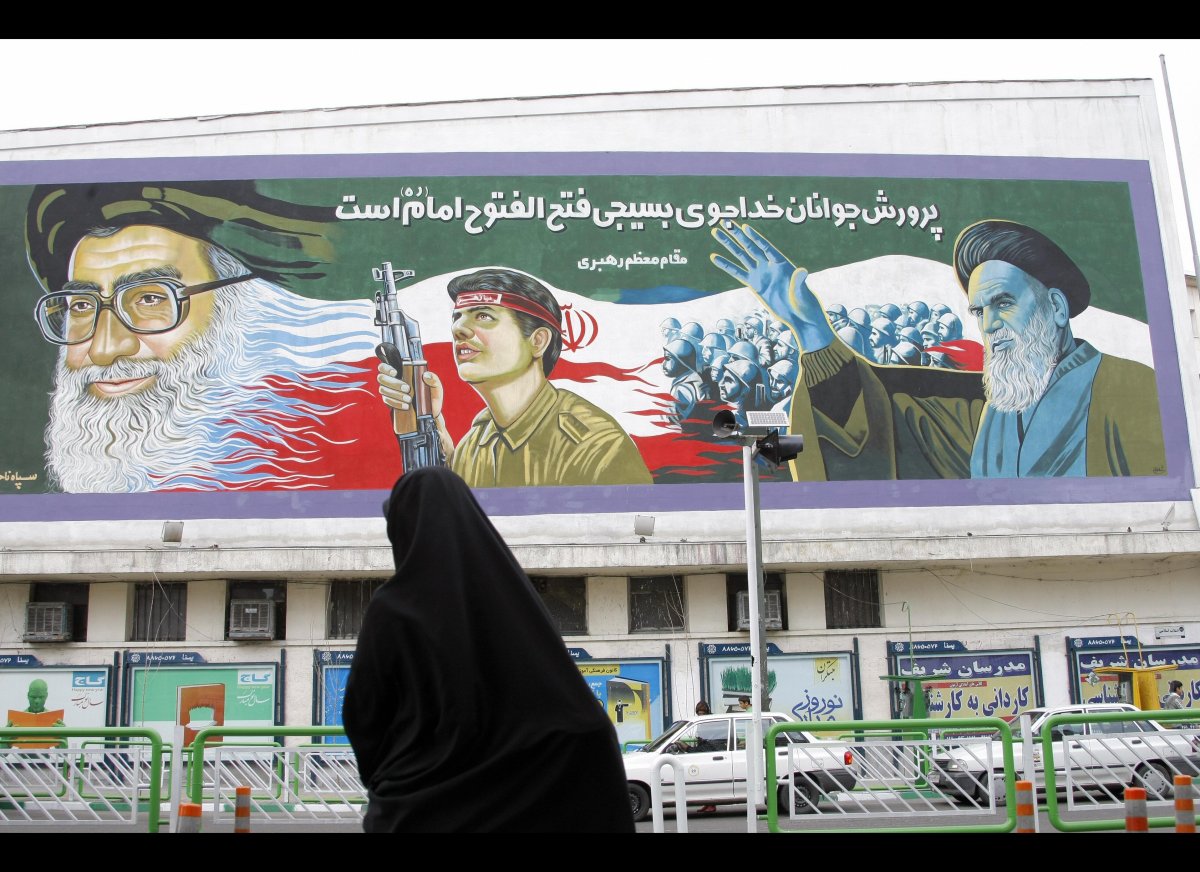
When it’s Hezbollah, we can perceive its clumsy, transparent manipulation of listeners’ emotions. We can also see it in Tehran’s huge propaganda murals, the “Walls of Martyrdom,” which constantly remind Iranians of soldiers killed in the “Imposed War” with Iraq in the 1980s and imply the dead heroes loved Ayatollah Khomeini and Ayatollah Khamenei. And in Slobodan Milosevic’s 1989 St. Vitus Day speech, in which he used the 600th anniversary of Serbian defeat at the Battle of Kosovo to demand that Serbs remember how “this unjustly suffering country” had “defended the European culture, religion, and European society” from cruel enemies with a different religion.
When the clumsy, transparent manipulation is being done by our own politicians, though, it can be harder to see. But if you don’t think Lebanese Shiites should trust the leaders of Hezbollah, or Iranians should trust their ayatollahs, you shouldn’t trust Chris Christie. Or these guys:
(This post is from our new blog: Unofficial Sources.)
Photo: Darren McCollester / Getty
IT’S EVEN WORSE THAN WE THOUGHT.
What we’re seeing right now from Donald Trump is a full-on authoritarian takeover of the U.S. government.
This is not hyperbole.
Court orders are being ignored. MAGA loyalists have been put in charge of the military and federal law enforcement agencies. The Department of Government Efficiency has stripped Congress of its power of the purse. News outlets that challenge Trump have been banished or put under investigation.
Yet far too many are still covering Trump’s assault on democracy like politics as usual, with flattering headlines describing Trump as “unconventional,” “testing the boundaries,” and “aggressively flexing power.”
The Intercept has long covered authoritarian governments, billionaire oligarchs, and backsliding democracies around the world. We understand the challenge we face in Trump and the vital importance of press freedom in defending democracy.
We’re independent of corporate interests. Will you help us?
IT’S BEEN A DEVASTATING year for journalism — the worst in modern U.S. history.
We have a president with utter contempt for truth aggressively using the government’s full powers to dismantle the free press. Corporate news outlets have cowered, becoming accessories in Trump’s project to create a post-truth America. Right-wing billionaires have pounced, buying up media organizations and rebuilding the information environment to their liking.
In this most perilous moment for democracy, The Intercept is fighting back. But to do so effectively, we need to grow.
That’s where you come in. Will you help us expand our reporting capacity in time to hit the ground running in 2026?
We’re independent of corporate interests. Will you help us?

I’M BEN MUESSIG, The Intercept’s editor-in-chief. It’s been a devastating year for journalism — the worst in modern U.S. history.
We have a president with utter contempt for truth aggressively using the government’s full powers to dismantle the free press. Corporate news outlets have cowered, becoming accessories in Trump’s project to create a post-truth America. Right-wing billionaires have pounced, buying up media organizations and rebuilding the information environment to their liking.
In this most perilous moment for democracy, The Intercept is fighting back. But to do so effectively, we need to grow.
That’s where you come in. Will you help us expand our reporting capacity in time to hit the ground running in 2026?
We’re independent of corporate interests. Will you help us?
Contact the author:


Latest Stories

Kohen Wiley’s Family Says Investigators Didn’t Contact Them Before Concluding Cops Did No Wrong
Mississippi has yet to release any support for its claim that a “thorough and impartial” review showed the shooting was “justified.”

Targeting Iran
Yemenis Unable to Reach Hospital Are Part of the Iran War Death Toll
At least 10 patients with kidney failure near Taiz, a city under a Houthi siege, died because they were unable to get to their dialysis treatments.

Midterms 2026
Mike Rogers Spent $100K on Private Jets and Luxury Travel Last Quarter
The Republican running for Senate in Michigan is directing campaign funds toward chartered flights, a Miami car service, and BMW repairs.