
Billionaire conservative activist Charles Koch on Sunday likened his political efforts to the struggles of Martin Luther King Jr. and Frederick Douglass, saying that “we, too, are seeking to right injustices that are holding our country back.”
We know this because Politico and the Washington Post were allowed to attend Charles and David Koch’s fundraiser at a southern California luxury resort over the weekend, in exchange for a promise from the reporters that they would help keep the names of donors secret.
They may as well have promised to keep what the donors are actually paying for secret as well.
The two media organizations dutifully reprinted Koch’s claim that his political network is focused on reforming the criminal justice system, reducing irresponsible government spending and even “helping the lower class.”
The reality of the Koch political agenda is wildly different.
Koch executives have gained positive headlines recently by partnering with groups such as the ACLU, the Brennan Center for Justice, and the Pew Charitable Trust to promote alternatives to incarceration and other criminal justice reforms.
But the political network developed by the Koch brothers — the one that wins policy debates on Capitol Hill and elects favored candidates at the ballot box — has continued to elevate a narrow set of issues relating to upper income taxes and environmental deregulation.
Americans for Prosperity, the biggest political organ in the sprawling network of groups financed by the Koch brothers, has never lobbied the federal government on criminal justice reform. Rather, disclosures from the group show that it has dedicated its efforts to repealing the estate tax (a tax on heirs inheriting estates worth over $5.43 million), repealing a tax on medical device companies, and undermining Environmental Protection Agency regulations on industrial pollution.
In Louisiana, a state with one of the highest rates of poverty in the nation, Americans for Prosperity has distributed a pledge to lawmakers, asking state officials to promise not to expand Medicaid, a program that provides healthcare to the poor.
In the election last year, Americans for Prosperity launched a relentless series of campaign advertisements designed to help elect a wave of Republican candidates, including this television spot urging support for Tom Cotton, who won a U.S. Senate seat last November in Arkansas.
In the Senate, Cotton’s agenda has not focused on reducing government spending or relaxing America’s criminal justice laws. To the contrary, he has demanded higher taxpayer spending on military projects and a police crackdown on undocumented immigrants.
Koch Companies Public Sector, a subsidiary for Koch Industries that helps the company influence government policy, spent very little on criminal justice. The firm, which spent over $13 million on federal lobbying last year, disclosed that it, like Americans for Prosperity, focused mostly on efforts to restrict government action on industrial pollution, particularly on proposals to regulate and tax carbon emissions and other greenhouse gases. Out of 38 lobbyists employed last quarter to influence the government on behalf of Koch, only one was registered to work on criminal justice issues.
Koch Industries has subsidiaries involved in the production of oil, gas, coal, and fertilizer, all industries that produce greenhouse gas emissions, which explains its obsessive lobbying over greenhouse gas regulation. The Koch brothers have pumped over $79 million into organizations that deny that climate change is happening and that the problem is caused by greenhouse gases.
Little has changed in regards to how Charles Koch has used his vast political reach to advance the interests of his company. In 1990, when the government proposed a system to regulate sulfur dioxide to cut down on acid rain, Citizens for a Sound Economy, a group founded by the Koch brothers, claimed that acid rain was a myth and that deregulation would benefit the environment. The acid regulations were implemented and are viewed largely as a success.
What has changed is the Koch brothers’ efforts to manage their reputation. Last year, Koch Industries hired Steve Lombardo, a public relations executive who helped the tobacco industry reshape its image. Koch now airs special branding advertisements on television and has begun funding groups on the political left through the Coalition for Public Safety initiative.
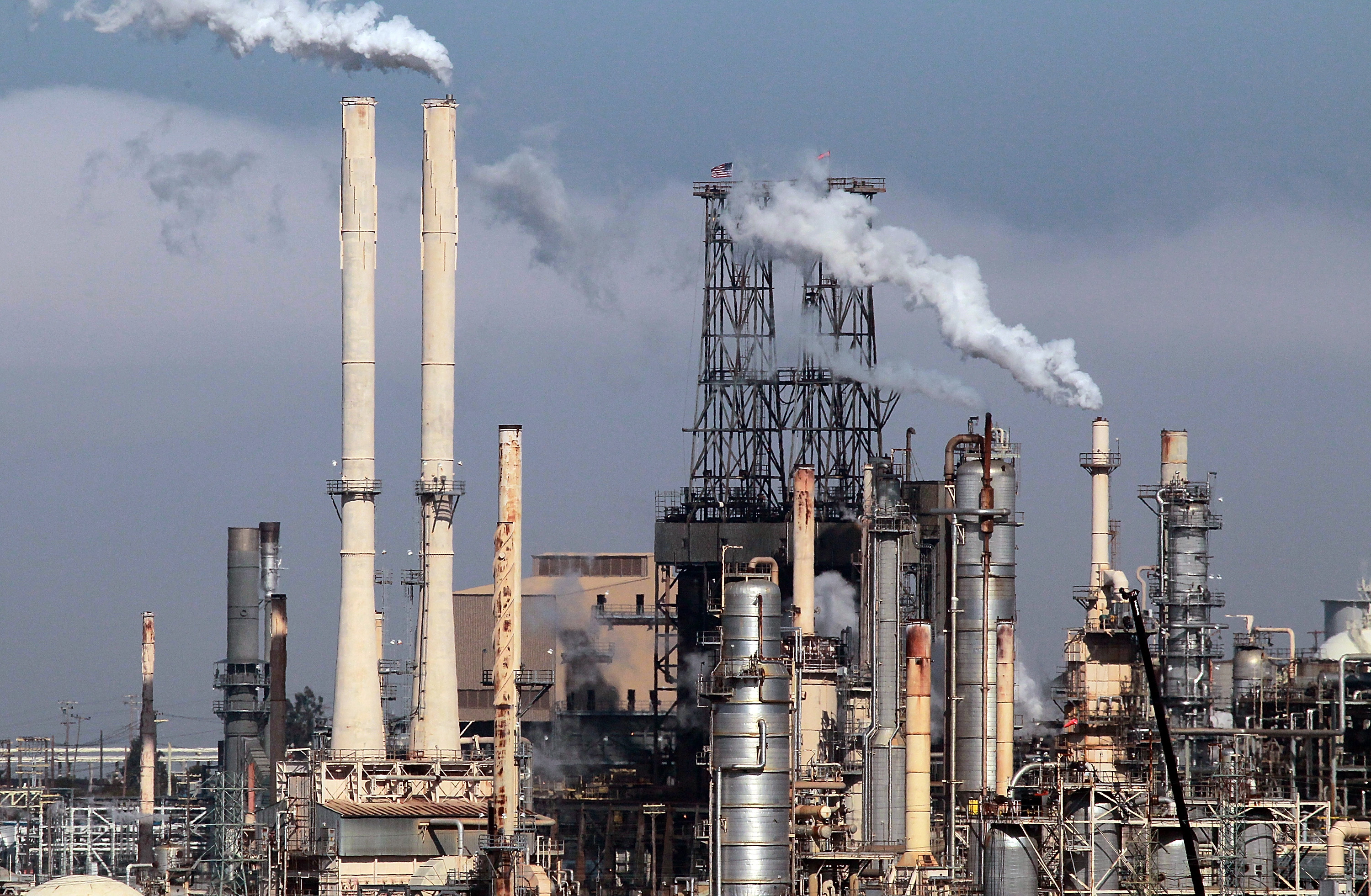
Photo: Steam rises from stacks at the Conoco-Phillips refinery in Rodeo, California.
IT’S EVEN WORSE THAN WE THOUGHT.
What we’re seeing right now from Donald Trump is a full-on authoritarian takeover of the U.S. government.
This is not hyperbole.
Court orders are being ignored. MAGA loyalists have been put in charge of the military and federal law enforcement agencies. The Department of Government Efficiency has stripped Congress of its power of the purse. News outlets that challenge Trump have been banished or put under investigation.
Yet far too many are still covering Trump’s assault on democracy like politics as usual, with flattering headlines describing Trump as “unconventional,” “testing the boundaries,” and “aggressively flexing power.”
The Intercept has long covered authoritarian governments, billionaire oligarchs, and backsliding democracies around the world. We understand the challenge we face in Trump and the vital importance of press freedom in defending democracy.
We’re independent of corporate interests. Will you help us?
IT’S BEEN A DEVASTATING year for journalism — the worst in modern U.S. history.
We have a president with utter contempt for truth aggressively using the government’s full powers to dismantle the free press. Corporate news outlets have cowered, becoming accessories in Trump’s project to create a post-truth America. Right-wing billionaires have pounced, buying up media organizations and rebuilding the information environment to their liking.
In this most perilous moment for democracy, The Intercept is fighting back. But to do so effectively, we need to grow.
That’s where you come in. Will you help us expand our reporting capacity in time to hit the ground running in 2026?
We’re independent of corporate interests. Will you help us?

I’M BEN MUESSIG, The Intercept’s editor-in-chief. It’s been a devastating year for journalism — the worst in modern U.S. history.
We have a president with utter contempt for truth aggressively using the government’s full powers to dismantle the free press. Corporate news outlets have cowered, becoming accessories in Trump’s project to create a post-truth America. Right-wing billionaires have pounced, buying up media organizations and rebuilding the information environment to their liking.
In this most perilous moment for democracy, The Intercept is fighting back. But to do so effectively, we need to grow.
That’s where you come in. Will you help us expand our reporting capacity in time to hit the ground running in 2026?
We’re independent of corporate interests. Will you help us?
Contact the author:

Latest Stories

Decision on Charging Renee Good and Alex Pretti’s Killers Looms Over Minneapolis DA Race
A former public defender and former federal prosecutor both say they’ll make the right call on charging the federal immigration agents who killed Pretti and Good.

ICE Revives Former “Hellhole” Prison — And Hires the Same Company To Run It
At Leavenworth, former workers say CoreCivic made conditions dangerous, which led to a near-death attack.

Israel’s War on Gaza
Robert Kraft Claims His Donations Help Palestinians. Turns Out He’s Funding Friends of the IDF.
An analysis of tax forms by The Intercept show Kraft’s charity and LLC have donated to Friends of the IDF and AIPAC’s super PAC.