
John Boehner, the retired speaker of the House, is monetizing his decades of political relationships and cashing out to serve some of the most powerful special interests in the world.
Boehner is joining Squire Patton Boggs, a lobbying firm that peddles its considerable influence on behalf of a number of foreign nations, including most notably the People’s Republic of China. Serving Beijing is somewhat appropriate: Boehner has long been a supporter of unfettered trade, helping to lead the effort to grant Most Favored Nation status to China. Squire Patton Boggs also represents a long list of corporate clients, including AT&T, Amazon.com, Goldman Sachs & Co., Royal Dutch Shell, and the Managed Funds Association, a trade group for the largest hedge funds in the country.
Boehner is signing onto Squire Patton Boggs “as a strategic advisor to clients in the U.S. and abroad, and will focus on global business development.”
The news comes just a week after the announcement that Boehner will be joining the board of Reynolds American, the tobacco company responsible for brands such as Camel and Newport cigarettes. The tobacco board seat will likely earn Boehner over $400,000 a year in stock and cash. The Squire Patton Boggs salary has not been disclosed, but lawmakers of Boehner’s stature have easily obtained salaries at similar gigs in the seven-figure range.
Boehner is reportedly declining to register as a lobbyist for his new job at a lobbying firm, but that label makes little difference these days. Thousands of professionals engaged in government affairs positions work to influence policy on behalf of well-heeled special interests every day without registering under the Lobbying Disclosure Act. The law governing lobby registration is virtually unenforced.
In Congress, Boehner was known for his strong alliances with the lobbying community. In 1995, Boehner was caught distributing campaign checks from the tobacco industry on the House floor to members to influence a vote on tobacco legislation. In 2006, the Washington Post revealed that Boehner lived in an apartment on Capitol Hill rented to him by a lobbyist who did business with his committee. As Republican leader, he was known for scheduling votes around fundraising events, including one incident in which Boehner interrupted House proceedings so he could attend a lobbyist-fueled bash called the “Boehner Beach Party.”
Boehner’s closeness with the lobbying industry was a big part of how he moved up the leadership ladder within the GOP. For years, he convened a “Thursday Group” to huddle with representatives of the largest corporations in America to discuss strategy and to fundraise for his party.
Boehner’s retirement from the House was met by speculation in the political press that he was done with politics and more interested in sipping wine and mowing the lawn. But in reality, he’ll still be a major political player, finally getting the role he’s auditioned for over the course of three decades in elected office.
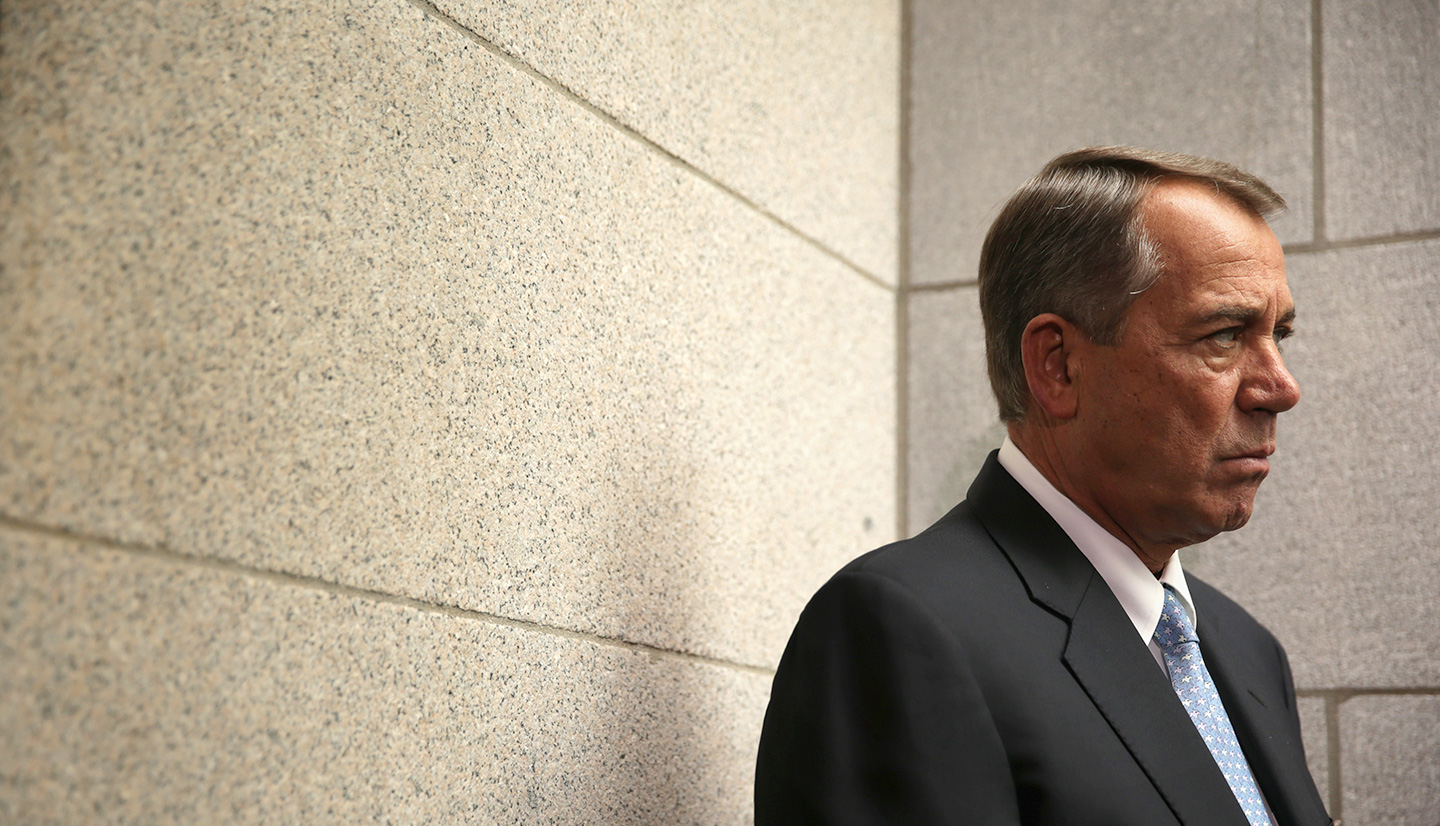
Top photo: Former Speaker of the House John Boehner listens during a news conference on Dec. 3, 2013, in Washington, D.C.
IT’S EVEN WORSE THAN WE THOUGHT.
What we’re seeing right now from Donald Trump is a full-on authoritarian takeover of the U.S. government.
This is not hyperbole.
Court orders are being ignored. MAGA loyalists have been put in charge of the military and federal law enforcement agencies. The Department of Government Efficiency has stripped Congress of its power of the purse. News outlets that challenge Trump have been banished or put under investigation.
Yet far too many are still covering Trump’s assault on democracy like politics as usual, with flattering headlines describing Trump as “unconventional,” “testing the boundaries,” and “aggressively flexing power.”
The Intercept has long covered authoritarian governments, billionaire oligarchs, and backsliding democracies around the world. We understand the challenge we face in Trump and the vital importance of press freedom in defending democracy.
We’re independent of corporate interests. Will you help us?
IT’S BEEN A DEVASTATING year for journalism — the worst in modern U.S. history.
We have a president with utter contempt for truth aggressively using the government’s full powers to dismantle the free press. Corporate news outlets have cowered, becoming accessories in Trump’s project to create a post-truth America. Right-wing billionaires have pounced, buying up media organizations and rebuilding the information environment to their liking.
In this most perilous moment for democracy, The Intercept is fighting back. But to do so effectively, we need to grow.
That’s where you come in. Will you help us expand our reporting capacity in time to hit the ground running in 2026?
We’re independent of corporate interests. Will you help us?

I’M BEN MUESSIG, The Intercept’s editor-in-chief. It’s been a devastating year for journalism — the worst in modern U.S. history.
We have a president with utter contempt for truth aggressively using the government’s full powers to dismantle the free press. Corporate news outlets have cowered, becoming accessories in Trump’s project to create a post-truth America. Right-wing billionaires have pounced, buying up media organizations and rebuilding the information environment to their liking.
In this most perilous moment for democracy, The Intercept is fighting back. But to do so effectively, we need to grow.
That’s where you come in. Will you help us expand our reporting capacity in time to hit the ground running in 2026?
We’re independent of corporate interests. Will you help us?
Contact the author:

Latest Stories

Bodycam: Cop Was Not in Danger When He Fired Shots That Killed 1-Year-Old Kohen Wiley
Mississippi investigators said the shooting was “justified,” but new body camera footage shows the cop firing into the passenger’s side as the car passed by him.

The Intercept Briefing
The Intercept Live in Conversation With Robert Reich
Inequality Media co-founder Robert Reich and The Intercept’s Akela Lacy break down the most pressing issues of the midterm elections.

Midterms 2026
Giant Crypto Super PAC Funnels Big Money to Former Trump Official’s Firm to Support… Democrats?
The Fellowship PAC routed more than half a million dollars in support of Democrats through a firm co-founded by former Trump crypto adviser Bo Hines.