

Standing outside the union hall for the International Brotherhood of Electrical Workers in Pittsburgh, Rep. Conor Lamb, D-Pa., announced his much-awaited Senate bid. “I am Conor Lamb,” he told the several dozen people in attendance. “You all know me, but I’m getting ready to introduce myself all over the state.”
Lamb’s entry into the race has been the topic of much discussion of late. A moderate front-line Democrat, Lamb narrowly won reelection to the House last year and has been eyeing the seat since Sen. Pat Toomey, R-Penn., announced his retirement last year.
In his speech to Pittsburgh union workers on Friday, and in a video his campaign posted Friday morning announcing his entry into the race, Lamb portrayed himself as an antagonist to former President Donald Trump. “I talk with Pennsylvanians every day who have come to believe that our democracy is in crisis. And they’re right,” he said in the video. “The other side denies reality and worships Trump. They’re making it harder to vote, and lying about our elections.”
Such rhetoric marks a 180-degree turn for Lamb, whose voting record has actually been very generous to the former president.


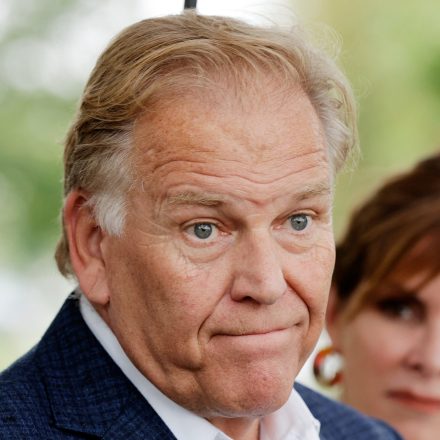
During Lamb’s first session in Congress, he voted almost 70 percent of the time in line with Trump’s positions on issues like opposing a carbon tax, expressing support for the Immigration and Customs Enforcement agency and denouncing calls to abolish ICE, and making signature pieces of the 2017 Tax Cuts and Jobs Act permanent. During Lamb’s next session, that number was closer to 10 percent. During his last, the number was zero percent.
Lamb also voted in favor of a measure by former Rep. Steve King, R-Iowa, to fund a border wall under Trump and to extend the ongoing war in Iraq (he was one of just two Democrats to vote for extension). In addition, he voted against the HEROES Act, one of his party’s signature Covid-19 reliefs packages. Other votes Lamb took in recent years include a vote last year against a measure that would have prevented Trump from using military force against protests; a vote against a bill to decriminalize marijuana; and a vote in favor of a failed measure that would have prevented tax-paying families with an undocumented parent from receiving stimulus checks.
But Lamb’s Senate strategy appears to include carefully distancing himself from that record. “Here is the real danger, if they will take such a big lie and place it at the center of their party, you cannot expect them to tell the truth about anything else,” Lamb said of the Republican Party’s attempts to undermine the 2020 election results — a party with which he voted over much of his time in Congress. And that makes sense: Lamb will enter a field of frontrunners in the Democratic primary, namely Pennsylvania Lt. Gov. John Fetterman and state Rep. Malcolm Kenyatta, who are significantly to his left. Lamb, a lifelong moderate, was always expected to take a more centrist lane in the race. But he and Fetterman will be battling over some of the same voters in Pennsylvania’s western and Allegheny County regions.
Lamb won reelection to the House last year by a slim margin of 2 percentage points, which he blamed during a now-infamous post-Election Day House Democratic caucus call on the push from organizers to defund police forces. What Lamb left out was that several of his recent votes — including his vote against the HEROES Act — hadn’t sat well with many of his constituents. Or that while his 2020 House race was close, he still won by a more comfortable margin than in his 2018 special election to the House.
It was always an open question of whether Lamb’s congressional seat would survive upcoming redistricting, or whether it would survive in a way that would make him viable next cycle, said one Democratic strategist close to the race. “He’s got a really nice profile,” they added. “He also has problems. He’s voted with Trump more than any other Democrat.”
Lamb’s campaign did not immediately respond to a request for comment.
IT’S EVEN WORSE THAN WE THOUGHT.
What we’re seeing right now from Donald Trump is a full-on authoritarian takeover of the U.S. government.
This is not hyperbole.
Court orders are being ignored. MAGA loyalists have been put in charge of the military and federal law enforcement agencies. The Department of Government Efficiency has stripped Congress of its power of the purse. News outlets that challenge Trump have been banished or put under investigation.
Yet far too many are still covering Trump’s assault on democracy like politics as usual, with flattering headlines describing Trump as “unconventional,” “testing the boundaries,” and “aggressively flexing power.”
The Intercept has long covered authoritarian governments, billionaire oligarchs, and backsliding democracies around the world. We understand the challenge we face in Trump and the vital importance of press freedom in defending democracy.
We’re independent of corporate interests. Will you help us?
IT’S BEEN A DEVASTATING year for journalism — the worst in modern U.S. history.
We have a president with utter contempt for truth aggressively using the government’s full powers to dismantle the free press. Corporate news outlets have cowered, becoming accessories in Trump’s project to create a post-truth America. Right-wing billionaires have pounced, buying up media organizations and rebuilding the information environment to their liking.
In this most perilous moment for democracy, The Intercept is fighting back. But to do so effectively, we need to grow.
That’s where you come in. Will you help us expand our reporting capacity in time to hit the ground running in 2026?
We’re independent of corporate interests. Will you help us?

I’M BEN MUESSIG, The Intercept’s editor-in-chief. It’s been a devastating year for journalism — the worst in modern U.S. history.
We have a president with utter contempt for truth aggressively using the government’s full powers to dismantle the free press. Corporate news outlets have cowered, becoming accessories in Trump’s project to create a post-truth America. Right-wing billionaires have pounced, buying up media organizations and rebuilding the information environment to their liking.
In this most perilous moment for democracy, The Intercept is fighting back. But to do so effectively, we need to grow.
That’s where you come in. Will you help us expand our reporting capacity in time to hit the ground running in 2026?
We’re independent of corporate interests. Will you help us?
Contact the author:

Related


Latest Stories

Bodycam: Cop Was Not in Danger When He Fired Shots That Killed 1-Year-Old Kohen Wiley
Mississippi investigators said the shooting was “justified,” but new body camera footage shows the cop firing into the passenger’s side as the car passed by him.

The Intercept Briefing
The Intercept Live in Conversation With Robert Reich
Inequality Media co-founder Robert Reich and The Intercept’s Akela Lacy break down the most pressing issues of the midterm elections.

Midterms 2026
Giant Crypto Super PAC Funnels Big Money to Former Trump Official’s Firm to Support… Democrats?
The Fellowship PAC routed more than half a million dollars in support of Democrats through a firm co-founded by former Trump crypto adviser Bo Hines.