

Stop Cop City activists march toward the construction site for the Atlanta Public Safety Training Center as part of the Block Cop City march in Atlanta on Nov. 13, 2023.
When the state of Georgia indicted 61 Stop Cop City activists on racketeering charges last year, it mangled the meaning of “racketeering” beyond recognition. In the indictment, prosecutors cited typical social justice activities, such as “mutual aid,” writing “zines,” and “collectivism,” as proof of criminal conspiracy and raising money for protest signs as grounds for money laundering charges.
Just as it seemed that Georgia Republicans couldn’t push the state’s broad Racketeer Influenced and Corrupt Organizations, or RICO, statute any further, GOP state senators introduced a bill on Friday that would significantly expand the reach of the Georgia RICO law, with blatantly repressive designs.
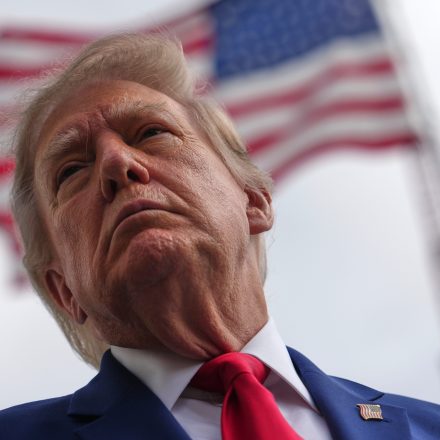
Former President Donald Trump and his allies currently face the highest profile RICO charges in Georgia for attempting to interfere in the 2020 presidential election. Trump’s case, however, is a political outlier when it comes to the increased deployment of RICO charges in recent years, as it takes aim at a truly powerful cohort engaged in the very paradigm of conspiracy. While this is the purported intention of RICO laws — first introduced in 1970 to target mob bosses — recent uses of Georgia’s statute have involved casting Atlanta public school teachers as organized criminals for altering test scores and claiming that the lyrics of Black rap artists can indicate potential violent gang involvement.
The newly introduced Senate Bill 359, or S.B. 359, sponsored by 10 Republican state senators, makes clear that the Georgia GOP intends to continue using RICO as a tool for sweeping criminalization and repressive prosecutions. The proposed law would include low-level misdemeanors, such as “loitering” and placing posters in unpermitted places, as crimes to which RICO charges and hefty enhanced penalties could apply. The bill also includes “political affiliation or belief” as a factor for enhanced penalties in certain circumstances.
S.B. 359 will likely face significant challenges and amendments. Still, the effort serves as a grim harbinger of the far right’s further weaponization of RICO to circumvent legal standards and criminalize whole movements — even disparate activist constellations like Stop Cop City, which has brought together thousands of local and national environmentalists and abolitionists to stop the construction of a vast police training compound atop Atlanta’s crucial forest land.
“RICO is meant to be a narrow criminal statute to address a very specific form of conduct where the puppeteer escapes culpability while the puppets continue to cause serious and often violent harm to the community over the course of years,” Lauren Regan, executive director of the Civil Liberties Defense Center, which is providing legal support for numerous Stop Cop City defendants, wrote in an email. “The proposed amendments to this statute circumvent that intent and are clearly meant to chill political organizing activities.”
The first trial in the Cop City racketeering case was scheduled to begin in early January but has been delayed, ironically enough, over the question of whether 19-year-old defendant Ayla King had her right to a speedy trial violated. King was arrested last March when police raided a music festival hosted by organizers in the Atlanta forest and made indiscriminate arrests based on scant evidence. An hour earlier, and more than a mile away, masked activists had vandalized construction vehicles and materials at the planned Cop City site. King now faces a single charge of violating the RICO law, with a potential sentence of five to 20 years in prison.
Alongside King, more than 20 defendants arrested at the music festival face racketeering charges. Prosecutors have cast other movement participants as part of a “criminal enterprise” for no more than fundraising or posting flyers naming police officers involved in the killing of activist Manuel “Tortuguita” Terán during a raid last January. They are all awaiting trial.
During a public panel last September, veteran Georgia attorney Don Samuel, who is representing a number of activists in the RICO case, noted that the state’s 109-page indictment “doesn’t allege a single racketeering act” but instead names “protected activities” as grounds for the charges. “Aspects of it are extremely unintelligible,” he said.
A malicious prosecution like the Cop City RICO case, given its weakness, has a questionable chance of success in court but nonetheless spreads fear and drains movement energies and resources through lengthy trials. Should a law like S.B. 359 pass, future RICO cases as flimsy and groundless as the one facing Cop City activists could have a better chance of success, as prosecutors could choose from a greater range of low-level violations, newly classified as potential “racketeering acts.”
The specific misdemeanors listed in the bill are telling. “Loitering,” “littering,” “disorderly conduct,” “trespass,” and the unpermitted placement of posters and advertisements are not the typical activities of high-level criminal organizations. They are, meanwhile, common examples of low-level charges faced by activists who take up public space and spread awareness; indeed, they’re the very activities for which dozens of Stop Cop City participants face overreaching charges. Right-wing movements could, as a point of law, face penalties for the same activities — but police and Republican attorney generals are not in the habit of targeting the far right.
Another peculiar part of the proposed RICO expansion is the suggestion that enhanced penalties should be applied when the victim of a so-called criminal enterprise is chosen due to “political affiliation or beliefs.” Unlike race, gender, and sexual orientation, a victim’s political beliefs are not considered relevant under hate crime or other statutes when it comes to enhanced sentencing considerations. Indeed, it would be unconstitutional if they were, as the First Amendment protects political speech — including when that speech targets another group’s political affiliation or beliefs.
“Any law that is written with the words ‘political affiliation or belief’ as contributing factors for enhanced penalties immediately raises serious first amendment issues,” the Civil Liberties Defense Center’s Regan told me. Samuel also noted that “to include ‘political beliefs or affiliations’ within the scope of what we generally consider to be ‘hate’ crimes is inviting First Amendment disaster.”
With such clear flaws, it’s unlikely that S.B. 359 will survive in its originally proposed form. It should be understood, rather, as a statement of intent. The Stop Cop City racketeering case is an example that the right plans to see followed: RICO as a tool for repression, either de facto or in the letter of the law.
IT’S EVEN WORSE THAN WE THOUGHT.
What we’re seeing right now from Donald Trump is a full-on authoritarian takeover of the U.S. government.
This is not hyperbole.
Court orders are being ignored. MAGA loyalists have been put in charge of the military and federal law enforcement agencies. The Department of Government Efficiency has stripped Congress of its power of the purse. News outlets that challenge Trump have been banished or put under investigation.
Yet far too many are still covering Trump’s assault on democracy like politics as usual, with flattering headlines describing Trump as “unconventional,” “testing the boundaries,” and “aggressively flexing power.”
The Intercept has long covered authoritarian governments, billionaire oligarchs, and backsliding democracies around the world. We understand the challenge we face in Trump and the vital importance of press freedom in defending democracy.
We’re independent of corporate interests. Will you help us?
IT’S BEEN A DEVASTATING year for journalism — the worst in modern U.S. history.
We have a president with utter contempt for truth aggressively using the government’s full powers to dismantle the free press. Corporate news outlets have cowered, becoming accessories in Trump’s project to create a post-truth America. Right-wing billionaires have pounced, buying up media organizations and rebuilding the information environment to their liking.
In this most perilous moment for democracy, The Intercept is fighting back. But to do so effectively, we need to grow.
That’s where you come in. Will you help us expand our reporting capacity in time to hit the ground running in 2026?
We’re independent of corporate interests. Will you help us?

I’M BEN MUESSIG, The Intercept’s editor-in-chief. It’s been a devastating year for journalism — the worst in modern U.S. history.
We have a president with utter contempt for truth aggressively using the government’s full powers to dismantle the free press. Corporate news outlets have cowered, becoming accessories in Trump’s project to create a post-truth America. Right-wing billionaires have pounced, buying up media organizations and rebuilding the information environment to their liking.
In this most perilous moment for democracy, The Intercept is fighting back. But to do so effectively, we need to grow.
That’s where you come in. Will you help us expand our reporting capacity in time to hit the ground running in 2026?
We’re independent of corporate interests. Will you help us?
Contact the author:
Related

Cop City Protesters Tried to Plant Trees. Atlanta Police Beat Them for It.

Defying RICO Indictment, Faith Leaders Chain Themselves to Bulldozer to Stop Cop City

Activists Face Felonies for Distributing Flyers on “Cop City” Protester Killing

Atlanta Cop City Protesters Charged With Domestic Terror for Having Mud on Their Shoes
Latest Stories

Google DeepMind Engineer Resigns in Protest of Pentagon Contract
Sofia Liguori stepped down from DeepMind due to current military contracts — not speculative fears of an AI apocalypse.

The War on Immigrants
Trump’s Obsession With Somalia Isn’t Just Racist. It’s Been Lethal.
Beyond targeting Rep. Ilhan Omar, the Trump administration has killed, arrested, deported, and demonized Somalis at home and abroad.

Kohen Wiley’s Family Says Investigators Didn’t Contact Them Before Concluding Cops Did No Wrong
Mississippi has yet to release any support for its claim that a “thorough and impartial” review showed the shooting was “justified.”