
A diplomatic cable sent Monday from the U.S. Embassy in Israel offers an unusually candid assessment of the humanitarian situation in Rafah, a southern city in the Palestinian Gaza Strip.
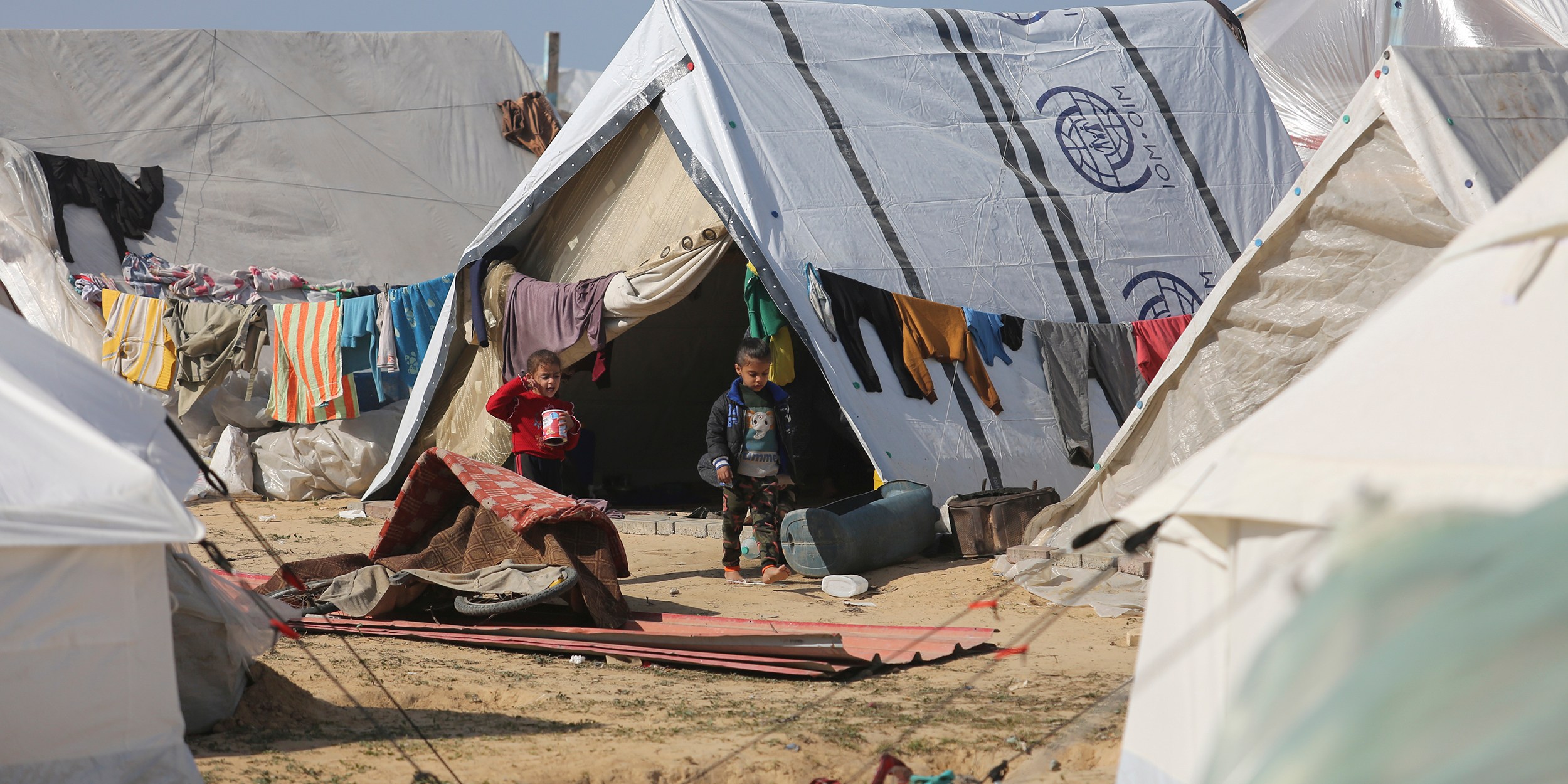
The cable, written by officials with the Bureau for Humanitarian Assistance at the U.S. Agency for International Development, or USAID, warns about the potential effects of an all-out Israeli ground invasion of Rafah, where about 1.5 million Palestinians, driven south by Israeli evacuation orders, are sheltering from Israel’s war on Gaza.
“A potential escalation of military operations in within Southern Gaza’s Rafah Governorate could result in catastrophic humanitarian consequences, including mass civilian casualties, extensive population displacement, and the collapse of the existing humanitarian response, multiple relief actors have warned USAID’s Levant Disaster Assistance Response Team,” the cable says.
“Ahead of the proposed military operation, the impact of hostilities has stretched the capacity of Gaza’s health system beyond its limit.”
In its “Key Points,” the cable says, “An offensive in Rafah would likely block the entry and transport of fuel and life-saving humanitarian assistance throughout the enclave, rendering critical infrastructure inoperable and leaving people in Gaza without food, medicine, shelter, and water.”
Though highlighting the consequences of an Israeli ground invasion of Rafah, the cable also includes a more subtle warning: Rafah is well past the point of crisis — with Israeli bombs already raining down.
“As of mid-February relief actors had reported escalating panic and increased breakdown of social order in Rafah amid an uptick in aerial bombardment,” the cable says. The communique stresses that Gaza’s health system is already in a dire state: “Ahead of the proposed military operation, the impact of hostilities has stretched the capacity of Gaza’s health system beyond its limit.”
Marked “sensitive but unclassified,” the cable was sent Monday morning from the U.S. Embassy in Jerusalem’s Office of Palestinian Affairs to State Department officials in Washington, with copies sent to, among others, the National Security Council, secretary of defense, and the CIA.
The cable comes as calls were growing for the Biden administration to oppose an Israeli offensive in Rafah and, more broadly, orchestrate a ceasefire in the war that, since October 7, has seen about 2,000 Israelis and 30,000 Palestinians killed.
Asked about the cable, the State Department did not immediately responded to a request for comment.
A spokesperson for USAID said the agency doesn’t comment on internal documents and pointed to a remarks made last week by Samantha Power, the agency’s administrator, in the West Bank. “The United States has been clear that we cannot support a campaign in Rafah without a credible plan to protect civilians who are living there,” Power said. “And we have seen no credible plan to move these people who are in Rafah to safety, to get them adequate shelter, and to relocate the humanitarian operations.”


“No Viable Evacuation Options”
On February 9, Israeli Prime Minister Benjamin Netanyahu ordered the Israeli military to prepare evacuation plans for Rafah in anticipation of a ground offensive. But there’s nowhere for civilians to go, a point acknowledged in the diplomatic cable.
“At present, there appear to be no viable evacuation options for the 1.5 million in Rafah,” says the diplomatic cable.
Over half of Palestinians in the Gaza Strip are currently sheltering in the environs of Rafah, which has swelled to more than seven times its normal population, the cable notes. The Rafah Governorate, the southernmost of four regions of the Gaza Strip, covers about 25 square miles, which the cable says is roughly the same size as Syracuse, New York, with its 150,000 people.
Palestinians from other parts of Gaza fled south as the Israel Defense Forces began its military campaign in the wake of the October 7 Hamas-led attacks. Israel said it opened evacuation corridors, though reports of fighting along the routes was routine.
As internally displaced people, or IDPs, passed through the governorate north of Rafah, according to the cable, they were forced to leave their belongings behind.
“In Southern Gaza’s Khan Younis Directorate, the IDF have repeatedly screened and stripped IDPs of most of their possessions,” the cable says, adding that Palestinians “spent months” acquiring basic necessities in Rafah, such as blankets.
The memo warns that while some people want to make the dangerous trip back to locales further north in Gaza, “a large portion of those residing in Rafah, including elderly populations, exhausted IDPs, and those with reduced mobility, would likely remain in the governorate during the potential military operation due to lack of viable alternatives, heightening the risk of mass casualties.”
“The World Wants Us to Die”
A full-fledged ground offensive in Rafah could have devastating consequences for humanitarian aid throughout the Gaza Strip. Since the October 7 attacks, the Gaza Strip only has two operational border crossings — both in the Rafah Governorate.
Rafah borders the Sinai Peninsula and is home to a crossing with Egypt. The governorate also has a crossing with Israel, called Kerem Shalom.
In a section of the diplomatic cable titled “Rafah Offensive to Halt All Humanitarian Aid to Gaza,” the authors wrote, “A military operation in Rafah may restrict humanitarian assistance from entering the governorate and hinder relief actors stationed in Rafah from reaching people in other areas of the enclave.”
“A military operation in Rafah may restrict humanitarian assistance from entering the governorate and hinder relief actors stationed in Rafah from reaching people in other areas.”
Rafah is already the site of an ongoing Israeli bombardment. The area has been pounded by airstrikes for weeks. Following a set of Israeli airstrikes in Rafah that killed at least 13 people in February, the Biden administration said that it did not constitute a “full-scale offensive.”
“It is not our assessment that this air strike is the launch of a full-scale offensive happening in Rafah,” State Department spokesperson Matthew Miller said. He added that “we do not support a full-scale military operation there going ahead.”
The U.S. is unaware when the full-scale operation might happen. “As of March 1, GoI” — government of Israel — “officials have not indicated a specific timeline for the potential military operation,” the cable says.
The cable quotes aid partners on the ground in Gaza, one of whom warned that transiting out of Rafah had become difficult and dangerous because of highly congested roads: “Another partner noted hopelessness among its staff who reported, ‘the world wants us to die.’”
Update: March 5, 2024, 10:59 p.m. ET
This story has been updated to include comment from USAID made after publication.
IT’S EVEN WORSE THAN WE THOUGHT.
What we’re seeing right now from Donald Trump is a full-on authoritarian takeover of the U.S. government.
This is not hyperbole.
Court orders are being ignored. MAGA loyalists have been put in charge of the military and federal law enforcement agencies. The Department of Government Efficiency has stripped Congress of its power of the purse. News outlets that challenge Trump have been banished or put under investigation.
Yet far too many are still covering Trump’s assault on democracy like politics as usual, with flattering headlines describing Trump as “unconventional,” “testing the boundaries,” and “aggressively flexing power.”
The Intercept has long covered authoritarian governments, billionaire oligarchs, and backsliding democracies around the world. We understand the challenge we face in Trump and the vital importance of press freedom in defending democracy.
We’re independent of corporate interests. Will you help us?
IT’S BEEN A DEVASTATING year for journalism — the worst in modern U.S. history.
We have a president with utter contempt for truth aggressively using the government’s full powers to dismantle the free press. Corporate news outlets have cowered, becoming accessories in Trump’s project to create a post-truth America. Right-wing billionaires have pounced, buying up media organizations and rebuilding the information environment to their liking.
In this most perilous moment for democracy, The Intercept is fighting back. But to do so effectively, we need to grow.
That’s where you come in. Will you help us expand our reporting capacity in time to hit the ground running in 2026?
We’re independent of corporate interests. Will you help us?

I’M BEN MUESSIG, The Intercept’s editor-in-chief. It’s been a devastating year for journalism — the worst in modern U.S. history.
We have a president with utter contempt for truth aggressively using the government’s full powers to dismantle the free press. Corporate news outlets have cowered, becoming accessories in Trump’s project to create a post-truth America. Right-wing billionaires have pounced, buying up media organizations and rebuilding the information environment to their liking.
In this most perilous moment for democracy, The Intercept is fighting back. But to do so effectively, we need to grow.
That’s where you come in. Will you help us expand our reporting capacity in time to hit the ground running in 2026?
We’re independent of corporate interests. Will you help us?
Contact the author:

Related

WCNSF: The Most Haunting Acronym the World Has Produced

With Netanyahu Threatening Rafah Invasion, Biden Prepares to Send Israel More Bombs

“Where Can We Go?”: Terror and Panic Set In as Israel Readies to Invade Rafah

A Palestinian Aid Worker Describes a Harrowing 18-Day Siege Inside a Gaza Hospital
Latest Stories

Google DeepMind Engineer Resigns in Protest of Pentagon Contract
Sofia Liguori stepped down from DeepMind due to current military contracts — not speculative fears of an AI apocalypse.

The War on Immigrants
Trump’s Obsession With Somalia Isn’t Just Racist. It’s Been Lethal.
Beyond targeting Rep. Ilhan Omar, the Trump administration has killed, arrested, deported, and demonized Somalis at home and abroad.

Kohen Wiley’s Family Says Investigators Didn’t Contact Them Before Concluding Cops Did No Wrong
Mississippi has yet to release any support for its claim that a “thorough and impartial” review showed the shooting was “justified.”