

During more than four hours of Senate testimony Tuesday, Defense Secretary nominee Pete Hegseth faced a single question about the war in Gaza — and only in response to a Code Pink protest.
Hegseth and Secretary of State nominee Marco Rubio touted unconditional support for Israel during confirmation hearings this week, but they faced little scrutiny over the U.S. response to civilian casualties and the risk of mass starvation in Gaza.
Instead, Hegseth fended off questions about his personal character, and Rubio warned about the danger of China. Democrats mostly stuck to a list of questions that did not highlight divisions within their own party.

Pointing to the Hegseth hearing, one advocate lobbying Congress to put more pressure on Israel said he was dismayed by the lack of substance.
“The frustrating part about watching that hearing was the lack of concern for how the United States military could really impact billions of people on this planet,” said Hassan El-Tayyab of the Quaker advocacy group Friends Committee on National Legislation. “There were so many pressing issues and existential issues to the United States, our allies, and the planet at large that were not addressed.”
Since Hamas’s October 7, 2023 attacks, sitting Defense Secretary Lloyd Austin III has played a key role in the Biden administration’s relationship with Israel, liaising with the Israeli defense minister and overseeing the shipment of weapons such as 2,000-pound bombs to the Israeli military.
“I support Israel destroying and killing every last member of Hamas.”
Yet while the defense secretary exerts sway over U.S. relations with Israel, the topic barely came up Tuesday during the hearing for his would-be successor. Instead, Hegseth’s hearing was dominated by Democrats’ questions about his drinking habits, sexual assault allegations, and infidelities, and by friendlier questions from Republicans seeking to prop up his nomination.

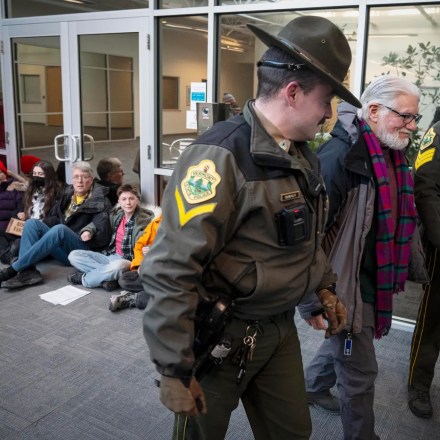
One of the few breaks from that script came an hour and a half into the hearing, when Sen. Tom Cotton, R-Ark., asked Hegseth a series of questions about Israel. Cotton noted that protesters from the activist group Code Pink had disrupted the hearing with criticisms of Hegseth and asked him to respond.
“I support Israel’s existential war in Gaza. I assume like me and President Trump, you support that war as well, don’t you?” Cotton said.
“Senator, I do,” Hegseth said. “I support Israel destroying and killing every last member of Hamas.”

The day after Hegseth’s hearing, Rubio faced questioning in the Senate Committee on Foreign Relations as the details of the Gaza ceasefire were coming into focus. Only a single question, from Sen. Jeff Merkley, D-Ore., edged close to criticizing Israel.
“I, by the way, fully support Israel’s ability to respond to Hamas, but I am very concerned about how it has played out in terms of the massive humanitarian conditions in Gaza. Will you help lead the world in responding to those humanitarian conditions?” Merkley asked, while adding another question about whether Rubio would support a regional agreement aimed at pursuing a two-state solution.
Rubio did not respond directly to whether he would seek to ease the suffering in Gaza, pivoting instead to express support for the ceasefire. He also said the ceasefire, along with Bashar al-Assad’s flight from Syria and a new presidential administration in Lebanon, could lead to a broader, regional agreement.
“We don’t know yet for sure, but there are opportunities that exist now in the Middle East that did not exist 90 days ago,” Rubio said. “Whether it’s what’s happened in Lebanon, whether it’s what happened in Syria, whether it’s hopefully what will happen with the ceasefire and the release of hostages after horrifying detentions.”
Elsewhere during the hearing, Rubio criticized the International Criminal Court for issuing arrest warrants for Israeli Prime Minster Benjamin Netanyahu and former Defense Minister Yoav Gallant.
El-Tayyab, who helped rally support for the trio of resolutions from Sen. Bernie Sanders, I-Vt., last year to block shipments of weapons to Israel, said it was not surprising that longtime, staunch supporter of Israel would adopt such a stance.
Still, the very ceasefire agreement blessed by Rubio could live or die on whether the U.S. is willing to police Israeli violations of the pact, he said.
“I didn’t see anything by Rubio in that hearing that said he is willing to exert any amount of leverage with the Israel government should this go sideways,” El-Tayyab said, “which I think is going to be really important, because there are so many things that could go wrong here.”
IT’S EVEN WORSE THAN WE THOUGHT.
What we’re seeing right now from Donald Trump is a full-on authoritarian takeover of the U.S. government.
This is not hyperbole.
Court orders are being ignored. MAGA loyalists have been put in charge of the military and federal law enforcement agencies. The Department of Government Efficiency has stripped Congress of its power of the purse. News outlets that challenge Trump have been banished or put under investigation.
Yet far too many are still covering Trump’s assault on democracy like politics as usual, with flattering headlines describing Trump as “unconventional,” “testing the boundaries,” and “aggressively flexing power.”
The Intercept has long covered authoritarian governments, billionaire oligarchs, and backsliding democracies around the world. We understand the challenge we face in Trump and the vital importance of press freedom in defending democracy.
We’re independent of corporate interests. Will you help us?
IT’S BEEN A DEVASTATING year for journalism — the worst in modern U.S. history.
We have a president with utter contempt for truth aggressively using the government’s full powers to dismantle the free press. Corporate news outlets have cowered, becoming accessories in Trump’s project to create a post-truth America. Right-wing billionaires have pounced, buying up media organizations and rebuilding the information environment to their liking.
In this most perilous moment for democracy, The Intercept is fighting back. But to do so effectively, we need to grow.
That’s where you come in. Will you help us expand our reporting capacity in time to hit the ground running in 2026?
We’re independent of corporate interests. Will you help us?

I’M BEN MUESSIG, The Intercept’s editor-in-chief. It’s been a devastating year for journalism — the worst in modern U.S. history.
We have a president with utter contempt for truth aggressively using the government’s full powers to dismantle the free press. Corporate news outlets have cowered, becoming accessories in Trump’s project to create a post-truth America. Right-wing billionaires have pounced, buying up media organizations and rebuilding the information environment to their liking.
In this most perilous moment for democracy, The Intercept is fighting back. But to do so effectively, we need to grow.
That’s where you come in. Will you help us expand our reporting capacity in time to hit the ground running in 2026?
We’re independent of corporate interests. Will you help us?
Contact the author:

Related

Trump Decried This Law as a Deep State Spy Weapon. His Nominees Sure Seem to Love It.

White House Budget Office Nominee Tries to Whitewash Trump’s First Term

Does This Trump Crypto Appointee Even Have Crypto Experience? Yes, With a Trump-Themed Meme Coin.

The Reason Netanyahu and Putin Both Want a Trump Victory
Latest Stories

Israel’s War on Gaza
A C-Section in Shackles: A Palestinian Woman’s Harrowing Birth in Israeli Detention
Dana Joudeh was denied proper food and medical care throughout her pregnancy in an Israeli prison. She gave birth to a premature baby surrounded by armed guards.

ICE Shooting in NYC Inflames Mamdani’s Policing Problem
After ICE shot a young father in Manhattan, New Yorkers asked the mayor to protect them from his police department and federal agents alike.

Where Are the Iran War Protests?
Despite a wildly unpopular war with Iran, a mass protest movement for peace hasn’t materialized — at least in the ways we’ve been taught to recognize.