
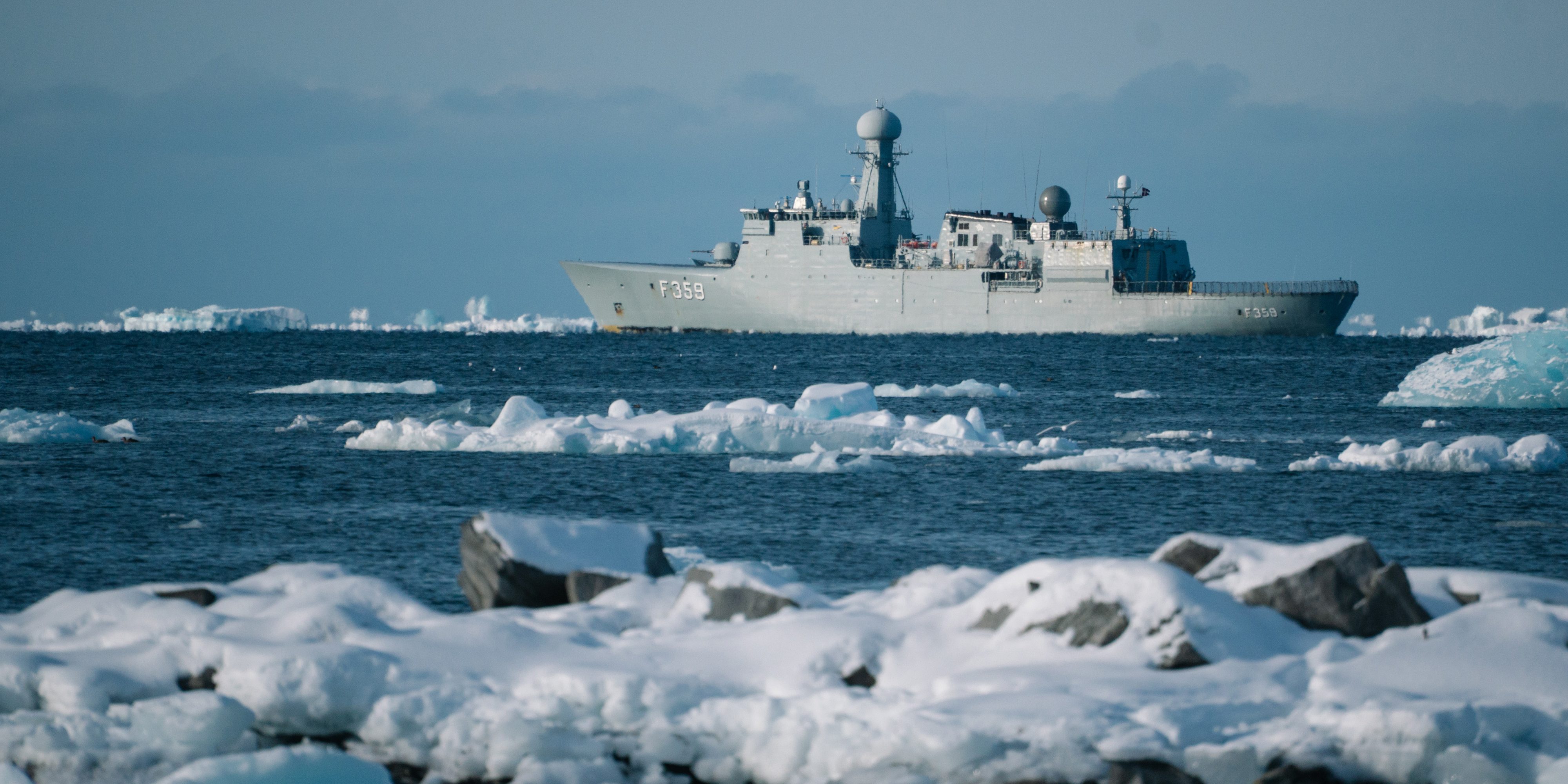
The Trump administration has threatened that if it can’t buy Greenland, it may take it by military force. Top aide Stephen Miller even proclaimed that “nobody’s going to fight the United States militarily over the future of Greenland.” But in the case of military attack, Danish troops are required to shoot first and ask questions later.
“Danish military units have a duty to defend Danish territory if it is subjected to an armed attack, including by taking immediate defensive action if required,” Tobias Roed Jensen, spokesperson for the Danish Defense Command, told The Intercept, referencing a 1952 royal decree that applies to the entire Kingdom of Denmark, including Greenland.
Jensen said that the decree ensures that “Danish forces can act to defend the Danish Kingdom in situations where Danish territory or Danish military units are attacked, even if circumstances make it impossible to await further political or military instruction.”
The fact that Denmark’s small military says it is ready to defend Greenland hasn’t deterred U.S. imperial ambitions.
“One way or the other, we’re going to have Greenland,” President Donald Trump said on Sunday. On Monday, Rep. Randy Fine, R-Fla., introduced legislation authorizing Trump “to take whatever steps necessary to annex or acquire Greenland as a territory of the United States.”
That same day, a bipartisan House coalition, led by Reps. Bill Keating, D-Mass., and Don Bacon, R-Neb., introduced the No Funds for NATO Invasion Act. The legislation would prohibit any federal funds from being made available for the invasion of any NATO member state or territory, and prohibit any officer or employee of the U.S. from taking action to execute an invasion of any NATO member state or territory.
Three sources on Capitol Hill told The Intercept that Sen. Chris Coons, D-Del. — the ranking Democrat on the Defense Appropriations subcommittee — has resisted the addition of similar language to the pending defense appropriations bill, as to not derail negotiations with Republicans.
“Frankly, it’s a massive unforced error,” a congressional aide told The Intercept. “By refusing to dig in on the NATO language, Coons is giving the GOP exactly what they want without getting anything in return, and he’s doing it at the expense of our most critical alliances.”
Coons is also leading a bipartisan, bicameral group of lawmakers on a trip to Copenhagen to meet with Danish and Greenlandic government officials this week. His office did not respond to requests for comment prior to publication.
Meanwhile, the foreign ministers of Denmark and Greenland will meet Vice President JD Vance and Secretary of State Marco Rubio at the White House on Wednesday, Danish Foreign Affairs Minister Lars Løkke Rasmussen told reporters.
The United States already has a military foothold in Greenland, the world’s largest island that is not a continent. The U.S. has a long-standing military garrison, Pituffik Space Base, which was formerly known as Thule Air Base. The War Department’s northernmost installation is key to U.S. missile warning, missile defense, and space surveillance missions, including sophisticated radars and satellite command and control from Pituffik Tracking Station. Last week, defense contractor InDyne Inc. was awarded a little-noticed billion-dollar contract for missile warning, missile defense, and space domain awareness mission services at six sites, including Pituffik.
On Sunday, Trump repeated baseless claims that there are “Russian destroyers and submarines and China destroyers and submarines all over the place” in Greenland and that “Russia or China will” take over if the U.S. doesn’t.
Lopsided does not begin to capture the disparity between the armed forces of the United States and Denmark. The former has around 1.3 million active-duty personnel. The latter — just 13,100. “Their defense is two dog sleds,” Trump said of Greenland.
Danish Defense Command acknowledged that the Sirius Dog Sled Patrol is a part of the military forces. Based at Daneborg in East Greenland, it consists of about a dozen soldiers, in addition to the canines, and enforces Danish sovereignty and law enforcement authority in the world’s largest national park, which covers almost the entire northeast of Greenland.

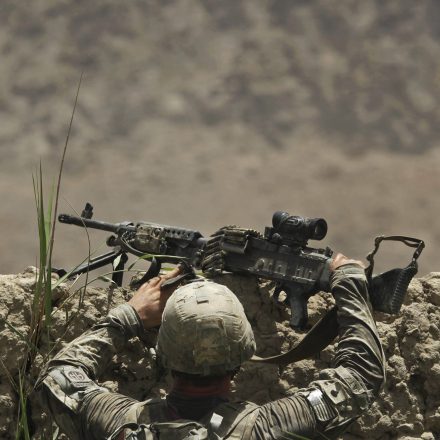
Danish Defense forces also have modest numbers of troops stationed at bases around Greenland, including Station Nord, the northernmost military base in the world in northeast Greenland, the Royal Danish Air Force Detachment Greenland in Kangerlussuaq in the west, a facility at Mestersvig in the east, a logistics hub at Grønnedal in the southwest, and a liaison detachment at Pituffik, in the northwest. When alerted, a Danish Arctic Response Force — including aircraft and ships — stands ready to support forces in Greenland.
Spokesperson Louise Hedegaard said the Arctic Command’s sea capabilities include “inspection vessels,” while air capabilities include Bombardier Challenger maritime surveillance aircraft and Seahawk helicopters, as well as helicopters from Air Greenland. Hedegaard noted that the Arctic Command regularly deploys units from across the Danish Armed Forces and is managed by Arctic Command’s staff, logistics, and stations, which comprise approximately 150 personnel.
Ironically, late last month the State Department approved a possible Foreign Military Sale to the Government of Denmark of maritime patrol and reconnaissance aircraft worth an estimated $1.8 billion.
Danish Defense Command would not answer questions about how, specifically, troops would respond in the face of U.S. attack, or if new orders had been issued amid Trump administration threats. “We have no further comments on the subject,” Hedegaard told The Intercept.
“The real question is, by what right does Denmark assert control over Greenland?” Miller demanded to know last week. “What is the basis of their territorial claim?”
In conjunction with a 1917 agreement between the U.S. and Denmark ceding Danish territories in the West Indies — including the islands of St. Thomas, St. John, and St. Croix — to the U.S., Secretary of State Robert Lansing stated that “the Government of the United States of America will not object to the Danish Government extending their political and economic interests to the whole of Greenland.” In 1933, when Norway tried to claim an area of East Greenland, the Permanent Court of International Justice affirmed Denmark’s sovereignty over Greenland.
After Denmark was occupied by Nazi Germany in 1940, the Danish envoy in Washington signed the Greenland Defense Agreement of 1941, under which the U.S. obtained rights to establish military bases in Greenland. Immediately after the war, the Danish government tried unsuccessfully to terminate the agreement and rebuffed a 1946 U.S. offer of $100 million in gold for Greenland.

Under pressure from the U.S., the 1941 pact was replaced with a sweeping Cold War-era agreement. The Greenland Defense Agreement of 1951 provides the U.S. with “free access to and movement between the defense areas throughout Greenland, including the territorial waters, by land, sea, and air.” While it does not give the United States the right to establish facilities by fiat — Danish agreement is required — the pact allows the United States to “construct, install, maintain, and operate” military bases across Greenland, “house personnel,” and “control landings, takeoffs, anchorages, moorings, movements, and operation of ships, aircraft, and waterborne craft.” The pact was signed to ensure “the preservation of peace and security.”
Trump acknowledged his ability to beef up the U.S. military presence on Sunday. “We have bases on Greenland,” he told reporters. “We can put a lot of soldiers there right now if I want.”
In 1979, Greenlandic home rule came into force, and in 2009, self-rule was introduced, meaning that Denmark today recognizes Greenland as an autonomous nation. Greenlanders have the right to hold a referendum on independence, and Danish officials say the island’s 57,000 inhabitants have a right to decide their future. A 2025 survey found that 85 percent of Greenlanders do not want to join the U.S. Just 6 percent of respondents said they were in favor of an American takeover.
Trump has been clear that he is not interested in expanding U.S. access via a new agreement or pact that falls short of a takeover or annexation. Trump told the New York Times that “ownership is very important.” He continued, “That’s what I feel is psychologically needed for success. I think that ownership gives you a thing that you can’t do, whether you’re talking about a lease or a treaty.”
Denmark is a founding member of the North Atlantic Treaty Organization, or NATO, which was created in 1949 by the United States, Canada, and several Western European nations. Trump routinely denigrates the group. “I DOUBT NATO WOULD BE THERE FOR US IF WE REALLY NEEDED THEM,” Trump wrote on Truth Social last week. The Danish military fought with NATO as part of the U.S. wars in Afghanistan and Iraq.

The NATO alliance consists of 32 member states from North America and Europe. Article 5 of the NATO treaty states that any armed attack against one of the member states is considered an attack against all members, and other members shall assist the attacked nation with armed forces, if necessary. It was, until recently, unthinkable that one member would attack another.
Danish Prime Minister Mette Frederiksen said that a U.S. military takeover of Greenland would signal the end of the NATO alliance. “If the United States chooses to attack another NATO country militarily, then everything stops,” he told Danish broadcaster TV2 last week.
Rubio told members of Congress in a classified briefing that Trump wants to buy Greenland from Denmark, two government officials told The Intercept. But in public comments, he would not rule out military action in Greenland.
During his second term Trump has launched attacks on Iran, Iraq, Nigeria, Somalia, Syria, Venezuela, Yemen, and on civilians in boats in the Caribbean Sea and Pacific Ocean, despite claiming to be a “peacemaker.”
Under the Greenland Annexation and Statehood Act, introduced by Fine, Trump would be authorized to “annex or otherwise acquire Greenland as a territory of the United States” and seeks to “expedite congressional approval of … statehood for Greenland.”
On Monday, Rep. Jimmy Gomez, D-Calif., introduced the “Greenland Sovereignty Protection Act,” which would block federal funds from being used to facilitate “the invasion, annexation, purchase, or other form of acquisition of Greenland” by the U.S. government. The bill would also prevent a surge of troops to the island.
“Greenland is not for sale, not for conquest, and not a bargaining chip,” said Gomez. “Threatening to seize territory from an ally undermines basic international law and destabilizes one of the United States and the world’s most important alliances in NATO. This bill draws a clear line: Congress will not fund Donald Trump’s imperial fantasies.”
IT’S EVEN WORSE THAN WE THOUGHT.
What we’re seeing right now from Donald Trump is a full-on authoritarian takeover of the U.S. government.
This is not hyperbole.
Court orders are being ignored. MAGA loyalists have been put in charge of the military and federal law enforcement agencies. The Department of Government Efficiency has stripped Congress of its power of the purse. News outlets that challenge Trump have been banished or put under investigation.
Yet far too many are still covering Trump’s assault on democracy like politics as usual, with flattering headlines describing Trump as “unconventional,” “testing the boundaries,” and “aggressively flexing power.”
The Intercept has long covered authoritarian governments, billionaire oligarchs, and backsliding democracies around the world. We understand the challenge we face in Trump and the vital importance of press freedom in defending democracy.
We’re independent of corporate interests. Will you help us?
IT’S BEEN A DEVASTATING year for journalism — the worst in modern U.S. history.
We have a president with utter contempt for truth aggressively using the government’s full powers to dismantle the free press. Corporate news outlets have cowered, becoming accessories in Trump’s project to create a post-truth America. Right-wing billionaires have pounced, buying up media organizations and rebuilding the information environment to their liking.
In this most perilous moment for democracy, The Intercept is fighting back. But to do so effectively, we need to grow.
That’s where you come in. Will you help us expand our reporting capacity in time to hit the ground running in 2026?
We’re independent of corporate interests. Will you help us?

I’M BEN MUESSIG, The Intercept’s editor-in-chief. It’s been a devastating year for journalism — the worst in modern U.S. history.
We have a president with utter contempt for truth aggressively using the government’s full powers to dismantle the free press. Corporate news outlets have cowered, becoming accessories in Trump’s project to create a post-truth America. Right-wing billionaires have pounced, buying up media organizations and rebuilding the information environment to their liking.
In this most perilous moment for democracy, The Intercept is fighting back. But to do so effectively, we need to grow.
That’s where you come in. Will you help us expand our reporting capacity in time to hit the ground running in 2026?
We’re independent of corporate interests. Will you help us?
Contact the author:

Related


Latest Stories

Chilling Dissent
Trump Wanted Minneapolis 15 Case to Be Another Prairieland. Instead, Twin Cities Rallied Behind Anti-ICE Activists.
The mainstream of Minnesota’s left-of-center politics — including unions, the backbone of Democratic power — are behind the radical left.

Israel’s War on Gaza
A C-Section in Shackles: A Palestinian Woman’s Harrowing Birth in Israeli Detention
Dana Joudeh was denied proper food and medical care throughout her pregnancy in an Israeli prison. She gave birth to a premature baby surrounded by armed guards.

ICE Shooting in NYC Inflames Mamdani’s Policing Problem
After ICE shot a young father in Manhattan, New Yorkers asked the mayor to protect them from his police department and federal agents alike.