
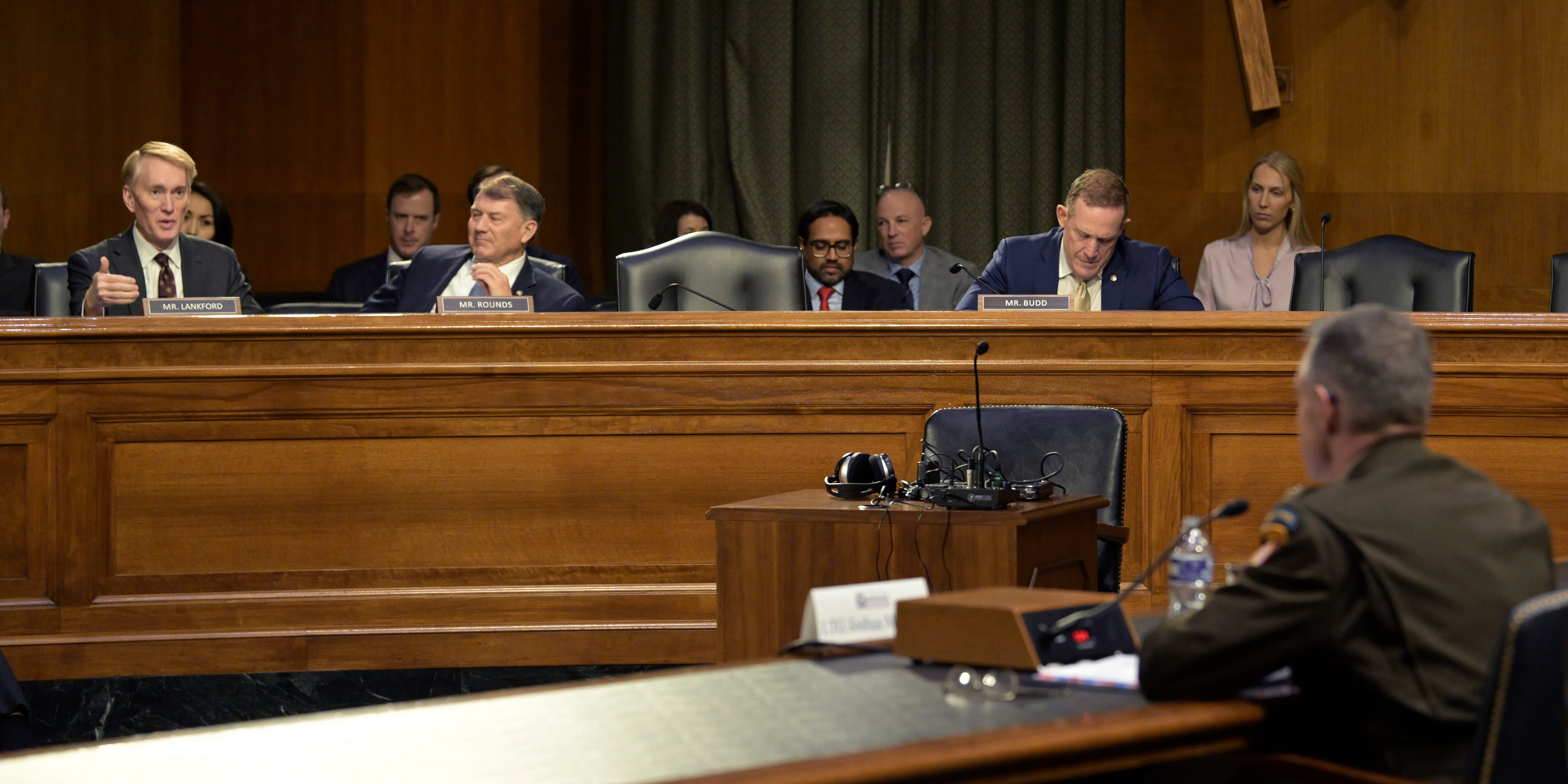
Congress has two months to decide whether to abandon, renew, or reform a controversial surveillance law at the heart of Edward Snowden’s leaks.
Administrations of both parties have taken a lead role in jockeying over the Foreign Intelligence Surveillance Act, or FISA, typically working to tamp down reform talk. Trump officials, however, were absent at a hearing on the subject Wednesday.
The silence continued Thursday, when President Donald Trump’s nominee to serve as National Security Agency director dodged a question about FISA reforms at a confirmation hearing.
The White House says it is working behind the scenes, but the administration’s lack of a public stance has garnered criticism from Democrats. Even the Republican chair of the Senate Judiciary Committee, Sen. Chuck Grassley of Iowa, acknowledged the absence of administration officials.
“If the administration would like to brief us in an open or closed setting, I will help work to set it up,” he said. “In the meantime, the Senate Judiciary Committee needs to move ahead.”
Claire Slattery, a spokesperson for Grassley, told The Intercept in a statement received after publication that Trump administration officials had not been invited to the hearing. Asked for comment, the White House declined to explain why the administration was absent.
“The administration is having productive discussions,” the White House said in an unsigned statement.
Grassley and other lawmakers are working ahead of an April 20 deadline to renew FISA’s Section 702.


Warrant for “Backdoor” Search?
The provision allows the FBI and other agencies to search through a massive trove of ostensibly “foreign” intelligence gathered when NSA spymasters point their collection tools abroad. Those “foreign” communications, however, include large quantities of information sent from and to Americans.
Civil liberties advocates have long sought to force agents at the FBI and other entities to obtain a court-approved warrant before conducting “backdoor” searches for information on American subjects.
They came within a single vote of achieving their aim in 2024, when a bipartisan coalition banded together to support a warrant requirement. The push failed in the House of Representatives, but Section 702 supporters were forced to agree to a short-term extension that expires this year.
Since the last debate, the advocates’ case has been bolstered by a federal court opinion finding that the FBI violated one man’s rights by searching a Section 702 database without a warrant.
Trump has at times lashed out at FISA because a separate provision of the law was abused to improperly spy on an adviser to his 2016 presidential campaign. When push came to shove during his first term, however, the Trump administration supported a renewal of the law without warrant protections. His nominees for top posts also lined up to oppose further reforms during confirmation hearings last year.
Trump’s nominee to serve as NSA director, Lt. Gen. Joshua Rudd, gave little indication as to where he stood on the issue during testimony before the Senate Intelligence Committee on Thursday.
Sen. Ron Wyden, D-Ore., asked him whether he would support a warrant requirement, with exemptions for emergency, “four-alarm crisis” situations.
Rudd sidestepped the question.

“Well, senator, that is a topic I would need to look into and get a better understanding of to give you a more fulsome and complete answer on that one,” he said. “Again, what I would highlight though is supreme confidence that the men and women of the NSA are committed to protecting civil liberties and privacy of American citizens.”
At the separate Senate Judiciary Committee hearing, experts on both sides opined on the controversial law — but no one from the administration attended to answer questions.
“We are three months from the expiration of Section 702 and the Trump administration, as best as I can discern, still has no official position on it. That is stunning,” said Sen. Chris Coons, D-Del., who in 2024 voted to extend the law in its current form.
Joe Biden’s administration aggressively lobbied lawmakers for months to support a renewal of the law without modification during that go-around.
Coons, for his part, said he did not know how he would ultimately vote on the issue this year.
“Kick the Can?”
Democrats who voted for the law two years ago are under increasing pressure this year — including from primary opponents — to support a warrant requirement as the Trump administration erases privacy protections.

To make matters more complicated, Republicans who voted for reforms under Biden could flip back to supporting sweeping powers for the executive branch now that Trump is president.
There are other surveillance powers that could figure into the renewal debate. Civil liberties advocates are also worried about a separate provision created in 2024 that allows the government to force data centers — and, critics fear, anyone with a computer — to hand records over to the government.
Jake Laperruque, deputy director of the security and surveillance project at the nonprofit Center for Democracy and Technology, said that he was concerned legislators may be tempted to approve another short-term extension during an election year.
“It’s an open question of, are we going to get a reform vote on this in the next couple months, or is Congress going to try to kick the can?” he said.
Trump administration’s silent stance may reflect internal debates, Laperruque said.
“I think there’s probably just a lot of internal uncertainty on how exactly they are going to come down on this stuff,” he said, “and I guess they would rather not engage until they have a set position.”
Update: January 30, 2026
This story has been updated to include a statement received after publication from Sen. Chuck Grassley’s office stating that Trump administration officials had not been invited to Thursday’s Judiciary Committee hearing.
IT’S EVEN WORSE THAN WE THOUGHT.
What we’re seeing right now from Donald Trump is a full-on authoritarian takeover of the U.S. government.
This is not hyperbole.
Court orders are being ignored. MAGA loyalists have been put in charge of the military and federal law enforcement agencies. The Department of Government Efficiency has stripped Congress of its power of the purse. News outlets that challenge Trump have been banished or put under investigation.
Yet far too many are still covering Trump’s assault on democracy like politics as usual, with flattering headlines describing Trump as “unconventional,” “testing the boundaries,” and “aggressively flexing power.”
The Intercept has long covered authoritarian governments, billionaire oligarchs, and backsliding democracies around the world. We understand the challenge we face in Trump and the vital importance of press freedom in defending democracy.
We’re independent of corporate interests. Will you help us?
IT’S BEEN A DEVASTATING year for journalism — the worst in modern U.S. history.
We have a president with utter contempt for truth aggressively using the government’s full powers to dismantle the free press. Corporate news outlets have cowered, becoming accessories in Trump’s project to create a post-truth America. Right-wing billionaires have pounced, buying up media organizations and rebuilding the information environment to their liking.
In this most perilous moment for democracy, The Intercept is fighting back. But to do so effectively, we need to grow.
That’s where you come in. Will you help us expand our reporting capacity in time to hit the ground running in 2026?
We’re independent of corporate interests. Will you help us?

I’M BEN MUESSIG, The Intercept’s editor-in-chief. It’s been a devastating year for journalism — the worst in modern U.S. history.
We have a president with utter contempt for truth aggressively using the government’s full powers to dismantle the free press. Corporate news outlets have cowered, becoming accessories in Trump’s project to create a post-truth America. Right-wing billionaires have pounced, buying up media organizations and rebuilding the information environment to their liking.
In this most perilous moment for democracy, The Intercept is fighting back. But to do so effectively, we need to grow.
That’s where you come in. Will you help us expand our reporting capacity in time to hit the ground running in 2026?
We’re independent of corporate interests. Will you help us?
Contact the author:

Related

FBI Raid on WaPo Reporter’s Home Was Based on Sham Pretext

How Many Members Does Antifa Have? Where Is Its Headquarters? The FBI Has No Answers.

Are You on Trump’s List of Domestic Terrorists? There’s No Way to Know.

Counterterror Director Used Hamas Attack to Justify Mass Surveillance Program Renewal
Latest Stories

Midterms 2026
Lockheed Martin Showered Susan Collins With Cash as F-35 Program Hit Turbulence
Collins received tens of thousands from Lockheed during a two-month period surrounding a critical 2023 watchdog report.

Voices
Trump Is Targeting Ilhan Omar. Where’s the Elite Media Outrage?
Unlike the raid on John Bolton, the targeting of Omar has elicited zero condemnation from NYT, WSJ, and Washington Post.

America’s Sordid History of Filming Executions as Entertainment
Hegseth’s plan to livestream an execution was not without precedent — it tapped into a dark and forgotten U.S. tradition.