

President Donald Trump announced on Thursday that a temporary ceasefire agreement had been reached between Israel and Lebanon. The 10-day ceasefire, set to begin at 5 p.m. ET, will reportedly see a pause to Israel’s relentless assault on southern Lebanon, which has displaced over 1.2 million people and killed at least 2,000 since early March.
Any news of reduced annihilation by Israeli and U.S. forces in the region is, of course, to be welcomed. Just a week ago, Trump was threatening to wipe out the whole civilization of Iran. In Lebanon, Israel has targeted civilian infrastructure like hospitals and demolished villages and homes with ferocity.
In the Israeli context, however, the very meaning of “ceasefire” has been irreparably degraded. This is the lesson of Israel’s ongoing genocide in Gaza. Under the conditions of an alleged ceasefire in Gaza since October, Israel has killed over 765 Palestinians in the Strip and injured over 2,000 — while maintaining a ground occupation of at least half the territory.

Those concerned about Israeli occupation and ethnic cleansing in Lebanon, too, have little reason to believe a ceasefire will see an end to Israel’s expansionist violence.
None of this is a secret. “Israel has no plans to withdraw its military from southern Lebanon during the announced 10 day ceasefire,” an Israeli security official confirmed to Reuters.
Israeli officials frame unambiguous expansion into Lebanon’s territory as the creation of a security “buffer zone.” The plan to maintain control of southern Lebanon is an open one, with a long history, imbued with renewed fervor by Prime Minister Benjamin Netanyahu’s extremist government.
Israeli Defense Minister Israel Katz has said that, even after the current war ends, Israel intends to maintain control over the territory up to the Litani River in southern Lebanon, and that all villages near Israel’s ever-moving border would be destroyed.
“[T]he policy of occupying and annexing south Lebanon up to the Litani River has long held influence among parts of the Israeli government,” wrote Mireille Rebeiz, chair of Middle East Studies at Dickinson College. She noted that it “dates back to influential Zionist leaders — secular and religious alike — before Israeli independence in 1948.”
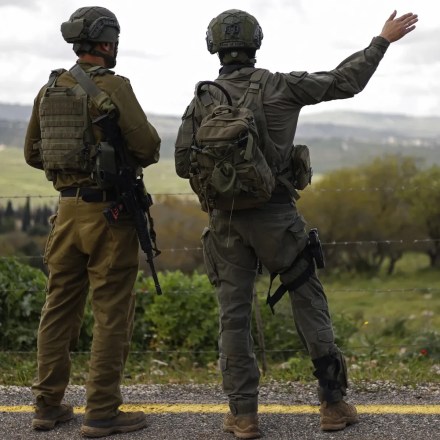
Israel has invaded Lebanon seven times in the last half century. Between 1978 and 2000, Israel maintained an 18-year occupation of southern Lebanon — the occupation Hezbollah was formed to fight.
It’s worth stressing, too, that while Israel and the U.S. describe the war as one against Hezbollah, it is being waged against the Lebanese people. Much like it is an unacceptable euphemism to describe Israel’s genocide and ethnic cleansing of Palestinians as a war with Hamas.
Lebanese journalist Lylla Younes told “Democracy Now!” that in southern Lebanon, as in Gaza, Israel is carrying out a “scorched-earth campaign,” destroying whole villages, mosques, and cultural sites. Her family’s village in the southern border region was bombed earlier this week.
“What the world should know is that we will return to these villages, and when we do, we’ll return to rubble, and it will be an immense process of rebuilding,” she said. That is, if return is possible at all.
Hezbollah, for its part, will not be fighting through the ceasefire, the group’s representatives had said.
“We will be respecting the ceasefire and we will deal with it cautiously,” said Ibrahim Moussawi, a member of the Lebanese Parliament and a Hezbollah spokesperson. He added that “it should hopefully be a beginning of a course of the Israeli withdrawal from our occupied territories.”

Lebanon’s Prime Minister Nawaf Salam wrote on X on Thursday that he has “full hope” that the Lebanese civilians displaced from the south will be able to return to their homes.
It is an optimism at direct odds with Israel’s open commitment to annexation — and it is a hollow hope in the face of what we’re seeing in Gaza.
“Israeli forces continue their violent attacks and expand their military control of the Strip,” noted Médecins Sans Frontières in a report last week. “Living conditions of Palestinians remain dire, while Israel continues to deliberately obstruct aid, which is translating into entirely preventable deaths.” The humanitarian medical aid group put it plainly: “This is not a ceasefire.”
This cannot be what “ceasefire” gets to mean.
IT’S EVEN WORSE THAN WE THOUGHT.
What we’re seeing right now from Donald Trump is a full-on authoritarian takeover of the U.S. government.
This is not hyperbole.
Court orders are being ignored. MAGA loyalists have been put in charge of the military and federal law enforcement agencies. The Department of Government Efficiency has stripped Congress of its power of the purse. News outlets that challenge Trump have been banished or put under investigation.
Yet far too many are still covering Trump’s assault on democracy like politics as usual, with flattering headlines describing Trump as “unconventional,” “testing the boundaries,” and “aggressively flexing power.”
The Intercept has long covered authoritarian governments, billionaire oligarchs, and backsliding democracies around the world. We understand the challenge we face in Trump and the vital importance of press freedom in defending democracy.
We’re independent of corporate interests. Will you help us?
IT’S BEEN A DEVASTATING year for journalism — the worst in modern U.S. history.
We have a president with utter contempt for truth aggressively using the government’s full powers to dismantle the free press. Corporate news outlets have cowered, becoming accessories in Trump’s project to create a post-truth America. Right-wing billionaires have pounced, buying up media organizations and rebuilding the information environment to their liking.
In this most perilous moment for democracy, The Intercept is fighting back. But to do so effectively, we need to grow.
That’s where you come in. Will you help us expand our reporting capacity in time to hit the ground running in 2026?
We’re independent of corporate interests. Will you help us?

I’M BEN MUESSIG, The Intercept’s editor-in-chief. It’s been a devastating year for journalism — the worst in modern U.S. history.
We have a president with utter contempt for truth aggressively using the government’s full powers to dismantle the free press. Corporate news outlets have cowered, becoming accessories in Trump’s project to create a post-truth America. Right-wing billionaires have pounced, buying up media organizations and rebuilding the information environment to their liking.
In this most perilous moment for democracy, The Intercept is fighting back. But to do so effectively, we need to grow.
That’s where you come in. Will you help us expand our reporting capacity in time to hit the ground running in 2026?
We’re independent of corporate interests. Will you help us?
Contact the author:
Related



Latest Stories

Israel’s War on Gaza
A C-Section in Shackles: A Palestinian Woman’s Harrowing Birth in Israeli Detention
Dana Joudeh was denied proper food and medical care throughout her pregnancy in an Israeli prison. She gave birth to a premature baby surrounded by armed guards.

ICE Shooting in NYC Inflames Mamdani’s Policing Problem
After ICE shot a young father in Manhattan, New Yorkers asked the mayor to protect them from his police department and federal agents alike.

Where Are the Iran War Protests?
Despite a wildly unpopular war with Iran, a mass protest movement for peace hasn’t materialized — at least in the ways we’ve been taught to recognize.