

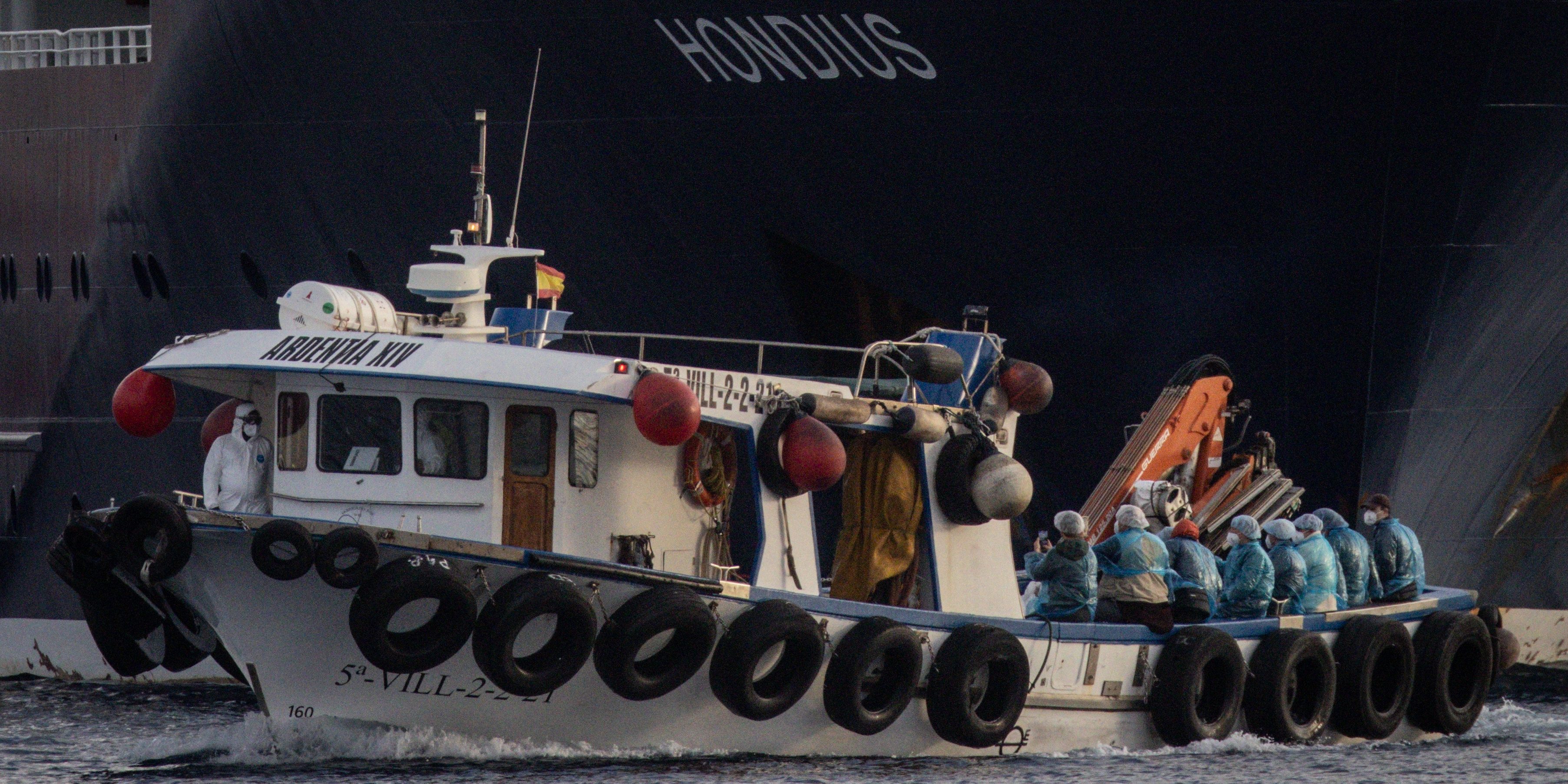
A Manhattan resident who was on the cruise ship at the center of the hantavirus outbreak traveled freely after leaving the ship, and the U.S. Centers for Disease Control and Prevention did not warn public health authorities in New York of her potential exposure to the deadly virus, according to New York City and state officials.
The woman, a dual citizen of New Zealand and the United States with residences in Manhattan and Fort Lauderdale, Florida, was one of 30 passengers who left the MV Hondius expedition cruise ship while it docked at Saint Helena island, in the South Atlantic, in late April after one passenger had already died of a lethal strain of hantavirus. A second and third passenger died days later, one on board and one in a hospital in South Africa, but by the time the ship had become a focus of headlines worldwide, the woman was well on her way on a globe-hopping itinerary.
The CDC informed health officials in various states of other Americans potentially exposed to the virus, but failed to alert New York health officials about the Manhattan woman.
There is no indication that the woman intended to come back to the United States or to New York any time soon. Instead, she continued on a multi-continental trip around the world. Her ability to continue traveling — and the lack of notice issued to authorities in the location to which she might eventually return — raise worrying questions about the potential spread of the disease, said Dr. Abraar Karan, an infectious disease specialist at Stanford University.
“If she’s on the loose, then we need to be aware of where she might come back to,” Karan said. “So the New York Department of Health, and officials at the port of entry, they need to make sure this person is flagged when they return.”

The traveler, a 75-year-old former pharmaceutical executive, matches the description of a former ship passenger who is now in quarantine in Taiwan, according to local news reports there. Her peregrinations first came to light in reporting by Intercept contributor Jacqueline Sweet, who published a report on the traveler on her personal Substack.
The woman’s dual nationality and connection to addresses in multiple states appears to have muddied the lines of communication.
A spokesperson for the New York State Department of Health told The Intercept that after raising the issue with the CDC, they learned that the agency had notified a different state of the woman’s possible exposure to the virus. The spokesperson did not identify the state in question, but public records show the woman is registered to vote at an apartment in Fort Lauderdale, Florida. Despite her voter registration in Florida, she has referred in social media posts to the co-op she owns in Manhattan as her home.
Representatives of the CDC and the Florida Department of Health did not respond to The Intercept’s requests for comment. Florida has not reported that it is monitoring any residents for possible exposure to hantavirus.
New York and other states — including California, Arizona, Washington, Georgia, Virginia, and North Carolina — have reported residents with possible exposures, with some states indicating they received notice from the CDC and others saying cruise passengers self-reported. All 18 U.S. citizens who returned to the country directly from the cruise are currently in quarantine in Omaha, Nebraska, and Atlanta, Georgia, while another 16 citizens who shared a plane with a woman evacuated to Johannesburg are being monitored.
From the South Atlantic to a Global Conference
The outbreak took place aboard the MV Hondius, an “expedition” cruise ship that takes adventurous passengers on a monthlong specialized polar tour, stopping at hard-to-reach islands in the South Atlantic. The cruise attracted wildlife enthusiasts, biologists, and extreme travelers attempting to visit as many countries and territories as possible, willing to shell out tens of thousands of dollars for the trip.
On April 6, one of those travelers, a 70-year-old Dutch man who prior to the sea voyage had spent more than three months traveling in South America, became ill. He died onboard on April 11, and on April 24, the victim’s 69-year-old wife disembarked at Saint Helena; the next day, she flew to Johannesburg, South Africa, where she died soon after. A third passenger died on May 2 — the same day that the World Health Organization declared an outbreak of hantavirus as the culprit.
The CDC has been accused of a slow response to the outbreak, holding its first briefing on the crisis on May 9, a week after WHO announced that the deaths were caused by the rare Andes strain of hantavirus, which is spread in South America by the pygmy rice rat and which can be transmitted among humans via close physical contact with someone already showing signs of infection. Because the early symptoms of the virus, including fever, fatigue, and muscle aches, are common in many other viral infections, the disease can be hard to identify before the rapid onset of more serious symptoms like pneumonia and respiratory distress.
In the case of the hantavirus outbreak, as with other public health crises, officials need to walk a careful line between ensuring safety and avoiding panic, Karan said. And the key to keeping a lid on the outbreak is ensuring proper quarantine for anyone with a potential exposure.
“Because this took place on a cruise ship, it actually helped us detect this quickly, and for now it appears to be decently contained,” Karan said. “But the problem is that, it’s not like you have a camera on these people to know if they’re not going out or seeing other people. So you don’t definitely know unless they’re quarantining at a monitored center.”
Compounding the trouble, however, is that many of the passengers on the cruise are part of an “extreme travel” subculture whose lifestyle centers around relentless jetsetting. Even with the international attention being paid to the ship and its passengers, a number of people have been found to have trekked globe-spanning itineraries since the outbreak was revealed.
The itinerary of the Manhattan woman after she left the MV Hondius showed a complexity typical of such “extreme travelers.” In a social media post on April 28, the traveler said she had flown from Saint Helena to Johannesburg, where she stayed in a hotel before flying on to Hong Kong and then to Bangkok, Thailand. In Bangkok, she wrote that she took a shuttle across the city to its second airport and flew to Trang, in southern Thailand, where she stayed in a hotel overnight before taking a boat to the island of Ko Ngai. Her most recent social media post was from Hanoi, Vietnam, several days before reports surfaced of the former ship passenger matching her description under quarantine in Taiwan.
She was just one of 30 travelers who left the ship while it docked at Saint Helena, prior to the declaration of an outbreak — setting off a scramble by global public health officials to identify everyone who might have been exposed.
The profile of the passengers themselves complicated the picture, according to Alina Chan, a molecular biologist and co-author of “VIRAL: The Search for the Origin of Covid-19” who advocated for more scrutiny of a possible lab origin for the virus that caused the Covid pandemic.
“The cruise selected for these extreme travelers, and you cannot ask for a potentially better superspreader,” Chan said. “And if one of the passengers presented to an international hospital with symptoms without the hospital being aware of their exposure on the ship, by the time the hospital would know, healthcare workers could have already been exposed.”
Most public health officials agree the hantavirus outbreak is unlikely to transform into a pandemic. But the incubation period for the Andes virus is anywhere from four to 42 days, raising concerns that the traveler and others who left the ship prior to the outbreak becoming known could transmit the virus to others if they become sick. That’s led global health officials to scramble to identify passengers and notify their home countries. But the timing of these communications, and how they unfolded, are unclear, as the case of this woman reveals.
While the CDC alerted a number of states, including New York, to the fact that residents with potential exposures could be coming home, the Manhattan-based traveler appears to have slipped through the cracks, and state health officials there only learned of her connection to the state after receiving inquiries from Sweet.
It appears that the MV Hondius’s parent company first reported that this passenger was a New Zealand national to New Zealand health authorities. After The Intercept began making inquiries with the New Zealand Ministry of Health in conjunction with reporters from news outlet Radio New Zealand, as well as to the woman and other conference attendees, the Ministry of Health told Radio New Zealand that although the woman had ignored their previous attempts to contact and assist her, on Tuesday she suddenly contacted them. The Ministry of Health said they had alerted the United States last week that she was in fact a resident of the U.S., and not New Zealand, and on Tuesday, they also alerted health officials in the country she is in currently, which is unknown.
On Monday, news from New Zealand broke that an American woman, since reported as being from California, had turned up in remote Pitcairn Island, a tiny South Pacific island with less than 50 residents. She had flown from Saint Helena after departing the MV Hondius early to San Francisco, before flying to Tahiti and then taking a boat voyage to Pitcairn. It’s unknown if any health authorities contacted her before her travels. She is now being quarantined on the island.
Reached by The Intercept, a spokesperson for the California Department of Public Health pointed to an existing press release about monitoring hantavirus exposures and added: “When we have new information to share, we will do so.”
Chan advised that “the WHO should make a list of all passengers available to all countries so they can be aware of visitors with exposure, rather than rely on each country.” Communication between the WHO and the United States was delayed in the days of the MV Hondius outbreak, since the Trump administration left the global health alliance, but the CDC and the WHO have reportedly been working together for the past week.
“In a best-case scenario there are no more waves, but this shows the WHO and the CDC are not prepared. This was the best-case scenario, with the passengers all known from the cruise,” Chan said. “When you can mess up with this controlled of a scenario, what will happen next time?”
IT’S EVEN WORSE THAN WE THOUGHT.
What we’re seeing right now from Donald Trump is a full-on authoritarian takeover of the U.S. government.
This is not hyperbole.
Court orders are being ignored. MAGA loyalists have been put in charge of the military and federal law enforcement agencies. The Department of Government Efficiency has stripped Congress of its power of the purse. News outlets that challenge Trump have been banished or put under investigation.
Yet far too many are still covering Trump’s assault on democracy like politics as usual, with flattering headlines describing Trump as “unconventional,” “testing the boundaries,” and “aggressively flexing power.”
The Intercept has long covered authoritarian governments, billionaire oligarchs, and backsliding democracies around the world. We understand the challenge we face in Trump and the vital importance of press freedom in defending democracy.
We’re independent of corporate interests. Will you help us?
IT’S BEEN A DEVASTATING year for journalism — the worst in modern U.S. history.
We have a president with utter contempt for truth aggressively using the government’s full powers to dismantle the free press. Corporate news outlets have cowered, becoming accessories in Trump’s project to create a post-truth America. Right-wing billionaires have pounced, buying up media organizations and rebuilding the information environment to their liking.
In this most perilous moment for democracy, The Intercept is fighting back. But to do so effectively, we need to grow.
That’s where you come in. Will you help us expand our reporting capacity in time to hit the ground running in 2026?
We’re independent of corporate interests. Will you help us?

I’M BEN MUESSIG, The Intercept’s editor-in-chief. It’s been a devastating year for journalism — the worst in modern U.S. history.
We have a president with utter contempt for truth aggressively using the government’s full powers to dismantle the free press. Corporate news outlets have cowered, becoming accessories in Trump’s project to create a post-truth America. Right-wing billionaires have pounced, buying up media organizations and rebuilding the information environment to their liking.
In this most perilous moment for democracy, The Intercept is fighting back. But to do so effectively, we need to grow.
That’s where you come in. Will you help us expand our reporting capacity in time to hit the ground running in 2026?
We’re independent of corporate interests. Will you help us?
Contact the author:

Related


Latest Stories

Where Are the Iran War Protests?
Despite a wildly unpopular war with Iran, a mass protest movement for peace hasn’t materialized — at least in the ways we’ve been taught to recognize.

The Intercept Briefing
Prediction Markets Have a Lock on the Midterms
As Kalshi and Polymarket dodge state regulations, prediction markets are upping the ante on next month’s elections.

The War on Immigrants
ICE Agent on Scene of NYC Shooting Was Posing as Construction Worker, Eyewitness Says
A member of Congress at the scene confirmed to The Intercept that there was a child in the victim’s car when ICE agents shot at it.