
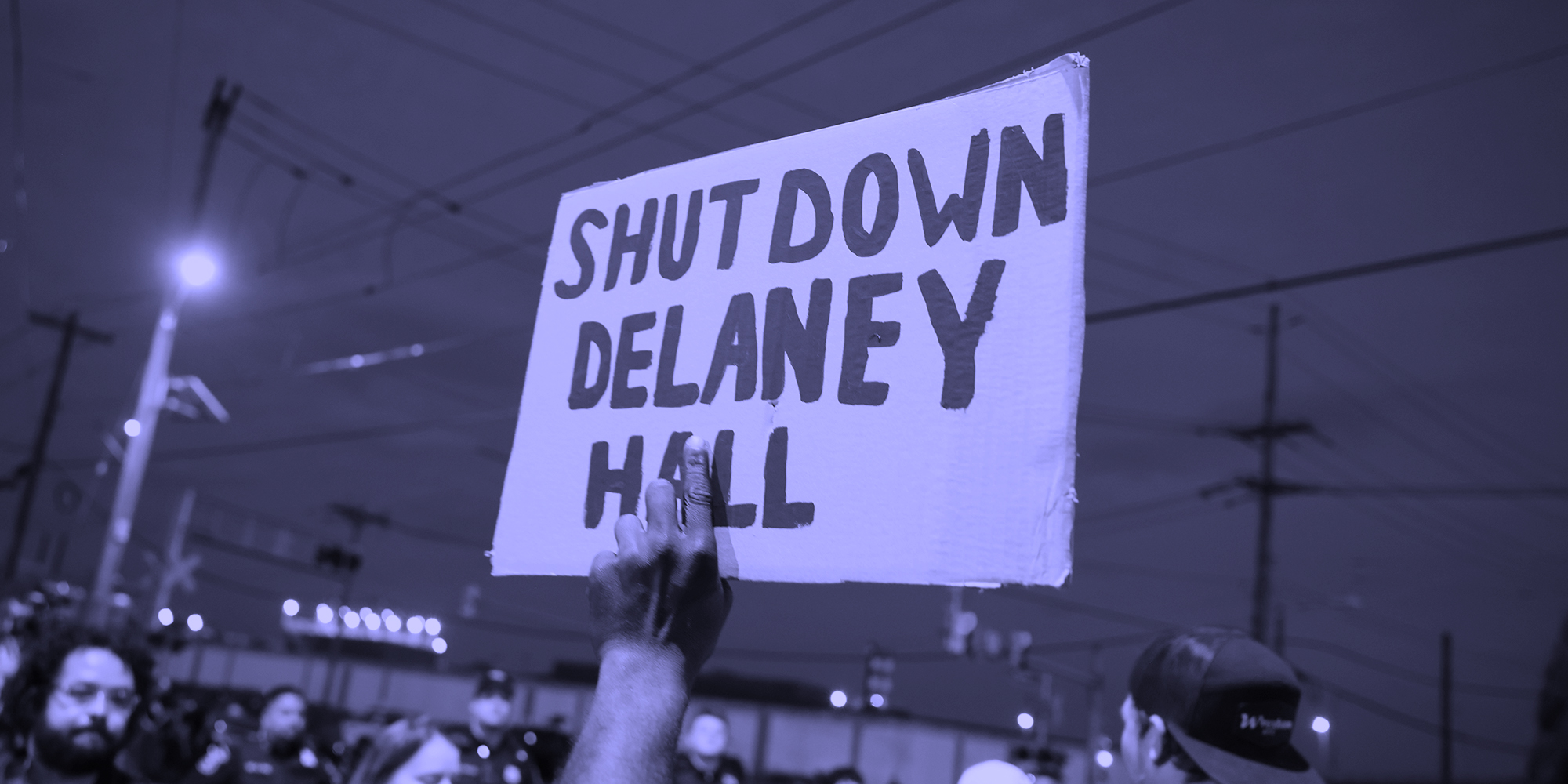
Hundreds of detained people launched a hunger and labor strike at Delaney Hall in Newark, New Jersey, over Memorial Day weekend to protest inhumane conditions at the immigration detention facility run by the for-profit company GEO Group. Protesters flocked to the scene to echo detainees’ pleas for release and better conditions — and were met with brutal tactics from federal, local, and state law enforcement officials, who beat, tear-gassed, and arrested protesters.
“Detainees are raising that they have no access to quality medical care, that they’re not getting needed medications,” Andrea Sáenz, a former federal appellate immigration judge who was fired by the Trump administration last year, tells The Intercept Briefing. “They don’t have enough food to eat. The food that they are getting is spoiled. They’re facing hostility and harassment and violence from the guards.”
This week on the podcast, host Jessica Washington speaks to Sáenz and Aaron Reichlin-Melnick, a senior policy fellow at the American Immigration Council, about the conditions at the 1,000-bed jail and other detention centers across the country. The Trump administration has restricted members of Congress and state officials from oversight of federal immigration detention centers. “ICE doesn’t want people to see the way that they’re treating human beings in these facilities,” says Sáenz.
Intercept reporter Noah Hurowitz, who covers federal law enforcement and immigration, was on the scene at Delaney Hall on Monday. He describes the violence that erupted outside of the facility between protesters and law enforcement officers.
“The ICE agents on the scene were quite willing to use violence at times against protesters,” says Hurowitz. “But from everything I saw, the Newark and New Jersey police were much more indiscriminate with their violence and much more willing to attack outright and fire tear gas and really put people in danger.”
Reichlin-Melnick says that the Trump administration’s war on immigrants should concern everyone. “We’re seeing every government database being turned into a tool of the mass deportation state, and that is something that impacts all Americans,” he adds, “because you cannot carry out a mass deportation of 4 percent of the U.S. population without fundamentally transforming the United States into more of a police state.”
For more, listen to the full conversation of The Intercept Briefing on Apple Podcasts, Spotify, YouTube or wherever you listen.
Transcript
Jessica Washington: Welcome to The Intercept Briefing, I’m Jessica Washington, politics reporter at The Intercept.
Noah Hurowitz: And I’m Noah Hurowitz. I cover federal law enforcement and immigration at The Intercept.
JW: Noah, you were outside Delaney Hall in Newark, New Jersey, on Monday afternoon after dozens of protesters were arrested the night before after clashing with state and local police. Noah, what can you tell us about what went down and why protesters were out there in the first place?
NH: The current wave of protests outside Delaney Hall started around May 28, and it was called in solidarity with detainees inside the facility who were withholding labor and hunger striking, some of them, to protest really bad conditions inside the jail, including bad food, maggots in the food, inadequate medical care. There’s all sorts of complaints that we’re hearing from people inside. A wife of one of the hunger strikers called on local organizations to rally in solidarity.
Now, the way that it began was, for several days, there were protesters standing directly outside one of the entrances to Delaney Hall. And the way it would go for several nights was that basically after dark, the protesters would be standing along the entrance. And every time a car had to go in or out, the ICE agents who were standing outside — full kit, masks — would push out and try to clear the way for cars to come in or out.
That is usually when some of the more spectacular clashes that you may have seen took place. So they’d be swinging batons, they’d be hitting people with pepper sprays. It was pretty ugly, but it was this weird choreography of static, static, static — and then conflict when the ICE agents would attack, and then back to a sort of status quo.
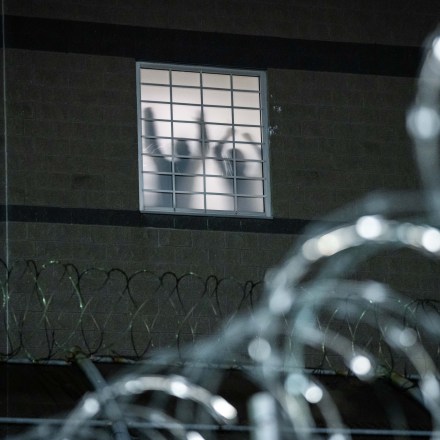
But when state and local police arrived on the scene and tried to secure the area around Delaney Hall, that’s when things got really ugly. So on the night of Friday, May 29, and really on the evening of Saturday, May 30, there were these widespread scenes of disorder as police came in with riot shields and gas masks and started firing tear gas.
A number of people were injured, including a freelance photographer for The Associated Press who suffered a pretty severe injury to her leg. Everyone that I spoke to said that as rough as ICE could be — and as daunting as the image of these masked guys just taking swings at protesters was — it really got so much more chaotic when state and local police got involved.
Now, Mayor Ras Baraka declared a curfew, which is ironic because Mayor Baraka was previously arrested protesting conditions at ICE, and he’s, from the beginning, taken a stance of what’s happening at Delaney Hall is unacceptable but protesters need to be peaceful. The way that was enforced was very not peaceful.
On Sunday night, there was a curfew imposed for 9 p.m., and they had also set up a frozen zone on the industrial corridor that Delaney sits. So they had set up police checkpoints about a half mile in either direction so that protesters couldn’t even get in front of the detention facility anymore.
On Sunday night, according to a number of my colleagues who were covering it that night and other reporting that I’ve seen, after 9 p.m., when the curfew was imposed, police began to kettle protesters. They began to surround them and prevent them from leaving, saying that they were now in violation of the curfew.
They let media leave for the most part if they were able to show credentials, but a handful of more citizen journalists were arrested that night. They held dozens of protesters and a handful of reporters in jail. After a certain point, they needed to be released on Monday afternoon.
So when I arrived on the scene, late on Monday afternoon, people were just starting to get released. It was a pretty tame scene. No one was able to get close to the facility. The police had set up these free-speech zones with several dozen protesters there with signs and megaphones. There were many dozens of police and a lot of media.
When 9 o’clock rolled around, most of the protesters started to filter out, with the exception of a handful of protesters who played this brief game of cat and mouse with the police. As police were advancing, they were backing up to the supposed “free-speech zone” about 500 yards away.

There were no arrests that night that I saw. There was a number of Newark community leaders on the scene who were also trying to bring down the temperature, which protesters were not happy about because they felt like this was just an effort to diffuse things.
From what I saw, the ICE agents on the scene were quite willing to use violence at times against protesters in order to maintain that entrance. But from everything I saw, the Newark and New Jersey police were much more indiscriminate with their violence and much more willing to attack outright and fire tear gas and really put people in danger.
JW: You and I have both covered the aggressive and deadly tactics used by federal immigration agents in Minneapolis. Noah, how is what we’re seeing different in New Jersey than what we saw in Minneapolis or even Chicago last year? Or is this just a continuation of more of the same?
NH: I think it’s a continuation of what we saw in those other places with some notable differences. Minnesota and in Chicago, the police and the state and local officials there got a lot of flak from the Trump administration for speaking out against the ICE raids that were happening and for taking a step back.
“Law and order were their first priority, rather than the lawless and lack of order behavior of ICE agents and of this privately operated detention facility.”
Here, the rhetoric was there from the state and local officials. Both the mayor and the governor were speaking quite stridently against the alleged abuses at Delaney Hall and against the violence being used against protesters. But they also seemed a lot more willing to use their authority to diffuse the protests, which has led to a lot of criticism from protesters who were saying that they basically were trying to co-opt this protest, they were trying to prevent any problems for their own political calculations — that law and order were their first priority, rather than the lawless and lack of order behavior of ICE agents and of this privately operated detention facility.
JW: We’re going to get into all of that and much more in our next conversation. I speak with Andrea Sáenz, a senior counsel at Co-Counsel NYC, a nonprofit providing immigration legal services and training. She previously served as an appellate immigration judge with the Board of Immigration Appeals in the U.S. Department of Justice from 2021 to 2025.
Also joining us is Aaron Reichlin-Melnick, a senior policy fellow at the American Immigration Council, where he works to break down the complex reality of immigration law and policy to the media, policymakers, and the general public.
NH: Hell yeah, let’s get into it.
JW: Andrea and Aaron, welcome to The Intercept Briefing.
Aaron Reichlin-Melnick: Thank you for having us.
Andrea Sáenz: Thank you.
JW: Andrea, we just heard from my colleague Noah Hurowitz, who’s been reporting from Delaney Hall. Detainees have been holding hunger and labor strikes at the New Jersey detention center. What more can you tell us about the conditions at Delaney that sparked these strikes?
AS: What’s going on at Delaney is really a microcosm of what’s happening all over the country in terms of incredibly harsh and inhumane conditions in ICE detention, that don’t have any accountability.
At Delaney in particular, detainees are raising that they have no access to quality medical care, that they’re not getting needed medications. They don’t have enough food to eat. The food that they are getting is spoiled. They’re facing hostility and harassment and violence from the guards.
I’ve been really gratified to see elected officials and press and others paying attention to this. But unfortunately, it’s something that we’re seeing all over the country, from Adelanto to Dilley to Camp East Montana in Texas.
JW: So Aaron, your organization, the American Immigration Council published a report earlier this year about the Trump administration’s immigration detention expansion efforts this term. A section of the report reads, “A system of detention, which did not fully take off until the mid-1990s, is now on track to rival the entire federal criminal prison system by the end of President Trump’s second term in office. This expansion is fueled by an unprecedented increase in funding provided by Congress in President Trump’s One Big Beautiful Bill Act. Combined with ICE’s annual appropriations, ICE has nearly $15 billion per year to use on immigration detention through the end of fiscal year 2029.”
Aaron, what can you tell us about the scale of the Trump administration’s efforts to expand detention centers?
ARM: Since taking office, Trump expanded the scale of the detention system by 75 percent, rising from about 40,000 people in detention when he took office in 2025 to over 73,000 people in detention in January 2026. While that number has fallen somewhat in the months since “Operation Metro Surge” in Minneapolis, the Trump administration is sitting on an unprecedented pot of cash that they can use to keep expanding the system even bigger.
“The Trump administration is sitting on an unprecedented pot of cash that they can use to keep expanding the system even bigger.”
JW: Andrea, I want to bring you in. We’ve been hearing about these efforts from the Trump administration to convert warehouses to detention centers. What do we know about those plans, and what can we surmise about what those conditions could look like?
AS: What we know is that the government has spent a whole lot of money to buy large facilities without really having any plan of how they’re going to humanely keep human beings there. We know this because they haven’t even had the plans to figure out how they’re going to handle water and trash and things like that at these facilities, and that’s been the source of some lawsuits.

But I think we have reason to be incredibly worried that the government is in no position to hold a large number of human beings. Delaney is a good example because it’s the largest facility on the East Coast. It can hold up to 1,000 people. We’ve got a human rights situation going on inside, pepper-spraying a U.S. senator on the outside.
“These are preventable deaths.”
So I can only imagine if you were to try to expand the capacity of these facilities, the government just doesn’t have the infrastructure, the accountability, the oversight to care for people. As we’re seeing the numbers of deaths in ICE detention rise — I believe it’s 18 deaths just in this calendar year, which is unprecedented. What really worries me is that these are preventable deaths, and that we’re going to see more of them if the government’s permitted to keep expanding, literally warehousing human beings in this way.
JW: Aaron, obviously there’s a lot of attention on Delaney Hall, on these new makeshift warehouse detention facilities, but what do we know about what conditions are like in facilities around the country right now outside of Delaney?
ARM: ICE detention has never been great and that’s to really underplay it. At the American Immigration Council, we have filed countless complaints over the years about inadequate medical care, verbal physical abuse against people in detention, pressure on people to give up their rights rather than accept time in detention, while they’re fighting their cases. This is endemic to the system and has been something that advocates have raised attention to for decades.
The key difference now is the speed at which the Trump administration is expanding the system and the ways in which accountability has been dismantled. When Trump took office, there was the Office of Civil Rights and Civil Liberties inside the Department of Homeland Security, and the Office of the Immigration Detention Ombudsman as internal watchdogs. Within the first month, the Trump administration slashed their staff to the bones and has since dismantled the Office of Immigration Detention Ombudsman entirely, shutting it down despite a congressional mandate that the office remain in existence. With no internal accountability, that’s left only external accountability, and there they are trying to prevent members of Congress from going into detention centers.
The end result of this is that conditions are worsening, deaths are rising, and the need for reform is growing every day.
JW: That lack of transparency that you’ve mentioned is something that’s come up a lot in our reporting — the inability to monitor what’s happening inside of these facilities is incredibly concerning.
Andrea, I want to ask, from your perspective, what does access look like even for immigration attorneys that are trying to reach their clients?
AS: It’s a good question because there are lots of ways that we should be able to know what’s happening in the detention center. It’s not intended to be a secret.
I’ve been representing detained people for 18 years, and it’s always been part of the practice to drive out and physically see your client, have them sign papers, that their family members are allowed to visit them. And that when they have a court hearing, they’re either produced in person or they’re there on video, and observers can come and watch because it’s a public court hearing.
Right now, what we’re seeing is that all of those things are being obstructed. It’s incredibly hard to even find out where your client is anymore because they’re being transferred from state to state. They disappear off the public detainee locator. ICE is not responsive.
As Aaron mentioned, there aren’t oversight agencies to complain to, and the immigration court system is increasingly keeping out observers and press from even watching these hearings to know what’s happening.

And then, of course, on the oversight side, as we’ve been talking about, part of what’s happening at Delaney, the reason why this escalated with elected officials, is because they wanted to get inside the facilities and exercise their right to oversight. They’ve been denied that right and in New Jersey, you have state health officials who weren’t allowed to go inside and inspect. And so ICE doesn’t want people to see the way that they’re treating human beings in these facilities.
But at least I’m gratified that people from lawyers to family members to elected officials keep trying.
JW: Do we have a sense of whether or not conditions are deteriorating? Obviously, these are horrific conditions that we’re describing, but maggots in the food, lack of access to medical care, these are not necessarily new issues inside of detention facilities.
Aaron, are we seeing a much worsening of conditions, or is there just a lot more attention on this issue right now?
ARM: It’s a little bit of both. There are some issues that you’re seeing raised in the media and brought to people’s attention now that aren’t new. As you said, maggots in food, bad medical care. This is not a new problem.
When you look at spoiled food, there are DHS Office of Inspector General reports going back many years which document violations of standards at Essex County Jail outside of New York City, a jail that is no longer working with ICE. Inspectors went there in 2018 and found spoiled food, covered in mold in the fridge that was being served to people. So that’s not a new issue.

But what is new is the way in which the Trump administration has made getting out of detention more difficult so that more people are being detained there. Before last year, the Trump administration adopted the legal position saying that essentially any person who ever entered the United States across the southern border is permanently barred from seeking release on bond, even if they’ve been here for 20 years with no criminal record.
That means more people in detention, more overcrowding, and as they open up these new facilities or repurpose old facilities, like Delaney Hall, it’s clear that there isn’t enough staffing to keep these places operating at the capacity that they are operating. This is not a problem that’s also unique to immigration detention.
There is a shortage of corrections officers in jails and prisons nationwide and a shortage of prison healthcare providers. One of the biggest ones, Corizon, actually went bankrupt two years ago. Given that, it’s not a surprise that the administration is failing to meet the standards that it is legally required to meet.
“What is new is the way in which the Trump administration has made getting out of detention more difficult so that more people are being detained there.”
AS: I do think that conditions are deteriorating. And I think another factor is the increased enforcement itself is causing severe overcrowding, including in these facilities that were intended to be holding facilities. So one of the places that conditions have been the source of lawsuits is in places like the Baltimore Hold Room, 26 Federal Plaza in New York City.
These are facilities where people are supposed to be taken for an hour or two after they’re arrested by ICE, and instead people have been packed in like sardines, sleeping on the floor next to toilets, and judges have had to order that you can’t hold people overnight there. So that’s part of the problem.
A second aspect to the problem is because ICE enforcement is so indiscriminate at the moment, and, that’s gone back and forth with time, but I do think it is worse than I have ever seen it, that ICE is not holding back from arresting very young people, very sick people, very old people’s moms and dads. So you have medically vulnerable and sick people in ICE detention with these conditions, and you’re setting up a recipe for disaster.
JW: To your point, at The Intercept, we’ve covered the detention of pregnant women and postpartum women who previously have been exempted, generally speaking, from detention, who are now in these facilities, who are lacking access to medical care, water, all of these necessities you need to thrive in pregnancy.
“ICE enforcement is so indiscriminate at the moment … ICE is not holding back from arresting very young people, very sick people, very old people’s moms and dads.”
[Break]
JW: The Trump administration recently made some pretty significant changes to the green card process. Aaron, can you walk us through what they did and how it’s going to impact people applying to become permanent residents?
ARM: A couple weeks ago, the Trump administration put out a memo from U.S. Citizenship and Immigration Services, America’s legal immigration benefits agency. That memo said that for the first time ever, adjustment of status where someone applies for a green card from inside the United States, would no longer be treated as a normal part of the legal immigration process, but would instead be treated as an extraordinary benefit and only given in an act of administrative grace.
This was particularly strange because adjustment of status is the norm by which about half of all people get their green cards. These are people who are in the United States already, living here either on a visa or seeking to change their status. So it could be anything from a foreign student who comes here, falls in love with an American at college, and applies for a green card, to someone present on an H-1B visa for 10 years who is seeking to finally get their green card and become a lawful permanent resident.
Almost immediately, this set off a lot of backlash, and the administration has had to walk this back a little bit because their initial suggestion in this memo was that potentially as many as half a million people a year would have to leave the United States and seek an immigrant visa in their home country if they wanted to get a green card that they were legally entitled to.
Silicon Valley was not happy. A lot of people were very clear that this seemed like an unnecessary process because the vetting that someone gets inside the United States is identical to the vetting that they get if they’re outside the United States seeking a visa, which means the only difference is where the bureaucrat is deciding this.
Is it a bureaucrat at a consulate abroad deciding if you get a green card, or a bureaucrat at an office in the United States? From the government’s perspective, that should make no difference, but for the immigrant themselves, this means time away from their family and home in the United States, time away from their job, and the possibility that if there’s some error or red tape, they might not be able to come back for maybe weeks, months, or longer, which just threw a wrench in a lot of people’s plans for staying in this country and being on a path to citizenship.
However, crucially, the administration, ever since they put out that vaguely worded memo, has been trying to walk it back somewhat, and is now suggesting it may apply to a much more narrow group of people, potentially people who overstayed visas years ago and are trying to get a green card through a spouse, which would be a lot narrower a group, but still impact potentially tens of thousands of people.
JW: I’m not going to lie, this does seem like quite a mess.
“There is this level of contempt and dismissiveness even for people who have forms of status.”
Andrea, are we seeing other ways that the Trump administration is targeting people with legal status?
AS: Yes. What really the big picture here is that’s alarming to me with both the green card memo and some of the decisions coming out of the Board of Immigration Appeals that I used to sit on, is that there is this level of contempt and dismissiveness even for people who have forms of status.
So it really, I think, gives lie to that idea that the administration or Republicans are only interested in illegal immigration, they’re only interested in people who are out of status. Because you’re also seeing increased targeting and detention of Dreamers, people with DACA, young people with special immigrant juvenile status who have an approved application to stay in the U.S. and are in a line to get their green cards, people who have visas for being victims of violent crimes or trafficking.

These are all kinds of status that already exist in law that Congress has created, and you’re seeing these people additionally detained and put into proceedings. And the Board of Immigration Appeals is putting out case law day after day saying, “These classes of people are not special. They’re not worthy of particular protection. They can all be denied bond. They can all be put in removal proceedings and detained.”
JW: And we’ve also obviously seen a targeting of U.S. citizens who’ve stood up for immigrants as well. Since Trump fired Homeland Security Secretary Kristi Noem and former Border Patrol official Gregory Bovino “retired” after violent raids in Minnesota killed two American citizens, it appears the Trump administration has at least toned down publicizing these aggressive raids.
But has there actually been a shift in tactics under the new DHS secretary? Aaron, I want to start with you, and then Andrea, I want to get you in as well.
ARM: The short answer is it does appear that yes, they have pulled back from the aggressive raids that were really characteristic of the Noem term, in particular under the leadership of Gregory Bovino, a mid-level Border Patrol official who was unexpectedly elevated to the position of “commander-at-large” of DHS operations in the interior.
What we are seeing now is a return in some ways to the more traditional targeted so-called enforcement tactics, where ICE officers have lists of people that they are specifically intending to arrest, go out into the communities to arrest those specific people.
But we are seeing a major increase in so-called collateral arrests. If they arrest that one person, they also might arrest everyone else in the building who’s nearby or anyone who looks like an immigrant near there. The end result of this is that the administration is now arresting slightly fewer people than during Operation Metro Surge. Detention numbers have come down, about 10 to 20 percent from the height of that operation.

But they are building out a more robust enforcement capacity, and especially relying on state and local police who are cooperating with them through so-called 287(g) agreements, agreements that allow local law enforcement to act as ICE officers. So the Trump administration’s new plan is to gradually build up the capacity rather than rushing out to make splashy headlines, and they believe that is more sustainable in the long term, both from an enforcement perspective and also importantly from a political perspective.
AS: We are seeing not only a decrease in maybe these large-scale campaigns that have a cute nickname. We’re also seeing a decrease in courthouse arrests, partly because they were stopped by litigation. But I am continuing to see waves of street enforcement and street arrests that are often racially motivated, and I think we have to keep our eye on that.
Early on during the Los Angeles ICE surge, we saw a lot of those stories of ICE stopping people, regular people, Latino people walking down the street, going to school and work, including U.S. citizens, and that got a lot of press. I think those arrests are still happening; they’re just happening one at a time in less obvious ways.
I do a lot of habeas corpus litigation, and so I get a lot of emails and calls about who has been arrested. And, Aaron mentioned this idea of targeted arrests, which is what ICE says that they’re doing, that they’re looking for a particular person who has a criminal arrest or who has a prior deportation order.
But there are a lot of arrests in which ICE says that they’re looking for a target, and really what they have done is drive up next to a Latino person and ask them for their ID and then arrest them — when they were very obviously not the target that they were looking for. So I think we can’t let the idea of targeted enforcement cover the actual reality that people, especially people of color walking down the street, have something to fear from ICE.
I think it’s a terrible state of affairs, but I think we have to continue to be vigilant and push back on it.
JW: In that vein, how would you characterize this phase of Trump’s immigration agenda? Where is Trump in this? What is the end goal here that we can visualize at this stage?
AS: This is part of the question is, like, how much does Trump himself have to do with this as opposed to other people in the administration?
“People in the administration … are intending to decrease the amount of immigrants in the United States, both legal and undocumented.”
We’re in a transitional phase as we have new DOJ and DHS leadership. Certainly, the people in the administration like Stephen Miller, who have had an agenda all along, are intending to decrease the amount of immigrants in the United States, both legal and undocumented. And that it’s intentional to have people be scared of the kind of enforcement that I’m talking about that the administration hopes that a lot of people will get scared and frustrated and leave the United States, including through things like the green card memo, that it’s just so confusing and overwhelming and expensive to stay here that people will pick up and leave, even at incredible cost to our economy and to our fabric as a community.
What’s exactly coming next I can’t say, but I’m guessing that there is more to come. Trying to advise clients in this atmosphere, trying to advise immigrant communities is really hard. People are scared, and it’s hard to tell them not to be.
ARM: To add on to that, the administration is very clearly trying to create a climate of fear for immigrants. While they claim that they are aiming that at undocumented immigrants, fear has a splash zone. You can’t target fear on an individual level like that, and communities are frightened. But as Andrea said, this is a transition moment right now.
What we are seeing them do is attempt to take a system that was always imperfect but strived towards due process and basic principles of fairness, and turning it into an assembly line for deportations — one in which basic legal rights are tossed aside and procedures are followed potentially to the letter, but in clear violation of the spirit.
“What we are seeing them do is attempt to take a system that was always imperfect but strived towards due process and basic principles of fairness, and turning it into an assembly line for deportations.”
You see this with new policies like “mega master” calendar hearings, 100 people scheduled for a hearing with maybe 72 hours of notice, maybe sent by mail or email that they might not even know about the hearing ahead of time because they were scheduled for a hearing in 2027, and all of a sudden they’re told, “Show up two days from now in New York City. Oh, and by the way, you might not have a lawyer.”
You have no idea what’s going to happen to you. When you show up at that hearing, you’re told, “You have 20 days to get everything on file. We don’t care that you don’t have a lawyer. We’re moving forward.” If you miss that hearing, you’re ordered deported immediately.
They’re doing this even for children, and they’re firing the judges that were seen to be too liberal or too willing to grant cases, even if those cases were legally meritorious. The asylum grant rate has dropped to less than 10 percent of cases, when before it was 30 to 40 percent of cases were granted. All of this is a system that is being systematically turned against the immigrant and against the idea of a fair day in court.
However, given the scale of immigration court backlogs, there are still over 3.2 million cases pending in the system. It’s not clear whether they will actually be able to clear these backlogs by the time Trump leaves office. Crucially, all of this funding in the One Big Beautiful Bill Act and the funding that Congress has been debating, the additional $70 billion for CBP and ICE that’s being debated in the most recent reconciliation bill — that is all set to expire at the end of Trump’s term, by the end of fiscal year 2029.
So we are in a situation where they may get all of this infrastructure in place, and then who controls Congress in 2029 will determine whether that infrastructure has to be slashed back and whether we can get some handle on the system and help right the ship.
JW: I want to get into control of Congress in just a moment.
But Andrea, first I wanted to ask you, because you have personal experience with being pushed out because of the perception of your views on immigration. So I’m curious, how are you viewing this effort by the Trump administration to push anyone out who could have any sympathy for immigrants in the system?
AS: So I was an appellate immigration judge on the Board of Immigration Appeals, which is the second level of the immigration court system. I was on the BIA for three and a half years during the Biden administration. Starting last year, the administration started to fire both trial-level immigration judges, and they also fired all of the remaining Biden appointees off of the BIA, which is the body that sets case law.
It’s been honestly devastating to see this happen to an administrative court system that obviously needed improvement, but was functioning and had a lot of excellent public servants that were trying to give people due process day in and day out. The Biden administration had really tried hard to put people with a variety of professional experience on the bench, both the federal bench and the immigration bench, in terms of not only having all prosecutors on the bench there because they can be good judges too, but also putting people who had been defense attorneys and civil rights attorneys, like myself. I think that had made the court system stronger and better.
One thing I can say is that when I was a judge, I didn’t have any pressure coming from the top telling me how to rule. We had training, we had expectations, we had normal job evaluations, but I didn’t have anyone looking over my shoulder and saying, “Why did you do that?” Or “You’re not allowed to do that.”

What’s coming out now is that’s exactly what’s happened to the immigration court system such that it’s no longer independent. You have leadership of the system watching which judges grant asylum too much, which judges grant bond too much. It destroys any idea that judges are being allowed to apply the law independently as opposed to enacting a political agenda.
It’s also just exhausting and confusing for the immigrants actually appearing before the court, not knowing if they’re going to get a fair day or they’re just going to be immediately deported without a chance to present their evidence. It’s a crazy time to be an immigration lawyer and have to do hundreds of hours of work not knowing if you’re going to get a judge who’s going to give you 10 minutes to present your case.
So certainly a lot of us are gearing up to do more federal court and appeals work, but the bigger issue is that the immigration court system has ceased to function in a way that lets judges make decisions independently.
JW: Aaron, I want to get back to your point about Congress and the midterms.
So we’re obviously in the middle of an election year. What are you hoping to see from candidates on immigration, and what do you hope legislators change if they actually make it to Congress?
ARM: What we need to see is a fundamental rethinking of what interior enforcement looks like inside the United States.
Polling consistently shows that the American public believes ICE has gone too far. As much as 2 out of every 3 Americans think that the Trump administration’s mass deportation campaign has gone beyond what they want. But at the same time, people still do want some form of immigration enforcement.
“Our interior enforcement system has not been updated in 30 years. We are using laws that were crafted by Congress in the height of the tough-on-crime era of the 1990s.”
So I would love to see legislators look at revamping the system towards one that embraces principles of compliance and proportionality, accountability and safety, really focusing on actual public safety threats, not people who’ve been here for 20, 30 years who’ve never had any interaction with the criminal justice system.
At the same time, help restore a system that allows judges to decide that deportation doesn’t make sense in every case. Right now, our interior enforcement system has not been updated in 30 years. We are using laws that were crafted by Congress in the height of the tough-on-crime era of the 1990s.
We live in a very different time today. Most Americans believe there should be some form of path to legal status for people who have been living here for years without getting in trouble, working hard, raising a family, and being productive members of their community. But the law just doesn’t reflect that, and so Congress really needs to sit down and think through what kind of compromise will produce a better system that helps Americans and doesn’t take us further down this path of mass deportations, which just tear communities apart.
AS: I agree with Aaron’s frame, but I also want to say that I think we have a bigger issue that we’ve spent years now hearing this administration dehumanize immigrants and talk about people who are in our neighborhoods and communities like they are less than, that they don’t care about their families the way we do, and that asylum is a fraud on the system, that people don’t deserve asylum.

Both administrations recently, frankly, have done that. So I think going forward, it’s time for us to not be afraid to say that immigrants are an incredibly important part of our communities, and also that there is a place for the United States to welcome bona fide refugees and asylum-seekers. Both the refugee program and the asylum adjudication program have been totally decimated in recent years. And of course, we need regulations on that program. We need ways to handle the backlog.
But at its core, we have to decide that the United States is a place where people who are fleeing persecution and torture can, at least in some instances, find safety here. I think that’s part of our historical heritage that we shouldn’t turn away from. I don’t think candidates should be afraid to say that, at risk of seeing “soft on immigration.”
It’s time to stand up for people who are an incredibly important part of our communities, and acknowledge their contributions, and then figure out what’s a system going forward that allows people to work and live in safety together.
JW: Just thinking about everything we’ve discussed today, there is so much happening in the immigration space, so much horror, frankly. What should people be paying attention to right now? Aaron, I want to start with you.
ARM: I think with everything else going on in the world right now, with the war in Iran, rising gas prices, and the deconstruction of the American state by the Trump administration, it’s easy to let the immigration issue fall by the wayside now that they are trying to be a little bit more quiet.
But every single day, the administration is arresting around 1,000 people, or slightly more than 1,000 people, and many of those have been members of our communities for decades. They have family members here. The climate of fear and surveillance that is being imposed on immigrants is growing.
That is something that impacts all of us. We saw this week the Trump administration say that they wanted to try to restrict undocumented immigrants from even having bank accounts. We’re seeing every government database being turned into a tool of the mass deportation state, and that is something that impacts all Americans because you cannot carry out a mass deportation of 4 percent of the U.S. population without fundamentally transforming the United States into more of a police state.
That should concern everybody, even if it’s not something that they’re seeing on the headlines because of splashy raids in American cities.
AS: A lot of this news is really sad and hard to keep reading. I feel that myself as someone who has to for my job, continue to read immigration news. I would encourage people to continue to pay attention to stories of courage and people who are bringing the conditions of detention centers and what’s happening to their families to light.
I just spoke yesterday to a client of ours who was released from Delaney Hall on Monday because of a habeas corpus petition that we won. I was asking her what people need to know, and while she was telling me about the poor medical care and the lack of food, I was just really struck by her care for the other people who were still detained there and her spirit and the way that when she was released from that facility, the protesters outside cheered and chanted her name.
There are folks inside Delaney and hunger strikers in Adelanto, people in Camp East Montana have brought a lawsuit to complain about their own conditions. And so there are a lot of examples, from Minnesota to detention of people being courageous and having hope in these times.
So that’s what I hope people can keep watching for and participating in.
JW: That’s a really beautiful message. And we’re going to leave it there, but Aaron, Andrea, thank you both so much for joining us on the Intercept Briefing.
ARM: Thank you for having me.
AS: Thank you.
JW: That does it for this episode.
This episode was produced by Laura Flynn. Ben Muessig is our editor in chief. Maia Hibbett is our managing editor. Fei Liu is our product and design manager. Nara Shin is our copy editor. William Stanton mixed our show. Legal review by David Bralow. Slipstream provided our theme music. This show and your reporting at The Intercept doesn’t exist without you.
Your donation, no matter the amount, makes a real difference. Keep our investigations free and fearless at theintercept.com/join. And if you haven’t already, please subscribe to The Intercept Briefing wherever you listen to podcasts. Do leave us a rating or review. It helps other listeners to find us. Let us know what you think of this episode, or if you want to send us a general message, email us at podcast@theintercept.com.
Is there an immigration detention center near you that you’re concerned about or another issue? Send us an email or leave us a voicemail at 530-PODCAST. That’s 530-763-2278.
Until next time, I’m Jessica Washington.
IT’S EVEN WORSE THAN WE THOUGHT.
What we’re seeing right now from Donald Trump is a full-on authoritarian takeover of the U.S. government.
This is not hyperbole.
Court orders are being ignored. MAGA loyalists have been put in charge of the military and federal law enforcement agencies. The Department of Government Efficiency has stripped Congress of its power of the purse. News outlets that challenge Trump have been banished or put under investigation.
Yet far too many are still covering Trump’s assault on democracy like politics as usual, with flattering headlines describing Trump as “unconventional,” “testing the boundaries,” and “aggressively flexing power.”
The Intercept has long covered authoritarian governments, billionaire oligarchs, and backsliding democracies around the world. We understand the challenge we face in Trump and the vital importance of press freedom in defending democracy.
We’re independent of corporate interests. Will you help us?
IT’S BEEN A DEVASTATING year for journalism — the worst in modern U.S. history.
We have a president with utter contempt for truth aggressively using the government’s full powers to dismantle the free press. Corporate news outlets have cowered, becoming accessories in Trump’s project to create a post-truth America. Right-wing billionaires have pounced, buying up media organizations and rebuilding the information environment to their liking.
In this most perilous moment for democracy, The Intercept is fighting back. But to do so effectively, we need to grow.
That’s where you come in. Will you help us expand our reporting capacity in time to hit the ground running in 2026?
We’re independent of corporate interests. Will you help us?

I’M BEN MUESSIG, The Intercept’s editor-in-chief. It’s been a devastating year for journalism — the worst in modern U.S. history.
We have a president with utter contempt for truth aggressively using the government’s full powers to dismantle the free press. Corporate news outlets have cowered, becoming accessories in Trump’s project to create a post-truth America. Right-wing billionaires have pounced, buying up media organizations and rebuilding the information environment to their liking.
In this most perilous moment for democracy, The Intercept is fighting back. But to do so effectively, we need to grow.
That’s where you come in. Will you help us expand our reporting capacity in time to hit the ground running in 2026?
We’re independent of corporate interests. Will you help us?
Contact the author:

Latest Stories

Bodycam: Cop Was Not in Danger When He Fired Shots That Killed 1-Year-Old Kohen Wiley
Mississippi investigators said the shooting was “justified,” but new body camera footage shows the cop firing into the passenger’s side as the car passed by him.

The Intercept Briefing
The Intercept Live in Conversation With Robert Reich
Inequality Media co-founder Robert Reich and The Intercept’s Akela Lacy break down the most pressing issues of the midterm elections.

Midterms 2026
Giant Crypto Super PAC Funnels Big Money to Former Trump Official’s Firm to Support… Democrats?
The Fellowship PAC routed more than half a million dollars in support of Democrats through a firm co-founded by former Trump crypto adviser Bo Hines.