
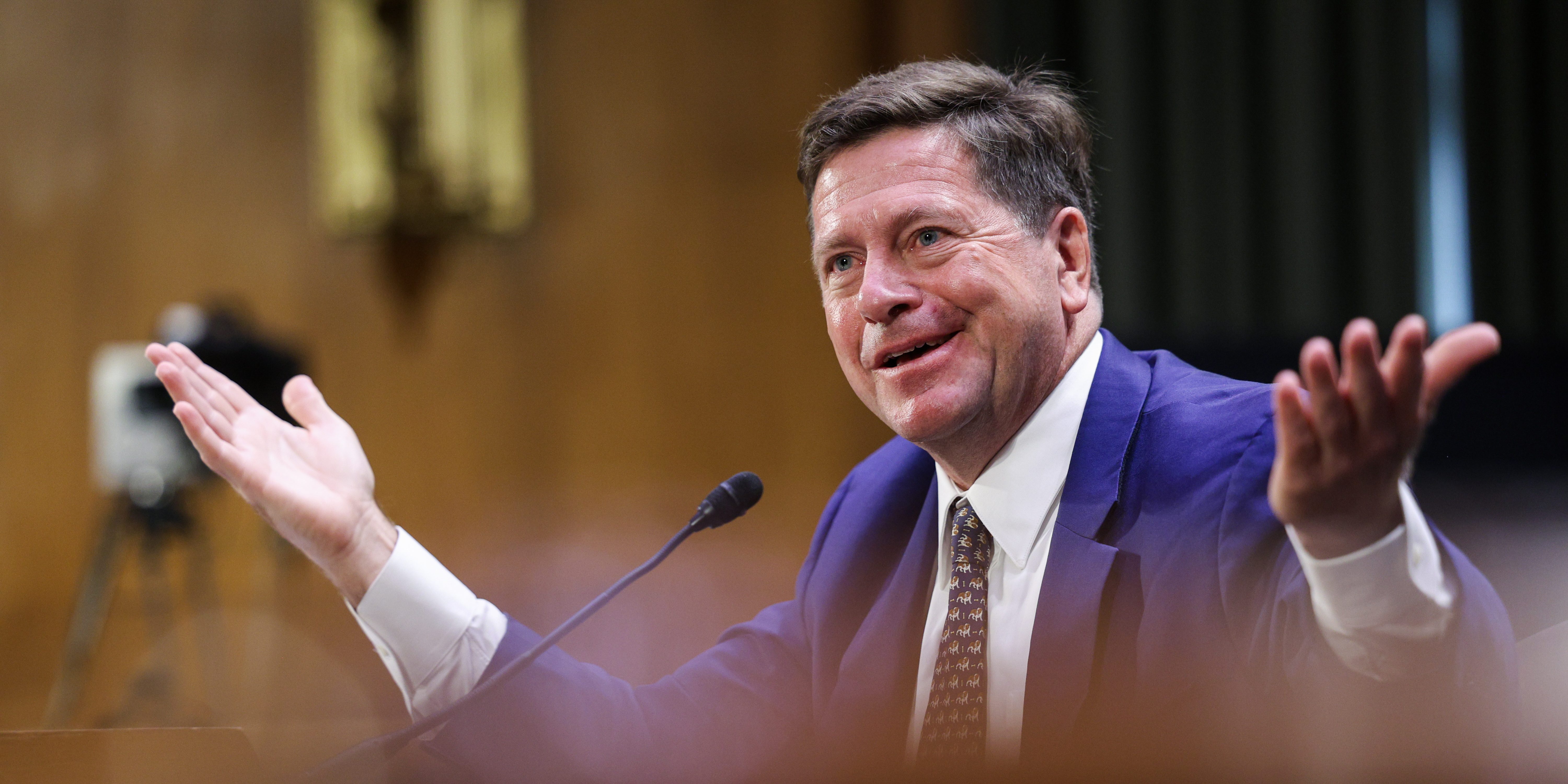
At his confirmation hearing to serve as the nation’s top intelligence officer, Jay Clayton dodged questions about whether the White House ordered him to send subpoenas to New York Times journalists as part of an FBI investigation into alleged leaks of classified information.
Under questioning from Democratic senators, Clayton, who currently serves as the top federal prosecutor in the Southern District of New York, defended the process that resulted in FBI agents showing up to the reporters’ homes to hand-deliver subpoenas seeking the source of disclosures about security flaws in the Qatari-donated new Air Force One jet.
“I’m not going to get into the details. But what I can tell you is that we followed the procedures.”
Clayton declined to answer questions, however, on whether the White House or top officials at the Justice Department ordered him to send the subpoenas.
“I’m not going to get into the details,” Clayton said under questioning from Sen. Michael Bennet, D-Colo. “But what I can tell you is that we followed the procedures, and those procedures, for the reasons that I believe firmly and you believe — protecting the freedom of the press, being the least intrusive possible — require consultation.”
Clayton’s role in sending the subpoenas, which went out under his signature Friday shortly after FBI Director Kash Patel met with Trump, has emerged as a flashpoint in his nomination to replace Tulsi Gabbard as director of national intelligence.
A press freedom advocate said he found Clayton’s testimony about the subpoenas to be “totally disingenuous” because Trump’s own subpoena guidelines say the government must exhaust other means of getting evidence before going to journalists.
“Yet these subpoenas were issued less than two days after the story came out, and just hours after Patel’s reported White House meeting with Trump,” Trevor Timm, executive director of the Freedom of the Press Foundation, said in an email. “All evidence points to Trump ordering this action for retribution because he’s embarrassed about the plane debacle, not because of anything to do with ‘national security.’”

Housing czar and Trump loyalist Bill Pulte is currently serving as the intelligence chief on a temporary basis, and some centrist Democrats have argued that Clayton should be swiftly confirmed to shut off Pulte’s access to classified information.
For Democrats on the intelligence committee, however, Clayton’s role in the subpoena to New York Times journalists suggested that he may be just as eager as Gabbard and Pulte to use the powers of public office to appease the president.
Those concerns about the subpoenas dovetailed with worries about Clayton’s views on election fraud. Democratic senators repeatedly questioned Clayton on whether former President Joe Biden won the 2020 election, which has emerged as an important litmus test in light of Gabbard’s role in an ongoing administration effort to relitigate the president’s loss.
Clayton repeatedly confirmed the fact that Biden’s election was certified by Congress but declined to say whether he thought Biden actually won the race.
“Isn’t it humiliating to be unable to answer this question? To have to indulge the president’s delusions?” Sen. Jon Ossoff, D-Ga., said at one point. “Why can you not give it?”
On the subpoena issue, Clayton’s answers offered little new light on why the subpoenas were swiftly delivered to journalists. He repeatedly said that the subpoenas were the “least intrusive” means possible to discover the source of the New York Times’s reporting on the new Air Force One.
The reporting revealed that Trump was forced to use an older version of the presidential airplane on his return from a recent trip to Turkey because the new one lacked missile defense systems despite a pricey retrofit.
Administration officials reportedly asked the newspaper not to publish its report on the jet’s security flaws, but it went ahead. The Times and other outlets have reported that the White House ordered Patel, the FBI director, to oversee a probe into the leaks about the jets. Patel reportedly spent eight hours Friday at the White House overseeing the investigation.

Under Justice Department policies, investigators seeking to subpoena journalists must receive approval from the attorney general, in this case Acting Attorney General Todd Blanche, who had his own, separate confirmation hearing on Wednesday. The government must first have made “all reasonable attempts” to obtain the information from alternative sources.
Press freedom groups have questioned whether the Justice Department really did try to discover the source of the Air Force One leaks. They also raised alarm bells about the FBI sending agents to deliver the subpoenas by hand, rather than going through the newspaper’s lawyers.
“The subpoenas were issued so closely after a very long meeting at the White House. There seemed to be an unnecessary urgency.”
“The subpoenas were issued so closely after a very long meeting at the White House. There seemed to be an unnecessary urgency behind it,” said Sen. Kirsten Gillibrand, D-N.Y. “Delivering it to a private home seems quite aggressive.”
Clayton, in his response, seemed to suggest that the White House was worried that following a more typical, slow-moving process would have resulted in the destruction of evidence.
“How quickly you would do something following the process depends on those facts and circumstances of the investigation including the potential spoliation of information, and the timeliness of the threat. I think I’m going to leave it at that,” Clayton said. “But this was a judgment, and it should always be a judgment, that is made collectively, that’s the way I look at these things.”
The White House declined to answer a question from The Intercept about whether Trump ordered the subpoenas in a statement sent Tuesday.
“Jay Clayton is a highly qualified legal expert who also possesses a significant degree of national security experience,” said Davis Ingle, a White House spokesperson. “He will undoubtedly do an excellent job in leading the Office of the Director of National Intelligence under President Trump, and the White House looks forward to his swift confirmation.”
Update: July 15, 2026, 2:00 p.m. ET
The article was updated with a statement from the Freedom of the Press Foundation.
IT’S EVEN WORSE THAN WE THOUGHT.
What we’re seeing right now from Donald Trump is a full-on authoritarian takeover of the U.S. government.
This is not hyperbole.
Court orders are being ignored. MAGA loyalists have been put in charge of the military and federal law enforcement agencies. The Department of Government Efficiency has stripped Congress of its power of the purse. News outlets that challenge Trump have been banished or put under investigation.
Yet far too many are still covering Trump’s assault on democracy like politics as usual, with flattering headlines describing Trump as “unconventional,” “testing the boundaries,” and “aggressively flexing power.”
The Intercept has long covered authoritarian governments, billionaire oligarchs, and backsliding democracies around the world. We understand the challenge we face in Trump and the vital importance of press freedom in defending democracy.
We’re independent of corporate interests. Will you help us?
IT’S BEEN A DEVASTATING year for journalism — the worst in modern U.S. history.
We have a president with utter contempt for truth aggressively using the government’s full powers to dismantle the free press. Corporate news outlets have cowered, becoming accessories in Trump’s project to create a post-truth America. Right-wing billionaires have pounced, buying up media organizations and rebuilding the information environment to their liking.
In this most perilous moment for democracy, The Intercept is fighting back. But to do so effectively, we need to grow.
That’s where you come in. Will you help us expand our reporting capacity in time to hit the ground running in 2026?
We’re independent of corporate interests. Will you help us?

I’M BEN MUESSIG, The Intercept’s editor-in-chief. It’s been a devastating year for journalism — the worst in modern U.S. history.
We have a president with utter contempt for truth aggressively using the government’s full powers to dismantle the free press. Corporate news outlets have cowered, becoming accessories in Trump’s project to create a post-truth America. Right-wing billionaires have pounced, buying up media organizations and rebuilding the information environment to their liking.
In this most perilous moment for democracy, The Intercept is fighting back. But to do so effectively, we need to grow.
That’s where you come in. Will you help us expand our reporting capacity in time to hit the ground running in 2026?
We’re independent of corporate interests. Will you help us?
Contact the author:

Related

Latest Stories

Hegseth Built a New Pentagon Office for Religion. Military Religious Leaders Wish He Hadn’t.
“What do I tell a soldier who believes an action is immoral, but also believes that God commanded it?” one Army chaplain told The Intercept.

Voices
The Spirit of “Party Unity, My Ass” Is Back and Coming for the DSA (and El-Sayed)
Centrist Democrats’ calls to fall in line behind the party’s nominee only ever seem to cut one way — and fall apart when their candidate loses.

Bodycam: Cop Was Not in Danger When He Fired Shots That Killed 1-Year-Old Kohen Wiley
Mississippi investigators said the shooting was “justified,” but new body camera footage shows the cop firing into the passenger’s side as the car passed by him.