
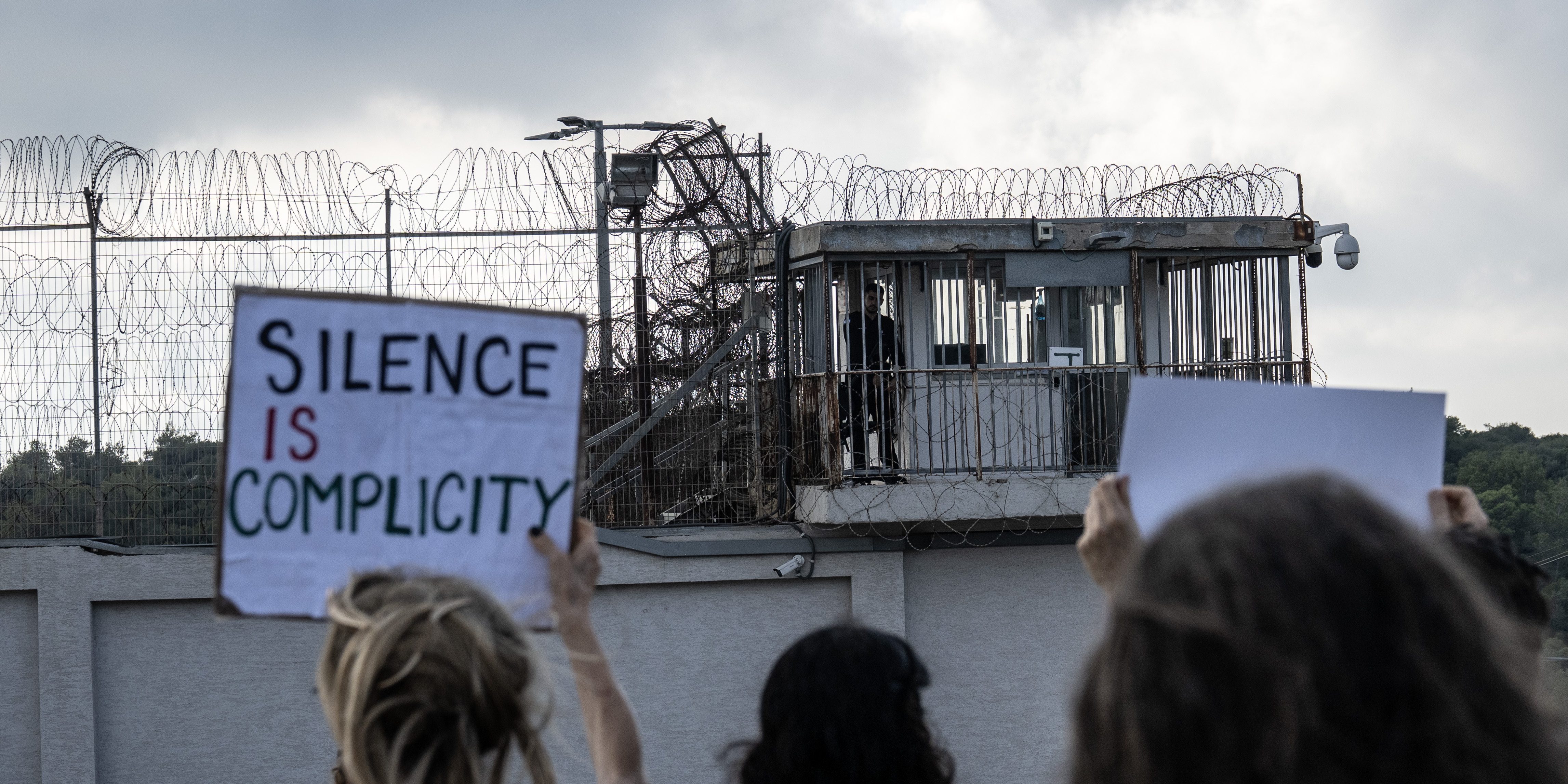
Dana Joudeh was in shackles when she found out she was pregnant.
The 35-year-old from the West Bank city of Nablus was newly married and had just spent her first night in an Israeli prison. Israeli forces had arrested her without charges and put her under administrative detention, an arbitrary condition for holding Palestinians hostage. She lost consciousness in front of Israeli soldiers at Sharon Prison, a temporary detention facility in the city of Netanya, and they took her to a hospital blindfolded. There, with her hands and feet bound in chains, she was given a pregnancy test that came back positive.
Joudeh would never get to experience the joys and travails of pregnancy outside of prison. She was in Israeli custody from the moment she found out, until she gave birth.
Like Joudeh, pregnant Palestinian women arrested by Israeli security forces since October 7, 2023, are forced to endure a physically and medically complex process in conditions characterized by inadequate access to food, family visits, and medicine, as well as frequent reports of violence.
The total number of pregnancies in custody among the hundreds of women seized since October 7 is unknown, but Joudeh is only the second documented example of a woman who gave birth while under Israeli detention in nearly 17 years, according to Palestinian prisoners’ rights advocates. Many cases, advocates say, may have gone unreported.
The Intercept spoke to Joudeh through her sister, Maram, who sat with Joudeh by her side while sharing a detailed account of her sister’s six-month pregnancy, which ended in a premature cesarean section.
Corroborated by statements and reports published by the Palestinian Prisoners’ Society and the Commission of Detainees and Ex-Detainees Affairs, among others, Joudeh’s story offers a glimpse into what it’s like to go through pregnancy while locked in Israel’s prison system, where she struggled to obtain basic prenatal care and relied on other prisoners to share their already limited food.
“She went through every kind of suffering in there,” Maram said.
Israeli forces used sound grenades inside the prison, according to Joudeh’s family and her lawyer, Hassan Abbadi, who provides volunteer legal support for detained Palestinians. They said soldiers would force the women to lie face down on the floor.
“Female prisoners are subjected to all forms of violence and are deprived of the most basic rights,” said Abbadi, who regularly visits Palestinian women in Israeli prisons. He described shortages of underwear, attacks by police dogs, and strip searches, among other forms of mistreatment.

Joudeh’s pregnancy unfolded against a broader surge in Israeli arrests and violence across the occupied Palestinian territories. As of September, Israel was holding roughly 9,350 Palestinian prisoners and detainees, including 90 women and more than 350 children, according to Palestinian prisoners’ organizations. More than 3,100 of them are being held under administrative detention, without charge or trial.
For Joudeh, who was transferred to Damon Prison in Haifa soon after discovering she was pregnant, there was little effort to make accommodations for her pregnancy. According to Maram and Abbadi, the food was scarce and of poor quality, consisting usually of a slice of toast and lentils, chickpeas, or hummus. Sometimes, the prisoners received a few olives, and the other women incarcerated with Joudeh would offer a part of their own meager portions and give it to her.
In a small cell she shared with 13 other women, she discussed baby names with Manar Karaja, another detainee who was pregnant at the same time. According to Amany Sarahneh, the media director of the Palestinian Prisoners’ Society, Karaja was still pregnant and still in Israeli detention as of October 6.
As her pregnancy progressed, Joudeh grew increasingly worried about her baby. She repeatedly asked for medical tests to make sure that both she and the fetus were healthy, Maram said, but her requests were refused.
“I would reassure myself by the baby’s heartbeat, and later, when I started feeling her move,” Maram relayed on behalf of her sister, who sat next to her at Maram’s home in Ramallah. “I needed vitamins and folic acid, but they refused to give them to me.”
In response to outreach from The Intercept, a spokesperson for the Israeli military directed queries to the Israel Prison Service. An Israel Prison Service spokesperson said the agency could not comment on individual detainees’ cases, but described a detailed list of Joudeh’s experiences as “false.”

Palestinian women have faced pregnancy and childbirth inside Israeli prisons for decades, often under harsh conditions and with limited medical care. The first documented Palestinian woman to give birth in Israeli custody was Zakia Shammout, who delivered her daughter Nadia in 1972 at Neve Tirza prison in Ramla, assisted by fellow prisoners. The last documented case before the start of Israel’s ongoing genocide was Fatima al-Zaq, who gave birth to her son Youssef in prison in 2008; the 17-year-old was killed in July 2025 after an Israeli drone hit his family’s apartment on Al-Thawra Street, in central Gaza City.
In September 2025, Tahani Abu Samhan gave birth to her son Yahya while in Israeli custody. Then, a year later, there was Joudeh.

Joudeh suffered from debilitating headaches while pregnant, but basic pain relief was difficult to obtain. Prison authorities refused to give her Acamol, a common brand of acetaminophen, which is generally considered safe for use during pregnancy despite recent guidance to the contrary from health officials in the U.S.
The other women found ways to help. One prisoner would sometimes pretend that she had a headache herself, ask for a painkiller, and secretly give the tablet to Joudeh.
“She was crying most of the time,” Maram said.
By July, Joudeh had contracted scabies, a rash caused by highly contagious mites that results in severe itching and pain. The women were given single container of a topical treatment to share among the entire cell, and it wasn’t enough for everyone who was infected. They resorted to mixing the treatment with chlorine to make it stretch further, Maram said.
Months into the pregnancy, Joudeh began suffering severe pain and bleeding. She was taken to the prison clinic, where she was told that her condition was stable and that there was no need to send her to a hospital. She learned she was carrying a girl.
By then six months pregnant, Joudeh was having her first medical examination since her positive test, Maram said. World Health Organization guidelines recommend that a pregnant person would have had at least three prenatal appointments by that point, though many doctors recommend more frequent visits to monitor the development of the fetus and identify potential complications. Joudeh had received none.
In response to detailed questions from The Intercept, an Israeli Prison Service spokesperson wrote in a statement, “The allegations described are false, entirely without factual basis, and form part of a broader campaign to defame the State of Israel and its lawful institutions.”
“All prisoners and detainees held by the Israel Prison Service are held in accordance with the law and receive the rights and care to which they are entitled,” the spokesperson added, including medical care in accordance with Israeli standards. They wrote that the prison agency would not provide medical information specific to any particular detainee.
Israeli officials have shown an interest in following the most limited interpretation of the law. In an interview last week, national security minister Itamar Ben-Gvir said prisoners “will not receive a single grain more than the legal minimum.” He recalled making a monitoring visit to Ketziot prison because, he claimed, he’d heard prisoners had received two extra olives on their plates.

Outside the prisons, access to prenatal and other medical care has been pulled further out of reach for Palestinians in the occupied West Bank. By the end of 2025, the United Nations had documented 925 Israeli checkpoints, road gates, and other movement obstacles across the territory, restricting the movement of 3.4 million Palestinians and making it harder to reach health services. And in Gaza, where Israel keeps bombing despite the ceasefire announced last October, the health system has been destroyed, with severe shortages of basic necessities and a lack of functioning medical facilities making pregnancy particularly dangerous.
Around 50,000 women are pregnant in Gaza, according to UNFPA. One in 3 pregnancies are considered high-risk. Nearly 4,000 pregnancy losses were reported in the first half of 2026, three times the number recorded in the previous six months.
In the prison, Joudeh’s bleeding would not stop.
It continued for two weeks, Maram said, and Joudeh’s hemoglobin level eventually fell to 9 grams per deciliter, which the WHO classifies as anemic during pregnancy. As her condition deteriorated, she was taken to Rambam Hospital, again blindfolded and with her hands and feet shackled. There, doctors decided that the baby needed to be delivered prematurely.
“The terrorist has arrived,” she remembered the Israeli doctor saying about the fragile newborn.
On September 12, Joudeh gave birth by C-section under local anesthesia, watching the operation as it was happening. Maram said that Joudeh’s hands and feet were shackled while she was cut open, and female Israeli soldiers surrounded her with guns in the operating room, standing guard.
She saw her daughter only briefly in the first 72 hours after giving birth, Maram said, because the baby, born prematurely at around six months, needed to be cared for in a neonatal intensive care unit.
Joudeh’s doctor was Israeli, and she recalled him speaking to her in cruel, degrading terms, according to Maram. “The terrorist has arrived,” she remembered him saying about the fragile newborn. Joudeh named her Lia.
Some of the nurses caring for Joudeh were Palestinian citizens of the 1948 occupied territories, Maram said. They looked for small ways to help her, like secretly bringing the baby to Joudeh’s bedside while she remained handcuffed to the hospital bed. They dressed Lia in a pink onesie. And they asked the Israeli soldiers guarding Joudeh to remove her handcuffs so she could walk around, but the soldiers refused, Maram said.
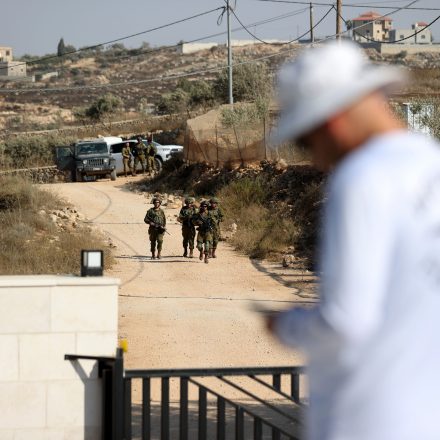
Officials at Rambam Hospital did not respond to The Intercept’s request for comment.
Joudeh and Lia were supposed to be released on September 15, according to Maram, but on September 14, just two days after the birth, Israeli authorities took Joudeh and her newborn daughter from the hospital back to the prison to process Joudeh’s release. An ambulance was waiting outside with Joudeh’s husband, Maram said, and as soon as Joudeh and Lia were released, the baby was taken by ambulance to Hclinic Specialty hospital in Ramallah. Before they left, Lia’s pink onesie was replaced with a gray outfit.
Maram believes her sister was released a day early to prevent the family from preparing a celebration to welcome them home.
When Joudeh’s sisters were finally able to hug her, they were shocked by how frail she seemed. “She was exhausted. She had lost so much weight,” Maram said. “She was physically and psychologically devastated.”
She was still suffering from scabies, but her family embraced her anyway. “I didn’t care about anything except hugging her,” Maram said. “I had missed her so much, and I had been so worried about her.”
Joudeh is now staying with Maram at her home in Ramallah, where she’s recovering from her pregnancy and incarceration. Lia remains in the neonatal unit at Istishari Arab Hospital in Ramallah.
Sometimes, Maram said, Joudeh breaks down when she remembers the trauma of giving birth in detention. But when the mother and baby are both well, Joudeh wants to hold a small celebration, bringing relatives and loved ones together to welcome Lia. She’s already begun thinking about the food and sweets she wants to serve. Despite all she’s been through, Maram said, when the family talks about the celebration, Joudeh smiles.
IT’S EVEN WORSE THAN WE THOUGHT.
What we’re seeing right now from Donald Trump is a full-on authoritarian takeover of the U.S. government.
This is not hyperbole.
Court orders are being ignored. MAGA loyalists have been put in charge of the military and federal law enforcement agencies. The Department of Government Efficiency has stripped Congress of its power of the purse. News outlets that challenge Trump have been banished or put under investigation.
Yet far too many are still covering Trump’s assault on democracy like politics as usual, with flattering headlines describing Trump as “unconventional,” “testing the boundaries,” and “aggressively flexing power.”
The Intercept has long covered authoritarian governments, billionaire oligarchs, and backsliding democracies around the world. We understand the challenge we face in Trump and the vital importance of press freedom in defending democracy.
We’re independent of corporate interests. Will you help us?
IT’S BEEN A DEVASTATING year for journalism — the worst in modern U.S. history.
We have a president with utter contempt for truth aggressively using the government’s full powers to dismantle the free press. Corporate news outlets have cowered, becoming accessories in Trump’s project to create a post-truth America. Right-wing billionaires have pounced, buying up media organizations and rebuilding the information environment to their liking.
In this most perilous moment for democracy, The Intercept is fighting back. But to do so effectively, we need to grow.
That’s where you come in. Will you help us expand our reporting capacity in time to hit the ground running in 2026?
We’re independent of corporate interests. Will you help us?

I’M BEN MUESSIG, The Intercept’s editor-in-chief. It’s been a devastating year for journalism — the worst in modern U.S. history.
We have a president with utter contempt for truth aggressively using the government’s full powers to dismantle the free press. Corporate news outlets have cowered, becoming accessories in Trump’s project to create a post-truth America. Right-wing billionaires have pounced, buying up media organizations and rebuilding the information environment to their liking.
In this most perilous moment for democracy, The Intercept is fighting back. But to do so effectively, we need to grow.
That’s where you come in. Will you help us expand our reporting capacity in time to hit the ground running in 2026?
We’re independent of corporate interests. Will you help us?
Contact the author:
Related

Latest Stories

ICE Shooting in NYC Inflames Mamdani’s Policing Problem
After ICE shot a young father in Manhattan, New Yorkers asked the mayor to protect them from his police department and federal agents alike.

Where Are the Iran War Protests?
Despite a wildly unpopular war with Iran, a mass protest movement for peace hasn’t materialized — at least in the ways we’ve been taught to recognize.

The Intercept Briefing
Prediction Markets Have a Lock on the Midterms
As Kalshi and Polymarket dodge state regulations, prediction markets are upping the ante on next month’s elections.