Documents
DOD IG Report on Predator Program
Aug. 12, 2015

er 10, 2010
can
I VlUl-
Report No. Septem
AI
"h
D.
Inspector General
United States
Department Defense
Implementation of the Predator/Sky Warrior
Acquisition Decision Memorandum
Dated May 19, 2008
retnt 5W a
vg" 4'27: -
. tugecu-W? .
?tu Li -
If,
er 10, 2010
can
I VlUl-
Report No. Septem
AI
"h
D.
Inspector General
United States
Department Defense
Implementation of the Predator/Sky Warrior
Acquisition Decision Memorandum
Dated May 19, 2008
retnt 5W a
vg" 4'27: -
. tugecu-W? .
?tu Li -
If,

Additional Copies
To obtain additional copies of this report contact the Secondary Reports Distribution Unit
at (703) 604-8937 (DSN 664-8937) or fax (703) 604-8932.
Suggestions for Audits
To suggest or request audits, contact the Office of the Deputy Inspector General for
Auditing by phone (703) 604-9142 (DSN 664-9142), by fax (703) 604-8932, or by mail:
ODIG-AUD (ATTN: Audit Suggestions)
Department of Defense Inspector General
400 Army Navy Drive (Room 801)
Arlington, VA 22202-4 704
DEPARTMENT OF DEFENSE
To report fraud, waste, mismanagement, and abuse of authority.
Send written complaints to: Defense Hotline, The Pentagon, Washington, DC 20301-1900
Phone: 800.424.9098 e-mail: hotline@dodig.mil www.dodig.mil/hotline
-r.r
Acronyms and Abbreviations
ACAT
Acquisition Category
ADM
Acquisition Decision Memorandum
CFR
Code of Federal Regulations
EO/IR
Electro-Optical/Infrared
ESG
Executive Steering Group
GAO
Government Accountability Office
ISR
Intelligence, Surveillance, and Reconnaissance
JCIDS
Joint Capabilities Integration and Development System
JROC
Joint Requirements Oversight Council
OIPT
Overarching Integrated Product Team
QDR
Quadrennial Def~nse Review
TEMP
Test and Evaluation Master Plan
UAS
Unmanned Aircraft System
USD(AT&L)
Under Secretary of Defense for Acquisition, Technology,
, and Logistics
..
F81t 8FFI@Ii'm "SSE
a
8N~H
aI
Additional Copies
To obtain additional copies of this report contact the Secondary Reports Distribution Unit
at (703) 604-8937 (DSN 664-8937) or fax (703) 604-8932.
Suggestions for Audits
To suggest or request audits, contact the Office of the Deputy Inspector General for
Auditing by phone (703) 604-9142 (DSN 664-9142), by fax (703) 604-8932, or by mail:
ODIG-AUD (ATTN: Audit Suggestions)
Department of Defense Inspector General
400 Army Navy Drive (Room 801)
Arlington, VA 22202-4 704
DEPARTMENT OF DEFENSE
To report fraud, waste, mismanagement, and abuse of authority.
Send written complaints to: Defense Hotline, The Pentagon, Washington, DC 20301-1900
Phone: 800.424.9098 e-mail: hotline@dodig.mil www.dodig.mil/hotline
-r.r
Acronyms and Abbreviations
ACAT
Acquisition Category
ADM
Acquisition Decision Memorandum
CFR
Code of Federal Regulations
EO/IR
Electro-Optical/Infrared
ESG
Executive Steering Group
GAO
Government Accountability Office
ISR
Intelligence, Surveillance, and Reconnaissance
JCIDS
Joint Capabilities Integration and Development System
JROC
Joint Requirements Oversight Council
OIPT
Overarching Integrated Product Team
QDR
Quadrennial Def~nse Review
TEMP
Test and Evaluation Master Plan
UAS
Unmanned Aircraft System
USD(AT&L)
Under Secretary of Defense for Acquisition, Technology,
, and Logistics
..
F81t 8FFI@Ii'm "SSE
a
8N~H
aI
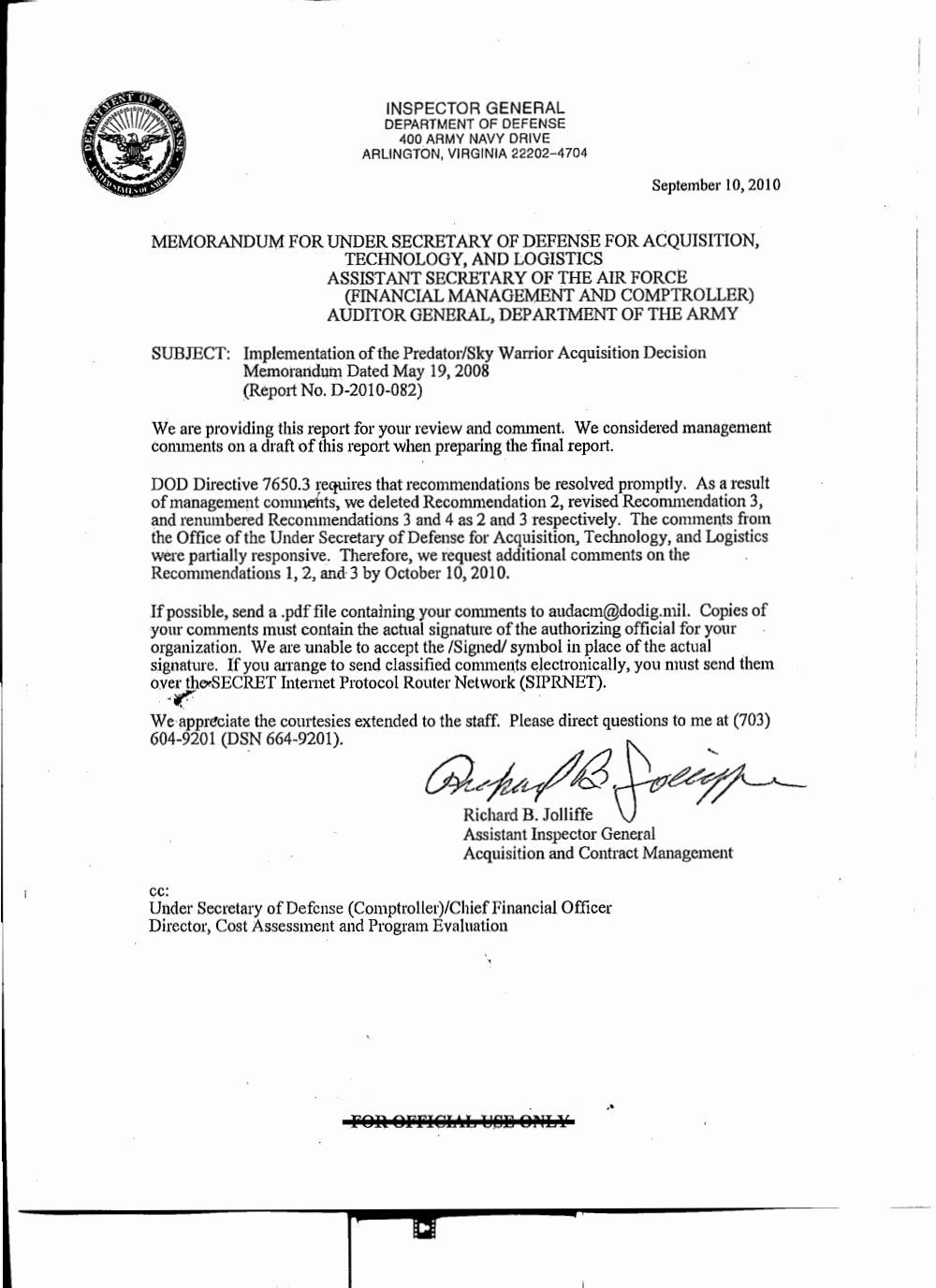
INSPECTOR GENERAL
DEPARTMENT OF DEFENSE
400 ARMY NAVY DRIVE
ARLINGTON, VIRGINIA 22202-4704
September 10, 201 0
MEMORANDUM FOR UNDER SECRETARY OF DEFENSE FOR ACQUISITION,
TECHNOLOGY, AND LOGISTICS
ASSISTANT SECRETARY OF THE AIR FORCE
(FINANCIAL MANAGEMENT AND COMPTROLLER)
AUDITOR GENERAL, DEPARTMENT OF THE ARMY
SUBJECT: Implementation of the Predator/Sky Wan·ior Acquisition Decision
Memotartduin Dated May 19, 2008
(RepmtNo. D-2010-082)
We are providing this report for your review and comment We considered management
comments on a draft of this report when preparing the final repmi.
DOD Directive 7650.3 requires that recommendations be resolved promptly. As a result
of management cmm1wilts, we deleted Recommendation 2, revised Recommendation 3,
and renumbered Recommendations 3 and 4 as 2 and 3 tespectively. The comments from
the Office of the Under Secretary of Defense for Acquisition, Technology, and Logistics
were pa1tially responsive. Therefore, we request additional comments on the
Recommendations 1, 2, and 3 by October 10,2010.
If possible, send a .pdf file containing your comments to audacm@dodig.mil. Copies of
your cmmnents must contain the actual signature of the authorizing official for your
organization. We are unable to accept the /Signed/ symbol in place of the actual
signature. If you arrange to send classified comme1~ts electronically, you must send them
over therSECRET Internet Protocol Router Network (SIPRNET).
~~
.
.
We·appreciate the courtesies extended to the staff. Please direct questions to me at (703)
604-9201 (DS_N 664~9201).
Assistant Inspector General
Acquisition m1d Contract Management
cc:
U11der Secretary of Defense (Comptroller)/ChiefFinancial Officer
Director, Cost Assessment and Program Evaluation
..
F8Il 9FFl@k'M5 t;S~ 81'115Y
p
d
I
I
INSPECTOR GENERAL
DEPARTMENT OF DEFENSE
400 ARMY NAVY DRIVE
ARLINGTON, VIRGINIA 22202-4704
September 10, 201 0
MEMORANDUM FOR UNDER SECRETARY OF DEFENSE FOR ACQUISITION,
TECHNOLOGY, AND LOGISTICS
ASSISTANT SECRETARY OF THE AIR FORCE
(FINANCIAL MANAGEMENT AND COMPTROLLER)
AUDITOR GENERAL, DEPARTMENT OF THE ARMY
SUBJECT: Implementation of the Predator/Sky Wan·ior Acquisition Decision
Memotartduin Dated May 19, 2008
(RepmtNo. D-2010-082)
We are providing this report for your review and comment We considered management
comments on a draft of this report when preparing the final repmi.
DOD Directive 7650.3 requires that recommendations be resolved promptly. As a result
of management cmm1wilts, we deleted Recommendation 2, revised Recommendation 3,
and renumbered Recommendations 3 and 4 as 2 and 3 tespectively. The comments from
the Office of the Under Secretary of Defense for Acquisition, Technology, and Logistics
were pa1tially responsive. Therefore, we request additional comments on the
Recommendations 1, 2, and 3 by October 10,2010.
If possible, send a .pdf file containing your comments to audacm@dodig.mil. Copies of
your cmmnents must contain the actual signature of the authorizing official for your
organization. We are unable to accept the /Signed/ symbol in place of the actual
signature. If you arrange to send classified comme1~ts electronically, you must send them
over therSECRET Internet Protocol Router Network (SIPRNET).
~~
.
.
We·appreciate the courtesies extended to the staff. Please direct questions to me at (703)
604-9201 (DS_N 664~9201).
Assistant Inspector General
Acquisition m1d Contract Management
cc:
U11der Secretary of Defense (Comptroller)/ChiefFinancial Officer
Director, Cost Assessment and Program Evaluation
..
F8Il 9FFl@k'M5 t;S~ 81'115Y
p
d
I
I

September 10, 2010
Report No. D-201 0-082 (Project No. D2009-DOOOCD-0071.000)
Results in Brief: Implementation of the
Predator/Sky Warrior Acquisition Decision
Memorandum Dated May 19, 2008
What We Did
We evaluated whether the Air Force and the
Army complied with the direction in the May 19,
2008, Acquisition Decision Memorandum
(ADM) to combine the Air Force Predator and
Army Sky Warrior programs into a single
acquisition program to achieve common ·
development, procurement, sustainment, and
training activities.
What We Found
The Predator, Sky Warrior, and Reaper are
Predator-class Unmanned Aerial Systems (UAS)
and are manufactured by the same contractor.
Despite using the same primary contractor, the
Air Force and the Army have not complied with
the September 13, 2007, Deputy Secretary of
Defense memorandum or the May 19,2008,
ADM to combine the Predator and Sky Warrior
a"'single acquisition program.
programs
Further, the'Air ~orce and Army had not
implemented adequate management controls to
comply with Public Law 110-417, "Duncan
Hunter National Defense Authorization Act for
Fiscal Year 2009," section 144, October 14,
2008. This occurred because the Air Force was
not committed to a single acquisition program as
demonstrated by actions that were inconsistent
with the May 19,2008, ADM guidance. These
actions included the Air Force zeroing out
procurement funding for the Predator in FY 201 0
and planning to transition to an all Reaper fleet.
In addition, the Under Secretary of Defense for
Acquisition, Technology, and Logistics
(USD[AT&L]) did not create a single acquisition
program office responsible for a combined
Predator/Sky Warrior program. The Air Force
and the Army will not achieve a potential savings
of $400 million that the USD(AT&L) estimated
would result from combining the Predator and
jr.-
,
the Sky Warrior programs. Additionally, the Air
Force plan to buy five Air Force unique MQ-1C
aircraft, valued at $60 million was canceled.
What We Recommend
We recommend that the USD(AT&L) do the
following.
• Determine whether the combination program
is still valid; if so, establish a single
acquisition category program designation
with joint requirements and, develop an
analysis of alternatives and acquisition
strategy, and 'determine the optimum mix of
aircraft to procure.
• Require the Air Force and Army to provide
cost, schedule, and performance milestones
for the development of the ground system
architecture and conduct quarterly reviews.
Management Comments and
Our Response
The Director, Portfolio Systems Acquisition,
responded for the USD(AT&L). As a result of
his comments, we deleted draft Recommendation 2. We renumbered Recommendations 3 and 4 as 2 and 3. The Director's
comments on Recommendations 1 and 2 were
partially responsive. He proposed an alternative
action for Recommendation 3 that met the intent
of the recommendation. We request that the
Director provide additional comments by
October 10, 2010, on Recommendations 1, 2,
and 3. The comments on Recommendation 1
,should address the Reaper as a potential
klternative for combining the programs, and the
comments on Recommendation 2 should address
the revised recommendation. The comments on
Recommendation 3 should provide a date when ·
the alternative action will be completed.
Please see the recommendations table on the
back of this page .
..
(I
September 10, 2010
Report No. D-201 0-082 (Project No. D2009-DOOOCD-0071.000)
Results in Brief: Implementation of the
Predator/Sky Warrior Acquisition Decision
Memorandum Dated May 19, 2008
What We Did
We evaluated whether the Air Force and the
Army complied with the direction in the May 19,
2008, Acquisition Decision Memorandum
(ADM) to combine the Air Force Predator and
Army Sky Warrior programs into a single
acquisition program to achieve common ·
development, procurement, sustainment, and
training activities.
What We Found
The Predator, Sky Warrior, and Reaper are
Predator-class Unmanned Aerial Systems (UAS)
and are manufactured by the same contractor.
Despite using the same primary contractor, the
Air Force and the Army have not complied with
the September 13, 2007, Deputy Secretary of
Defense memorandum or the May 19,2008,
ADM to combine the Predator and Sky Warrior
a"'single acquisition program.
programs
Further, the'Air ~orce and Army had not
implemented adequate management controls to
comply with Public Law 110-417, "Duncan
Hunter National Defense Authorization Act for
Fiscal Year 2009," section 144, October 14,
2008. This occurred because the Air Force was
not committed to a single acquisition program as
demonstrated by actions that were inconsistent
with the May 19,2008, ADM guidance. These
actions included the Air Force zeroing out
procurement funding for the Predator in FY 201 0
and planning to transition to an all Reaper fleet.
In addition, the Under Secretary of Defense for
Acquisition, Technology, and Logistics
(USD[AT&L]) did not create a single acquisition
program office responsible for a combined
Predator/Sky Warrior program. The Air Force
and the Army will not achieve a potential savings
of $400 million that the USD(AT&L) estimated
would result from combining the Predator and
jr.-
,
the Sky Warrior programs. Additionally, the Air
Force plan to buy five Air Force unique MQ-1C
aircraft, valued at $60 million was canceled.
What We Recommend
We recommend that the USD(AT&L) do the
following.
• Determine whether the combination program
is still valid; if so, establish a single
acquisition category program designation
with joint requirements and, develop an
analysis of alternatives and acquisition
strategy, and 'determine the optimum mix of
aircraft to procure.
• Require the Air Force and Army to provide
cost, schedule, and performance milestones
for the development of the ground system
architecture and conduct quarterly reviews.
Management Comments and
Our Response
The Director, Portfolio Systems Acquisition,
responded for the USD(AT&L). As a result of
his comments, we deleted draft Recommendation 2. We renumbered Recommendations 3 and 4 as 2 and 3. The Director's
comments on Recommendations 1 and 2 were
partially responsive. He proposed an alternative
action for Recommendation 3 that met the intent
of the recommendation. We request that the
Director provide additional comments by
October 10, 2010, on Recommendations 1, 2,
and 3. The comments on Recommendation 1
,should address the Reaper as a potential
klternative for combining the programs, and the
comments on Recommendation 2 should address
the revised recommendation. The comments on
Recommendation 3 should provide a date when ·
the alternative action will be completed.
Please see the recommendations table on the
back of this page .
..
(I

September 10,2010
Report No. D-2010-082 (Project No. D2009-DOOOCD-0071.000)
Recommendations Table
Management
Recommendations
Requiring Comment
Under Secretary for Defense for -~1, 2, and 3
Acquisition, Technology, and
Logistics
No Additional Comments
Required
I
-----------------~--------------------~
Please provide comments by October 10,2010.
j
(
l*91l 9l*l*l~lhls lsf(!JiJ 9l'Tls¥
11
·•
September 10,2010
Report No. D-2010-082 (Project No. D2009-DOOOCD-0071.000)
Recommendations Table
Management
Recommendations
Requiring Comment
Under Secretary for Defense for -~1, 2, and 3
Acquisition, Technology, and
Logistics
No Additional Comments
Required
I
-----------------~--------------------~
Please provide comments by October 10,2010.
j
(
l*91l 9l*l*l~lhls lsf(!JiJ 9l'Tls¥
11
·•

Table of Contents
1
Introduction
1
1
Objectives
Background
Review of Internal Controls
3
5
Finding. Predator/Sky Warrior Combination
Recommendations, Management Comments, and Our Response
Appendices
.
A. Scope andJV[ethodology
Prior Coverage
B. Laws and DOD Guidance
C. September 13, 2.007, Deputy Secretary ofDefense Memorandum
D. May 19, 2008, Acquisition Decision Memorandum
E. Status of Air Force and Army Compliance With
the Acquisition Decision Memorandum
F. Oversight Structure for Combining Predator and Sky Warrior Programs
~rg~ment
15
18
19
20
.24
25
27
29
Comments
dffice ofthe Under Secretary of Defense for
Acquisition, Technology, and Logistics
32
..
F81t 8FFIElllJ.ifs "SS@
8N~H
-------
----
Table of Contents
1
Introduction
1
1
Objectives
Background
Review of Internal Controls
3
5
Finding. Predator/Sky Warrior Combination
Recommendations, Management Comments, and Our Response
Appendices
.
A. Scope andJV[ethodology
Prior Coverage
B. Laws and DOD Guidance
C. September 13, 2.007, Deputy Secretary ofDefense Memorandum
D. May 19, 2008, Acquisition Decision Memorandum
E. Status of Air Force and Army Compliance With
the Acquisition Decision Memorandum
F. Oversight Structure for Combining Predator and Sky Warrior Programs
~rg~ment
15
18
19
20
.24
25
27
29
Comments
dffice ofthe Under Secretary of Defense for
Acquisition, Technology, and Logistics
32
..
F81t 8FFIElllJ.ifs "SS@
8N~H
-------
----

Introduction
Objectives
The overall audit objective was to determine the implementation status of the May 19,
2008, Acquisition Decision Memorandum (ADM). The specific objectives were to
evaluate whether the Air Force and the Army complied with the May 19,2008, ADM and
whether they considered alternatives such as the Reaper program.
We performed this audit pursuant to Public Law 110-181, "The National Defense
Authorization Act for Fiscal Year 2008," section 842, "Investigation of Waste, Fraud,
and Abuse in Wartime Contracts and Contracting Processes in Iraq and Afghanistan,"
January 28, 2008. Section 842 requires "thorough audits ... to identify potential waste,
fraud, and abuse in the performance of (1) Department of Defense contracts,
subcontracts, and task and delivery orders for the logistical support of coalition forces in
Iraq and Afghanistan; and (2) Federal agency contracts, subcontracts, and task and
delivery orders for the pc;rformance of security and reconstruction functions in Iraq arid
Afghanistan." This audit supports DOD's efforts in Southwest Asia, where unmanned
aircraft systems (UASs) are used for intelligence, surveillance, and reconnaissance (I~R)
missions. See Appendix A for a discussion of scope and methodology, and prior audit
coverage.
Background
The history of the May 19, 2008, ADM dates back to the 2005 deliberations on the
Quad_rennial Defense Review. During the 2005 Quadrennial Defense Review, the Joint
Capabilit.¥ Enabler integrated Product Team recommended combining acquisition
progWl'fus of similar capability. The Air Force Predator and the Army Sky Warrior
programs were identified as potential candidates. The Quadrennial Defense Review
report, published February 2006, stated that to build on progress to date, Military Servicefocused efforts.should shift toward a more Department-wide net-centric approach. The
Quadrennial Defense Review report projected that 45 percent of the future long-range
strike force would be unmanned. Consequently, combining the Predator and Sky Warrior
programs is critical because it establishes the framework for UAS commonality and
standardization.
The initiative to develop a common UAS has been supported in various laws and
memoranda from the Office of the Secretary of Defense, the Air Force, and the Army.
Appendix B identifies the laws that have been issued concerning UAS consolidations and
lists DOD guidance supp01iing the need for comJ:>ining and standardizing the systems.
1?8M
8J?J?H~IA45
1
l9"Siil 8NI!li
..
Introduction
Objectives
The overall audit objective was to determine the implementation status of the May 19,
2008, Acquisition Decision Memorandum (ADM). The specific objectives were to
evaluate whether the Air Force and the Army complied with the May 19,2008, ADM and
whether they considered alternatives such as the Reaper program.
We performed this audit pursuant to Public Law 110-181, "The National Defense
Authorization Act for Fiscal Year 2008," section 842, "Investigation of Waste, Fraud,
and Abuse in Wartime Contracts and Contracting Processes in Iraq and Afghanistan,"
January 28, 2008. Section 842 requires "thorough audits ... to identify potential waste,
fraud, and abuse in the performance of (1) Department of Defense contracts,
subcontracts, and task and delivery orders for the logistical support of coalition forces in
Iraq and Afghanistan; and (2) Federal agency contracts, subcontracts, and task and
delivery orders for the pc;rformance of security and reconstruction functions in Iraq arid
Afghanistan." This audit supports DOD's efforts in Southwest Asia, where unmanned
aircraft systems (UASs) are used for intelligence, surveillance, and reconnaissance (I~R)
missions. See Appendix A for a discussion of scope and methodology, and prior audit
coverage.
Background
The history of the May 19, 2008, ADM dates back to the 2005 deliberations on the
Quad_rennial Defense Review. During the 2005 Quadrennial Defense Review, the Joint
Capabilit.¥ Enabler integrated Product Team recommended combining acquisition
progWl'fus of similar capability. The Air Force Predator and the Army Sky Warrior
programs were identified as potential candidates. The Quadrennial Defense Review
report, published February 2006, stated that to build on progress to date, Military Servicefocused efforts.should shift toward a more Department-wide net-centric approach. The
Quadrennial Defense Review report projected that 45 percent of the future long-range
strike force would be unmanned. Consequently, combining the Predator and Sky Warrior
programs is critical because it establishes the framework for UAS commonality and
standardization.
The initiative to develop a common UAS has been supported in various laws and
memoranda from the Office of the Secretary of Defense, the Air Force, and the Army.
Appendix B identifies the laws that have been issued concerning UAS consolidations and
lists DOD guidance supp01iing the need for comJ:>ining and standardizing the systems.
1?8M
8J?J?H~IA45
1
l9"Siil 8NI!li
..

Predator-Class Unmanned Aircraft Systems
The Predator, Sky Warrior, and Reaper are Predator-class UASs and are manufactured
by General Atomics Aeronautical Systems Inc. (General Atomics). A UAS includes
aircraft, a ground control station, and a communication suite. All three aircraft are used
for ISR and in varying capacities perform a hunter-killer role. Table 1 identifies the
various characteristics of the aircraft, along with their costs.
Table 1. Aircraft Characteristics
,---·fie;-----,
f
Categorization
~
/ Sky Warri~r (MQ-lC)
Predator (MQ-lB)
I
Medium-altitude, longendurance VAS
1
airborne surveillance, and
target acquisition
j
I
Endurance
I
Unit Cost
Reaper (MQ-9)
I
- - - - - - - - -Long-dwell,
---------Armed reconnaissance,
wide-area
Primary Function
Maximum
Altitude
Speed
Medium-altitude,
extended-range VAS
I
I
j
25,000 ft
· ·135 mph
I
24 hours
I
[--sYstem Cost ~---~
rI
I
r
·-
Persistent hunter-killer
weapon system and ISR
25,000 ft
172 mph
50,000 ft
276_m_p_h_ __
30 hours
24 hours
$3.5 million
I
$6.3 million
$10.4 million
$20.8 million
r---$40.0 million
$48.4 million
ry--r·-.288 Current (288=Program
Total Projection)
fti~~~~~~~on~l ~--------~arch 2005
r-~~~~;~~~~~~9;----~-------
reconnaissance,
surveillance, target
acquisition,
communications relay,
and attack missions
1
Medi~~-to-high altitude,
long-endurance VAS
$3,420 million
21 Current
(163=Program Total
Projection)
-~---
April 2008
~7 Current (319=Program
Total Projection)
~-
--T-------;7-;~ million----~---
October 200; -----$1,688 million
I~~:~;'_T_ -~.,~:million ----~s~::6 milli=--~-:o,2s4~~uon
_____
---Soirrce: filforniailonfoi--ilieiiilile'was ·aofaiiied.rrolnvanous oun sciiii'i:esillcllidiiiglnetTriiJiaiiiieOSY.tems Roaaiii'ap,·A:irForceTacEfiee!S;allil-6nefing ·-----··· ---charts and other documents provided by Air Force and Anny program office officials.
September 13s 2007s Deputy Secretary of Defense Memorandum
and May 19s 200Bs Acquisition Decision
Memorandum
,
The September 13, 2007, Deputy Secretary of Defense memorandum requires the
Predator and Sky Warrior programs to be combined into a single acquisition program,
with a common data link, to achieve common development, procurement, sustainment,
and training activities. The Department was to migrate to a single contract by October
2008. The Under Secretary of Defense for Acquisition, Technology, and Logistics
(USD[AT&L]) issued the May 19, 2008, ADM.because the Air Force and the Army
F8ft 8F'Ff@twh tfSIS
2
8N~Y
..
Predator-Class Unmanned Aircraft Systems
The Predator, Sky Warrior, and Reaper are Predator-class UASs and are manufactured
by General Atomics Aeronautical Systems Inc. (General Atomics). A UAS includes
aircraft, a ground control station, and a communication suite. All three aircraft are used
for ISR and in varying capacities perform a hunter-killer role. Table 1 identifies the
various characteristics of the aircraft, along with their costs.
Table 1. Aircraft Characteristics
,---·fie;-----,
f
Categorization
~
/ Sky Warri~r (MQ-lC)
Predator (MQ-lB)
I
Medium-altitude, longendurance VAS
1
airborne surveillance, and
target acquisition
j
I
Endurance
I
Unit Cost
Reaper (MQ-9)
I
- - - - - - - - -Long-dwell,
---------Armed reconnaissance,
wide-area
Primary Function
Maximum
Altitude
Speed
Medium-altitude,
extended-range VAS
I
I
j
25,000 ft
· ·135 mph
I
24 hours
I
[--sYstem Cost ~---~
rI
I
r
·-
Persistent hunter-killer
weapon system and ISR
25,000 ft
172 mph
50,000 ft
276_m_p_h_ __
30 hours
24 hours
$3.5 million
I
$6.3 million
$10.4 million
$20.8 million
r---$40.0 million
$48.4 million
ry--r·-.288 Current (288=Program
Total Projection)
fti~~~~~~~on~l ~--------~arch 2005
r-~~~~;~~~~~~9;----~-------
reconnaissance,
surveillance, target
acquisition,
communications relay,
and attack missions
1
Medi~~-to-high altitude,
long-endurance VAS
$3,420 million
21 Current
(163=Program Total
Projection)
-~---
April 2008
~7 Current (319=Program
Total Projection)
~-
--T-------;7-;~ million----~---
October 200; -----$1,688 million
I~~:~;'_T_ -~.,~:million ----~s~::6 milli=--~-:o,2s4~~uon
_____
---Soirrce: filforniailonfoi--ilieiiilile'was ·aofaiiied.rrolnvanous oun sciiii'i:esillcllidiiiglnetTriiJiaiiiieOSY.tems Roaaiii'ap,·A:irForceTacEfiee!S;allil-6nefing ·-----··· ---charts and other documents provided by Air Force and Anny program office officials.
September 13s 2007s Deputy Secretary of Defense Memorandum
and May 19s 200Bs Acquisition Decision
Memorandum
,
The September 13, 2007, Deputy Secretary of Defense memorandum requires the
Predator and Sky Warrior programs to be combined into a single acquisition program,
with a common data link, to achieve common development, procurement, sustainment,
and training activities. The Department was to migrate to a single contract by October
2008. The Under Secretary of Defense for Acquisition, Technology, and Logistics
(USD[AT&L]) issued the May 19, 2008, ADM.because the Air Force and the Army
F8ft 8F'Ff@twh tfSIS
2
8N~Y
..

compliance with the Deputy Secretary of Defense's direction had not been fast enough,
and significant work remained to accomplish this direction. See Appendices C and D for
copies of these memoranda.
·
The May 19, 2008, ADM emphasizes the need for the Air Force and the Army to increase
interoperability and commonality through the delivery of a common MQ-1 C. The ADM
requires the Air Force and the Army to resolve hardware differences with a joint plan and
includes language for a common MQ-1 C .to support operations in Southwest Asia. The
ADM requires the Air Force and the Army to procure the maximum number of common
MQ-1 Cs from a single contract with FY 2009 funding, taking into account risk factors,
production ramp-up timelines, and force structure mix.
The May 19, 2008, ADM designates the Predator and Sky Warrior programs as
Acquisition Category ID programs and directs the Air Force and the Army to continue to
explore options and schedules for combining the two programs into a single Acquisition
Category (ACAT) ID program. Programs designated as Acquisition Category ID
undergo additional review and consideration by the Office of the Secretary of Defense,
specifically the USD(.tYT&L) and the Defense Advisory Board. The USD(AT&L) is
responsible for making critical acquisition decisions, and documents these decisions in an
ADM.
Quadrennial Defense Review
The Quadrennial Defense Review Report (QDR) that DOD issued in February 2010
noted that long-dwell UASs, such as the Predator, Reaper, and other systems, have
proven to be invaluable for monitoring activities in contested areas, enhancing situational
awareness, protect~ng our forces, and assisting in targeting enemy fighters. According to
the rtport DOD made a commitment to grow the capacity of Predator/Reaper. The report
alS'<f'Stated that in FY 2011 the Air Force will be on track to obtain 50 orbits with the
Predator/Reaper and the capacity will continue to expand to 65 orbits by FY 2015. The
Army is expa11ding all classes ofUASs, including the accelerated production of the
Predator-class Sky Warrior UAS.
Review of Internal Controls
We determined that control weaknesses as defined by DOD Instruction 5010.40,
"Managers' Internal Control (MIC) Program Procedures," January 4, 2006, existed in the
processes to implement the Predator and Sky Warrior combination. The Office of the
USD(AT&L), the Air Force, and the Army did not have adequate controls for
implementing the direction in the September 13, 2007, Deputy Secretary of Defense
memorandum or the May 19, 2008, ADM. Public Law 111-23, "Weapons Systems
Acquisition Reform Act of2009," section 139c,,May 22, 2009, contains requirements for
assessment of alternative plans, programs, and policies with respect to the acquisition
programs ofthe Department of Defense. Further, Public Law 110-417, "Duncan Hunter
National Defense Authorization Act for Fiscal Year 2009," section 144, October 14,
2008, contain requirements affecting UASs. Specifically, the management controls were
not adequate for ensuring that the programs were combined in a timely and cost-effective
manner and that plans, goals, and milestones were established for the development and
P81t 8PPI@ftl.lls ~SI!l 8"Pfl5¥
3
¢
a
II
..
compliance with the Deputy Secretary of Defense's direction had not been fast enough,
and significant work remained to accomplish this direction. See Appendices C and D for
copies of these memoranda.
·
The May 19, 2008, ADM emphasizes the need for the Air Force and the Army to increase
interoperability and commonality through the delivery of a common MQ-1 C. The ADM
requires the Air Force and the Army to resolve hardware differences with a joint plan and
includes language for a common MQ-1 C .to support operations in Southwest Asia. The
ADM requires the Air Force and the Army to procure the maximum number of common
MQ-1 Cs from a single contract with FY 2009 funding, taking into account risk factors,
production ramp-up timelines, and force structure mix.
The May 19, 2008, ADM designates the Predator and Sky Warrior programs as
Acquisition Category ID programs and directs the Air Force and the Army to continue to
explore options and schedules for combining the two programs into a single Acquisition
Category (ACAT) ID program. Programs designated as Acquisition Category ID
undergo additional review and consideration by the Office of the Secretary of Defense,
specifically the USD(.tYT&L) and the Defense Advisory Board. The USD(AT&L) is
responsible for making critical acquisition decisions, and documents these decisions in an
ADM.
Quadrennial Defense Review
The Quadrennial Defense Review Report (QDR) that DOD issued in February 2010
noted that long-dwell UASs, such as the Predator, Reaper, and other systems, have
proven to be invaluable for monitoring activities in contested areas, enhancing situational
awareness, protect~ng our forces, and assisting in targeting enemy fighters. According to
the rtport DOD made a commitment to grow the capacity of Predator/Reaper. The report
alS'<f'Stated that in FY 2011 the Air Force will be on track to obtain 50 orbits with the
Predator/Reaper and the capacity will continue to expand to 65 orbits by FY 2015. The
Army is expa11ding all classes ofUASs, including the accelerated production of the
Predator-class Sky Warrior UAS.
Review of Internal Controls
We determined that control weaknesses as defined by DOD Instruction 5010.40,
"Managers' Internal Control (MIC) Program Procedures," January 4, 2006, existed in the
processes to implement the Predator and Sky Warrior combination. The Office of the
USD(AT&L), the Air Force, and the Army did not have adequate controls for
implementing the direction in the September 13, 2007, Deputy Secretary of Defense
memorandum or the May 19, 2008, ADM. Public Law 111-23, "Weapons Systems
Acquisition Reform Act of2009," section 139c,,May 22, 2009, contains requirements for
assessment of alternative plans, programs, and policies with respect to the acquisition
programs ofthe Department of Defense. Further, Public Law 110-417, "Duncan Hunter
National Defense Authorization Act for Fiscal Year 2009," section 144, October 14,
2008, contain requirements affecting UASs. Specifically, the management controls were
not adequate for ensuring that the programs were combined in a timely and cost-effective
manner and that plans, goals, and milestones were established for the development and
P81t 8PPI@ftl.lls ~SI!l 8"Pfl5¥
3
¢
a
II
..

delivery of a common MQ-1 C ·aircraft. However, USD(AT&L) issued a revised ADM
on June 18, 2010, that states that the Air Force is no longer required to procure MQ-1 C
airc.caft from a common contract with the Army as directed in the May 19, 2008, ADM.
Implementing Recommendation 2 will improve management controls for the
development of the ground control station. We will provide a copy of the report to the
Office of the USD(AT&L) responsible for internal controls.
..
f?81t 8F'Jiitt?follrfs f:JS~ 8ffts"f
4
r
.
r
delivery of a common MQ-1 C ·aircraft. However, USD(AT&L) issued a revised ADM
on June 18, 2010, that states that the Air Force is no longer required to procure MQ-1 C
airc.caft from a common contract with the Army as directed in the May 19, 2008, ADM.
Implementing Recommendation 2 will improve management controls for the
development of the ground control station. We will provide a copy of the report to the
Office of the USD(AT&L) responsible for internal controls.
..
f?81t 8F'Jiitt?follrfs f:JS~ 8ffts"f
4
r
.
r

Finding. Predator/Sky Warrior Combination
The Air Force and the Army did not initiate or complete various requirements of the
acquisition process that were needed to combine the Predator/Sky Warrior program into
a single acquisition program. Specific acquisition requirements not initiated or
completed included the acquisition strategy, test and evaluation master plan, analysis of
alternatives, or the Joint Capabilities Integration and Development System (JCIDS)
process. By not initiating the required acquisition activities the Air Force and the Army
have not complied with the September 13, 2007, Deputy Secretary ofDefense
memorandum or the May 19, 2008, ADM to combine the Predator and Sky Warrior
programs into a single acquisition program. In addition, the Air Force and Army had not
implemented adequate management controls to comply with Public Law 110-417,
"Duncan Hunter National Defense Authorization Act for Fiscal Year 2009," section 144,
October 14, 2008. This occurred because:
•
•
The Air Force was not committed to a single acquisition program as
demonstrated tyy actions that were inconsistent with the May 19, 2008, ADM
guidance. TI:Iese actions included the Air Force zeroing out procurement funding
for the Predator in FY 2010 and planning to transition to an all Reaper fleet.
USD(AT&L) did not create a single acquisition program office responsible for a
combined Predator. and Sky Warrior program.
The Air Force and the Army did not make effective use of an estimated $115 million
spent on pursuing the combination from FY 2008 through FY 2009. The Air Force and
the Army will not maximize the return to the warfighter.or on funds designated or spent
in the future. In addition, the $400 million that the USD(AT&L) estimated would be
s~f;om combining the programs will not be realized if the combination does not
occur. •
Acquisition Decision Memorandum Guidance
In January 2006 the Air Force and the Army Chiefs of Staff agreed to converge programs
with complementary capabilities including the Predator and Sky Warrior programs.
Further, in February 2008 the Air Force and Army Program Management Offices signed
an agreement to leverage commonality in the development and acquisition of a common
MQ-1 C. See Appendix B for a list of Laws and DOD Guidance. Consistent with the two
agreements the Deputy Secretary of Defense directed the Air Force and Army to combine
the Predator/Sky Warrior programs into a single program. On September 13, 2007, the
Deputy Secretary of Defense issued a memorandum that required the Predator and Sky
Warrior programs to be combined into a single acquisition program. The May 19, 2008,
ADM reemphasized the direction in the Septenlber 13, 2007, Deputy Secretary of
Defense memorandum for the Air Force and the Aimy to combine the Predator and Sky
Warrior programs into a single acquisition program to achieve common development,
procurement, sustainment, and training activities. The May 19, 2008, ADM required the
Air Force and the Army to de~elop an acquisition strategy, transition to a common
P81t 8PPI81±tm "SSE
5
a
8l'l~ll
( I
..
Finding. Predator/Sky Warrior Combination
The Air Force and the Army did not initiate or complete various requirements of the
acquisition process that were needed to combine the Predator/Sky Warrior program into
a single acquisition program. Specific acquisition requirements not initiated or
completed included the acquisition strategy, test and evaluation master plan, analysis of
alternatives, or the Joint Capabilities Integration and Development System (JCIDS)
process. By not initiating the required acquisition activities the Air Force and the Army
have not complied with the September 13, 2007, Deputy Secretary ofDefense
memorandum or the May 19, 2008, ADM to combine the Predator and Sky Warrior
programs into a single acquisition program. In addition, the Air Force and Army had not
implemented adequate management controls to comply with Public Law 110-417,
"Duncan Hunter National Defense Authorization Act for Fiscal Year 2009," section 144,
October 14, 2008. This occurred because:
•
•
The Air Force was not committed to a single acquisition program as
demonstrated tyy actions that were inconsistent with the May 19, 2008, ADM
guidance. TI:Iese actions included the Air Force zeroing out procurement funding
for the Predator in FY 2010 and planning to transition to an all Reaper fleet.
USD(AT&L) did not create a single acquisition program office responsible for a
combined Predator. and Sky Warrior program.
The Air Force and the Army did not make effective use of an estimated $115 million
spent on pursuing the combination from FY 2008 through FY 2009. The Air Force and
the Army will not maximize the return to the warfighter.or on funds designated or spent
in the future. In addition, the $400 million that the USD(AT&L) estimated would be
s~f;om combining the programs will not be realized if the combination does not
occur. •
Acquisition Decision Memorandum Guidance
In January 2006 the Air Force and the Army Chiefs of Staff agreed to converge programs
with complementary capabilities including the Predator and Sky Warrior programs.
Further, in February 2008 the Air Force and Army Program Management Offices signed
an agreement to leverage commonality in the development and acquisition of a common
MQ-1 C. See Appendix B for a list of Laws and DOD Guidance. Consistent with the two
agreements the Deputy Secretary of Defense directed the Air Force and Army to combine
the Predator/Sky Warrior programs into a single program. On September 13, 2007, the
Deputy Secretary of Defense issued a memorandum that required the Predator and Sky
Warrior programs to be combined into a single acquisition program. The May 19, 2008,
ADM reemphasized the direction in the Septenlber 13, 2007, Deputy Secretary of
Defense memorandum for the Air Force and the Aimy to combine the Predator and Sky
Warrior programs into a single acquisition program to achieve common development,
procurement, sustainment, and training activities. The May 19, 2008, ADM required the
Air Force and the Army to de~elop an acquisition strategy, transition to a common
P81t 8PPI81±tm "SSE
5
a
8l'l~ll
( I
..

MQ-1C airframe and contract, develop a common test and evaluation master plan,
develop common hardware components, and procure the optimum mix of aircraft.
Compliance with the Acquisition Decision
Memorandums
We determined compliance with the May 19,2008, ADM's directions and whether the
Air Force and the Army efforts resulted in streamlining acquisition between the two
programs. See Appendix E for a listing of the May 19, 2008, ADM's action items, audit
determinations regarding compliance, the status of the action items as reported by the Air
Force and the Army, and comments from the Air Force and the Army. See Appendix F
for an understanding of the oversight structure for combining the Predator and Sky
Warrior programs.
The Air Force and the Army officials briefed.staffin several offices within the Office of
the USD(AT&L) on the status of their combination activities. Air Force and Army
officials indicated that there were opportunities for the Office ofUSD(AT&L) to raise
concerns on the comm~nality issues during these briefings. The Air Force and the Army
briefed the Overarching Integrated Product Team (OIPT) and addressed whether the
May 19, 2008, ADM action items were open, requested to close, or closed. Additionally,
the Air Force and the Army requested approval from the OIPT for closing the action
items. Our review disclosed that the OIPT forwarded memoranda to the USD(AT&L)
with recommendations on the action item because the OIPT lacked the authority to make
the final decisions regarding the combination of the Predator/Sky Warrior programs.
According
to the Assistant to the Deputy Director for . Unmanned Warfare (in the Office
ofthe qsD[AT&L]), the OIPT did not have decision making autl)ority over the Air Force
a~e Army. This was consistent with Title 32, Code of Federal Regulations,
section 382.5 (32 CFR sec. 382.5 [2002]), which states the USD(AT&L)'s decisions shall
be reflected in an ADM issued by the USD(AT&L) for implementation by the Heads of
DOD Components. The authority of the USD(A T&L) under this paragraph may not be
delegated by the USD(A T &L). Although the OIPT reviewed and made recommendation
on the action items, the Air Force and Army should have continued to pursue the
common program as directed in the May 19,2008, ADM.
Little progress was made in establishing a single program. Specifically, the Air Force
and Army did not initiate or complete various requirements of the acquisition process
needed to establish a common program including an acquisition strategy, test and
evaluation master plan, alternatives of analysis, or the JCIDS process. In Congressional
testimony on March 23,2010, the Government Accountability Office (GAO) noted that
the Air Force and Army had not effectively collaborated on their Sky Warrior and
Predator programs, and greater commonality could have been achieved given that the Sky
WarTier is a variant of the Predator and is being developed by the same contractor. The
GAO also noted that the individual services continued to drive requirements and make
independent resource allocatim1 decisions. The GAO stated that in many cases, the
services had established requirements so specific that they demanded service-unique
solutions, thereby precluding opportunities for commonality.
fi(i.i)tl 8l*l*l@ltlft3 "8819 8l'ff5¥
6
..
MQ-1C airframe and contract, develop a common test and evaluation master plan,
develop common hardware components, and procure the optimum mix of aircraft.
Compliance with the Acquisition Decision
Memorandums
We determined compliance with the May 19,2008, ADM's directions and whether the
Air Force and the Army efforts resulted in streamlining acquisition between the two
programs. See Appendix E for a listing of the May 19, 2008, ADM's action items, audit
determinations regarding compliance, the status of the action items as reported by the Air
Force and the Army, and comments from the Air Force and the Army. See Appendix F
for an understanding of the oversight structure for combining the Predator and Sky
Warrior programs.
The Air Force and the Army officials briefed.staffin several offices within the Office of
the USD(AT&L) on the status of their combination activities. Air Force and Army
officials indicated that there were opportunities for the Office ofUSD(AT&L) to raise
concerns on the comm~nality issues during these briefings. The Air Force and the Army
briefed the Overarching Integrated Product Team (OIPT) and addressed whether the
May 19, 2008, ADM action items were open, requested to close, or closed. Additionally,
the Air Force and the Army requested approval from the OIPT for closing the action
items. Our review disclosed that the OIPT forwarded memoranda to the USD(AT&L)
with recommendations on the action item because the OIPT lacked the authority to make
the final decisions regarding the combination of the Predator/Sky Warrior programs.
According
to the Assistant to the Deputy Director for . Unmanned Warfare (in the Office
ofthe qsD[AT&L]), the OIPT did not have decision making autl)ority over the Air Force
a~e Army. This was consistent with Title 32, Code of Federal Regulations,
section 382.5 (32 CFR sec. 382.5 [2002]), which states the USD(AT&L)'s decisions shall
be reflected in an ADM issued by the USD(AT&L) for implementation by the Heads of
DOD Components. The authority of the USD(A T&L) under this paragraph may not be
delegated by the USD(A T &L). Although the OIPT reviewed and made recommendation
on the action items, the Air Force and Army should have continued to pursue the
common program as directed in the May 19,2008, ADM.
Little progress was made in establishing a single program. Specifically, the Air Force
and Army did not initiate or complete various requirements of the acquisition process
needed to establish a common program including an acquisition strategy, test and
evaluation master plan, alternatives of analysis, or the JCIDS process. In Congressional
testimony on March 23,2010, the Government Accountability Office (GAO) noted that
the Air Force and Army had not effectively collaborated on their Sky Warrior and
Predator programs, and greater commonality could have been achieved given that the Sky
WarTier is a variant of the Predator and is being developed by the same contractor. The
GAO also noted that the individual services continued to drive requirements and make
independent resource allocatim1 decisions. The GAO stated that in many cases, the
services had established requirements so specific that they demanded service-unique
solutions, thereby precluding opportunities for commonality.
fi(i.i)tl 8l*l*l@ltlft3 "8819 8l'ff5¥
6
..

Acquisition Strategy
Neither the Air Force nor the Army updated its acquisition strategy for a common
MQ-1C as the May 19, 2008, ADM directs. The Air Force did not present an acquisition
strategy because it planned to move to the Reaper platform and discontinue production of
the Predator. The Army presented an updated acquisition strategy for its Sky Warrior in
January 2009. We believe the Army did not develop an acquisition strategy for a
common MQ-1C because the Army was aware the Air Force no longer planned to
procure the Air Force Predator aircraft. If the Air Force and the Army had established
standard requirements for the common MQ-1 C, an acquisition strategy for the common
MQ-1 C could have been developed.
In December 2009 the Assistant to the Deputy Director for Unmanned Warfare stated
that the requirement for a common MQ-1 C has been superseded during the budget
process, with the Air Force decision to zero out Predator procurement funds in FY 2010.
We agree this budgetary decision on Predator production will affect the Predator and Sky
Warrior programs. However, the Air Force has not provided an exit strategy for the
Predator. Further, the Air Force's decision to discontinue Predator production may
conflict with DOD IQstruction 5000.02, "Operation of the Defense Acquisition System,"
December 8, 2008. This Instruction prohibits terminating or substantially reducing
participation in joint ACAT ID programs without Requirements Authority review and the
USD(AT&L)'s approval. In addition, the QDR discussed growing the capacity of the
Predators/Reapers to, 50 su-stained orbits by FY 2011 and continuing to grow to 65 orbits
by 2015. Even if the Air Force's decision to discontinue Predator production did not
conflict with DOD Instruction 5000.02 or the QDR, the May 19, 2008, ADM still
contains requirements for the electro-optical/infrared (EO/IR) sensor, data link, and
ground control station, which are subject to subsequent ADMs and public laws and also
a~~ t8 the Reaper and other UASs.
Common MQ-1C Airframe
The Air Force has not made the transition to a common airframe, and the Air Force and
the Army do not have a common airframe contract. The May 19, 2008, ADM required
the Air Force to transition to a common airframe by January 2009, and the Air Force and
the Army to use a common airframe contract as soon as possible to achieve quantity
efficiencies. Further, the ADM stated that FY 2009 funds may be used only to purchase
common airframes unless the USD(AT&L) grants a waiver.
In July 2008, the Air Force requested a waiver from the USD(AT&L) allowing the Air
Force to procure up to 20 Predator aircraft using FY 2009 funding rather than acquire
common MQ-1C airframes as initially directed. In October 2008, the USD(AT&L)
approved the Air Force's request to procure thelle 20 Predator aircraft on the condition
that the Air Force procure five common MQ-1 C aircraft using a common contract with
the Army. In response, the Air Force issued a request for proposal to General Atomics
requiring five Air Force unique MQ-1C aircraft and four Army unique MQ-lC aircraft.
In February 2009, General Atomics submitted its proposal to the Air Force for review .
..
F81t 8FFI@Jcilt+J 8S:B 8N+luT
7
a
I
I
Acquisition Strategy
Neither the Air Force nor the Army updated its acquisition strategy for a common
MQ-1C as the May 19, 2008, ADM directs. The Air Force did not present an acquisition
strategy because it planned to move to the Reaper platform and discontinue production of
the Predator. The Army presented an updated acquisition strategy for its Sky Warrior in
January 2009. We believe the Army did not develop an acquisition strategy for a
common MQ-1C because the Army was aware the Air Force no longer planned to
procure the Air Force Predator aircraft. If the Air Force and the Army had established
standard requirements for the common MQ-1 C, an acquisition strategy for the common
MQ-1 C could have been developed.
In December 2009 the Assistant to the Deputy Director for Unmanned Warfare stated
that the requirement for a common MQ-1 C has been superseded during the budget
process, with the Air Force decision to zero out Predator procurement funds in FY 2010.
We agree this budgetary decision on Predator production will affect the Predator and Sky
Warrior programs. However, the Air Force has not provided an exit strategy for the
Predator. Further, the Air Force's decision to discontinue Predator production may
conflict with DOD IQstruction 5000.02, "Operation of the Defense Acquisition System,"
December 8, 2008. This Instruction prohibits terminating or substantially reducing
participation in joint ACAT ID programs without Requirements Authority review and the
USD(AT&L)'s approval. In addition, the QDR discussed growing the capacity of the
Predators/Reapers to, 50 su-stained orbits by FY 2011 and continuing to grow to 65 orbits
by 2015. Even if the Air Force's decision to discontinue Predator production did not
conflict with DOD Instruction 5000.02 or the QDR, the May 19, 2008, ADM still
contains requirements for the electro-optical/infrared (EO/IR) sensor, data link, and
ground control station, which are subject to subsequent ADMs and public laws and also
a~~ t8 the Reaper and other UASs.
Common MQ-1C Airframe
The Air Force has not made the transition to a common airframe, and the Air Force and
the Army do not have a common airframe contract. The May 19, 2008, ADM required
the Air Force to transition to a common airframe by January 2009, and the Air Force and
the Army to use a common airframe contract as soon as possible to achieve quantity
efficiencies. Further, the ADM stated that FY 2009 funds may be used only to purchase
common airframes unless the USD(AT&L) grants a waiver.
In July 2008, the Air Force requested a waiver from the USD(AT&L) allowing the Air
Force to procure up to 20 Predator aircraft using FY 2009 funding rather than acquire
common MQ-1C airframes as initially directed. In October 2008, the USD(AT&L)
approved the Air Force's request to procure thelle 20 Predator aircraft on the condition
that the Air Force procure five common MQ-1 C aircraft using a common contract with
the Army. In response, the Air Force issued a request for proposal to General Atomics
requiring five Air Force unique MQ-1C aircraft and four Army unique MQ-lC aircraft.
In February 2009, General Atomics submitted its proposal to the Air Force for review .
..
F81t 8FFI@Jcilt+J 8S:B 8N+luT
7
a
I
I

However, the General Atomics proposal included two statements of work with unit price
differences between the Air Force and the Army aircraft, which is inconsistent with a
common contract approach. Government Accountability Office Report No. 09-520,
"Defense Acquisitions - Opportunities Exist to Achieve Greater Commonality and
Efficiencies among Unmanned Aircraft Systems," July 2009, also addresses the lack of
commonality in the two systems. The report states that the Predator and the Sky Warrior
have little in common and have missed opportunities to achieve commonality and
efficiencies, including the commonality of their airframes.
We informed USD(AT&L) officials and the Air Force Executive Steering Group (ESG)
cochair about the differences in the airframes. All these officials stated that they were
unaware of the differences in the airframes. Without a common contract proposal, the
Air Force and the Army were not in compliance with the USD(AT&L)'s direction in the
May 19,2008, ADM. ·The lack of a common airframe and a common contract
underscores the need to establish internal controls for monitoring compliance with the
May 19, 2008, ADM and executing the combination.
.
Common Test arid Evaluation Master Plan
The Air Force and the Army did not prepare a common Test and Evaluation Master Plan
(TEMP). The May 19, 2008, ADM directs the Air Force and the Army to establish an
MQ-lC Integrated Test Team and submit the plan within 90 days. On August 1, 2008,
the Air Force and the Army sent a memorandum to the OIPT stating that the MQ-1C
Integrated Test Team had been established and that the team was coordinating with test
organizations in the Office ofthe USD(AT&L) to meet the May 19,2008, ADM
direction for a common TEMP. When asked to provide a copy ofthe common TEMP, an
Air Fore~ official responded that there is no long~r an expectation for the Air Force and
the-~y to produce a common TEMP. Since the Air Force and Army consider the May
19, 2008, ADM guidance to combine the programs no-longer valid there are no plans to
submit a common TEMP.
Common Hardware Components
The May 19, 2008, ADM directs the Air Force and the Army to develop fully common
hardware components for the EO/IR sensor ball and data link, and develop a common
ground control segment interface standard.
Electro-Optical/Infrared Sensor Ball and Data Link
Since 2006 the Air Force and the Army have been directed by the Deputy Secretary of
Defense and the USD(AT&L) to addressjointness and commonality issues. Public Law
110-417 requires procurement of common payloaps by vehicle class, including electrooptical and synthetic aperture radar. When he issued the May 19, 2008, ADM, the then
USD(AT&L) was "not satisfied with the progress on common EOIIR sensor ball and
data-link components for Predator and Sky Warrior." The May 1~, 2008, ADM directs
the Air Force and the Army to accelerate efforts to resolve differences in the EOIIR
sensor ball and data link components, and to return in 90 days with a joint plan achieving
fully common components for these subsystems, including cost and schedule effects. The
..
F8lt 8FFICI2'llS "88'S 8Nis'l
8
However, the General Atomics proposal included two statements of work with unit price
differences between the Air Force and the Army aircraft, which is inconsistent with a
common contract approach. Government Accountability Office Report No. 09-520,
"Defense Acquisitions - Opportunities Exist to Achieve Greater Commonality and
Efficiencies among Unmanned Aircraft Systems," July 2009, also addresses the lack of
commonality in the two systems. The report states that the Predator and the Sky Warrior
have little in common and have missed opportunities to achieve commonality and
efficiencies, including the commonality of their airframes.
We informed USD(AT&L) officials and the Air Force Executive Steering Group (ESG)
cochair about the differences in the airframes. All these officials stated that they were
unaware of the differences in the airframes. Without a common contract proposal, the
Air Force and the Army were not in compliance with the USD(AT&L)'s direction in the
May 19,2008, ADM. ·The lack of a common airframe and a common contract
underscores the need to establish internal controls for monitoring compliance with the
May 19, 2008, ADM and executing the combination.
.
Common Test arid Evaluation Master Plan
The Air Force and the Army did not prepare a common Test and Evaluation Master Plan
(TEMP). The May 19, 2008, ADM directs the Air Force and the Army to establish an
MQ-lC Integrated Test Team and submit the plan within 90 days. On August 1, 2008,
the Air Force and the Army sent a memorandum to the OIPT stating that the MQ-1C
Integrated Test Team had been established and that the team was coordinating with test
organizations in the Office ofthe USD(AT&L) to meet the May 19,2008, ADM
direction for a common TEMP. When asked to provide a copy ofthe common TEMP, an
Air Fore~ official responded that there is no long~r an expectation for the Air Force and
the-~y to produce a common TEMP. Since the Air Force and Army consider the May
19, 2008, ADM guidance to combine the programs no-longer valid there are no plans to
submit a common TEMP.
Common Hardware Components
The May 19, 2008, ADM directs the Air Force and the Army to develop fully common
hardware components for the EO/IR sensor ball and data link, and develop a common
ground control segment interface standard.
Electro-Optical/Infrared Sensor Ball and Data Link
Since 2006 the Air Force and the Army have been directed by the Deputy Secretary of
Defense and the USD(AT&L) to addressjointness and commonality issues. Public Law
110-417 requires procurement of common payloaps by vehicle class, including electrooptical and synthetic aperture radar. When he issued the May 19, 2008, ADM, the then
USD(AT&L) was "not satisfied with the progress on common EOIIR sensor ball and
data-link components for Predator and Sky Warrior." The May 1~, 2008, ADM directs
the Air Force and the Army to accelerate efforts to resolve differences in the EOIIR
sensor ball and data link components, and to return in 90 days with a joint plan achieving
fully common components for these subsystems, including cost and schedule effects. The
..
F8lt 8FFICI2'llS "88'S 8Nis'l
8

May 19, 2008, ADM states that any noncommon aircraft hardware should obtain a
waiver from the USD(AT&L).
In September 2008, the Air Force and the Army presented their plan to the OIPT for the
EOIIR sensor ball and data link. The Air Force and Army presentations identified
commonality options, and cost and schedule options for the components instead of a joint
plan as required by the May 19, 2008, ADM. Table 2 illustrates the options the Air Force
and the Army presented to the OIPT.
Table 2. Estimated Commonality, Cost, and Schedule Delays for Common
Components as Presented on September 15, 2008
The presentation did not result in an OIPT recommendation to the USD(AT&L) on how
to proceed with developing the common hardware components. The Air Force and the
Army gave briefings on the EOIIR sensor ball anq data link to the OIPT and the
USD(AT&L) in March and April2009, respectively. In both briefings, the Air Force and
the Army showed the same set of options they had presented in the September 2008
meet~~... For the data link, the Air Force and the Army asked the USD(AT&L) to close
the-a~'iion item, explaining that it would require an additional $35 million and an
additional'4 years to complete Predator retrofitting with no increased interoperability.
Again, the Air.Force and the Army did not present a plan with cost and schedule effects
for achieving a fully common EO/IR sensor ball and data link. Furthermore, the Air
Force and the Army did not support the cost estimates they presented to the OIPT. The
Air Force stated that the cost estimates were "rough order values." The percentage of
commonality was obtained from the equipment manufacturers and subsequently adjusted
by a program manager. We were unable to determine the validity of the estimates
because the Air Force and the Army did not provide supporting documentation.
In August 2009, the USD(A T&L) issued another ADM directing the Air Force and the
Army to develop and field a highly common EO/IR sensor ball emphasizing the
importance of joint capabilities with cost and schedule effects. In September 2009, the
Air Force and the Army presented to the OIPT their intention to purchase a highly
common EO/IR sensor with deliveries scheduled for FY 2013. The Air Force and the
Army stated that the OIPT agreed with the plan, and the OIPT closed this action item.
Also, in the September 2009 OifT briefing, the Air Force and the Army requested relief
for the common data link. The Air Force and Anny considered the item closed since the
..
Fett eFFtet}!\»ih "6Sfi! ertt:N
9
(
,.
jI
May 19, 2008, ADM states that any noncommon aircraft hardware should obtain a
waiver from the USD(AT&L).
In September 2008, the Air Force and the Army presented their plan to the OIPT for the
EOIIR sensor ball and data link. The Air Force and Army presentations identified
commonality options, and cost and schedule options for the components instead of a joint
plan as required by the May 19, 2008, ADM. Table 2 illustrates the options the Air Force
and the Army presented to the OIPT.
Table 2. Estimated Commonality, Cost, and Schedule Delays for Common
Components as Presented on September 15, 2008
The presentation did not result in an OIPT recommendation to the USD(AT&L) on how
to proceed with developing the common hardware components. The Air Force and the
Army gave briefings on the EOIIR sensor ball anq data link to the OIPT and the
USD(AT&L) in March and April2009, respectively. In both briefings, the Air Force and
the Army showed the same set of options they had presented in the September 2008
meet~~... For the data link, the Air Force and the Army asked the USD(AT&L) to close
the-a~'iion item, explaining that it would require an additional $35 million and an
additional'4 years to complete Predator retrofitting with no increased interoperability.
Again, the Air.Force and the Army did not present a plan with cost and schedule effects
for achieving a fully common EO/IR sensor ball and data link. Furthermore, the Air
Force and the Army did not support the cost estimates they presented to the OIPT. The
Air Force stated that the cost estimates were "rough order values." The percentage of
commonality was obtained from the equipment manufacturers and subsequently adjusted
by a program manager. We were unable to determine the validity of the estimates
because the Air Force and the Army did not provide supporting documentation.
In August 2009, the USD(A T&L) issued another ADM directing the Air Force and the
Army to develop and field a highly common EO/IR sensor ball emphasizing the
importance of joint capabilities with cost and schedule effects. In September 2009, the
Air Force and the Army presented to the OIPT their intention to purchase a highly
common EO/IR sensor with deliveries scheduled for FY 2013. The Air Force and the
Army stated that the OIPT agreed with the plan, and the OIPT closed this action item.
Also, in the September 2009 OifT briefing, the Air Force and the Army requested relief
for the common data link. The Air Force and Anny considered the item closed since the
..
Fett eFFtet}!\»ih "6Sfi! ertt:N
9
(
,.
jI

OIPT recommended closure to the USD(AT&L). However, according to 32 CFR sec.
382.5 (2002), the authority ofthe USD(AT&L) cannot be delegated; therefore, the OIPT
lacked authority to close the action items.
Ground Segment Interface
The Air Force and the Army have not finalized a plan for a common ground segment
interface standard. The May 19,2008, ADM directs the Air Force and th~ Army, in
coordination with the UAS Task Force, to develop a common ground segment interface
standard that supports all system functions· between the ground segment and the aircraft
and payloads. The Air Force and the Army are also to provide an update on efforts to
achieve maximum commonality for the ground segment interface. Public Law 110-417
requires policy and acquisition strategy for commonality of ground system architecture
by vehicle class, ground system interoperability standardization, and competitive
procurement. The Army stated that it targeted a Level II Interoperability Standard. • The
Air Force stated that it did not develop a common ground segment interface standard
supporting all system functions before February 2009.
On February 11, 2009,..the USD(AT&L) published another ADM expanding the common
ground segment inter(ace standard to the Air Force, the Army, and the Navy. The
February 11,2009, ADM requires a joint effort to develop and demonstrate a common,
open, and scalable UAS architecture with an interface standard. The Air Force and the
Army stated that they· delivered an initial framework for the ground segment standard
through version 0.5 in December 2009, and planning continues.
Air Force UAS Plan for Optimum Mix of Aircraft
The May 19, 2008, ADM directs the Air Force to plan to procure the optimum mix of
Predato.liiS and Reapers within existing manufacturing capability for FY 2008 to support
opeffffions in Southwest Asia. When asked to provide methodology and plans for the
procurem'ent, the former Air Force Branch Chief of the Predator/Reaper stated that the
Strategic Command was developing an ISR force mix study to be used in planning the
optimum mix. However, Strategic Command officials directed us to the District
Intelligence and Operations Coordination Center, whose officials stated the ISR force
mix study would not recommend the quantity or type of aircraft the Air Force should
procure. The Air Force reported 24 Predators and 20 Reapers were procured with
FY 2008 funds but could not provide source documents supporting how the procurement
optimized the mix of Predators and Reapers within existing manufacturing capability in
support of operations in Southwest Asia.
Additionally, the Air Force and the Anny have not procured the maximum number of
common MQ-1C aircraft using a single contract, The May 19, 2008, ADM instructs the
Air Force and the Army to procure from a single'contract the maximum number of
• Interoperability levels range from Level I to Level V. Level II is the second lowest level of
interoperability.
..
10
OIPT recommended closure to the USD(AT&L). However, according to 32 CFR sec.
382.5 (2002), the authority ofthe USD(AT&L) cannot be delegated; therefore, the OIPT
lacked authority to close the action items.
Ground Segment Interface
The Air Force and the Army have not finalized a plan for a common ground segment
interface standard. The May 19,2008, ADM directs the Air Force and th~ Army, in
coordination with the UAS Task Force, to develop a common ground segment interface
standard that supports all system functions· between the ground segment and the aircraft
and payloads. The Air Force and the Army are also to provide an update on efforts to
achieve maximum commonality for the ground segment interface. Public Law 110-417
requires policy and acquisition strategy for commonality of ground system architecture
by vehicle class, ground system interoperability standardization, and competitive
procurement. The Army stated that it targeted a Level II Interoperability Standard. • The
Air Force stated that it did not develop a common ground segment interface standard
supporting all system functions before February 2009.
On February 11, 2009,..the USD(AT&L) published another ADM expanding the common
ground segment inter(ace standard to the Air Force, the Army, and the Navy. The
February 11,2009, ADM requires a joint effort to develop and demonstrate a common,
open, and scalable UAS architecture with an interface standard. The Air Force and the
Army stated that they· delivered an initial framework for the ground segment standard
through version 0.5 in December 2009, and planning continues.
Air Force UAS Plan for Optimum Mix of Aircraft
The May 19, 2008, ADM directs the Air Force to plan to procure the optimum mix of
Predato.liiS and Reapers within existing manufacturing capability for FY 2008 to support
opeffffions in Southwest Asia. When asked to provide methodology and plans for the
procurem'ent, the former Air Force Branch Chief of the Predator/Reaper stated that the
Strategic Command was developing an ISR force mix study to be used in planning the
optimum mix. However, Strategic Command officials directed us to the District
Intelligence and Operations Coordination Center, whose officials stated the ISR force
mix study would not recommend the quantity or type of aircraft the Air Force should
procure. The Air Force reported 24 Predators and 20 Reapers were procured with
FY 2008 funds but could not provide source documents supporting how the procurement
optimized the mix of Predators and Reapers within existing manufacturing capability in
support of operations in Southwest Asia.
Additionally, the Air Force and the Anny have not procured the maximum number of
common MQ-1C aircraft using a single contract, The May 19, 2008, ADM instructs the
Air Force and the Army to procure from a single'contract the maximum number of
• Interoperability levels range from Level I to Level V. Level II is the second lowest level of
interoperability.
..
10

common MQ-1C aircraft achievable. The Air Force explained it would procure five
MQ-1Cs based on the October 28,2008, memorandum from the USD(AT&L). This
memorandum allowed the Air Force to procure 20 Predators on the condition that
five MQ-1Cs be procured to facilitate the Air Force's transition to a common MQ-1C.
The Air Force did not provide information supporting plans to procure a maximum
number of common MQ-1 C aircraft from a single contract. The Army stated that,
without the Air Force commitment to procure the common MQ-1C, the intended
efficiencies will not be achieved. As a result, the Army continues to focus resources on
developing and procuring its own MQ-1 C.
The Air Force did not make an MQ-1C production transition decision. The May 19,
2008, ADM directs the Air Force and the Army to return in January 2009 'and address the
Air Force MQ-1C production transition decision, progress on common components,
production capacity, life-cycle cost and schedule effects, and future management
structure. The Army returned to the USD(AT&L) in January 2009 to obtain approval to
procure four Sky Warrior production-ready test assets and presented a Sky Warrior
program update, includin~ a briefing on the Army's revised acquisition strategy. The Air
Force did not addressr11:le production transition decision, explaining that analysis
supporting a transition decision for the common MQ-1 C was halted when the Air Force
decided to procure an all-Reaper fleet. The Air Force decision to transition to an allReaper fleet was made in spite of direction from the Deputy Secretary of Defense and the
USD(AT&L) and contrary" to the Air Force's prior commitments in memoranda of
agreement and understanding identified in Appendix B. In addition, the QDR issued in
February 2010 discussed growing the capacity ofthe Predators/Reapers to 50 sustained
orbits by FY 2011 and continuing to grow to 65 orbits by 2015. Without the Air Force
committing to an MQ-1 C production transition decision and a supportable production
plan for-rPredator-class aircraft, the Air Force and the Army could not make the transition
to ..rommon MQ-1 C .
.
Use of the Joint Capabilities Integration and
Development System
The Office of the USD(A T&L ), the Air Force, and the Army (including the joint
organizations) have not followed through on joint commitments for developing
requirements increasing operational capability and interoperability through delivery of a
common MQ-1C. Various memoranda from January 2006 through October 2008 provide
direction on joint activities for UASs. For example, the September 13, 2007, Deputy
Secretary of Defense memorandum instructs the USD(AT&L) and the Chairman of the
Joint Chiefs of Staff to develop interoperability profiles for incorporation in the JCIDS.
Further, a joint concept of operations was published in November 2008 to provide
fundamental guidance for joint operations ofUA.Ss. Appendix B summarizes DOD
guidance for joint activities regarding the combination beginning January 2006.
Chairman of the Joint Chiefs of Stafflnstruction 3170.0 IF, "Joint Capabilities
Integration and Development System," May 1, 2007, establishes policies and procedures
for the JCIDS process. The JCIDS supports the Chairman of the Joint Chiefs of Staff and
FQR QFFI~Iiltis lJf!lll Ql>Th¥
11
I
a
a
..
common MQ-1C aircraft achievable. The Air Force explained it would procure five
MQ-1Cs based on the October 28,2008, memorandum from the USD(AT&L). This
memorandum allowed the Air Force to procure 20 Predators on the condition that
five MQ-1Cs be procured to facilitate the Air Force's transition to a common MQ-1C.
The Air Force did not provide information supporting plans to procure a maximum
number of common MQ-1 C aircraft from a single contract. The Army stated that,
without the Air Force commitment to procure the common MQ-1C, the intended
efficiencies will not be achieved. As a result, the Army continues to focus resources on
developing and procuring its own MQ-1 C.
The Air Force did not make an MQ-1C production transition decision. The May 19,
2008, ADM directs the Air Force and the Army to return in January 2009 'and address the
Air Force MQ-1C production transition decision, progress on common components,
production capacity, life-cycle cost and schedule effects, and future management
structure. The Army returned to the USD(AT&L) in January 2009 to obtain approval to
procure four Sky Warrior production-ready test assets and presented a Sky Warrior
program update, includin~ a briefing on the Army's revised acquisition strategy. The Air
Force did not addressr11:le production transition decision, explaining that analysis
supporting a transition decision for the common MQ-1 C was halted when the Air Force
decided to procure an all-Reaper fleet. The Air Force decision to transition to an allReaper fleet was made in spite of direction from the Deputy Secretary of Defense and the
USD(AT&L) and contrary" to the Air Force's prior commitments in memoranda of
agreement and understanding identified in Appendix B. In addition, the QDR issued in
February 2010 discussed growing the capacity ofthe Predators/Reapers to 50 sustained
orbits by FY 2011 and continuing to grow to 65 orbits by 2015. Without the Air Force
committing to an MQ-1 C production transition decision and a supportable production
plan for-rPredator-class aircraft, the Air Force and the Army could not make the transition
to ..rommon MQ-1 C .
.
Use of the Joint Capabilities Integration and
Development System
The Office of the USD(A T&L ), the Air Force, and the Army (including the joint
organizations) have not followed through on joint commitments for developing
requirements increasing operational capability and interoperability through delivery of a
common MQ-1C. Various memoranda from January 2006 through October 2008 provide
direction on joint activities for UASs. For example, the September 13, 2007, Deputy
Secretary of Defense memorandum instructs the USD(AT&L) and the Chairman of the
Joint Chiefs of Staff to develop interoperability profiles for incorporation in the JCIDS.
Further, a joint concept of operations was published in November 2008 to provide
fundamental guidance for joint operations ofUA.Ss. Appendix B summarizes DOD
guidance for joint activities regarding the combination beginning January 2006.
Chairman of the Joint Chiefs of Stafflnstruction 3170.0 IF, "Joint Capabilities
Integration and Development System," May 1, 2007, establishes policies and procedures
for the JCIDS process. The JCIDS supports the Chairman of the Joint Chiefs of Staff and
FQR QFFI~Iiltis lJf!lll Ql>Th¥
11
I
a
a
..

the Joint Requirements Oversight Council (JROC). Chairman of the Joint Chiefs of Staff
Instruction 3170.01F states:
1. The JCIDS process was created to support the statutory requirements
of the JROC to validate and prioritize joint warfighting
requirements . . . . The primary objective of the JCIDS process is to
ensure the joint warfighter receives the capabilities required to
successfully execute the missions assigned to them. This is done
through an open process that provides the JROC the information they
need to make decisions on required capabilities.
2. Recognizing that not all capabilities/weapon systems require the
same level of consideration, the JCIDS process is tailorable. The JROC
has identified several alternative paths to allow accelerated
identification of capability gaps and potential solutions, and to allow
them to enter into the JCIDS process at the appropriate stage to deliver
those capabilities more rapidly.
Neither the Air Force n9r the Army followed through on a tailorable JCIDS process for a
common MQ-1C or refated hardware. The Air Force stated that the common MQ-1C did
not require JCIDS validation because the Air Force considered its MQ-1 C an upgrade to
the Predator. The Army prepared JCIDS documentation for the Sky Warrior, but did not
collaborate on developing a. tailorable JCIDS process for a common MQ-1 C with the Air
Force. Further, the Air Force and the Army position is that there have never been JCIDSapproved requirements for a common MQ-1 C aircraft, EO/IR sensor, data link, or ground
control station and that the May 19, 2008, ADM does not provide a threshold definition
for commonality. Also the Air Force and the Army explained that forcing commonality
cart be difficult and wasteful as their two separate programs mature. However, the Air
Forrrid the Army should have pursued the JCIDS process as part of their efforts to
. comply with the September 13, 2007, Deputy Secretary of Defense memorandum and the
May 19,2008, ADM.
Consideration of Alternatives
The Air Force and the Army have not considered all Predator-class system alternatives,
such as the Air Force Reaper, throughout the combination activities. Public Law 111-23
requires an assessment of alternative plans, programs, and policies with respect to the
acquisition programs of the Department ofDefense. DOD Instruction 5000.02 requires
an analysis of alternatives throughout the acquisition life cycle. The Assistant to the
Deputy Director for Unmanned Warfare stated that the Reaper was not originally
considered in the combination. On June 13, 2007, the Deputy Secretary of Defense
issued a memorandum directing the Air Force and the Army to identify and quantify the
efficienCies in development, procurement, sustainment, and training related to pursuing a
common acquisition program for Predator-class UASs. The memorandum directed the
Air Force and the Army to present their proposed common program to the Deputy
Secretary's Advisory Working Group. We were unable to locate a copy of the
presentation to the Advisory Working Group. However, based on the Deputy Secretary
of Defense discussions with the Advisory Working Group on September 13, 2007, he
issued another memorandum directing the Predator and Sky Warrior programs to
..
F81t 8FM@Jci'rl5 U8t!J
. 12
8~i'b¥
the Joint Requirements Oversight Council (JROC). Chairman of the Joint Chiefs of Staff
Instruction 3170.01F states:
1. The JCIDS process was created to support the statutory requirements
of the JROC to validate and prioritize joint warfighting
requirements . . . . The primary objective of the JCIDS process is to
ensure the joint warfighter receives the capabilities required to
successfully execute the missions assigned to them. This is done
through an open process that provides the JROC the information they
need to make decisions on required capabilities.
2. Recognizing that not all capabilities/weapon systems require the
same level of consideration, the JCIDS process is tailorable. The JROC
has identified several alternative paths to allow accelerated
identification of capability gaps and potential solutions, and to allow
them to enter into the JCIDS process at the appropriate stage to deliver
those capabilities more rapidly.
Neither the Air Force n9r the Army followed through on a tailorable JCIDS process for a
common MQ-1C or refated hardware. The Air Force stated that the common MQ-1C did
not require JCIDS validation because the Air Force considered its MQ-1 C an upgrade to
the Predator. The Army prepared JCIDS documentation for the Sky Warrior, but did not
collaborate on developing a. tailorable JCIDS process for a common MQ-1 C with the Air
Force. Further, the Air Force and the Army position is that there have never been JCIDSapproved requirements for a common MQ-1 C aircraft, EO/IR sensor, data link, or ground
control station and that the May 19, 2008, ADM does not provide a threshold definition
for commonality. Also the Air Force and the Army explained that forcing commonality
cart be difficult and wasteful as their two separate programs mature. However, the Air
Forrrid the Army should have pursued the JCIDS process as part of their efforts to
. comply with the September 13, 2007, Deputy Secretary of Defense memorandum and the
May 19,2008, ADM.
Consideration of Alternatives
The Air Force and the Army have not considered all Predator-class system alternatives,
such as the Air Force Reaper, throughout the combination activities. Public Law 111-23
requires an assessment of alternative plans, programs, and policies with respect to the
acquisition programs of the Department ofDefense. DOD Instruction 5000.02 requires
an analysis of alternatives throughout the acquisition life cycle. The Assistant to the
Deputy Director for Unmanned Warfare stated that the Reaper was not originally
considered in the combination. On June 13, 2007, the Deputy Secretary of Defense
issued a memorandum directing the Air Force and the Army to identify and quantify the
efficienCies in development, procurement, sustainment, and training related to pursuing a
common acquisition program for Predator-class UASs. The memorandum directed the
Air Force and the Army to present their proposed common program to the Deputy
Secretary's Advisory Working Group. We were unable to locate a copy of the
presentation to the Advisory Working Group. However, based on the Deputy Secretary
of Defense discussions with the Advisory Working Group on September 13, 2007, he
issued another memorandum directing the Predator and Sky Warrior programs to
..
F81t 8FM@Jci'rl5 U8t!J
. 12
8~i'b¥

combine into a single program. The direction from the Deputy Secretary of Defense gave
the Air Force and the Army the opportunity to consider alternatives for combining the
programs. The May 19, 2008, ADM requires the ESG to continue to develop options and
schedules to support the combination ofthe two programs into a single ACAT ID
program. The Office of the USD(AT&L), the Air Force, and the Army agree similarities
exist among the Predator, Sky Warrior, and Reaper. Memoranda issued after the May 19,
2008, ADM include Reaper as part of DOD's effort to enhance interoperability and
commonality among UASs. Therefore, opportunities still exist for improving
interoperability and commonality among all Predator-class systems.
Designation of a Program Official
In issuing the May 19, 2008, ADM, the USD(AT&L) directed the Air Force and the
Army to work together in achieving common development, procurement, sustainment,
and training activities and to deliver commonality and interoperability. However, the
USD(AT&L) did not assign responsibility to a single organization for overseeing and
monitoring the May 19, 2008, ADM or the combination effort. Instead, various working
groups and task forces all have roles in overseeing the combination activities. As
previously discussed, trie Air Force and the Army requested approval from the OIPT for
closing the action items in the May 19, 2008, ADM. However, the OIPT did not have
decisionmaking authority and could only make recommendations to the USD(AT&L), in
accordance with 32 CFR sec. 382.5 (2002). The combination's oversight structure is
described in detail in Appendix F. As discussed in this report, this structure has had
limited success in complying with the May 19, 2008, ADM.
To facilitate accomplishment of the May 19,2008, ADM tasks and provide adequate
management control, the USD(AT&L) should have designated a single organization for
the ~l5ination program. Delegating responsibility for the May 19, 2008, ADM and
corn"blnation program to a single organization with a designated program manager or
acquisitio~ executive would have provided accountability and improved cost, schedule,
and performance reporting.
Benefits of a Common Aircraft
We estimate about $115 million was spent on research, development, test, and evaluation
for the combination effort in FYs 2008 and 2009. The Air Force and the Army do not
track combination activity costs. The cost of the combination effort is recorded in the
Army's Sky Warrior budget and the Air Force's Predator program budget. Therefore, we
based our estimate on analysis ofFYs 2008 and 2009 appropriations for research,
development, test, and evaluation compared with amounts contained in the 2010 DOD
budget request. Spending continues on some aspects of the program without clear
decisions or time frames. In a November 8, 2006, memorandum, the USD(AT&L) cited
the potential to save at least $400 million by combining the Predator and Sky Warrior
programs. The savings would result from a single production line, reduced engine
maintenance, and reduced aircraft attrition. The amount does not include all potential
benefits from continuous improvements such as supply chain management, acquisition
streamlining, and sustainment activities.
f'8R 8f'¥1Cblzl3 1'815
13
8N~lf
..
combine into a single program. The direction from the Deputy Secretary of Defense gave
the Air Force and the Army the opportunity to consider alternatives for combining the
programs. The May 19, 2008, ADM requires the ESG to continue to develop options and
schedules to support the combination ofthe two programs into a single ACAT ID
program. The Office of the USD(AT&L), the Air Force, and the Army agree similarities
exist among the Predator, Sky Warrior, and Reaper. Memoranda issued after the May 19,
2008, ADM include Reaper as part of DOD's effort to enhance interoperability and
commonality among UASs. Therefore, opportunities still exist for improving
interoperability and commonality among all Predator-class systems.
Designation of a Program Official
In issuing the May 19, 2008, ADM, the USD(AT&L) directed the Air Force and the
Army to work together in achieving common development, procurement, sustainment,
and training activities and to deliver commonality and interoperability. However, the
USD(AT&L) did not assign responsibility to a single organization for overseeing and
monitoring the May 19, 2008, ADM or the combination effort. Instead, various working
groups and task forces all have roles in overseeing the combination activities. As
previously discussed, trie Air Force and the Army requested approval from the OIPT for
closing the action items in the May 19, 2008, ADM. However, the OIPT did not have
decisionmaking authority and could only make recommendations to the USD(AT&L), in
accordance with 32 CFR sec. 382.5 (2002). The combination's oversight structure is
described in detail in Appendix F. As discussed in this report, this structure has had
limited success in complying with the May 19, 2008, ADM.
To facilitate accomplishment of the May 19,2008, ADM tasks and provide adequate
management control, the USD(AT&L) should have designated a single organization for
the ~l5ination program. Delegating responsibility for the May 19, 2008, ADM and
corn"blnation program to a single organization with a designated program manager or
acquisitio~ executive would have provided accountability and improved cost, schedule,
and performance reporting.
Benefits of a Common Aircraft
We estimate about $115 million was spent on research, development, test, and evaluation
for the combination effort in FYs 2008 and 2009. The Air Force and the Army do not
track combination activity costs. The cost of the combination effort is recorded in the
Army's Sky Warrior budget and the Air Force's Predator program budget. Therefore, we
based our estimate on analysis ofFYs 2008 and 2009 appropriations for research,
development, test, and evaluation compared with amounts contained in the 2010 DOD
budget request. Spending continues on some aspects of the program without clear
decisions or time frames. In a November 8, 2006, memorandum, the USD(AT&L) cited
the potential to save at least $400 million by combining the Predator and Sky Warrior
programs. The savings would result from a single production line, reduced engine
maintenance, and reduced aircraft attrition. The amount does not include all potential
benefits from continuous improvements such as supply chain management, acquisition
streamlining, and sustainment activities.
f'8R 8f'¥1Cblzl3 1'815
13
8N~lf
..

Cancelation of Five MQ-1 C Aircraft
In October 2008, the USD(AT&L) directed the Air Force to procure five common
MQ-1C aircraft using a common contract with the Army. While the Air Force was
reviewing the General Atomics proposal for the aircraft, an official working for the
Assistant Secretary of the Air Force (Acquisition) reported to the Deputy Under Secretary of
Defense (Acquisition and Technology) that his office could not project cost savings in
executing a common contract with the Army and that adding a limited quantity of Air
Force MQ-1C aircraft to the Air Force's current UAS fleet would create interoperability
and sustainment problems. The Air Force's Air Combat Command and acquisition office
were also not able to elaborate on how these five aircraft would be used after delivery.
Further, at the time of the audit, the Air Force no longer planned to procure additional
UASs of this class and planned to transition to an all-Reaper fleet.
In April2009, we informed Office of the USD(AT&L) and Air Force officials that the
planned procurement of these five Air Force MQ-1 C aircraft was not prudent. In June
and July 2009, we presented our concerns about the Air Force's procurement of the five
MQ-1C aircraft to the D)J?utY Director for Unmanned Warfare and to Program Analysis
and Evaluation officials. We explained that the Air Force did not have plans to use the
five MQ-1 C aircraft. We also raised concerns about whether the Secretary of Defense,
relying on Air Force information, could certifY that the contract would achieve cost
savings as required by the Public Law 110-329, "Consolidated Security, Disaster
Assistance, and Continuing Appropriations Act, 2009," section 8094c, September 30,
2008. The Air Force could not project cost savings from the contract. Subsequently, the
Air Force asked the USD(AT&L) to rescind the direction to procure the five MQ-1C
aircraft, and the Under Secretary ofDefense (Comptroller)/ChiefFinancial Officer
reprogrammed the $60 million in FY 2009 funds budgeted for the five aircraft. These
fund~~r~ to be directed to higher priority ISR operations.
Summary
The Air Force and the Army have not complied with the direction in the September 13,
2007, Deputy Secretary of Defense Memorandum and the May 19, 2008, ADM to
combine the Predator and Sky Warrior programs. The Air Force and the Army could
have a single acquisition program if they had successfully updated their acquisition
strategies for a common MQ-1 C, transitioned to a common airframe and contract, used a
common test plan, developed fully common hardware components, procured the
optimum mix of aircraft, and used the JCIDS. However, the Air Force was not
committed to a single acquisition program as demonstrated by actions that were not
consistent with the May 19, 2008, ADMs guidance. In addition, the lack of an effective
oversight structure and the lack of plans, goals, and milestones for the common MQ-1 C
contributed to noncompliance with the May 19, 2008, ADM. The FY 2010 President's
budget may affect the Predator/Sky Warrior combination effort. However, the
USD(A T &L) still needs to ensure compliance with Public Law 110-417, "Duncan Hunter
National Defense Authorization Act for Fiscal Year 2009," section 144, October 14,
2008, as discussed in this report. '
..
14
-------
Cancelation of Five MQ-1 C Aircraft
In October 2008, the USD(AT&L) directed the Air Force to procure five common
MQ-1C aircraft using a common contract with the Army. While the Air Force was
reviewing the General Atomics proposal for the aircraft, an official working for the
Assistant Secretary of the Air Force (Acquisition) reported to the Deputy Under Secretary of
Defense (Acquisition and Technology) that his office could not project cost savings in
executing a common contract with the Army and that adding a limited quantity of Air
Force MQ-1C aircraft to the Air Force's current UAS fleet would create interoperability
and sustainment problems. The Air Force's Air Combat Command and acquisition office
were also not able to elaborate on how these five aircraft would be used after delivery.
Further, at the time of the audit, the Air Force no longer planned to procure additional
UASs of this class and planned to transition to an all-Reaper fleet.
In April2009, we informed Office of the USD(AT&L) and Air Force officials that the
planned procurement of these five Air Force MQ-1 C aircraft was not prudent. In June
and July 2009, we presented our concerns about the Air Force's procurement of the five
MQ-1C aircraft to the D)J?utY Director for Unmanned Warfare and to Program Analysis
and Evaluation officials. We explained that the Air Force did not have plans to use the
five MQ-1 C aircraft. We also raised concerns about whether the Secretary of Defense,
relying on Air Force information, could certifY that the contract would achieve cost
savings as required by the Public Law 110-329, "Consolidated Security, Disaster
Assistance, and Continuing Appropriations Act, 2009," section 8094c, September 30,
2008. The Air Force could not project cost savings from the contract. Subsequently, the
Air Force asked the USD(AT&L) to rescind the direction to procure the five MQ-1C
aircraft, and the Under Secretary ofDefense (Comptroller)/ChiefFinancial Officer
reprogrammed the $60 million in FY 2009 funds budgeted for the five aircraft. These
fund~~r~ to be directed to higher priority ISR operations.
Summary
The Air Force and the Army have not complied with the direction in the September 13,
2007, Deputy Secretary of Defense Memorandum and the May 19, 2008, ADM to
combine the Predator and Sky Warrior programs. The Air Force and the Army could
have a single acquisition program if they had successfully updated their acquisition
strategies for a common MQ-1 C, transitioned to a common airframe and contract, used a
common test plan, developed fully common hardware components, procured the
optimum mix of aircraft, and used the JCIDS. However, the Air Force was not
committed to a single acquisition program as demonstrated by actions that were not
consistent with the May 19, 2008, ADMs guidance. In addition, the lack of an effective
oversight structure and the lack of plans, goals, and milestones for the common MQ-1 C
contributed to noncompliance with the May 19, 2008, ADM. The FY 2010 President's
budget may affect the Predator/Sky Warrior combination effort. However, the
USD(A T &L) still needs to ensure compliance with Public Law 110-417, "Duncan Hunter
National Defense Authorization Act for Fiscal Year 2009," section 144, October 14,
2008, as discussed in this report. '
..
14
-------

The May 19, 2008, ADM lays out actions to combine programs of similar Gapability into
a common acquisition program. The initial direction was to combine the Predator and
Sky Warrior programs into a single program by October 2008. By not complying, the
Air Force and the Army have not achieved a potential savings of $400 million.
Moreover, we estimate that the Air Force and the Army spent about $115 million on
research, development, test, and evaluation in FYs 2008 and 2009 on ineffective efforts
to combine their programs. Furthermore, additional spending may not be effective
without controls necessary to fulfill instructions contained in the September 13, 2007,
Deputy Secretary of Defense memorandum; the May 19, 2008, ADM; and subsequent
ADMs related to the combination.
Recommendations, Management Comments, and Our
Response
Deleted, Revised, and Renumbered Recommendations
As a result of a meeting with senior AT&L officials and the subsequent management
comments, we deleted draft Recommendation 2, revised Recommendation 3, and
renumbered Recommendations 3 and 4 as 2 and 3, respectively.
(
Recommendations, Management Comments, and Our Response
We recommend that the Under Secretary of Defense for Acquisition, Technology,
and Logistics:
·
··
1. Determine whether the Predator/Sky Warrior May 19, 2008, Acquisition
· Decision Memorandum direction is still valid concerning combining the Predator
and Sky Warrior programs and include consideration of the Reaper, the third
Unmanned Aerial System in the Predator-class. lfthe combination program is still
valii(';stablish a single acquisition program with discrete funding and do the
following:
a. Validate the requirements through the Joint Capabilities
Integration and Development System.
b. Develop an analysis of alternatives in accordance with DOD
Instruction 5000.02, "Operation of the Defense Acquisition System," December 8,
2008, and Public Law 111-23 "Weapons Systems Acquisition Reform Act of2009,"
section 139c, May 22, 2009.
·
c. Prepare an acquisition strategy.
d. Prepare a test and evaluatiorl master plan.
e. Determine the optimum mix of aircraft to procure.
..
15
The May 19, 2008, ADM lays out actions to combine programs of similar Gapability into
a common acquisition program. The initial direction was to combine the Predator and
Sky Warrior programs into a single program by October 2008. By not complying, the
Air Force and the Army have not achieved a potential savings of $400 million.
Moreover, we estimate that the Air Force and the Army spent about $115 million on
research, development, test, and evaluation in FYs 2008 and 2009 on ineffective efforts
to combine their programs. Furthermore, additional spending may not be effective
without controls necessary to fulfill instructions contained in the September 13, 2007,
Deputy Secretary of Defense memorandum; the May 19, 2008, ADM; and subsequent
ADMs related to the combination.
Recommendations, Management Comments, and Our
Response
Deleted, Revised, and Renumbered Recommendations
As a result of a meeting with senior AT&L officials and the subsequent management
comments, we deleted draft Recommendation 2, revised Recommendation 3, and
renumbered Recommendations 3 and 4 as 2 and 3, respectively.
(
Recommendations, Management Comments, and Our Response
We recommend that the Under Secretary of Defense for Acquisition, Technology,
and Logistics:
·
··
1. Determine whether the Predator/Sky Warrior May 19, 2008, Acquisition
· Decision Memorandum direction is still valid concerning combining the Predator
and Sky Warrior programs and include consideration of the Reaper, the third
Unmanned Aerial System in the Predator-class. lfthe combination program is still
valii(';stablish a single acquisition program with discrete funding and do the
following:
a. Validate the requirements through the Joint Capabilities
Integration and Development System.
b. Develop an analysis of alternatives in accordance with DOD
Instruction 5000.02, "Operation of the Defense Acquisition System," December 8,
2008, and Public Law 111-23 "Weapons Systems Acquisition Reform Act of2009,"
section 139c, May 22, 2009.
·
c. Prepare an acquisition strategy.
d. Prepare a test and evaluatiorl master plan.
e. Determine the optimum mix of aircraft to procure.
..
15

Under Secretary of Defense for Acquisition, Technology, and
Logistics Comments
The Director, Portfolio Systems Acquisition, with agreement from the Director,
Acquisition Resources and Analysis, responded for the Office of the USD(AT&L) and
agreed with the recommendation but proposed an alternative action. Specifically, the
Director proposed an alternative recommendation that the May 19, 2008, ADM be
revised to reflect the budgetary and force structure decisions made in the FY 201 0 and
FY 2011 President's Budget. The Director noted that the President's Budget Request did
not include funding for the Air Force's procurement of Predator aircraft. In a meeting
with the Director on June 21,2010, we were provided an ADM dated June 18,2010,
which states that the Air Force is no longer required to procure MQ-1C aircraft from a
common contract with the Army as directed in the May 19,2008, ADM. During the
meeting, the Director explained that the Air Force and the Army are no longer required to
combine the Predator and the Sky Warrior programs.
Our Response /
The Director's comments were partially responsive. We agree that the Air 'Force's
decision to no longer procure the Predator reduces the need to combine the Predator and
Sky Warrior programs. The revised June 18, 2010, ADM meets the intent ofthe
recommendation as it pertains to combining the Predator and the Sky Warrior programs.
However, the Director's response did not give consideration to combining the Reaper and
Sky Warrior programs. Both the Sky Warrior and the Reaper were derived from the
Predator and are made by the same contractor. Opportunities may exist for combining
the two programs.· Therefore, we request that the Director provide additional comments
th~~cfress the Reaper as a potential alternative for combining the programs.
2. Require the Air Force and Army to provide cost, schedule, and
performance" milestones for the development of the ground system architecture.
Direct the Unmanned Aircraft System Task Force to conduct quarterly reviews and·
report on the progress in developing and implementing the ground system
architecture.
Under Secretary of Defense for Acquisition, Technology, and
Logistics Comments
The Director agreed with the recommendation but proposed an alternative. The Director
stated that Section 144 of Public Law 110-417 required the Secretary of Defense to
establish a policy and an acquisition strategy for pay loads and ground stations for
manned and unmanned aerial systems and to report compliance to Congress. He noted
that the report was provided to Congress as required. The Director proposed, as an
alternative~ that management controls be implemenled that address the need to promote
and initiate interoperability in the acquisition of future manned and unmanned ISR
platforms, sensors, and ground' stations. The Director further stated that the UAS Task
F9R 9FFI(!l1Ji15 "PSiiJ 9Nis¥
16
a
,I
..
Under Secretary of Defense for Acquisition, Technology, and
Logistics Comments
The Director, Portfolio Systems Acquisition, with agreement from the Director,
Acquisition Resources and Analysis, responded for the Office of the USD(AT&L) and
agreed with the recommendation but proposed an alternative action. Specifically, the
Director proposed an alternative recommendation that the May 19, 2008, ADM be
revised to reflect the budgetary and force structure decisions made in the FY 201 0 and
FY 2011 President's Budget. The Director noted that the President's Budget Request did
not include funding for the Air Force's procurement of Predator aircraft. In a meeting
with the Director on June 21,2010, we were provided an ADM dated June 18,2010,
which states that the Air Force is no longer required to procure MQ-1C aircraft from a
common contract with the Army as directed in the May 19,2008, ADM. During the
meeting, the Director explained that the Air Force and the Army are no longer required to
combine the Predator and the Sky Warrior programs.
Our Response /
The Director's comments were partially responsive. We agree that the Air 'Force's
decision to no longer procure the Predator reduces the need to combine the Predator and
Sky Warrior programs. The revised June 18, 2010, ADM meets the intent ofthe
recommendation as it pertains to combining the Predator and the Sky Warrior programs.
However, the Director's response did not give consideration to combining the Reaper and
Sky Warrior programs. Both the Sky Warrior and the Reaper were derived from the
Predator and are made by the same contractor. Opportunities may exist for combining
the two programs.· Therefore, we request that the Director provide additional comments
th~~cfress the Reaper as a potential alternative for combining the programs.
2. Require the Air Force and Army to provide cost, schedule, and
performance" milestones for the development of the ground system architecture.
Direct the Unmanned Aircraft System Task Force to conduct quarterly reviews and·
report on the progress in developing and implementing the ground system
architecture.
Under Secretary of Defense for Acquisition, Technology, and
Logistics Comments
The Director agreed with the recommendation but proposed an alternative. The Director
stated that Section 144 of Public Law 110-417 required the Secretary of Defense to
establish a policy and an acquisition strategy for pay loads and ground stations for
manned and unmanned aerial systems and to report compliance to Congress. He noted
that the report was provided to Congress as required. The Director proposed, as an
alternative~ that management controls be implemenled that address the need to promote
and initiate interoperability in the acquisition of future manned and unmanned ISR
platforms, sensors, and ground' stations. The Director further stated that the UAS Task
F9R 9FFI(!l1Ji15 "PSiiJ 9Nis¥
16
a
,I
..

Force had already developed interoperability profiles for line-of-sight communications
and is currently developing a common architecture for future ground control stations.
Our Response
The Director's comments are partially responsive. Although we agree that management
controls to promote interoperability are important, the Director's comments do not fully
address the intent of the recommendation. We continue to have concerns that without
specific cost, schedule, and performance milestones for the ground control station, the
Office ofthe USD(AT&L) will not have sufficient measures to track the progress ofthe
Air Force and the Army implementation of the ground control station. We have revised
the recommendation to reflect the common ground control station guidance from the
February 11, 2009, ADM. In addition, we have deleted the electro-optical sensors from
the recommendation based on the congressional testimony of the Deputy Director,
Unmanned Warfare Office, on March 23, 2010. Specifically, he testified that the Air
Force and the Army have converged on a common electro-optical/infrared sensor payload
for the Predator and the Sky Warrior. He stated that the Air Force and Army plan to use
common contract to procure the various components beginning in the third quarter of
FY 2010 with the fully upgraded sensor completely fielded in FY 2014 by both Military
Departments. We reqJest that the Director provide further comments on the revised
recommendation.
a
3. Perform a review and initiate appropriate administrative action for the
lack of compliance and the delays in implementing the direction in the
September 13,2007, Deputy Secretary of Defense memorandum and the subsequent
May 19, 2008, Acquisition Decision Memorandum.
Under Secretary of Defense for Acquisition, Technology, and
LogiStics Comments
The Director disagreed and stated that the budgetary decisions that impacted the
implementation of the May 19, 2008, ADM were made at the Secretary and the Deputy
Secretary level. As previously discussed, the USD(AT&L) issued a revised ADM that
effectively rescinded the requirement for the Air Force and the Army to combine the
Predator and Sky Warrior programs. However, the Director proposed, as an alternative
action, a review to identify and apply lessons learned for updating acquisition
documentation when programs are significantly impacted by the budgetary process.
Our Response
The alternative action that the Director proposed is responsive to the recommendation.
However, we request that the Director provide a date when the alternative action will be
completed.
..
17
J
Force had already developed interoperability profiles for line-of-sight communications
and is currently developing a common architecture for future ground control stations.
Our Response
The Director's comments are partially responsive. Although we agree that management
controls to promote interoperability are important, the Director's comments do not fully
address the intent of the recommendation. We continue to have concerns that without
specific cost, schedule, and performance milestones for the ground control station, the
Office ofthe USD(AT&L) will not have sufficient measures to track the progress ofthe
Air Force and the Army implementation of the ground control station. We have revised
the recommendation to reflect the common ground control station guidance from the
February 11, 2009, ADM. In addition, we have deleted the electro-optical sensors from
the recommendation based on the congressional testimony of the Deputy Director,
Unmanned Warfare Office, on March 23, 2010. Specifically, he testified that the Air
Force and the Army have converged on a common electro-optical/infrared sensor payload
for the Predator and the Sky Warrior. He stated that the Air Force and Army plan to use
common contract to procure the various components beginning in the third quarter of
FY 2010 with the fully upgraded sensor completely fielded in FY 2014 by both Military
Departments. We reqJest that the Director provide further comments on the revised
recommendation.
a
3. Perform a review and initiate appropriate administrative action for the
lack of compliance and the delays in implementing the direction in the
September 13,2007, Deputy Secretary of Defense memorandum and the subsequent
May 19, 2008, Acquisition Decision Memorandum.
Under Secretary of Defense for Acquisition, Technology, and
LogiStics Comments
The Director disagreed and stated that the budgetary decisions that impacted the
implementation of the May 19, 2008, ADM were made at the Secretary and the Deputy
Secretary level. As previously discussed, the USD(AT&L) issued a revised ADM that
effectively rescinded the requirement for the Air Force and the Army to combine the
Predator and Sky Warrior programs. However, the Director proposed, as an alternative
action, a review to identify and apply lessons learned for updating acquisition
documentation when programs are significantly impacted by the budgetary process.
Our Response
The alternative action that the Director proposed is responsive to the recommendation.
However, we request that the Director provide a date when the alternative action will be
completed.
..
17
J

Appendix A. Scope and Methodology
We conducted this performance audit from November 2008 through April2010 in accordance
with generally accepted government auditing standards. Those standards require that we plan
and perform the audit to obtain sufficient, appropriate evidence to provide a reasonable basis for
our finding and conclusion based on our audit objectives. We believe that the evidence obtained
provides a reasonable basis for our finding and conclusion based on the audit objectives.
The objective of the audit was to determine whether the Air Force and the Army complied with
the May 19, 2008, ADM. To accomplish this objective, we evaluated the efforts of the Air Force
and the Army in completing 16 specific action items contained in the May 19, 2008, ADM. See
Appendix E.
We interviewed personnel involved in the acquisition process for the Predator and Sky Warrior
programs as well as Office of the Secretary of Defense officials to determine the implementation
status of the Predator and Sky Warrior combination, as directed in the May 19, 2008, ADM. We
studied the roles, responsibijitres, and outputs of various oversight groups participating in the
Predator and Sky Warriorrcombination, including the ESG, OIPT, Senior Steering Group, and
VAS Task Force. We also coordinated with the following offices to determine what role, if any,
they played in the combination:
•
•
•
•
•
VSD(Comptroller)/Chief Financial Officer,
the JROC,
Cost Analysis Improvement Group/Cost Assessment and Program Evaluation,*
VSD(AT&L), Acquisition Resources and Analysis, and
U.S .. $trategic Command/District Intelligence and Operations Coordination Center.
-r
We obtained and reviewed Predator and Sky Warrior program data documenting Office of the
VSD(AT&L), Air Force, and Army efforts to combine the programs, incorporating information
from the General Atomics February 27, 2009, proposal, and verifying coordination among the
Office ofthe USD(AT&L), the Air Force, the Army, and other organizations listed above.
We obtained and analyzed information used to execute and report on the status ofthe
combination. Information examined includes:
•
•
•
•
•
•
Memoranda of Agreement and Understanding between the Air Force and the Army;
Joint Concept of Operations for Unmanned Aircraft Systems;
ESG briefings to the OIPT;
OIPT meeting minutes;
,
VAS Task Force briefings to the Senior Steering Group; and
Deputy Secretary of Defense memoranda and the USD(AT&L) ADMs.
'
• The functions of the Office of Program Analysis and Evaluation were transferred to the Office of the Director of
Cost Assessment and Program Evaluation by Public Law 111-23, "Weapon Systems Acquisition Reform Act of
2009," May 22,2009.
F8H: 8FFICJ12'i'ls USJg 8i't15¥
18
..
Appendix A. Scope and Methodology
We conducted this performance audit from November 2008 through April2010 in accordance
with generally accepted government auditing standards. Those standards require that we plan
and perform the audit to obtain sufficient, appropriate evidence to provide a reasonable basis for
our finding and conclusion based on our audit objectives. We believe that the evidence obtained
provides a reasonable basis for our finding and conclusion based on the audit objectives.
The objective of the audit was to determine whether the Air Force and the Army complied with
the May 19, 2008, ADM. To accomplish this objective, we evaluated the efforts of the Air Force
and the Army in completing 16 specific action items contained in the May 19, 2008, ADM. See
Appendix E.
We interviewed personnel involved in the acquisition process for the Predator and Sky Warrior
programs as well as Office of the Secretary of Defense officials to determine the implementation
status of the Predator and Sky Warrior combination, as directed in the May 19, 2008, ADM. We
studied the roles, responsibijitres, and outputs of various oversight groups participating in the
Predator and Sky Warriorrcombination, including the ESG, OIPT, Senior Steering Group, and
VAS Task Force. We also coordinated with the following offices to determine what role, if any,
they played in the combination:
•
•
•
•
•
VSD(Comptroller)/Chief Financial Officer,
the JROC,
Cost Analysis Improvement Group/Cost Assessment and Program Evaluation,*
VSD(AT&L), Acquisition Resources and Analysis, and
U.S .. $trategic Command/District Intelligence and Operations Coordination Center.
-r
We obtained and reviewed Predator and Sky Warrior program data documenting Office of the
VSD(AT&L), Air Force, and Army efforts to combine the programs, incorporating information
from the General Atomics February 27, 2009, proposal, and verifying coordination among the
Office ofthe USD(AT&L), the Air Force, the Army, and other organizations listed above.
We obtained and analyzed information used to execute and report on the status ofthe
combination. Information examined includes:
•
•
•
•
•
•
Memoranda of Agreement and Understanding between the Air Force and the Army;
Joint Concept of Operations for Unmanned Aircraft Systems;
ESG briefings to the OIPT;
OIPT meeting minutes;
,
VAS Task Force briefings to the Senior Steering Group; and
Deputy Secretary of Defense memoranda and the USD(AT&L) ADMs.
'
• The functions of the Office of Program Analysis and Evaluation were transferred to the Office of the Director of
Cost Assessment and Program Evaluation by Public Law 111-23, "Weapon Systems Acquisition Reform Act of
2009," May 22,2009.
F8H: 8FFICJ12'i'ls USJg 8i't15¥
18
..

Use of Computer-Processed Data
We did not use computer-processed data to perform this audit.
Use of Technical Assistance
We based our estimate of $400 million in potential savings on information from a GAO report
and the USD(AT&L). We coordinated with the DOD Office oflnspector General's Quantitative
Methods and Analysis Division, the Office of the USD(Comptroller)/Chieflnformation Officer,
and the Cost Assessment and Program Evaluation office to identify functions where potential
savings could be achieved for the Predator and Sky Warrior combination. We used commercial
industry standards and other factors obtained during the fieldwork to support the reasonableness
of the potential savings (monetary benefits).
Prior Coverage
During the last 5 years, GAO has issued two testimonies and four reports discussing the Predator
and Sky Warrior combination. Unrestricted GAO reports can be accessed over the Internet at
http://www .gao.gov.
GAO Report No. GAO-l 0-508T, "Defense Acquisitions- DOD Could Achieve Greater
Commonality and Efficiencies among Unmanned Aircraft Systems," March 2010t
GAO Report No. GA0-09-520, "Defense Acquisitions- Opportunities Exist to Achieve Greater
Commonality and Efficiencies among Unmanned Aircraft Systems," July 2009
GAO Report No. GA0-09-175, "Unmanned Aircraft Systems- Additional Actions Needed to
Improve Management and Integration of DOD Efforts to Support Warfighter Needs,"
Nove~ll~~~r-~008
GAO Report No. GA0-07-578, "Defense Acquisitions- Greater Synergies Possible for DOD's
Intelligence, Surveillance, and Reconnaissance Systems," May 2007
GAO Report No. GA0-06-593, "Defense Acquisitions- Better Acquisition Strategy Needed for
Successful Development of the Army's Warrior Unmanned Aircraft System," May 2006
GAO Report No. GA0-06-61 OT, "Unmanned Aircraft Systems- Improved Planning and
Acquisition Strategies Can Help Address Operational Challenges," April 6, 2006
tThe GAO gave testimony before the Subcommittee on National Security and Foreign Affairs, Committee on
Oversight and Government Reform, House of Representatives on March 23, 2010 .
..
P8R
8WI8tAif~•
19
19"81!1
81~ll
Use of Computer-Processed Data
We did not use computer-processed data to perform this audit.
Use of Technical Assistance
We based our estimate of $400 million in potential savings on information from a GAO report
and the USD(AT&L). We coordinated with the DOD Office oflnspector General's Quantitative
Methods and Analysis Division, the Office of the USD(Comptroller)/Chieflnformation Officer,
and the Cost Assessment and Program Evaluation office to identify functions where potential
savings could be achieved for the Predator and Sky Warrior combination. We used commercial
industry standards and other factors obtained during the fieldwork to support the reasonableness
of the potential savings (monetary benefits).
Prior Coverage
During the last 5 years, GAO has issued two testimonies and four reports discussing the Predator
and Sky Warrior combination. Unrestricted GAO reports can be accessed over the Internet at
http://www .gao.gov.
GAO Report No. GAO-l 0-508T, "Defense Acquisitions- DOD Could Achieve Greater
Commonality and Efficiencies among Unmanned Aircraft Systems," March 2010t
GAO Report No. GA0-09-520, "Defense Acquisitions- Opportunities Exist to Achieve Greater
Commonality and Efficiencies among Unmanned Aircraft Systems," July 2009
GAO Report No. GA0-09-175, "Unmanned Aircraft Systems- Additional Actions Needed to
Improve Management and Integration of DOD Efforts to Support Warfighter Needs,"
Nove~ll~~~r-~008
GAO Report No. GA0-07-578, "Defense Acquisitions- Greater Synergies Possible for DOD's
Intelligence, Surveillance, and Reconnaissance Systems," May 2007
GAO Report No. GA0-06-593, "Defense Acquisitions- Better Acquisition Strategy Needed for
Successful Development of the Army's Warrior Unmanned Aircraft System," May 2006
GAO Report No. GA0-06-61 OT, "Unmanned Aircraft Systems- Improved Planning and
Acquisition Strategies Can Help Address Operational Challenges," April 6, 2006
tThe GAO gave testimony before the Subcommittee on National Security and Foreign Affairs, Committee on
Oversight and Government Reform, House of Representatives on March 23, 2010 .
..
P8R
8WI8tAif~•
19
19"81!1
81~ll

Appendix B. Laws and DOD Guidance
Various laws and forms of DOD guidance provide direction for combining and standardizing the
Predator and Sky Warrior programs.
Public Laws
Public Law 110-329, "Consolidated Security, Disaster Assistance, and Continuing
Appropriations Act, 2009," section 8094c, September 30, 2008, requires that the Secretary of
Defense certify to the congressional Defense committees that an inter-Service common contract
for acquisition of Predator or MQ-1 C aircraft would achieve cost savings, be interoperable with
the current fleet, and not create undue sustainment costs compared with the current fleet.
Public Law 110-417, "Duncan Hunter National Defense Authorization Act for Fiscal
Year 2009," section 144, October 14,2008, mandates that the Secretary of Defense establish a
policy and acquisition strategy for ISR payloads and sensors for unmanned aerial vehicle
systems. This strategy will achieve integrated research, development, test, and evaluation and
procurement commonality~ •
(
Public Law 111-23, "Weapons Systems Acquisition Reform Act of2009," section 139c, May 22,
2009, requires an assessment of alternative plans, programs, and policies with respect to the
acquisition programs of the Department of Defense.
DOD Guidance
Memoranda and' Related Guidance
A mem~ndum of understanding dated January 30,2006, and signed by the Air Force and the
Army Chiefs bf Staff records their agreement to converge programs with complementary
capabilities including the Predator and Sky Warrior programs. The memorandum documents
their agreement on the need for joirit unmanned intelligence collection, reconnaissance,
surveillance, target acquisition/attack, and communications relay. The agreement includes the
need for complementary/joint requirements for these capabilities at the tactical level and
partnering to shape requirements for the Predator and Sky Warrior UAS programs with the goal
of meeting the full spectrum requirements of the Joint Commander.
A memorandum from the USD(AT&L) dated November 8, 2006, states that the Predator and
Sky Warrior UASs were identified as potential candidates to combine similar capabilities into a
common acquisition program as a result of the Quadrennial Defense Review. The memorandum
states that combining the two programs will increas(( capability and reduce costs for the Air
Force and the Army. The USD(AT&L) memorandun1 requests that the Air Force and the Army
provide a memorandum of agreement (within 30 days) with a plan for collaboration, including a
cost-benefit analysis identifying opportunities for increased efficiency and instances where
commonality fell short. The memorandum explains that the Joint Center of Excellence is
working toward an overarching UAS concept of operations and requests that the Joint Staff brief
the USD(AT&L) on the integrated concept of operations focusing on Predator/Sky Warrior
l'~lt
Sl'l'lt!I*h l'S"
20
~Uf5Y
..
Appendix B. Laws and DOD Guidance
Various laws and forms of DOD guidance provide direction for combining and standardizing the
Predator and Sky Warrior programs.
Public Laws
Public Law 110-329, "Consolidated Security, Disaster Assistance, and Continuing
Appropriations Act, 2009," section 8094c, September 30, 2008, requires that the Secretary of
Defense certify to the congressional Defense committees that an inter-Service common contract
for acquisition of Predator or MQ-1 C aircraft would achieve cost savings, be interoperable with
the current fleet, and not create undue sustainment costs compared with the current fleet.
Public Law 110-417, "Duncan Hunter National Defense Authorization Act for Fiscal
Year 2009," section 144, October 14,2008, mandates that the Secretary of Defense establish a
policy and acquisition strategy for ISR payloads and sensors for unmanned aerial vehicle
systems. This strategy will achieve integrated research, development, test, and evaluation and
procurement commonality~ •
(
Public Law 111-23, "Weapons Systems Acquisition Reform Act of2009," section 139c, May 22,
2009, requires an assessment of alternative plans, programs, and policies with respect to the
acquisition programs of the Department of Defense.
DOD Guidance
Memoranda and' Related Guidance
A mem~ndum of understanding dated January 30,2006, and signed by the Air Force and the
Army Chiefs bf Staff records their agreement to converge programs with complementary
capabilities including the Predator and Sky Warrior programs. The memorandum documents
their agreement on the need for joirit unmanned intelligence collection, reconnaissance,
surveillance, target acquisition/attack, and communications relay. The agreement includes the
need for complementary/joint requirements for these capabilities at the tactical level and
partnering to shape requirements for the Predator and Sky Warrior UAS programs with the goal
of meeting the full spectrum requirements of the Joint Commander.
A memorandum from the USD(AT&L) dated November 8, 2006, states that the Predator and
Sky Warrior UASs were identified as potential candidates to combine similar capabilities into a
common acquisition program as a result of the Quadrennial Defense Review. The memorandum
states that combining the two programs will increas(( capability and reduce costs for the Air
Force and the Army. The USD(AT&L) memorandun1 requests that the Air Force and the Army
provide a memorandum of agreement (within 30 days) with a plan for collaboration, including a
cost-benefit analysis identifying opportunities for increased efficiency and instances where
commonality fell short. The memorandum explains that the Joint Center of Excellence is
working toward an overarching UAS concept of operations and requests that the Joint Staff brief
the USD(AT&L) on the integrated concept of operations focusing on Predator/Sky Warrior
l'~lt
Sl'l'lt!I*h l'S"
20
~Uf5Y
..

capabilities. The memorandum states future opportunities for common training and basing
depend on success with the joint concept of operations development.
A memorandum dated June 13,2007, from the Deputy Secretary of Defense reiterates the
recommendation to combine programs of similar capability into common acquisition efforts.
The memorandum states the Air Force and the Army will pursue common acquisition programs
for Predator-class air systems and focus on common development, procurement, sustainment,
and training activities. The memorandum requests that the Air Force and the Army identify and
quantify efficiencies to be gained and present their recommendations to the Deputy's Advisory
Working Group in August. Additionally, the Deputy Secretary of Defense memorandum
instructs the Joint Staff to develop for the Joint Commander a joint-mission study for Predatorclass UAS capabilities-strike, ISR, and communications-that considers efficiencies and
operational risks associated with each alternative.
A memorandum from the Deputy Secretary of Defense dated September 13, 2007, based on a
meeting of the Deputy's Advisory Working Group states that the Predator and Sky Warrior
programs will combine into a single acquisition program to achieve common development,
procurement, sustainment,)ma training activities. The Air Force and the Army will migrate to a
single contract by October 2008. Additionally, the memorandum directs that the USD(AT&L)
convene a task force to coordinate specific UAS issues and opportunities. The Deputy Secretary
ofDefense's memorandum further instructs the Acting USD(AT&L) and the Chairman ofthe
Joint Chiefs to develop interoperability profiles to incorporate in JCIDS, and directs the JROC to
coordinate the development ofUAS training activities and operational employment.
An October 5, 2007, memorandum from the Acting USD(AT&L) directs the formation ofthe
UAS Task Force. The memorandum states that this task force will lead a Department-wide
effort to coordinate critical UAS issues and enhance operations, interdependencies, and
-~·
acquisifi.m streamlining. The memorandum asks the Secretaries of the Military Departments,
Under Secretary of Defense for Intelligence, Vice Chairman of the Joint Chiefs, Commander of
U.S. Joint Forces Command, Assistant Secretary of Defense (Networks and Information
Integration)/DOD'Chieflnformation Officer, and Director of Program Analysis and Evaluation
to support the UAS Task Force's joint integrated product teams.
On December I 0, 2007, DOD issued its integrated "UAS Systems Roadmap (2007-2032),"
summarizing five major studies underway to advance unmanned systems development across
DOD. The ~ystems roadmap defines and explains interoperability: "Interoperability is the
ability to operate in synergy in' the execution of assigned tasks .... interoperability is achieved
by buying common components, systems, and software and/or by building systems to common
standards."
On February 8, 2008, the Air Force and the Army P1:og~·am Management Offices signed a
memorandum of agreement to leverage commonality in the development and acquisition of a
common MQ-IC aircraft UAS to reduce total acquisition costs and facilitate interoperability.
The memorandum states that an MQ-1 C Joint Services Configuration Management Plan will be·
created. The memorandum assigns 'responsibility to the Joint Program Management Working
Group to support the establishment of the Joint Configuration Control Board .
F8tt 8FFI81!'!m "8~ 81'l+JY
21
..
capabilities. The memorandum states future opportunities for common training and basing
depend on success with the joint concept of operations development.
A memorandum dated June 13,2007, from the Deputy Secretary of Defense reiterates the
recommendation to combine programs of similar capability into common acquisition efforts.
The memorandum states the Air Force and the Army will pursue common acquisition programs
for Predator-class air systems and focus on common development, procurement, sustainment,
and training activities. The memorandum requests that the Air Force and the Army identify and
quantify efficiencies to be gained and present their recommendations to the Deputy's Advisory
Working Group in August. Additionally, the Deputy Secretary of Defense memorandum
instructs the Joint Staff to develop for the Joint Commander a joint-mission study for Predatorclass UAS capabilities-strike, ISR, and communications-that considers efficiencies and
operational risks associated with each alternative.
A memorandum from the Deputy Secretary of Defense dated September 13, 2007, based on a
meeting of the Deputy's Advisory Working Group states that the Predator and Sky Warrior
programs will combine into a single acquisition program to achieve common development,
procurement, sustainment,)ma training activities. The Air Force and the Army will migrate to a
single contract by October 2008. Additionally, the memorandum directs that the USD(AT&L)
convene a task force to coordinate specific UAS issues and opportunities. The Deputy Secretary
ofDefense's memorandum further instructs the Acting USD(AT&L) and the Chairman ofthe
Joint Chiefs to develop interoperability profiles to incorporate in JCIDS, and directs the JROC to
coordinate the development ofUAS training activities and operational employment.
An October 5, 2007, memorandum from the Acting USD(AT&L) directs the formation ofthe
UAS Task Force. The memorandum states that this task force will lead a Department-wide
effort to coordinate critical UAS issues and enhance operations, interdependencies, and
-~·
acquisifi.m streamlining. The memorandum asks the Secretaries of the Military Departments,
Under Secretary of Defense for Intelligence, Vice Chairman of the Joint Chiefs, Commander of
U.S. Joint Forces Command, Assistant Secretary of Defense (Networks and Information
Integration)/DOD'Chieflnformation Officer, and Director of Program Analysis and Evaluation
to support the UAS Task Force's joint integrated product teams.
On December I 0, 2007, DOD issued its integrated "UAS Systems Roadmap (2007-2032),"
summarizing five major studies underway to advance unmanned systems development across
DOD. The ~ystems roadmap defines and explains interoperability: "Interoperability is the
ability to operate in synergy in' the execution of assigned tasks .... interoperability is achieved
by buying common components, systems, and software and/or by building systems to common
standards."
On February 8, 2008, the Air Force and the Army P1:og~·am Management Offices signed a
memorandum of agreement to leverage commonality in the development and acquisition of a
common MQ-IC aircraft UAS to reduce total acquisition costs and facilitate interoperability.
The memorandum states that an MQ-1 C Joint Services Configuration Management Plan will be·
created. The memorandum assigns 'responsibility to the Joint Program Management Working
Group to support the establishment of the Joint Configuration Control Board .
F8tt 8FFI81!'!m "8~ 81'l+JY
21
..

On April9, 2008, the JROC directed the Air Force and Strategic Command to lead an integrated
Service/combatant command effort to define a force-sizing construct for airborne ISR. The
initial effort was to focus on supporting general-purpose maneuver elements sustaining existing
operational plans and return within 60 days with an initial draft of the candidate sizing
constructs.
The May 19, 2008, ADM emphasizes direction from the September 13,2007, Deputy Secretary
of Defense memorandum to combine the Predator and Sky Warrior programs "into a single
acquisition program, to include a common data link, in order to achieve common development,
procurement, sustainment and training activities."
On October 28, 2008, the USD(AT&L) directed the Air Force to participate in a joint effort to
develop a prototype of a common ground station interface and develop competitive solutions for
procurement of future ground stations for Predator-class unmanned aircraft.
A January 16, 2009, memorandum signed by the Deputy Under Secretary of Defense
(Acquisition and Technolo_g0 and the Deputy Under Secretary of Defense (Portfolio, Programs
and Resources) directs "the Army and the Air Force to collaborate in the accomplishment of a
single comprehensive business case analysis to assess the cost, schedule, performance, and
operational impacts of migrating to a single acquisition program by March 2, 2009," and "to
make an informed, fact-based decision on where to continue to invest funding to develop and
procure low-band Signals Intelligence sensor capability." The memorandum provides specific
guidance for the business case analysis.
The USD(AT&L) issued an ADM on February 11, 2009, that directs the Air Force and the Army
to adopt a common ground control station architecture and submit an initial plan within 45 days.
The plp.-15 to include a definition of a common functional architecture and interface standards.
Additionally., the USD(AT&L) directed the Air Force and the Army to accelerate the fielding of
a common data link-compliant communication system on Predators, Sky Warriors, Reapers, and
other Army UASs.
On March 2, 2009, the Deputy Under Secretary of Defense (Acquisition and Technology)
directed the Air Force and the Army to provide cost estimates for their individual MQ-1 Cs.
The August 13, 2009, ADM instructs the Army and the Air Force to develop and field a highly
common EO/IR sensor payload configuration for the Predator-class UASs and to include cost
and schedule documentation.
The Quadrennial Defense Review Report issued in February 2010 emphasized the DOD
commitment to unmanned aircraft systems. The report recognized that the Predator, Reaper and
other systems, have proven invaluable to the warfighter. According to the report DOD made a
commitment to grow the capacity ofthe Predator/Reaper in FY 2011 through 2015. In addition,
the Army will accelerate production of the Sky Warrior.
Jl~:A: ~11111~1hls Yf!l~ ~nTis Y
22
a
..
On April9, 2008, the JROC directed the Air Force and Strategic Command to lead an integrated
Service/combatant command effort to define a force-sizing construct for airborne ISR. The
initial effort was to focus on supporting general-purpose maneuver elements sustaining existing
operational plans and return within 60 days with an initial draft of the candidate sizing
constructs.
The May 19, 2008, ADM emphasizes direction from the September 13,2007, Deputy Secretary
of Defense memorandum to combine the Predator and Sky Warrior programs "into a single
acquisition program, to include a common data link, in order to achieve common development,
procurement, sustainment and training activities."
On October 28, 2008, the USD(AT&L) directed the Air Force to participate in a joint effort to
develop a prototype of a common ground station interface and develop competitive solutions for
procurement of future ground stations for Predator-class unmanned aircraft.
A January 16, 2009, memorandum signed by the Deputy Under Secretary of Defense
(Acquisition and Technolo_g0 and the Deputy Under Secretary of Defense (Portfolio, Programs
and Resources) directs "the Army and the Air Force to collaborate in the accomplishment of a
single comprehensive business case analysis to assess the cost, schedule, performance, and
operational impacts of migrating to a single acquisition program by March 2, 2009," and "to
make an informed, fact-based decision on where to continue to invest funding to develop and
procure low-band Signals Intelligence sensor capability." The memorandum provides specific
guidance for the business case analysis.
The USD(AT&L) issued an ADM on February 11, 2009, that directs the Air Force and the Army
to adopt a common ground control station architecture and submit an initial plan within 45 days.
The plp.-15 to include a definition of a common functional architecture and interface standards.
Additionally., the USD(AT&L) directed the Air Force and the Army to accelerate the fielding of
a common data link-compliant communication system on Predators, Sky Warriors, Reapers, and
other Army UASs.
On March 2, 2009, the Deputy Under Secretary of Defense (Acquisition and Technology)
directed the Air Force and the Army to provide cost estimates for their individual MQ-1 Cs.
The August 13, 2009, ADM instructs the Army and the Air Force to develop and field a highly
common EO/IR sensor payload configuration for the Predator-class UASs and to include cost
and schedule documentation.
The Quadrennial Defense Review Report issued in February 2010 emphasized the DOD
commitment to unmanned aircraft systems. The report recognized that the Predator, Reaper and
other systems, have proven invaluable to the warfighter. According to the report DOD made a
commitment to grow the capacity ofthe Predator/Reaper in FY 2011 through 2015. In addition,
the Army will accelerate production of the Sky Warrior.
Jl~:A: ~11111~1hls Yf!l~ ~nTis Y
22
a
..

DOD Directive and Instructions
DOD Directive 5000.01, "Defense Acquisition System," November 20, 2007, provides
management principles and mandatory policies for managing all acquisition programs. The
primary objective of defense acquisition is to acquire quality products that satisfy user needs
with measurable improvements to mission capability and operational support, in a timely
manner, and at a fair and reasonable price.
DOD Instruction 5000.02, "Operation of the Defense Acquisition System," December 8, 2008,
states that the Defense Acquisition Board must advise the USD(A T&L) on critical acquisition
decisions and document the decision(s) resulting from the review in an ADM. Further, DOD
Components cannot terminate or substantially reduce participation in joint ACAT ID programs
without Requirements Authority Review and USD(AT&L) approval. The USD(AT&L) may
require a DOD Component to continue some or all funding to sustain the joint program in an
efficient manner, despite approving the Component's request to terminate or reduce
participation. The Instruction also shows an analysis of alternatives is statutorily required in
major defense acquisition programs throughout the acquisition life cycle .
.
DOD Instruction 4120.24'-M, "Defense Standardization Program," March 2000, explains that
information superiority demands standardized data and equipment interfaces and performance .
requirements to permit information to be shared among systems and personnel.
(
Chairman of the Joint Chiefs ofStafflnstruction 3170.01F, "Joint Capabilities Integration and
Development System," May 1, 2007, identifies the JCIDS process as a key supporting process
for DOD acquisitions. The JCIDS identifies joint military capability needs and can be tailored.
Code of Fede;ral Regulations
Auth<filies and relationships, 32 CFR sec. 382.5 (2002) states the USD(AT&L)'s decisions must
be reflected' in an ADM issued by the USD(AT&L) for implementation by the Heads of DOD
Components. The authority of the USD(AT&L) under this paragraph may not be delegated by
the USD(AT&L).
Ji?8tt 8FFICIA"I5 eS@ 8Pfb\r
23
..
DOD Directive and Instructions
DOD Directive 5000.01, "Defense Acquisition System," November 20, 2007, provides
management principles and mandatory policies for managing all acquisition programs. The
primary objective of defense acquisition is to acquire quality products that satisfy user needs
with measurable improvements to mission capability and operational support, in a timely
manner, and at a fair and reasonable price.
DOD Instruction 5000.02, "Operation of the Defense Acquisition System," December 8, 2008,
states that the Defense Acquisition Board must advise the USD(A T&L) on critical acquisition
decisions and document the decision(s) resulting from the review in an ADM. Further, DOD
Components cannot terminate or substantially reduce participation in joint ACAT ID programs
without Requirements Authority Review and USD(AT&L) approval. The USD(AT&L) may
require a DOD Component to continue some or all funding to sustain the joint program in an
efficient manner, despite approving the Component's request to terminate or reduce
participation. The Instruction also shows an analysis of alternatives is statutorily required in
major defense acquisition programs throughout the acquisition life cycle .
.
DOD Instruction 4120.24'-M, "Defense Standardization Program," March 2000, explains that
information superiority demands standardized data and equipment interfaces and performance .
requirements to permit information to be shared among systems and personnel.
(
Chairman of the Joint Chiefs ofStafflnstruction 3170.01F, "Joint Capabilities Integration and
Development System," May 1, 2007, identifies the JCIDS process as a key supporting process
for DOD acquisitions. The JCIDS identifies joint military capability needs and can be tailored.
Code of Fede;ral Regulations
Auth<filies and relationships, 32 CFR sec. 382.5 (2002) states the USD(AT&L)'s decisions must
be reflected' in an ADM issued by the USD(AT&L) for implementation by the Heads of DOD
Components. The authority of the USD(AT&L) under this paragraph may not be delegated by
the USD(AT&L).
Ji?8tt 8FFICIA"I5 eS@ 8Pfb\r
23
..

Appendix C. September 13, 2007, Deputy
Secretary of Defense Memorandum
THE DEPUTY SECRETARY OF OEFENSS:
WASHINGTON
September 13,2007
MEMORANDUM FOR SECRETARIES OF THE MILITARY DEPARTMENTS
CHAIRMAN OF THE JOINT CHIEFS OF STAFF
UNDER SECRETARIES OF DEFENSE
COMMANDERS OF THE COMBATANT COMMANDS
ASSISTANT SECRETARIES OF DEFENSE
GENERAL COUNSEL OF THE DEPARTMENT OF DEFENSE
DIRECTOR, ADMINISTRATION AND MANAGEMENT
DIRECTOR, PROGRAM ANALYSIS AND EVALUATION
SUBJECT: Un!Jlatined Aircraft Systems {UAS)
(<
....
.
Putsuant to the discussions and agreement at the September 13,2007, Deputy's
Advisory Working Group, the following actions are hereby directed in lieu of establishing
an executive agent for UAS:
• ·The Acting USD(AT&L) win convene a task foxoo to coordinate critical
UAS issues and to develop a way ahead that wilt enhance operati<ms,
enable interdependencies, and streamline acquisition of'UAS. The task
force will report regularly to the DAWG on findings and recommendations.
• The task force will identify to the DAWG and, where appropriate, assign
lead organizations for issues related to acquisition and management of
UAS, including interoperabilily, civil aixspace integration, frequency
spectrum and bandwidth utilization, and airframe payload and sensor
management.
• The Joint Requirements Oversight Council wil• coordinate the development
ofUAS training activities and operational employment
• The Predator and Sky Wanior programs will be combined into a single
acquisition program, to include a common data link, in orde:r to achieve
common development, procurement, sustainment, and training activities
The Department will nugratc to a single contract by October 2008.
• The Acting USD(AT&L), in coordination with the Chairman of the Joint
Chiefs of Staff, will develop inteiOperability profiles for incOiporation into
the Joint Capabilities Integration Development Syslem.
• The Acting USD(AT&L) will evaluate and make recommeitdations leading
to increased COJ11petition for UAS acquisition
These actions will provide for common, joint, and operationally effective UAS
programs.
llllllinilmiiiiimm•
9/1312007 6·32 1l I'M
P8R: 8WI8Ill"l5 "SS~
8N~H
24
r
a
••
..
Appendix C. September 13, 2007, Deputy
Secretary of Defense Memorandum
THE DEPUTY SECRETARY OF OEFENSS:
WASHINGTON
September 13,2007
MEMORANDUM FOR SECRETARIES OF THE MILITARY DEPARTMENTS
CHAIRMAN OF THE JOINT CHIEFS OF STAFF
UNDER SECRETARIES OF DEFENSE
COMMANDERS OF THE COMBATANT COMMANDS
ASSISTANT SECRETARIES OF DEFENSE
GENERAL COUNSEL OF THE DEPARTMENT OF DEFENSE
DIRECTOR, ADMINISTRATION AND MANAGEMENT
DIRECTOR, PROGRAM ANALYSIS AND EVALUATION
SUBJECT: Un!Jlatined Aircraft Systems {UAS)
(<
....
.
Putsuant to the discussions and agreement at the September 13,2007, Deputy's
Advisory Working Group, the following actions are hereby directed in lieu of establishing
an executive agent for UAS:
• ·The Acting USD(AT&L) win convene a task foxoo to coordinate critical
UAS issues and to develop a way ahead that wilt enhance operati<ms,
enable interdependencies, and streamline acquisition of'UAS. The task
force will report regularly to the DAWG on findings and recommendations.
• The task force will identify to the DAWG and, where appropriate, assign
lead organizations for issues related to acquisition and management of
UAS, including interoperabilily, civil aixspace integration, frequency
spectrum and bandwidth utilization, and airframe payload and sensor
management.
• The Joint Requirements Oversight Council wil• coordinate the development
ofUAS training activities and operational employment
• The Predator and Sky Wanior programs will be combined into a single
acquisition program, to include a common data link, in orde:r to achieve
common development, procurement, sustainment, and training activities
The Department will nugratc to a single contract by October 2008.
• The Acting USD(AT&L), in coordination with the Chairman of the Joint
Chiefs of Staff, will develop inteiOperability profiles for incOiporation into
the Joint Capabilities Integration Development Syslem.
• The Acting USD(AT&L) will evaluate and make recommeitdations leading
to increased COJ11petition for UAS acquisition
These actions will provide for common, joint, and operationally effective UAS
programs.
llllllinilmiiiiimm•
9/1312007 6·32 1l I'M
P8R: 8WI8Ill"l5 "SS~
8N~H
24
r
a
••
..

Appendix D. May 19, 2008, Acquisition Decision
Memorandum
THE UNDER SECRETARY OF DEFENSE
•
3010 CEFENSE PENTAGON
WASHINGTON, tiC 20301•30t0
ACQUI51TION,
TECHNOL04Y
ANI:> I.OGU!I11CS
MEMORANDUM FOR SECRETARY OF THE AIR FORCE
SECRETARY OF THE ARMY
SUBJECT: Predator/Sky Warrior Acquisition Decision Memorandum (ADM)
On May 2, 2008. I conducted a Defense Acquisition Executive (DAE) Review of the
. Air Force Predator and;Anny Sky WatTior programs. The two Military Departments have
made some progress toward meeting the intent of1he September 13, 2007, DepSecDef
direction 10 combine the Predator and Sky Warrior programs into a single acquisition program
and migrate to a single contract. However, that progress has not been fast enough, and there is
significantly more W9rk to 1>e done 10 complete the task as directed. I catlllot emphasize
enough the direction from the Deputy Secretary to combine these programs "into a single
acquisitio:1 program, to include a common data lin.'lc, in order to achieve common development,
procurement, sustainment, and training activities."
I acknowledge the work of1he Program Executive Officer-led, Air Force/Army MQ-1 C
.Executive Steering Group (ESG) pursuant to the February 2008 Memorandum of Agreement.
I am. encouraged with the initial results of the ESG 1oward commonality and interoperability;
"~ever, the delivery of this capability comes through delivery of the common MQ-l C
aircraft, which is moving too slowly. I direct the ESG to establish an MQ-1 C Integrated Test
Team and within 90 days submit a common Test and Evaluation Master Plan (TEMP). The
TEMP shaH· encompass Developmental and Operational Testing and include a plan for an
integrated Operational Utility Evaluation t11 coincide vd.th the Qurrent Army Limited Us~r Test
scheduled for April 2009. The ESG shall also ensure the Military Departments complete an
update to their acquisition strategies prior to Milestone C.
The Air Force will transition to a common MQ-1 C airframe as soon as possible, but not
later than January 2009, and both the Army and Air Force will use a common airframe
contract as soon as possible to achieve quantity efficiencies. Prior to award, production
contracts in excess. of$20M for Predator and Sky Warrior shall be provided to me for review
until further notice. Fiscal Year 2009 budget and supplemental funds may only be used to
purchase common MQ-1C airframes unless a wah·er is granted in writing by me.
I am also not satisfied with the progress on epmmon electro-optical/infrared (EO/IR)
sensor ball and data-link components for Predator and Sky Warrior. I direct the ESG
accelerate efforts to resolve current hardware differences for those systems and return in 90
days with a joint plan that achieves fully common components for these subsystems. Provide
cost and schedule impacts to Predator, Sky Warrior, and Armed Reconnaissance Helicopter
f"OR: '8rf1Cb\L U81! 6Nt'f
F8R: 8FF181t't+J "SSE 8Nis¥
25
-•
Appendix D. May 19, 2008, Acquisition Decision
Memorandum
THE UNDER SECRETARY OF DEFENSE
•
3010 CEFENSE PENTAGON
WASHINGTON, tiC 20301•30t0
ACQUI51TION,
TECHNOL04Y
ANI:> I.OGU!I11CS
MEMORANDUM FOR SECRETARY OF THE AIR FORCE
SECRETARY OF THE ARMY
SUBJECT: Predator/Sky Warrior Acquisition Decision Memorandum (ADM)
On May 2, 2008. I conducted a Defense Acquisition Executive (DAE) Review of the
. Air Force Predator and;Anny Sky WatTior programs. The two Military Departments have
made some progress toward meeting the intent of1he September 13, 2007, DepSecDef
direction 10 combine the Predator and Sky Warrior programs into a single acquisition program
and migrate to a single contract. However, that progress has not been fast enough, and there is
significantly more W9rk to 1>e done 10 complete the task as directed. I catlllot emphasize
enough the direction from the Deputy Secretary to combine these programs "into a single
acquisitio:1 program, to include a common data lin.'lc, in order to achieve common development,
procurement, sustainment, and training activities."
I acknowledge the work of1he Program Executive Officer-led, Air Force/Army MQ-1 C
.Executive Steering Group (ESG) pursuant to the February 2008 Memorandum of Agreement.
I am. encouraged with the initial results of the ESG 1oward commonality and interoperability;
"~ever, the delivery of this capability comes through delivery of the common MQ-l C
aircraft, which is moving too slowly. I direct the ESG to establish an MQ-1 C Integrated Test
Team and within 90 days submit a common Test and Evaluation Master Plan (TEMP). The
TEMP shaH· encompass Developmental and Operational Testing and include a plan for an
integrated Operational Utility Evaluation t11 coincide vd.th the Qurrent Army Limited Us~r Test
scheduled for April 2009. The ESG shall also ensure the Military Departments complete an
update to their acquisition strategies prior to Milestone C.
The Air Force will transition to a common MQ-1 C airframe as soon as possible, but not
later than January 2009, and both the Army and Air Force will use a common airframe
contract as soon as possible to achieve quantity efficiencies. Prior to award, production
contracts in excess. of$20M for Predator and Sky Warrior shall be provided to me for review
until further notice. Fiscal Year 2009 budget and supplemental funds may only be used to
purchase common MQ-1C airframes unless a wah·er is granted in writing by me.
I am also not satisfied with the progress on epmmon electro-optical/infrared (EO/IR)
sensor ball and data-link components for Predator and Sky Warrior. I direct the ESG
accelerate efforts to resolve current hardware differences for those systems and return in 90
days with a joint plan that achieves fully common components for these subsystems. Provide
cost and schedule impacts to Predator, Sky Warrior, and Armed Reconnaissance Helicopter
f"OR: '8rf1Cb\L U81! 6Nt'f
F8R: 8FF181t't+J "SSE 8Nis¥
25
-•

Appendix D. May 19, 2008, Acquisition Decision
Memorandum {Cont'd)
associated with meeting this goal. A USD(AT&L) waiverthrough the ESGwill be required
for any non-common aircraft hardware. I also direct the ESG, in coordination with the OSD
Unmanned Aircraft Systems Task Force, to develop a common Ground Segment interfa~;e
standard that supports all system functions required between the Ground Segment and the
aircraft and payloads.
In accordance with the Department•a urgent need for Intelligence, SurveiiJance, and
Reconnaissance (ISR) capability, the FY 2008 Global War on Terrorism (GWOT} procuremmt
for Air Foree Unmanned AirCTatt Systems should include a mix ofMQ-ls and MQ-9s. For
FY 2008 GWOT, I direct the Air Force to plan to procure the optimum mix of MQ-ls and MQ9s within existing manufacturing capability and to report this plan to the ESG for approval. For
the FY 2009 Presid~nt's Budget and GWOT supplemental, I dirCA:t the Army and Air Force toprocure from a single contract the maximum number of common MQ-l C aircraft achievable,
considering risk factors, prodyction ramp-up timelines, and force structure mix. I will approve
that number, with the sup,JX>rting rationale, prior to the beginning of FY 2009.
The ESG will provide progress updates tC>ward MQ-1 C commonality via periodic
Defense Acquisi6oo Executive Reviews. l direct the Air Force Predator and Army Sky Wanior
programs return in January 2009 to address the Air Force MQ-1 C production transition decision,
continued progress on common'MQ-1 components, sufficiency of production capacity, with
:llSSociated lifecycle: cost and schedule impacts, 11nd future management $tructure. Ensure your
presentation includes an update on your efforts to achieve maximum oommonaJity for the data
links, the EO/IR sensor ball, the signal intelligence sensor, Ground Segment interface, and your
efforts to conform to Unmanned System Intewperability Profile version one, and a technology
readiness asses:sment, appropriate at this stage of the integrated ACAT ID program. I designate
both tb~..Air Force Predator and the Anny Sky Warrior as Acquisition Category (ACAT) ID
p~ms. The ESG shoJI cQntinue to develop options and schedules to support the combination
of~oth programs into a single ACAT lD program.
I will reyiew the results of the Jojnt Requirements Oversjgbt Council ISR force mix
results and adjust this direction if necessary.
My point of contact is Ms. Mona Lush, Deputy Director. Acquisition Resources. &
Analysis (OUSD{AT&L)), at 703-697-1660.
.
cc:
DAB Members
DAB Advisors
2
.. Oft OPP'IGIAL
tJ~I!
ONL'f
P8ft: 8PPtt!I*Is tJ~JiJ erttlf
26
I'
a
II
..
Appendix D. May 19, 2008, Acquisition Decision
Memorandum {Cont'd)
associated with meeting this goal. A USD(AT&L) waiverthrough the ESGwill be required
for any non-common aircraft hardware. I also direct the ESG, in coordination with the OSD
Unmanned Aircraft Systems Task Force, to develop a common Ground Segment interfa~;e
standard that supports all system functions required between the Ground Segment and the
aircraft and payloads.
In accordance with the Department•a urgent need for Intelligence, SurveiiJance, and
Reconnaissance (ISR) capability, the FY 2008 Global War on Terrorism (GWOT} procuremmt
for Air Foree Unmanned AirCTatt Systems should include a mix ofMQ-ls and MQ-9s. For
FY 2008 GWOT, I direct the Air Force to plan to procure the optimum mix of MQ-ls and MQ9s within existing manufacturing capability and to report this plan to the ESG for approval. For
the FY 2009 Presid~nt's Budget and GWOT supplemental, I dirCA:t the Army and Air Force toprocure from a single contract the maximum number of common MQ-l C aircraft achievable,
considering risk factors, prodyction ramp-up timelines, and force structure mix. I will approve
that number, with the sup,JX>rting rationale, prior to the beginning of FY 2009.
The ESG will provide progress updates tC>ward MQ-1 C commonality via periodic
Defense Acquisi6oo Executive Reviews. l direct the Air Force Predator and Army Sky Wanior
programs return in January 2009 to address the Air Force MQ-1 C production transition decision,
continued progress on common'MQ-1 components, sufficiency of production capacity, with
:llSSociated lifecycle: cost and schedule impacts, 11nd future management $tructure. Ensure your
presentation includes an update on your efforts to achieve maximum oommonaJity for the data
links, the EO/IR sensor ball, the signal intelligence sensor, Ground Segment interface, and your
efforts to conform to Unmanned System Intewperability Profile version one, and a technology
readiness asses:sment, appropriate at this stage of the integrated ACAT ID program. I designate
both tb~..Air Force Predator and the Anny Sky Warrior as Acquisition Category (ACAT) ID
p~ms. The ESG shoJI cQntinue to develop options and schedules to support the combination
of~oth programs into a single ACAT lD program.
I will reyiew the results of the Jojnt Requirements Oversjgbt Council ISR force mix
results and adjust this direction if necessary.
My point of contact is Ms. Mona Lush, Deputy Director. Acquisition Resources. &
Analysis (OUSD{AT&L)), at 703-697-1660.
.
cc:
DAB Members
DAB Advisors
2
.. Oft OPP'IGIAL
tJ~I!
ONL'f
P8ft: 8PPtt!I*Is tJ~JiJ erttlf
26
I'
a
II
..

Appendix E. Status of Air Force and Army
Compliance With the Acquisition Decision
Memorandum
Action Items (Addressed to both
Services unless specified in
parentheses)
Compliance
(Audit
Determined)
Air Force and
Army Status of
Action Items
1. Establish an MQ-1 C Integrated
Test Team.
Yes
Closed
2. Submit Common Test and
Evaluation Master Plan.
No
Request to Close
The Army Test and Evaluation
Master Plan was updated, and the
Army expects to forward it to
Office of the USD(AT&L) for
coordination in September 2009. *
No
Open
The Army's Acquisition Strategy
was briefed at the January 2009
Defense Acquisition Executive
Review.
No
Open
The Air Force is seeking
USD(AT&L) relief from
requirement to procure
five MQ-1 Cs. This action item
was superseded with the Air Force
decision to procure an all Reaper
fleet and zero out funding for the
Predator in FY 2010 .
5. Utilize common airframe
contract.
No
Open
FY 2009 Appropriation Act
requires the USD(AT&L) to certify
cost savings before contract
instituted. The Air Force and the
Army are waiting for congressional
response. As explained in Item 4
the Air Force funding decisions
superseded this item.
6. Submit production contracts in
excess of $20 million for review by
the USD(AT&L).
Yes
Request to Close
7. Use FY 2009 funds only to
purchase common MQ-1 C airframes
unless granted a waiver by the
USD(AT&L).
Yes
j
.
3. Complete update to acquisition
strategies prior to Milestone C.
.
.
4. Transition to a common MQ-1C
Airframe (Air Force).
.
.;.r -"
.
•
Closed
Air Force. and Army Comments
as of September 8, 2009
None
The August 13,2009, ADM
rescinds the action item .
None
'
F9R: 9FFUslltls llt9il
27
~Nis¥
..
Appendix E. Status of Air Force and Army
Compliance With the Acquisition Decision
Memorandum
Action Items (Addressed to both
Services unless specified in
parentheses)
Compliance
(Audit
Determined)
Air Force and
Army Status of
Action Items
1. Establish an MQ-1 C Integrated
Test Team.
Yes
Closed
2. Submit Common Test and
Evaluation Master Plan.
No
Request to Close
The Army Test and Evaluation
Master Plan was updated, and the
Army expects to forward it to
Office of the USD(AT&L) for
coordination in September 2009. *
No
Open
The Army's Acquisition Strategy
was briefed at the January 2009
Defense Acquisition Executive
Review.
No
Open
The Air Force is seeking
USD(AT&L) relief from
requirement to procure
five MQ-1 Cs. This action item
was superseded with the Air Force
decision to procure an all Reaper
fleet and zero out funding for the
Predator in FY 2010 .
5. Utilize common airframe
contract.
No
Open
FY 2009 Appropriation Act
requires the USD(AT&L) to certify
cost savings before contract
instituted. The Air Force and the
Army are waiting for congressional
response. As explained in Item 4
the Air Force funding decisions
superseded this item.
6. Submit production contracts in
excess of $20 million for review by
the USD(AT&L).
Yes
Request to Close
7. Use FY 2009 funds only to
purchase common MQ-1 C airframes
unless granted a waiver by the
USD(AT&L).
Yes
j
.
3. Complete update to acquisition
strategies prior to Milestone C.
.
.
4. Transition to a common MQ-1C
Airframe (Air Force).
.
.;.r -"
.
•
Closed
Air Force. and Army Comments
as of September 8, 2009
None
The August 13,2009, ADM
rescinds the action item .
None
'
F9R: 9FFUslltls llt9il
27
~Nis¥
..

8. Resolve current hardware
differences for the EOIIR sensor ball
and return in 90 days with a joint
plan. Provide cost and schedule
impacts.
No
Request to Close
The August 13,2009 ADM
supersedes the May 19, 2008
ADM. The Air Force and the
Army have agreed on a highly
common EO/IR sensor ball.*
9. Resolve current hardware
differences for the data link and
return in 90 days with a joint plan.
No
Request to Close
The Air Force and the Army
briefed the OIPT on March 25,
2009, and September 8, 2009.*
10. Provide cost and schedule
impacts to achieve fully common
components for the data link.
No
Open
Not Addressed.*
II. Submit a waiver to the
USD(AT&L) for any noncommon
aircraft hardware.
No
Open
Not Addressed.
12. Develop a common groullfl'
segment interface standard.
No
Request to Close
13. Plan to procure the optimum mix·
of Predator and Reaper within
existing manufacturing capability for
FY 2008 (Air Force).
No
Open
Not Addressed.
14. Procure from a single contract
the maxie 'iiumber of common
MQ-IC "a tc~aft achievable .
No
Open
Not Addressed.
15. Return in January 2009 to
address the Air Force MQ-IC
production transition decision,
common components, production
capacity, and future management
No
Open
Not Addressed.
16. Present ESG options for single
Acquisition Category ID program.
No
Request to Close
.
The February 2009 UAS Ground
Control Station ADM supersedes
the May 19, 2008, ADM.*
.
Briefed March 25,2009. The Air
Force and the Army will continue
to work commonality issues
through the ESG. *
1
*The Air Force and the Army stated that these action items were closed in the October 13,2009, OIPT report.
F81t 8FFI€1A+J "SB"B
28
8l~\r
..
8. Resolve current hardware
differences for the EOIIR sensor ball
and return in 90 days with a joint
plan. Provide cost and schedule
impacts.
No
Request to Close
The August 13,2009 ADM
supersedes the May 19, 2008
ADM. The Air Force and the
Army have agreed on a highly
common EO/IR sensor ball.*
9. Resolve current hardware
differences for the data link and
return in 90 days with a joint plan.
No
Request to Close
The Air Force and the Army
briefed the OIPT on March 25,
2009, and September 8, 2009.*
10. Provide cost and schedule
impacts to achieve fully common
components for the data link.
No
Open
Not Addressed.*
II. Submit a waiver to the
USD(AT&L) for any noncommon
aircraft hardware.
No
Open
Not Addressed.
12. Develop a common groullfl'
segment interface standard.
No
Request to Close
13. Plan to procure the optimum mix·
of Predator and Reaper within
existing manufacturing capability for
FY 2008 (Air Force).
No
Open
Not Addressed.
14. Procure from a single contract
the maxie 'iiumber of common
MQ-IC "a tc~aft achievable .
No
Open
Not Addressed.
15. Return in January 2009 to
address the Air Force MQ-IC
production transition decision,
common components, production
capacity, and future management
No
Open
Not Addressed.
16. Present ESG options for single
Acquisition Category ID program.
No
Request to Close
.
The February 2009 UAS Ground
Control Station ADM supersedes
the May 19, 2008, ADM.*
.
Briefed March 25,2009. The Air
Force and the Army will continue
to work commonality issues
through the ESG. *
1
*The Air Force and the Army stated that these action items were closed in the October 13,2009, OIPT report.
F81t 8FFI€1A+J "SB"B
28
8l~\r
..

Appendix F. Oversight Structure for Combining
Predator and Sky Warrior Programs
Several groups participate in implementing the Predator and Sky Warrior combination. The
figure below depicts the oversight structure for the combination.
Oversight Structure for the Combination*
Deputy Secretary of Defense
Deputy's Advisory Working Group
UAS Senior
USD(AT&L)/Milestone
Decision Authority/Defense
Acouisition Executive
Joint Program Management
Working Group
*We were unable to obtain a complete and accurate organizational chart, including
'responsibilities, protocols, and lines of authority for the combination. This is the
DOD Office oflnspector General's understanding and interpretation of the
comoination's organizational structure based on information provided by the
USD(AT&L), the Air Force, and the Army.
Joint Program Management Working Group
The Joint Program Management Working Group is cochaired by the Program Managers for the
Predator and Sky Warrior. The Joint Program Management Working Group is responsible for
providing collaborative program management in identifying and moving toward greater
commonality and interoperability of the two programs where practical. The Joint Program
Management Working Group coordinates weekly to achieve the intent ofthe May 19, 2008,
ADM. The cochairs are responsible for directing activities and developing plans of action along
with goals to achieve joint efficiencies.
Board of Directors
The Board ofDirectors is cochaired by the Air Force Program Director of the 658111 Aeronautical
Systems Squadron and the Army Program Manager for UASs. They are responsible for
providing guidance and assessing progress ofthe MQ-IC program. The Board ofDirectors also
f'81t 8f'f'I@Jc.tnm 88~ 8N.luT
..
29
..
--------------------------~·3
..........~------------------~·------
~£1~
Appendix F. Oversight Structure for Combining
Predator and Sky Warrior Programs
Several groups participate in implementing the Predator and Sky Warrior combination. The
figure below depicts the oversight structure for the combination.
Oversight Structure for the Combination*
Deputy Secretary of Defense
Deputy's Advisory Working Group
UAS Senior
USD(AT&L)/Milestone
Decision Authority/Defense
Acouisition Executive
Joint Program Management
Working Group
*We were unable to obtain a complete and accurate organizational chart, including
'responsibilities, protocols, and lines of authority for the combination. This is the
DOD Office oflnspector General's understanding and interpretation of the
comoination's organizational structure based on information provided by the
USD(AT&L), the Air Force, and the Army.
Joint Program Management Working Group
The Joint Program Management Working Group is cochaired by the Program Managers for the
Predator and Sky Warrior. The Joint Program Management Working Group is responsible for
providing collaborative program management in identifying and moving toward greater
commonality and interoperability of the two programs where practical. The Joint Program
Management Working Group coordinates weekly to achieve the intent ofthe May 19, 2008,
ADM. The cochairs are responsible for directing activities and developing plans of action along
with goals to achieve joint efficiencies.
Board of Directors
The Board ofDirectors is cochaired by the Air Force Program Director of the 658111 Aeronautical
Systems Squadron and the Army Program Manager for UASs. They are responsible for
providing guidance and assessing progress ofthe MQ-IC program. The Board ofDirectors also
f'81t 8f'f'I@Jc.tnm 88~ 8N.luT
..
29
..
--------------------------~·3
..........~------------------~·------
~£1~

coordinates and settles issues that have not been resolved by the Joint Program Management
. Working Group.
Executive Steering Group
The ESG is cochaired by the Air Force and the Army Program Executive Officers for Aviation
and Aircraft. According to the February 8, 2008, memorandum of agreement, the purpose of the
ESG is to provide overarching executive management of the Air Force and the Army combined
MQ-lC acquisition effort. The memorandum states the ESG also assesses progress toward stated
goals and settles issues that have not been resolved by the Board of Directors. The Air Force
cochair of the ESG and an Army ESG official stated that the ESG measures the progress of the
action items in the May 19, 2008, ADM using a "scorecard" listing the action items and whether
or not they are considered open or closed. This scorecard is presented to the USD(AT&L) or
Office ofthe USD(AT&L) representatives to elicit a decision. Ifthe USD(AT&L) closes an
action item, he indicates he is satisfied with the Air Force and the Army efforts.
Overarching Integrated Product Team
The OIPT is a DOD Instruction 5000.02 requirement for all Acquisition Category I acquisition
programs. According to th~Jinstruction, the primary role of the OIPT is to facilitate program
communications and issue (resolution and to support the USD(A T &L). The OIPT Chairman
stated that the OIPT is convened as needed on a program-by-program basis and is made up of
subject matter experts from the Office of the Secretary of Defense and the Joint Staff, and
representatives of the appropriate program office. The Chairman added that, regarding the
Predator and Sky Warrior combination, the OIPT's responsibility is to review program plans for
execution of the combination and advise the USD(A T&L). The ESG periodically briefs the
OIPT on the progress of the combination effort, and the OIPT subsequently issues meeting
minutes and recommendations to the USD(AT&L). The OIPT does not verify the accuracy or
reliability ofJhe information presented to it by the ESG. The Assistant to the Deputy Director
for U~ed Warfare explained there is no OIPT specifically designated for the combination,
and the OlPT weighs in on ESG recommendations but does not have decisionmaking authority.
Despite this, the Air Force and the Army stated the OIPT closed the action items in the May 19,
2008,ADM.
,
Unmanned Aircraft System Task Force
The UAS Task Force was formed in October 2007 by the acting USD(AT&L) as a result of
direction from the Deputy Secretary of Defense. The purpose of the task force is to lead a
Department-wide effort to coordinate critical UAS issues and to develop a way ahead for UASs
that will enhance operations, enable interdependencies, and streamline acquisition. With that
mandate, the UAS Task Force has responsibilities beyond the Sky Warrior and Predator
combination. Similar to the OIPT, the UAS Task Force has no decisionmaking authority and
cannot dictate what the Services can or cannot do. According to GAO Report Number 09-175, a
primary near-tenn focus of the UAS Task Force has been to implement the direction to combine
the Predator and Sky Warrior programs into a single program. However, the Assistant to the
Deputy Director for Unmanned Warfare, a member of the UAS Task Force, stated the Predator
and Sky Warrior combination has essentially been pushed out of the task force, and most of the
oversight is being done by the OIPT and the Defense Acquisition Board. The task force official
added that initially there were three sub-integrated product teams directly dedicated to the ,
Jiil81t 8Jii1Jiill@hlm "SSE 8Nis!I
30
·•
coordinates and settles issues that have not been resolved by the Joint Program Management
. Working Group.
Executive Steering Group
The ESG is cochaired by the Air Force and the Army Program Executive Officers for Aviation
and Aircraft. According to the February 8, 2008, memorandum of agreement, the purpose of the
ESG is to provide overarching executive management of the Air Force and the Army combined
MQ-lC acquisition effort. The memorandum states the ESG also assesses progress toward stated
goals and settles issues that have not been resolved by the Board of Directors. The Air Force
cochair of the ESG and an Army ESG official stated that the ESG measures the progress of the
action items in the May 19, 2008, ADM using a "scorecard" listing the action items and whether
or not they are considered open or closed. This scorecard is presented to the USD(AT&L) or
Office ofthe USD(AT&L) representatives to elicit a decision. Ifthe USD(AT&L) closes an
action item, he indicates he is satisfied with the Air Force and the Army efforts.
Overarching Integrated Product Team
The OIPT is a DOD Instruction 5000.02 requirement for all Acquisition Category I acquisition
programs. According to th~Jinstruction, the primary role of the OIPT is to facilitate program
communications and issue (resolution and to support the USD(A T &L). The OIPT Chairman
stated that the OIPT is convened as needed on a program-by-program basis and is made up of
subject matter experts from the Office of the Secretary of Defense and the Joint Staff, and
representatives of the appropriate program office. The Chairman added that, regarding the
Predator and Sky Warrior combination, the OIPT's responsibility is to review program plans for
execution of the combination and advise the USD(A T&L). The ESG periodically briefs the
OIPT on the progress of the combination effort, and the OIPT subsequently issues meeting
minutes and recommendations to the USD(AT&L). The OIPT does not verify the accuracy or
reliability ofJhe information presented to it by the ESG. The Assistant to the Deputy Director
for U~ed Warfare explained there is no OIPT specifically designated for the combination,
and the OlPT weighs in on ESG recommendations but does not have decisionmaking authority.
Despite this, the Air Force and the Army stated the OIPT closed the action items in the May 19,
2008,ADM.
,
Unmanned Aircraft System Task Force
The UAS Task Force was formed in October 2007 by the acting USD(AT&L) as a result of
direction from the Deputy Secretary of Defense. The purpose of the task force is to lead a
Department-wide effort to coordinate critical UAS issues and to develop a way ahead for UASs
that will enhance operations, enable interdependencies, and streamline acquisition. With that
mandate, the UAS Task Force has responsibilities beyond the Sky Warrior and Predator
combination. Similar to the OIPT, the UAS Task Force has no decisionmaking authority and
cannot dictate what the Services can or cannot do. According to GAO Report Number 09-175, a
primary near-tenn focus of the UAS Task Force has been to implement the direction to combine
the Predator and Sky Warrior programs into a single program. However, the Assistant to the
Deputy Director for Unmanned Warfare, a member of the UAS Task Force, stated the Predator
and Sky Warrior combination has essentially been pushed out of the task force, and most of the
oversight is being done by the OIPT and the Defense Acquisition Board. The task force official
added that initially there were three sub-integrated product teams directly dedicated to the ,
Jiil81t 8Jii1Jiill@hlm "SSE 8Nis!I
30
·•

Predator and Sky Warrior combination. The dedicated sub-IPTs were Acquisition and
Streamlining, Standardization and Interoperability, and Payload and Sensor. The Acquisition
and Streamlining IPT was consolidated into the core task force. The Standardization and
Interoperability IPT does not have responsibilities related to the combination. Additionally, the
Standardization and Interoperability IPT did not deliver interoperability profiles for the Predator
and Sky Warrior combination. The Payload and Sensor IPT is pursuing commonality for signal
intelligence. Overall, the IPT roles regarding the combination effort have been eliminated or
significantly reduced. The draft UAS Task Force charter does not specify responsibilities
pertaining to the Predator and Sky Warrior combination.
Senior Steering Group
Similar to the UAS Task Force, the Senior Steering Group was formed in October 2007 by the
acting USD(AT&L) at the direction ofthe Deputy Secretary ofDefense. Its members come from
the Services, the Joint Staff, the Office of Cost Assessment and Program Evaluation, the Office
ofthe Assistant Secretary of Defense (Networks and Information Integration)/DoD Chief
Information Officer, and the Joint Forces Command. The Senior Steering Group is responsible
for coordinating significant issues with the UAS Task Force before presenting them to the
Deputy's Advisory Workin~ crroup. The Senior Steering Group also issues UAS Task Force
meeting minutes to the USD(AT&L).
F81t 8FFI@IWts fiSI5
31
8NJ~H
·•
Predator and Sky Warrior combination. The dedicated sub-IPTs were Acquisition and
Streamlining, Standardization and Interoperability, and Payload and Sensor. The Acquisition
and Streamlining IPT was consolidated into the core task force. The Standardization and
Interoperability IPT does not have responsibilities related to the combination. Additionally, the
Standardization and Interoperability IPT did not deliver interoperability profiles for the Predator
and Sky Warrior combination. The Payload and Sensor IPT is pursuing commonality for signal
intelligence. Overall, the IPT roles regarding the combination effort have been eliminated or
significantly reduced. The draft UAS Task Force charter does not specify responsibilities
pertaining to the Predator and Sky Warrior combination.
Senior Steering Group
Similar to the UAS Task Force, the Senior Steering Group was formed in October 2007 by the
acting USD(AT&L) at the direction ofthe Deputy Secretary ofDefense. Its members come from
the Services, the Joint Staff, the Office of Cost Assessment and Program Evaluation, the Office
ofthe Assistant Secretary of Defense (Networks and Information Integration)/DoD Chief
Information Officer, and the Joint Forces Command. The Senior Steering Group is responsible
for coordinating significant issues with the UAS Task Force before presenting them to the
Deputy's Advisory Workin~ crroup. The Senior Steering Group also issues UAS Task Force
meeting minutes to the USD(AT&L).
F81t 8FFI@IWts fiSI5
31
8NJ~H
·•

Office of the Under Secretary of Defense for Acquisition,
Technology, and Logistics Comments
OFFICE OF THE UNDER SECRETARY OF DEFENSE
3000 DEFENSE PENTAGON
WASHINGTON, OC 20301-3000
JUN 30 2010
AcQUISITION,
TECHNOI.OGV
AND LOGISTICS
MEMORANDUM FOR ASSISTANT INSPECTOR GENERAL FOR ACQUISITION
AND CONTRACT MANAGEMENT, DoDIG
THROUGH: DIRECTOR, ACQUISITIONRESOURCESANDANALYSIS •
'('{P ,1_\0,.\0
SUBJECT: Response to DoDIG Draft Report on Implementation of the Predator/Sky
Warrior Acquisition De~ision Memorandum dated May 19,2008 (Project
No. D2009-DOOOC!)l.007I.OOO)
(
As requested, I am providing responses to the general content and
recommendations contained in the subject report.
Recommendation 1: Determine whether the Predator/Sky Warrior May 19, 2008,
Acquisition Decision Memorandum (ADM) direction is still valid concerning combining
the Predator and Sky Warrior programs and include consideration of the Reaper, the third
Unmanned Aircraft System (UAS) in the Predator-class. If the combination program is
still valid establish a single acquisition program with discrete funding and do the
following:
a. Validate the requirements through the Joint Capabilities Integration and
Developpnt"System.
- ··. b. Develop an analysis of alternatives in accordance with DoD Instruction
5000.02, "Operation of the Defense Acquisition System," December 8, 2008, and Public
Law 111-23 "Weapons Systems Acquisition Reform Act of2009," section 139c, May 22,
2009.
'
.
c. Prepare an acquisition strategy.
d. Prepare a test and evaluation master plan.
e. Determine the optimum mix of aircraft to procure.
Response: Concur. We recommend rewording the recommendation to: "Revise
direction given in the May 19, 2008, Predator/Extended Range Multi Purpose (ERMP)
Unmanned Aircraft System (UAS) Acquisition Decision Memorandum (ADM) to reflect
budgetary and force structure decisions made in the FYIO and FYll President's Budget."
This office recognizes that acquisition management decisions are made in support of the
Department's decisions regarding capability requirements and resource allocation. As
such, on June 18, 2010, the USD(AT&L) issued a revised ADM that reflects the
budgetary decisions made on the ERMP and Predator programs> Specifically, the
decision was made in the President's Budget Request for FYI0-15 to zero Air Force
Procurement of Predator aircraft. This was documented in POM-10 Program Decision
..
1"9M
91"1"I~IAis
32
lJ(iJIJ 9Nis Y
Office of the Under Secretary of Defense for Acquisition,
Technology, and Logistics Comments
OFFICE OF THE UNDER SECRETARY OF DEFENSE
3000 DEFENSE PENTAGON
WASHINGTON, OC 20301-3000
JUN 30 2010
AcQUISITION,
TECHNOI.OGV
AND LOGISTICS
MEMORANDUM FOR ASSISTANT INSPECTOR GENERAL FOR ACQUISITION
AND CONTRACT MANAGEMENT, DoDIG
THROUGH: DIRECTOR, ACQUISITIONRESOURCESANDANALYSIS •
'('{P ,1_\0,.\0
SUBJECT: Response to DoDIG Draft Report on Implementation of the Predator/Sky
Warrior Acquisition De~ision Memorandum dated May 19,2008 (Project
No. D2009-DOOOC!)l.007I.OOO)
(
As requested, I am providing responses to the general content and
recommendations contained in the subject report.
Recommendation 1: Determine whether the Predator/Sky Warrior May 19, 2008,
Acquisition Decision Memorandum (ADM) direction is still valid concerning combining
the Predator and Sky Warrior programs and include consideration of the Reaper, the third
Unmanned Aircraft System (UAS) in the Predator-class. If the combination program is
still valid establish a single acquisition program with discrete funding and do the
following:
a. Validate the requirements through the Joint Capabilities Integration and
Developpnt"System.
- ··. b. Develop an analysis of alternatives in accordance with DoD Instruction
5000.02, "Operation of the Defense Acquisition System," December 8, 2008, and Public
Law 111-23 "Weapons Systems Acquisition Reform Act of2009," section 139c, May 22,
2009.
'
.
c. Prepare an acquisition strategy.
d. Prepare a test and evaluation master plan.
e. Determine the optimum mix of aircraft to procure.
Response: Concur. We recommend rewording the recommendation to: "Revise
direction given in the May 19, 2008, Predator/Extended Range Multi Purpose (ERMP)
Unmanned Aircraft System (UAS) Acquisition Decision Memorandum (ADM) to reflect
budgetary and force structure decisions made in the FYIO and FYll President's Budget."
This office recognizes that acquisition management decisions are made in support of the
Department's decisions regarding capability requirements and resource allocation. As
such, on June 18, 2010, the USD(AT&L) issued a revised ADM that reflects the
budgetary decisions made on the ERMP and Predator programs> Specifically, the
decision was made in the President's Budget Request for FYI0-15 to zero Air Force
Procurement of Predator aircraft. This was documented in POM-10 Program Decision
..
1"9M
91"1"I~IAis
32
lJ(iJIJ 9Nis Y

Final Report
Reference
Memorandum III, signed by the Deputy Secretary of Defense on October 31, 2008. A
key highlight of the FYIO President's Budget, as stated by the Secretary in his budget
briefmg, was the significant ramp-up oflntelligence, Surveillance, and Reconnaissance
(ISR) capabilities to include 50 orbits of combined Predator/Reaper aircraft fielded by
FYlO. This ramp-up was achieved by zeroing procurement ofPredator and maximizing
procurement of Reaper aircraft through the FYDP.
Recommendation 2: Establish cost, schedule, and performance milestones for the
Predator-Class Unmanned Aircraft Systems to develop and field a standard data link or
grant a waiver and certifY that a standard data link is technologically infeasible or
uneconomical as required by PubJic Law 109·163, "National Defense Authorization Act
for Fiscal Year 2006," subtitle"E- Joint and Multiservice Matters, section 141, January 6,
2006.
(
Deleted
Response: Non-Concur. The teport correctly states that the data link for Predator and
ERMP already contain common components (about 40 percent). However, the
Overarching Integrated Product Team closed the action because the Air Force estimated
that it would require an additional $35 million to complete a fully common data link.
Since the Air Force no longer plans to buy the Predator, no further work is needed on a
common data link. Both the Predator and ERMP programs are still compliant with
Public Law 109-163, "National Defense Authorization Act for Fiscal Year 2006," subtitle
E- Joint and Multiservice Matters, section 141. The law requires "all tactical unmanned
aerial vehicles (UAYs) ofthe Army, Navy, Marine Corps, and Air Force are equipped
and co!!figured so that-(!) the data link used by those vehicles is the Department of
De.fiif!!e standard tactical unmanned aerial vehicle data link known as the Tactical
Com,;;on DQta Link (TCDL). until such time as the Tactical Common Data Link standard
is replaced by an updated standard for use by those vehicles." The law specifies a
standard, known as "Tactical Common Data Link" which is a subset of the Common
Data Link Specification and applies to all tactical UAS. To comply with the law the
Army ERMP program is developing and procuring aircraft with a TCDL-compliant data
link on both the Quick Reaction Capability configured systems and production
configured systems. The Air Force Predator program began in 1994 and pre-dates the
legislation. The Air Force is in the process oftransitioning Predator to the TCDLcompliant Predator Primary Data Link to complete in 2012 as reflected in their FY 11
budget documents. Recommend deleting this reconunendation.
Recommendation 3: Institute management controls that include establishing cost,
schedule, and performance milestones to comply with Public Law 110-417, "Duncan
Hunter National Defense Authorization Act for Fiscal Year2009," section 144,
October 14,2008, requiring an acquisition strategy for intelligence, surveillance, and
reconnaissance conducted for manned and unmanned systems; procurement of common
electro-optical sensors, ground system architecture; and starielardization for
interoperability.
2
..
tc8tt 8FFIC?Ilm -ss~
33
8N~H
Revised and
renumbered as
Recommendation 2
Final Report
Reference
Memorandum III, signed by the Deputy Secretary of Defense on October 31, 2008. A
key highlight of the FYIO President's Budget, as stated by the Secretary in his budget
briefmg, was the significant ramp-up oflntelligence, Surveillance, and Reconnaissance
(ISR) capabilities to include 50 orbits of combined Predator/Reaper aircraft fielded by
FYlO. This ramp-up was achieved by zeroing procurement ofPredator and maximizing
procurement of Reaper aircraft through the FYDP.
Recommendation 2: Establish cost, schedule, and performance milestones for the
Predator-Class Unmanned Aircraft Systems to develop and field a standard data link or
grant a waiver and certifY that a standard data link is technologically infeasible or
uneconomical as required by PubJic Law 109·163, "National Defense Authorization Act
for Fiscal Year 2006," subtitle"E- Joint and Multiservice Matters, section 141, January 6,
2006.
(
Deleted
Response: Non-Concur. The teport correctly states that the data link for Predator and
ERMP already contain common components (about 40 percent). However, the
Overarching Integrated Product Team closed the action because the Air Force estimated
that it would require an additional $35 million to complete a fully common data link.
Since the Air Force no longer plans to buy the Predator, no further work is needed on a
common data link. Both the Predator and ERMP programs are still compliant with
Public Law 109-163, "National Defense Authorization Act for Fiscal Year 2006," subtitle
E- Joint and Multiservice Matters, section 141. The law requires "all tactical unmanned
aerial vehicles (UAYs) ofthe Army, Navy, Marine Corps, and Air Force are equipped
and co!!figured so that-(!) the data link used by those vehicles is the Department of
De.fiif!!e standard tactical unmanned aerial vehicle data link known as the Tactical
Com,;;on DQta Link (TCDL). until such time as the Tactical Common Data Link standard
is replaced by an updated standard for use by those vehicles." The law specifies a
standard, known as "Tactical Common Data Link" which is a subset of the Common
Data Link Specification and applies to all tactical UAS. To comply with the law the
Army ERMP program is developing and procuring aircraft with a TCDL-compliant data
link on both the Quick Reaction Capability configured systems and production
configured systems. The Air Force Predator program began in 1994 and pre-dates the
legislation. The Air Force is in the process oftransitioning Predator to the TCDLcompliant Predator Primary Data Link to complete in 2012 as reflected in their FY 11
budget documents. Recommend deleting this reconunendation.
Recommendation 3: Institute management controls that include establishing cost,
schedule, and performance milestones to comply with Public Law 110-417, "Duncan
Hunter National Defense Authorization Act for Fiscal Year2009," section 144,
October 14,2008, requiring an acquisition strategy for intelligence, surveillance, and
reconnaissance conducted for manned and unmanned systems; procurement of common
electro-optical sensors, ground system architecture; and starielardization for
interoperability.
2
..
tc8tt 8FFIC?Ilm -ss~
33
8N~H
Revised and
renumbered as
Recommendation 2

Final Report
Reference
Response: Concur. Section 144 ofPublic Law 110-417 required the Secretary of
Defens.e to "establish a policy and acquisition strategy for intelligence, surveillance, and
reconnaissance payloads and ground stations for manned and unmanned aerial vehicle
systems" and to report compliance to Congress. The report provided to Congress
described the policy and acquisition strategy for commonality among control stations and
payloads for manned and unmanned ISR aircraft systems. We propose an alternative
recommendation: "Institute management controls that address the need to implement
open interfaces and standards-based architectures to promote interoperability in the
acquisition of future manned and unmanned intelligence, surveillance, and
reconnaissance (lSR) platforms, sensors, and ground stations." Enhanced interoperability
between ISR systems, sensors, and ground infrastructure is a key enabling capability as
the Department continues to e.liPand ISR support for ongoing conflicts. Key to
interoperability, however, is the definition and implementation of open architectures with
open, standards-based interfaces. In this light, the UAS Task Force has developed
interoperability profiles for line-ot:sight communications and is in the process of
developing a common architecture for future ground control stations. These interfaces
will be included as future requirements for the acquisition ofiSR systems.
Recommendation 4: Perform a review and initiate appropriate administrative action for
the lack of compliance and the delays in implementing the direction in the September 13,
2007, Deputy Secretary ofDefense memorandum and the subsequent May 19, 2008,
Acquisition Decision Memorandum.
Response: Non-Concur~ As discussed in our response to recommendation 1, the
bud~py lecisions that impacted the May 2008 ADM are made at the Secretary and
Depuf5t. ·secretary level and include the appropriate under secretaries, including the
USD(AT&L), along with representatives from the Military Departments. As an
alternative action to determining the lack of compliance with the ADM, we propose to
"Perform a review'and identicy lessons learned that can be applied to the process of
developing and revising acquisition documentation when programs are significantly
impacted by decisions made in the Planning Programming and Budget Execution (PPBE)
process.'' This office recognizes that acquisition management decisions are made in
support of the Department's decisions regarding capability requirements and resource
allocation.
Please contact
additional infonnation is required.
OUSD(AT&L)/A/PSA-UW,- if
avid G. Ahern
Director
Portfolio Systems Acquisition
3
..
F'8tt 8F'F'I@IA1s '8815 8NisTI
34
Renumbered as
Recommendation 3
Final Report
Reference
Response: Concur. Section 144 ofPublic Law 110-417 required the Secretary of
Defens.e to "establish a policy and acquisition strategy for intelligence, surveillance, and
reconnaissance payloads and ground stations for manned and unmanned aerial vehicle
systems" and to report compliance to Congress. The report provided to Congress
described the policy and acquisition strategy for commonality among control stations and
payloads for manned and unmanned ISR aircraft systems. We propose an alternative
recommendation: "Institute management controls that address the need to implement
open interfaces and standards-based architectures to promote interoperability in the
acquisition of future manned and unmanned intelligence, surveillance, and
reconnaissance (lSR) platforms, sensors, and ground stations." Enhanced interoperability
between ISR systems, sensors, and ground infrastructure is a key enabling capability as
the Department continues to e.liPand ISR support for ongoing conflicts. Key to
interoperability, however, is the definition and implementation of open architectures with
open, standards-based interfaces. In this light, the UAS Task Force has developed
interoperability profiles for line-ot:sight communications and is in the process of
developing a common architecture for future ground control stations. These interfaces
will be included as future requirements for the acquisition ofiSR systems.
Recommendation 4: Perform a review and initiate appropriate administrative action for
the lack of compliance and the delays in implementing the direction in the September 13,
2007, Deputy Secretary ofDefense memorandum and the subsequent May 19, 2008,
Acquisition Decision Memorandum.
Response: Non-Concur~ As discussed in our response to recommendation 1, the
bud~py lecisions that impacted the May 2008 ADM are made at the Secretary and
Depuf5t. ·secretary level and include the appropriate under secretaries, including the
USD(AT&L), along with representatives from the Military Departments. As an
alternative action to determining the lack of compliance with the ADM, we propose to
"Perform a review'and identicy lessons learned that can be applied to the process of
developing and revising acquisition documentation when programs are significantly
impacted by decisions made in the Planning Programming and Budget Execution (PPBE)
process.'' This office recognizes that acquisition management decisions are made in
support of the Department's decisions regarding capability requirements and resource
allocation.
Please contact
additional infonnation is required.
OUSD(AT&L)/A/PSA-UW,- if
avid G. Ahern
Director
Portfolio Systems Acquisition
3
..
F'8tt 8F'F'I@IA1s '8815 8NisTI
34
Renumbered as
Recommendation 3

mm mm wiw .. .AMnnv-F?q'
mm mm wiw .. .AMnnv-F?q'