

Wikipedia is suing the NSA over surveillance programs that involve tapping internet traffic en masse from communications infrastructure in the U.S. in order to search it for intelligence purposes.
The lawsuit argues that this broad surveillance, revealed in documents leaked by former NSA contractor Edward Snowden, violates the First Amendment by chilling speech and the open exchange of information, and that it also runs up against Fourth Amendment privacy protections.
“The surveillance that we’re challenging gives the government virtually unfettered access to U.S. communications and the content of those communications,” said Patrick Toomey, an attorney with the American Civil Liberties Union, which is bringing the litigation on behalf of the Wikimedia Foundation, which operates Wikipedia, and a group of human rights and media organizations including The Nation magazine and Amnesty International, who say that their sensitive overseas communications are imperiled by the NSA’s snooping.
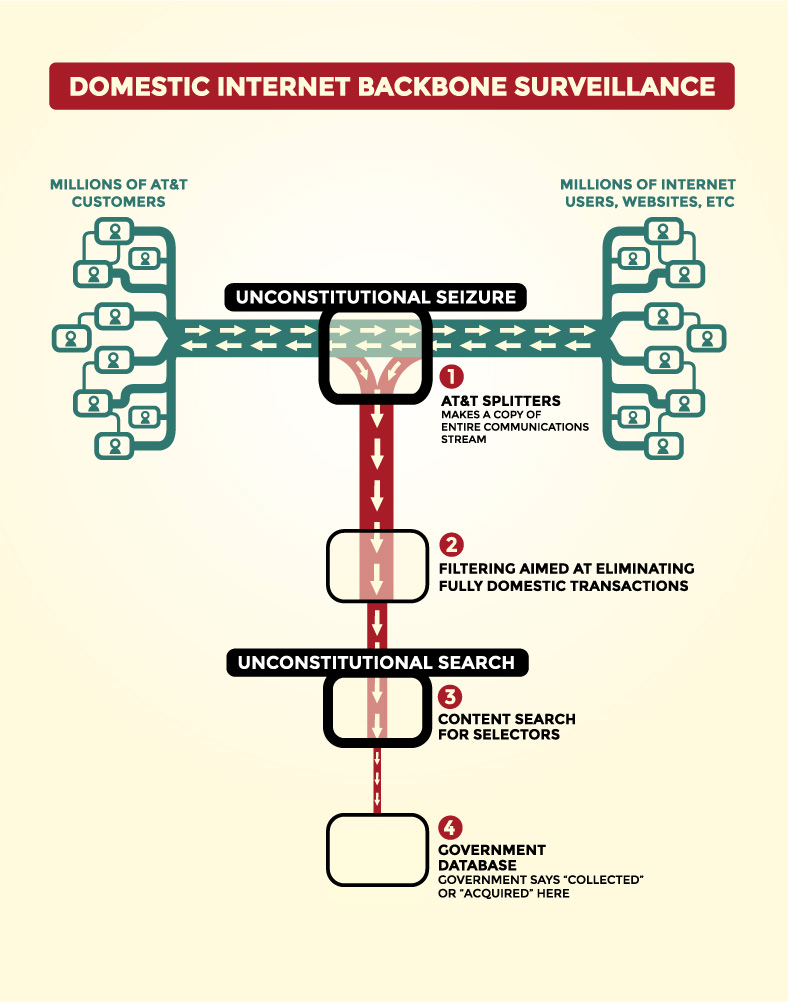
So-called “upstream” surveillance involves direct access to the physical cables, switches and routers that enable the flow of information across the internet. With its upstream efforts, the agency essentially copies virtually all international text-based communications — emails, instant messages, web searches and the like — and searches them for terms related to its investigations. In the process, purely domestic conversations can also be swept up and retained by the NSA.
“The NSA copies and reviews the communications of millions of innocent people to determine whether they are discussing or reading anything containing the NSA’s search terms,” ACLU lawyers wrote in their complaint filed today in the United States District Court in Maryland. “Its purpose is to identify not just communications that are to or from the NSA’s targets but also those that are merely ‘about’ its targets.”
In an op-ed in today’s New York Times announcing the lawsuit, Wikipedia’s co-founder, Jimmy Wales, and Lila Tretikov, executive director of the Wikimedia Foundation, cited the tens of thousands of volunteers who write and edit Wikipedia entries around the world.
Many of those volunteer contributors, they note, “prefer to work anonymously, especially those who work on controversial issues or who live in countries with repressive governments.” The fear that the NSA could be collecting information on contributors, and perhaps sharing that intelligence with other governments, “stifles freedom of expression and the free exchange of knowledge that Wikimedia was designed to enable.”
With billions of users worldwide, Wikipedia processes countless international communications and requests for data from its servers. As one NSA slide from the Snowden files indicates, the NSA is interested in HTTP, the protocol for those requests, “because nearly everything a typical user does on the Internet uses” it. The slide includes a picture of Wikipedia’s logo. (An administration official told Reuters, “We’ve been very clear about what constitutes a valid target of electronic surveillance. The act of innocuously updating or reading an online article does not fall into that category.”)
Upstream collection occurs under the Foreign Intelligence Surveillance Act, or FISA, a law passed in the 1970s to regulate overseas spying, and amended in 2008 to allow collection of Americans’ international communications under more expansive terms — so long as the NSA’s target is a foreigner outside the U.S., and it involves broadly defined “foreign intelligence information.”
In addition to constitutional questions, the new lawsuit argues that the 2008 law, expansive though it is, still “authorizes surveillance only of targets’ communications; it does not authorize surveillance of everyone.”
Nicole Navas, a spokeswoman with the Justice Department, said in an email that the department is “reviewing the complaint.”
If the case moves forward at all, it will reflect the impact of Snowden’s revelations.
A previous challenge by Amnesty International and others to warrantless spying on Americans’ international conversations was tossed out because the court said the plaintiffs couldn’t prove that their communications could be monitored under the 2008 FISA Amendments Act. The Supreme Court upheld that decision in February 2013, just a few months before the first Snowden documents were published.
The Snowden documents, and subsequent admissions by the government, said Toomey, “have made clear that the government it not just monitoring targets, but that in order to find the communications of those targets it is monitoring the communications of nearly everyone. That broadens the scope of the surveillance at issue, and removes some of the obstacles [to getting standing] that we encountered in the previous case.”
Separate challenges to the constitutionality of collecting metadata on domestic calls, under Section 215 of the Patriot Act, are awaiting decisions in three federal appeals courts.
Photo: Gregory Bull/AP
IT’S EVEN WORSE THAN WE THOUGHT.
What we’re seeing right now from Donald Trump is a full-on authoritarian takeover of the U.S. government.
This is not hyperbole.
Court orders are being ignored. MAGA loyalists have been put in charge of the military and federal law enforcement agencies. The Department of Government Efficiency has stripped Congress of its power of the purse. News outlets that challenge Trump have been banished or put under investigation.
Yet far too many are still covering Trump’s assault on democracy like politics as usual, with flattering headlines describing Trump as “unconventional,” “testing the boundaries,” and “aggressively flexing power.”
The Intercept has long covered authoritarian governments, billionaire oligarchs, and backsliding democracies around the world. We understand the challenge we face in Trump and the vital importance of press freedom in defending democracy.
We’re independent of corporate interests. Will you help us?
IT’S BEEN A DEVASTATING year for journalism — the worst in modern U.S. history.
We have a president with utter contempt for truth aggressively using the government’s full powers to dismantle the free press. Corporate news outlets have cowered, becoming accessories in Trump’s project to create a post-truth America. Right-wing billionaires have pounced, buying up media organizations and rebuilding the information environment to their liking.
In this most perilous moment for democracy, The Intercept is fighting back. But to do so effectively, we need to grow.
That’s where you come in. Will you help us expand our reporting capacity in time to hit the ground running in 2026?
We’re independent of corporate interests. Will you help us?

I’M BEN MUESSIG, The Intercept’s editor-in-chief. It’s been a devastating year for journalism — the worst in modern U.S. history.
We have a president with utter contempt for truth aggressively using the government’s full powers to dismantle the free press. Corporate news outlets have cowered, becoming accessories in Trump’s project to create a post-truth America. Right-wing billionaires have pounced, buying up media organizations and rebuilding the information environment to their liking.
In this most perilous moment for democracy, The Intercept is fighting back. But to do so effectively, we need to grow.
That’s where you come in. Will you help us expand our reporting capacity in time to hit the ground running in 2026?
We’re independent of corporate interests. Will you help us?
Contact the author:

Latest Stories

Midterms 2026
The Elon Musk Funder Trying to Sway the Race for LA’s Top Lawyer
The leading candidate for LA city attorney has the backing of the local DSA and vows to regulate Big Tech. Tech investors are spending millions against her.

Pentagon Fears Drone Attacks on U.S. and Foreign Bases
Government officials said a series of recent attacks and threats have highlighted the vulnerability of U.S. military bases.

Bankrolling American Empire in the Philippines
The Pentagon and private capital have teamed up to militarize the island nation.