
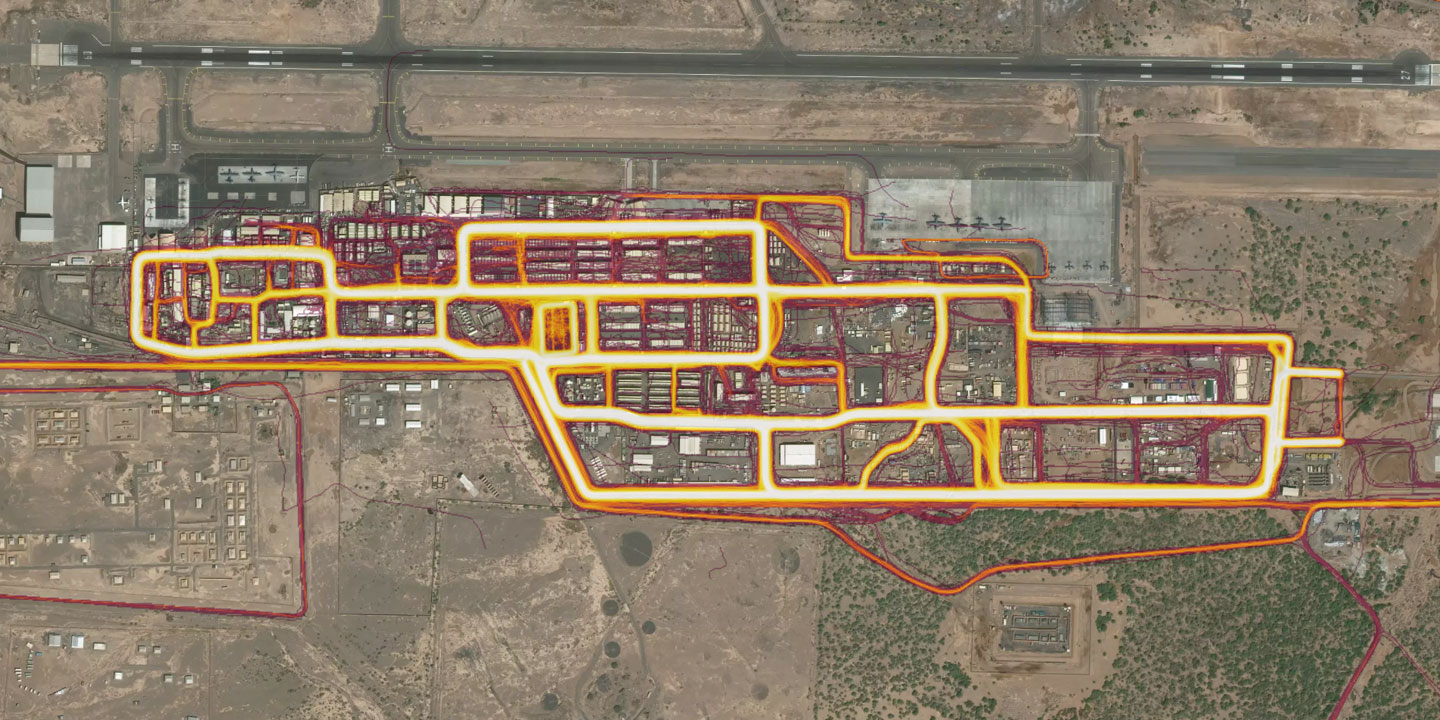
Out in the cocoa-colored wastes of north-central Niger, people have been running around in circles. Exactly who has been jogging or walking around this compound outside the town of Arlit is unclear. But there’s a good chance it has something to do with U.S. Africa Command’s “Analysis Office” there, the existence of which was disclosed in 2016 contracting documents.
Not far away, people have been running round and round in a compound near the airfield in Agadez, Niger, where the U.S. military is building a $100 million drone base. There has also been a significant amount of movement going on around the airport in Gao, Mali, where the U.S. military established an outpost in the early 2010s. And Garoua, Cameroon, the site of a U.S. drone base, is also aglow with the digital evidence of many past runs, according to an online interactive map that shows the routes of people who use fitness devices, such as Fitbit.

The outline of Camp Lemonnier, a large U.S. base in the sun-bleached nation of Djibouti, burns brighter than Las Vegas at midnight. A more remote site, about 10 kilometers away, is another popular locale for running … and drone flights. Chabelley Airfield is aglow with the digital signature of military personnel, with the most popular route circling the airstrip.
The Global Heat Map, released in November 2017 by fitness tracking company Strava, provides more than 3 trillion individual global GPS data points uploaded over the last two years via fitness devices, such as Fitbit, Jawbone, and Vivofit, as well as by people who directly subscribe to its mobile app, according to the company. In many parts of the United States and Europe, where millions of people use fitness trackers, the map is ablaze with light. In more austere locations, like the war zones of Yemen, Syria, and Afghanistan, as well as remote areas of Africa, fitness hot spots – in the form of neon paths along the perimeters of fenced-in compounds or secure roads – are far more likely to denote the presence of Western personnel working for the United Nations, humanitarian organizations, or foreign militaries like the U.S. armed forces.
In the past, the U.S. Defense Department has encouraged the use of Fitbits, distributing 2,500 to military personnel in 2013. Two years later, the Navy announced “plans to run a pilot program in the Pacific Fleet and Navy Reserve using wearable fitness trackers like Fitbits.” In 2016, Marines were, with a few important caveats, authorized to wear fitness tracking devices, including Fitbits, “in all Marine Corps spaces where collateral classified information and controlled unclassified information is processed, stored, or discussed” anywhere on earth. And last year, the Army announced plans to issue fitness bracelets “that will allow Army leaders to track their Soldiers’ fitness in real time.”
While Strava’s Global Heat Map was posted online last year, it only attained widespread notoriety over the weekend, when it was publicized on Twitter by Nathan Ruser, a 20-year-old Australian student studying international security. This has led to disclosures of the supposed locations of numerous low-profile U.S. military outposts, forward operating sites, and bases. It has raised fears about how such information might be linked to individual troops and imperil U.S. forces, while shining a light on the poor operational security habits of many U.S. military personnel based overseas.
For its part, U.S. Army Special Operations Command provides online guidance for maintaining digital privacy for personnel using Fitbits. U.S. Central Command, the umbrella organization for military operations in the greater Middle East, told the Washington Post that it will change its guidelines for the use of wireless and technological devices on military facilities.
The Intercept reached out to U.S. Africa Command, seeking comment on the implications of the Global Heat Map, regulations regarding the use of fitness trackers, and whether plans exist to issue new guidance regarding such devices. A digital receipt shows that AFRICOM personnel read the emailed questions, but the command did not respond to The Intercept prior to publication.
Akil Harris contributed to this report.
Top screenshot: The outline of Camp Lemonnier, a large U.S. base in Djibouti.
IT’S EVEN WORSE THAN WE THOUGHT.
What we’re seeing right now from Donald Trump is a full-on authoritarian takeover of the U.S. government.
This is not hyperbole.
Court orders are being ignored. MAGA loyalists have been put in charge of the military and federal law enforcement agencies. The Department of Government Efficiency has stripped Congress of its power of the purse. News outlets that challenge Trump have been banished or put under investigation.
Yet far too many are still covering Trump’s assault on democracy like politics as usual, with flattering headlines describing Trump as “unconventional,” “testing the boundaries,” and “aggressively flexing power.”
The Intercept has long covered authoritarian governments, billionaire oligarchs, and backsliding democracies around the world. We understand the challenge we face in Trump and the vital importance of press freedom in defending democracy.
We’re independent of corporate interests. Will you help us?
IT’S BEEN A DEVASTATING year for journalism — the worst in modern U.S. history.
We have a president with utter contempt for truth aggressively using the government’s full powers to dismantle the free press. Corporate news outlets have cowered, becoming accessories in Trump’s project to create a post-truth America. Right-wing billionaires have pounced, buying up media organizations and rebuilding the information environment to their liking.
In this most perilous moment for democracy, The Intercept is fighting back. But to do so effectively, we need to grow.
That’s where you come in. Will you help us expand our reporting capacity in time to hit the ground running in 2026?
We’re independent of corporate interests. Will you help us?

I’M BEN MUESSIG, The Intercept’s editor-in-chief. It’s been a devastating year for journalism — the worst in modern U.S. history.
We have a president with utter contempt for truth aggressively using the government’s full powers to dismantle the free press. Corporate news outlets have cowered, becoming accessories in Trump’s project to create a post-truth America. Right-wing billionaires have pounced, buying up media organizations and rebuilding the information environment to their liking.
In this most perilous moment for democracy, The Intercept is fighting back. But to do so effectively, we need to grow.
That’s where you come in. Will you help us expand our reporting capacity in time to hit the ground running in 2026?
We’re independent of corporate interests. Will you help us?
Contact the author:

Related


Latest Stories

Bodycam: Cop Was Not in Danger When He Fired Shots That Killed 1-Year-Old Kohen Wiley
Mississippi investigators said the shooting was “justified,” but new body camera footage shows the cop firing into the passenger’s side as the car passed by him.

The Intercept Briefing
The Intercept Live in Conversation With Robert Reich
Inequality Media co-founder Robert Reich and The Intercept’s Akela Lacy break down the most pressing issues of the midterm elections.

Midterms 2026
Giant Crypto Super PAC Funnels Big Money to Former Trump Official’s Firm to Support… Democrats?
The Fellowship PAC routed more than half a million dollars in support of Democrats through a firm co-founded by former Trump crypto adviser Bo Hines.