
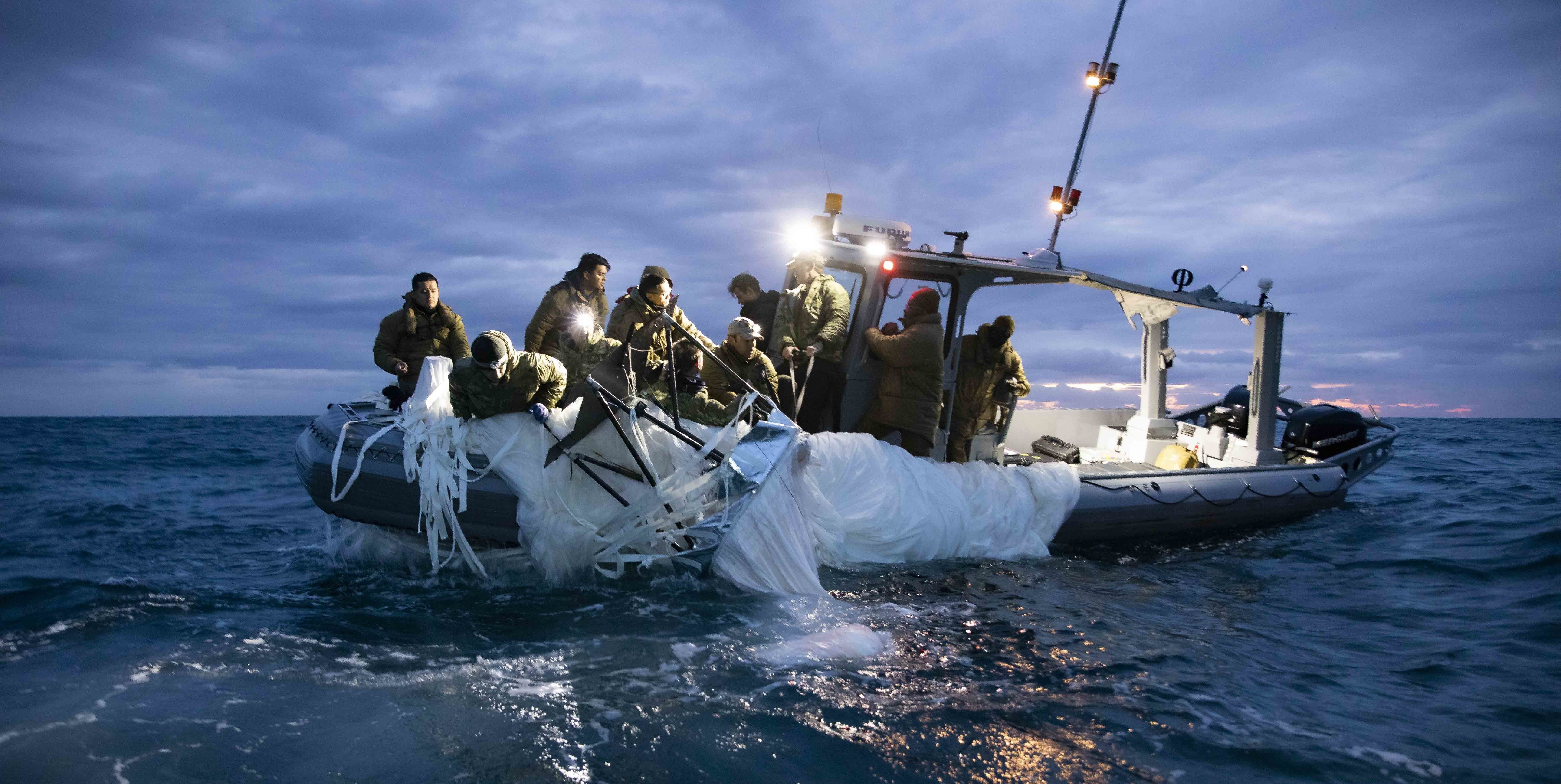
For the past week, the large Chinese balloon floating over the United States has consumed the attention of the American media.
Before the balloon was shot down by the U.S. on Saturday, China’s government stated it was a “civilian airship used for research, mainly meteorological.” For its part, the Pentagon says it has “very high confidence” that the balloon was conducting surveillance.
It’s understandable that the U.S. government would be suspicious, given that America sent spy balloons exactly the same size over both the Soviet Union and China in 1956 — and made exactly the same claims as China is making today about what we were up to.
The balloons the U.S. used were, oddly enough, manufactured by General Mills. The General Mills website describes its mission as “making food the world loves,” and it’s certainly best known today for its products like Cheerios, Chex, and Lucky Charms. But the company bragged in a 2011 blog post that it hired “the ‘daddy’ of the balloon industry,” thanks to the Aeronautical Research Division it established in 1946. (Another division of General Mills made the Alvin submarine that explored the Titanic.)
The General Mills balloons were supplied to the U.S. Air Force for Project Genetrix, a secret program to garner electronic and photographic information on communist countries. The Defense Department’s National Reconnaissance Office published a book in 2012 titled “HEXAGON (KH-9) Mapping Camera Program and Evolution” that covers Genetrix.

A photograph of a General Mills “Skyhook” high-altitude balloon launching in partnership with the U.S. Naval Research Laboratory in 1952 from New Brighton, Minn.
The balloons were about 20 stories tall, or around 200 feet. CBS today reported that the Chinese balloon “is believed to have been up to 200 feet tall” in a story breathlessly headlined “Suspected Chinese Spy Balloon Shot Down Over Atlantic Was Taller Than the Statue of Liberty.” Perhaps the Chinese chose this size balloon because of the demands of balloon physics, or perhaps they did it to taunt our freedom.


According to the NRO book,
The cover story to account for the existence of the large balloons stated that the project was part of a worldwide meteorological survey … to secure vital high altitude scientific data in conjunction with the International Geophysical Year.
The International Geophysical Year was envisioned, as President Dwight Eisenhower stated at the time, as a demonstration of the “ability of peoples of all nations to work together harmoniously for the common good.” At first, this seems distastefully cynical. But maybe it was an expression of Eisenhower believing that American spying was the common good and everyone was pulling together to do their part, the spies and the spied-upon.
“HEXAGON” records that the first of 512 balloons was launched on January 10, 1956. But the Soviet Union quickly noticed what was happening, and the program was suspended less than a month later on February 6 after the Politburo’s protests.
Of the 512 balloons, only 54 were recovered. But the NRO book reports that these 54 balloons provided photographs of 1.1 million square miles of “the Sino-Soviet area.” This was quite a lot, almost one-tenth of the area of the Soviet Union and China combined.
The film was analyzed by a photo interpreter team from the U.S. Army and Navy, the CIA, the Royal Air Force, the Strategic Air Command, and the Far East Air Force. “HEXAGON” optimistically states that “there were many benefits derived from this product. New targets were located, and confirmation of intelligence on previously known targets was possible.”
At a February 7, 1956, news conference, Eisenhower’s Secretary of State John Foster Dulles engaged in lengthy, hilarious prevarication about the spy balloons. First, there was straightforward lying. “The information that is being sought,” he said, “is not essentially or even at all military information.”
What was the U.S. goal with all these balloons, then? Why, to help all humanity: “They are gathering an extraordinary amount of new and useful information about these jet stream air currents. … [It] is a part of a project which has worldwide significance.”
Asked if “the United States feels that they have the right to send these balloons at a certain height anywhere around the globe,” Dulles answered, “Yes, I think that we feel that way.” He did then generously allow that the U.S. would “try” to avoid the territory of other countries that didn’t like it. This generosity apparently didn’t extend to American- (and British-) manned U-2 flights over the Soviet Union, which began several years later.
David Haight, an archivist at the Eisenhower Presidential Library, produced a 2009 article about this general issue titled “Ike and His Spies in the Sky.” In it, he writes, based on records of White House deliberations, “Eisenhower authorized aerial intelligence collecting programs in order to better assess the military capability of the Soviet Union, China, and other Communist bloc nations to launch a surprise attack on the United States.” In other words, the U.S. saw its balloon and U-2 programs as being essentially defensive.
If indeed the Chinese balloon turns out to have been carrying out surveillance, it’s plausible that they saw its incursion over the U.S. in the same way. Internal historical records show that countries almost always see their actions, even the most aggressive, as an understandable attempt to protect themselves against a dangerous foe. But what the U.S. did in 1956 didn’t feel like that to the Soviet Union and China, so China shouldn’t be surprised that it doesn’t feel like that to some in the U.S. today.
In any case, the lesson of the current balloon excitement is unclear. It may be that China is 70 years behind the U.S. in either weather or spying technology, or both. But there are some who believe we are on the brink of a Balloon Revolution — and this is merely the first shot in what sounds like something fun but wouldn’t be: a Balloon War.
IT’S EVEN WORSE THAN WE THOUGHT.
What we’re seeing right now from Donald Trump is a full-on authoritarian takeover of the U.S. government.
This is not hyperbole.
Court orders are being ignored. MAGA loyalists have been put in charge of the military and federal law enforcement agencies. The Department of Government Efficiency has stripped Congress of its power of the purse. News outlets that challenge Trump have been banished or put under investigation.
Yet far too many are still covering Trump’s assault on democracy like politics as usual, with flattering headlines describing Trump as “unconventional,” “testing the boundaries,” and “aggressively flexing power.”
The Intercept has long covered authoritarian governments, billionaire oligarchs, and backsliding democracies around the world. We understand the challenge we face in Trump and the vital importance of press freedom in defending democracy.
We’re independent of corporate interests. Will you help us?
IT’S BEEN A DEVASTATING year for journalism — the worst in modern U.S. history.
We have a president with utter contempt for truth aggressively using the government’s full powers to dismantle the free press. Corporate news outlets have cowered, becoming accessories in Trump’s project to create a post-truth America. Right-wing billionaires have pounced, buying up media organizations and rebuilding the information environment to their liking.
In this most perilous moment for democracy, The Intercept is fighting back. But to do so effectively, we need to grow.
That’s where you come in. Will you help us expand our reporting capacity in time to hit the ground running in 2026?
We’re independent of corporate interests. Will you help us?

I’M BEN MUESSIG, The Intercept’s editor-in-chief. It’s been a devastating year for journalism — the worst in modern U.S. history.
We have a president with utter contempt for truth aggressively using the government’s full powers to dismantle the free press. Corporate news outlets have cowered, becoming accessories in Trump’s project to create a post-truth America. Right-wing billionaires have pounced, buying up media organizations and rebuilding the information environment to their liking.
In this most perilous moment for democracy, The Intercept is fighting back. But to do so effectively, we need to grow.
That’s where you come in. Will you help us expand our reporting capacity in time to hit the ground running in 2026?
We’re independent of corporate interests. Will you help us?
Contact the author:

Related

White House-Linked Venture Capital Fund Boasts China War Would Be Great for Business

Apple Brings Mainland Chinese Web Censorship to Hong Kong

Kevin McCarthy Wants to Hold China Accountable. His Top Aide Lobbied for Alibaba.

Why Daniel Ellsberg Wants the U.S. to Prosecute Him Under the Espionage Act
Latest Stories

Pentagon Fears Drone Attacks on U.S. and Foreign Bases
Government officials said a series of recent attacks and threats have highlighted the vulnerability of U.S. military bases.

Bankrolling American Empire in the Philippines
The Pentagon and private capital have teamed up to militarize the island nation.

Pentagon Records Missed Almost Half of Troops’ Domestic Abuse Killings
“Records are important,” said the mother of a woman killed by her Navy colleague. We found nearly twice as many domestic-abuse killings by servicemembers as the DoD listed.