

In 2021, a Texas intelligence command center disseminated a bulletin warning its law enforcement partners about activists interested in sabotaging fossil fuel infrastructure. The report detailed no specific threat, but instead linked to an interview with Andreas Malm, a Swedish professor of human ecology, on a New Yorker podcast in which he advocated for the destroying or “neutralizing” new fossil fuel projects like pipelines using nonviolent methods.
Now, Malm’s work is once again drawing the attention of a fusion center. “How to Blow Up a Pipeline,” a new movie dramatizing Malm’s 2021 nonfiction book of the same name, sympathetically depicts the infrastructure sabotage by environmentalists. The film’s fictional protagonist, Theo, contracts leukemia after growing up in a Long Beach neighborhood with heavy pollution. She joins several others to strap a homemade bomb to an oil pipeline in West Texas.
In a report disseminated last week, another intelligence command center — this time in Kansas City, Missouri — quietly warned of a “developing threat” related to the movie. It was obtained by The Intercept via a source with access to law enforcement reporting, and the Kansas City Regional Fusion Center did not reply to a request for comment.
Again, however, this new report conceded that the intelligence center could not identify any specific threat — a contradiction that experts say speaks to the overbroad authority of state intelligence entities and the make-work required by these centers.
“The performance metric is the number of reports you write, rather than the accuracy of them,” Mike German, a retired FBI agent who is now a fellow at the Brennan Center for Justice, said of fusion centers. “What do you do after you write reports on realistic threats? Pretty soon you have to start writing about imaginary ones. Lots come straight from the fever swamps of social media.”
The Missouri report goes a step further than Texas’s, since the film “How to Blow Up a Pipeline” is fictional.

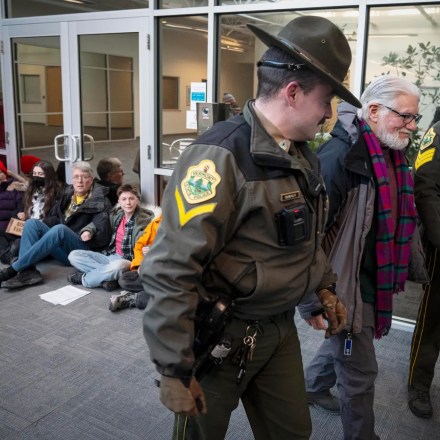
Another fusion center, the Colorado Information Analysis Center, recently issued a similar bulletin in anticipation of a student walkout to protest legislative inaction on gun violence, as The Intercept reported last week. The report did not identify any potential crime that might arise in relation to the protest. Defending its report, CIAC said that it was not monitoring the protesters and that the report was merely distributed for situational awareness.
“Fusion center leaders often say this type of reporting is for ‘situational awareness’ but then why send this type of report out broadly to the law enforcement community,” German said. “I am surprised how many of the fusion center products we see focus on protest activity, where the analysts acknowledge in the report itself that they have no indication that any criminal activity might take place.”
“The Kansas City Regional Fusion Center (KCRFC) has prepared the following Situational Awareness Bulletin,” the report, dated April 4, reads, “to provide information to partners concerning a developing threat targeting Critical Infrastructure and Key Resources (CIKR), especially oil and natural gas pipelines.” But in a separate caption, it notes “The KCRFC has no information on specific threats directed at the energy sector in this area.”
KCRFC is one of 80 fusion centers across the country, which were established in the wake of the 9/11 attacks to combat terrorism by sharing intelligence with law enforcement partners. But fusion centers lack the traditional law enforcement requirement for a criminal predicate to exist in order to investigate something, German told The Intercept.
“Passing along ‘see something, say something’ leads is a significant part of what fusion centers do,” German said. “The concept of proactive Intelligence Led Policing and predictive policing is to forego traditional law enforcement reporting requirements, by not waiting for crime to occur in favor of passing tips and leads that might forewarn of potential future problems; so the normal criminal predicates were intentionally reduced or abandoned, leading to some of the low-quality, and often low-accuracy ‘intelligence’ reports we’ve seen.”
While KCRFC’s bulletin acknowledges that neither the film nor the book advocate for the targeting of people, it alludes to unspecified social media posts calling for more extreme tactics. “While the book and movie advocate for property destruction and targeted sabotage, not the targeting of people, some social media posts have indicated the tactics employed do not go far enough,” the bulletin states.
While Malm’s book draws a hard line between sabotage that only affects property and tactics that might harm people, the FBI makes no such distinction, referring to it all as “eco-terrorism.” “Animal rights/Environmental violent extremism” represents one of five domestic terrorism threat categories the U.S. government has focused on since 2019, per a report to Congress last year.
KCRFC cites a January 24, 2022, intelligence report by the Department of Homeland Security called “Domestic Violent Extremists Likely to Continue Physical Threats Against Electricity Infrastructure.” Though the DHS report is not publicly available, its date matches an assessment by the same agency that reportedly said they “have developed credible, specific plans to attack electricity infrastructure since at least 2020.”
Fusion centers frequently share intelligence with DHS and countless other federal law enforcement agencies — which civil liberties advocates say dissolves the legal distinctions between state and federal authorities.
“Part of the problem is the overbroad mission,” German said. “Part of it is that there are so many fusion centers, on top of the FBI, DHS, DEA, etc. intelligence platforms, not to mention all the private intelligence sources, so everyone is either just re-hashing reports others wrote or trying to find something brand new.”
The KCRFC’s own bulletin appears to acknowledge that the film is protected by the First Amendment. “The KCRFC continues to recognize the constitutionally protected rights afforded to all people under the First Amendment,” the bulletin states. “KCRFC reports on only those activities where the potential use of rhetoric and/or propaganda could be used to incite violent or criminal acts.”
But experts say that law enforcement should not be interfering with anything protected by the First Amendment.
“I haven’t seen the movie, but my understanding is it’s not a literal step-by-step guide on how to blow up an oil pipeline,” Aaron Terr, director of public advocacy for the Foundation for Individual Rights and Expression told The Intercept. “Rather, it tells a story about environmental activists who went on a mission to sabotage a pipeline. That’s constitutionally protected artistic expression. If a movie or book lost First Amendment protection for portraying illegal activity, we’d lose a huge chunk of our culture’s artistic output.”
“Even if the movie gives viewers ideas on how to sabotage a pipeline, or conveys a message of approval of the character’s actions, that’s not enough to take it outside the First Amendment’s protection.”
Correction: April 11, 2023, 4:09 p.m.
This story incorrectly identified the intel center as a Kansas center. It is based in Kansas City, Missouri. The story has been corrected.
IT’S EVEN WORSE THAN WE THOUGHT.
What we’re seeing right now from Donald Trump is a full-on authoritarian takeover of the U.S. government.
This is not hyperbole.
Court orders are being ignored. MAGA loyalists have been put in charge of the military and federal law enforcement agencies. The Department of Government Efficiency has stripped Congress of its power of the purse. News outlets that challenge Trump have been banished or put under investigation.
Yet far too many are still covering Trump’s assault on democracy like politics as usual, with flattering headlines describing Trump as “unconventional,” “testing the boundaries,” and “aggressively flexing power.”
The Intercept has long covered authoritarian governments, billionaire oligarchs, and backsliding democracies around the world. We understand the challenge we face in Trump and the vital importance of press freedom in defending democracy.
We’re independent of corporate interests. Will you help us?
IT’S BEEN A DEVASTATING year for journalism — the worst in modern U.S. history.
We have a president with utter contempt for truth aggressively using the government’s full powers to dismantle the free press. Corporate news outlets have cowered, becoming accessories in Trump’s project to create a post-truth America. Right-wing billionaires have pounced, buying up media organizations and rebuilding the information environment to their liking.
In this most perilous moment for democracy, The Intercept is fighting back. But to do so effectively, we need to grow.
That’s where you come in. Will you help us expand our reporting capacity in time to hit the ground running in 2026?
We’re independent of corporate interests. Will you help us?

I’M BEN MUESSIG, The Intercept’s editor-in-chief. It’s been a devastating year for journalism — the worst in modern U.S. history.
We have a president with utter contempt for truth aggressively using the government’s full powers to dismantle the free press. Corporate news outlets have cowered, becoming accessories in Trump’s project to create a post-truth America. Right-wing billionaires have pounced, buying up media organizations and rebuilding the information environment to their liking.
In this most perilous moment for democracy, The Intercept is fighting back. But to do so effectively, we need to grow.
That’s where you come in. Will you help us expand our reporting capacity in time to hit the ground running in 2026?
We’re independent of corporate interests. Will you help us?
Contact the author:

Related

Tasked With Stopping Terror, Colorado’s Intel Agency Monitors Students Protesting Gun Violence

Tilting at Windmills: The FBI Chased Imagined Eco-Activist Enemies, Documents Reveal

Louisiana Environmental Activists Charged With “Terrorizing” for Nonviolent Stunt Targeting Plastics Giant

How a Movement That Never Killed Anyone Became the FBI’s No. 1 Domestic Terrorism Threat
Latest Stories

Israel’s War on Gaza
A C-Section in Shackles: A Palestinian Woman’s Harrowing Birth in Israeli Detention
Dana Joudeh was denied proper food and medical care throughout her pregnancy in an Israeli prison. She gave birth to a premature baby surrounded by armed guards.

ICE Shooting in NYC Inflames Mamdani’s Policing Problem
After ICE shot a young father in Manhattan, New Yorkers asked the mayor to protect them from his police department and federal agents alike.

Where Are the Iran War Protests?
Despite a wildly unpopular war with Iran, a mass protest movement for peace hasn’t materialized — at least in the ways we’ve been taught to recognize.