
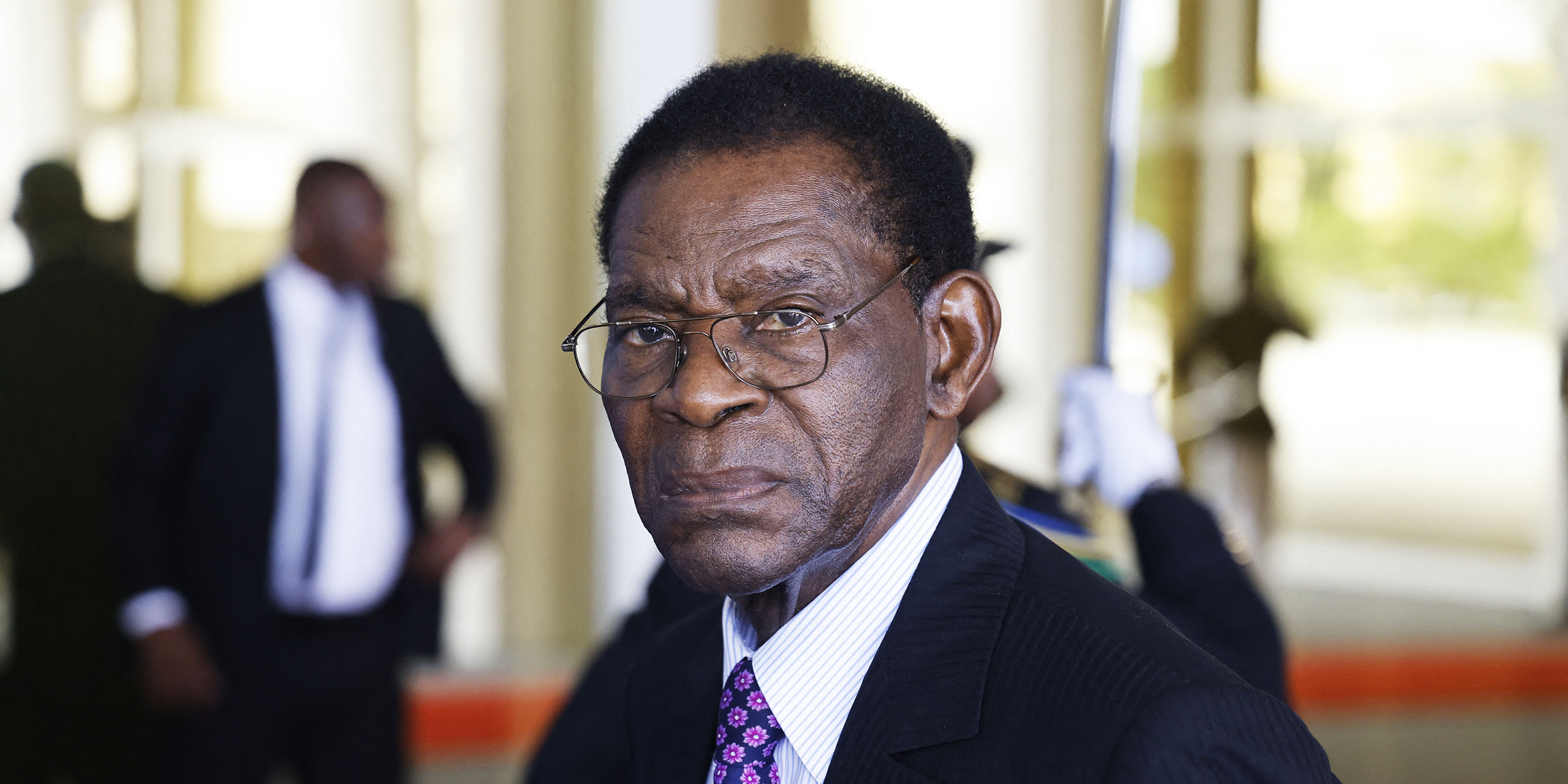
U.S. commandos have shown a special interest in strengthening ties with one of the most corrupt, abusive, and repressive regimes on the planet. The delivery of aid by Special Operations forces to the coastal African nation of Equatorial Guinea last month followed pilgrimages to the country’s pariah president by top U.S. officials.
The move came amid shifting West African geopolitics. A Pentagon report last year mentioned Equatorial Guinea as the potential site of a future Chinese military base. At the same time, U.S. relations with longtime allies in Central and West Africa have frayed, often in the aftermath of coups d’état by American-trained military officers.
The aid to Equatorial Guinea appears to be the latest facet of a U.S. charm offensive to woo the country’s president, Teodoro Obiang Nguema Mbasogo, a tyrant now in his sixth decade in power, as the U.S. has lost influence in the African Sahel.

“We hope that this donation is the beginning of additional cooperation,” said Commander Michael White, the defense attaché to the U.S. Embassy in Equatorial Guinea, after U.S. Special Operations Command Africa spearheaded a modest donation of humanitarian aid to the tiny, oil-rich central African nation.
U.S. Ambassador to Equatorial Guinea David Gilmour expressed hope that the recent donation of medical supplies would be the “first of many opportunities to partner with” the government there. It follows high-level engagement by the administration of President Joe Biden with Obiang’s regime.
“This seems to run counter to every value that the Biden administration publicly espouses when it comes to democracy, human rights, and anticorruption.”
“This seems to run counter to every value that the Biden administration publicly espouses when it comes to democracy, human rights, and anticorruption,” said Cameron Hudson, a former Africa analyst at the CIA, now at the Center for Strategic and International Studies. “The administration is doing everything it can to maintain a military foothold on the continent. And if we don’t already have a foothold, to create one. So establishing or deepening relationships with particularly odious regimes like Equatorial Guinea are not off the table.”
Efforts to improve relations with the notorious kleptocracy come as the U.S. has been forced to scale back its military reach on the continent. (Kelly Cahalan, a spokesperson for U.S. Africa Command, or AFRICOM, said the command was unaware of any increased U.S. engagement with Equatorial Guinea.) The Pentagon curtailed military ties with Burkina Faso, Mali, and Niger following coups and reduced its counterterrorism activities in Cameroon due to human rights abuses by the country’s military.
Earlier this month, Niger’s ruling junta, which includes a number of officers trained by the U.S. military, announced it was severing a long-standing security cooperation agreement with the United States “with immediate effect.”
Crisantos Obama Ondo, Equatorial Guinea’s ambassador to the U.S., did not respond to requests for an interview.
Corruption and Torture
Equatorial Guinea has been plagued by oppression, corruption, and poverty for decades. After seizing power in a military coup in 1979, Obiang and his family have ruled it as their personal fiefdom. Despite significant oil wealth, the country suffers widespread poverty due to rampant embezzlement.
The most recent State Department report on human rights in Equatorial Guinea details credible reports of extrajudicial killings, torture, “inhuman” punishment, arbitrary arrest, and political imprisonment by the state, among many other abuses. It also chronicles corruption at all levels of government, especially the top: “The president and members of his inner circle continued to amass personal fortunes from the revenues associated with monopolies on all domestic commercial ventures, as well as timber and oil exports.”
In 2011, the U.S. Justice Department seized a beachfront mansion in Malibu, California; a private plane; and a fleet of luxury cars — purchased with looted funds laundered in the U.S. — from Teodoro “Teodorin” Nguema Obiang Mangue, the president’s son and now Equatorial Guinea’s vice president. The U.S. settled the case after Teodorin forfeited nearly $30 million in assets.

Swiss prosecutors took possession of 11 of the younger Obiang’s luxury cars in 2016, seizing Lamborghinis, Ferraris, Bentleys, a Bugatti, and a Rolls-Royce. In 2021, France seized $170 million of Teodorin’s assets including a 101-room mansion near the Arc de Triomphe in Paris.
The seizures have not affected Teodorin’s conspicuous consumption, typified by his penchant for enjoying the high life on a luxury superyacht and, last year, staying in a $75,000-a-night New York hotel suite while asking the United Nations for aid.
Pentagon’s China Fears
In recent years, U.S. officials have publicly fretted about China establishing a naval outpost in West Africa. “The thing I think I’m most worried about is this military base on the Atlantic coast, and where they have the most traction for that today is in Equatorial Guinea,” Gen. Stephen J. Townsend, then-chief of AFRICOM, told the House Armed Services Committee in March 2022.
In an October 2023 analysis for Congress, the Defense Department reported it was “likely” that China has considered locating a “military logistics” facility in Equatorial Guinea. Earlier this month, Gen. Michael Langley, the current AFRICOM commander, warned the Senate Armed Services Committee: “China is actively pursuing a naval base on Africa’s Atlantic coast.”

The pariah state has been invited, since 2019, to participate in AFRICOM’s Obangame Express, the largest multinational maritime exercise in Western and Central Africa. AFRICOM also conducted a maritime capability assessment for the country in 2021.
That same year, when a Navy ship made a port call there, a U.S. news release called Equatorial Guinea “an important partner of the United States.” A visit by another ship in 2022 prompted Navy commander Tim Rustico to highlight the “great opportunity to continue building our partnership with Equatorial Guinea.”
“U.S. forces worked … with the government of Equatorial Guinea to facilitate this engagement signifying sustained relations between the two nations,” reads an Army news release about the February donation of $24,000 worth of supplies, including baby formula and first-aid kits to the country where most of the population lives on less than two dollars a day, but where the president has a reported net worth of $600 million.
Tutu Alicante, the head of EG Justice, a nonprofit organization that promotes human rights in Equatorial Guinea, said that the Biden administration’s high-level engagement with the Obiang government was even more damaging than providing aid.
Biden Engages
Since Biden took office, Obiang, his son, or both have met with Assistant Secretary of State for African Affairs Molly Phee, Principal Deputy National Security Advisor Jon Finer, CIA Deputy Director David Cohen, and Maj. Gen. Kenneth Ekman, the director of strategy, engagement, and programs at AFRICOM.
The Center for Strategic and International Studies’s Hudson said, “Equatorial Guinea seems blatant about the fact that they are very much for sale to the highest bidder. They are very happy to be courted by Washington and Beijing because they occupy a strategic spot in the world and sit on a strategic resource and they have the money to allow them an independence that other countries in the region don’t have.”
“Equatorial Guinea seems blatant about the fact that they are very much for sale to the highest bidder.”
Following rigged presidential elections in 2022 — in which Obiang won 95 percent of the vote — Phee wrote a letter to the newly reelected president. Posted to X by an Equatoguinean government official, the letter shows that Phee welcomed “close collaboration” in which their countries would “act together” and seize “opportunities to strengthen” and “enhance our mutual security.” (The State Department verified the authenticity of the letter to The Intercept, but did not respond to other questions about engagement with Obiang’s government.)
“The United States is committed to a world in which human rights are protected … and those who commit human rights abuses are held accountable,” said Phee’s boss, Secretary of State Anthony Blinken in a 2021 statement defining the Biden administration’s core principles. “President Biden is committed to a foreign policy … centered on the defense of democracy and the protection of human rights.”
Experts said engagement with Equatorial Guinea makes a mockery of this pledge and undermines U.S. credibility across Africa.
“The hypocrisy of publicly saying that democracy, human rights, and anticorruption are the cornerstone of your foreign policy and then to go down a path that does not put those values into any kind of real practice is most troubling,” Hudson told The Intercept. “It sends a message to everyone on the continent that everything we say is negotiable.”
IT’S EVEN WORSE THAN WE THOUGHT.
What we’re seeing right now from Donald Trump is a full-on authoritarian takeover of the U.S. government.
This is not hyperbole.
Court orders are being ignored. MAGA loyalists have been put in charge of the military and federal law enforcement agencies. The Department of Government Efficiency has stripped Congress of its power of the purse. News outlets that challenge Trump have been banished or put under investigation.
Yet far too many are still covering Trump’s assault on democracy like politics as usual, with flattering headlines describing Trump as “unconventional,” “testing the boundaries,” and “aggressively flexing power.”
The Intercept has long covered authoritarian governments, billionaire oligarchs, and backsliding democracies around the world. We understand the challenge we face in Trump and the vital importance of press freedom in defending democracy.
We’re independent of corporate interests. Will you help us?
IT’S BEEN A DEVASTATING year for journalism — the worst in modern U.S. history.
We have a president with utter contempt for truth aggressively using the government’s full powers to dismantle the free press. Corporate news outlets have cowered, becoming accessories in Trump’s project to create a post-truth America. Right-wing billionaires have pounced, buying up media organizations and rebuilding the information environment to their liking.
In this most perilous moment for democracy, The Intercept is fighting back. But to do so effectively, we need to grow.
That’s where you come in. Will you help us expand our reporting capacity in time to hit the ground running in 2026?
We’re independent of corporate interests. Will you help us?

I’M BEN MUESSIG, The Intercept’s editor-in-chief. It’s been a devastating year for journalism — the worst in modern U.S. history.
We have a president with utter contempt for truth aggressively using the government’s full powers to dismantle the free press. Corporate news outlets have cowered, becoming accessories in Trump’s project to create a post-truth America. Right-wing billionaires have pounced, buying up media organizations and rebuilding the information environment to their liking.
In this most perilous moment for democracy, The Intercept is fighting back. But to do so effectively, we need to grow.
That’s where you come in. Will you help us expand our reporting capacity in time to hit the ground running in 2026?
We’re independent of corporate interests. Will you help us?
Contact the author:

Related


Latest Stories

Google DeepMind Engineer Resigns in Protest of Pentagon Contract
Sofia Liguori stepped down from DeepMind due to current military contracts — not speculative fears of an AI apocalypse.

The War on Immigrants
Trump’s Obsession With Somalia Isn’t Just Racist. It’s Been Lethal.
Beyond targeting Rep. Ilhan Omar, the Trump administration has killed, arrested, deported, and demonized Somalis at home and abroad.

Kohen Wiley’s Family Says Investigators Didn’t Contact Them Before Concluding Cops Did No Wrong
Mississippi has yet to release any support for its claim that a “thorough and impartial” review showed the shooting was “justified.”