

In the face of increasing skepticism in Washington around Israel’s planned invasion of Rafah, where some 1.4 million displaced Palestinians take refuge, the America Israel Public Affairs Committee spent this week lobbying Congress to support the operation.
In talking points sent to congressional offices on Tuesday and reviewed by The Intercept, AIPAC argued that invading Rafah is the only way to take out Hamas, and that Israel had “no other option.”
“There is no example in recent military history of defeating a force like Hamas in Rafah without entering the city,” read the talking points. “Commando raids and arms embargoes can have a positive impact but will not defeat Hamas.”


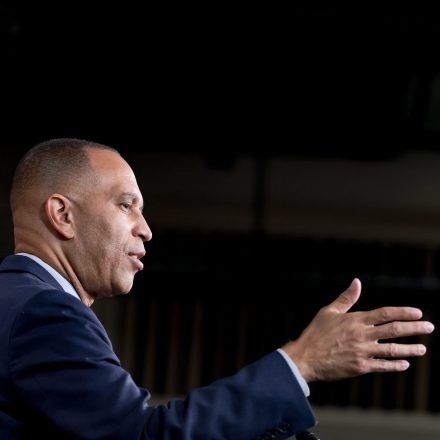
For more than a week, officials in Washington have been speaking out against Israel’s plan to invade Rafah, and on Wednesday, President Joe Biden said that the U.S. would stop supplying Israel with heavy weapons should it move forward with its plans. He also admitted that Israel has killed civilians with U.S. bombs. Last week, 57 House Democrats wrote to Biden, saying “an offensive invasion into Rafah by Israel in the upcoming days is wholly unacceptable” and urging him to pause weapon shipments. The Biden administration made the unprecedented move to halt one shipment of offensive weapons to Israel, and on Wednesday, the State Department said that the administration is “reviewing” other arms shipments.
The AIPAC memo describes the invasion as a “limited operation” targeting Hamas, and it notes that Israel is encouraging Palestinian civilians to move into “humanitarian zones” to the north.
Horrific images of this “limited operation” have already circulated: a heavily burnt boy lying on a gurney next to his decapitated father, young children crushed beneath the rubble of their bombed home, and first responders picking through remains of Palestinians. For hundreds of thousands of hungry, injured, and sick Palestinians who have been displaced repeatedly over the last seven months, Rafah was supposed to be the last safe refuge.
In its messaging to Congress, the pro-Israel lobby also claims Israeli forces have taken important steps to limit civilian casualties. Israel’s bombings of Rafah, which have continued for months, suggest a different picture. A pair of Israeli airstrikes in late April killed a man, his pregnant wife, and their 3-year-old child, along with another 17 children and two women from an extended family.
AIPAC also argued that “continued war in Gaza is only necessary because Hamas continues to refuse to surrender and free the hostages.” Hamas continues to hold an estimated 132 hostages who it captured on October 7, an issue that has been central to ongoing ceasefire negotiations. Yet last week, Israeli Prime Minister Bibi Netanyahu vowed to invade Rafah “with or without a deal” on the hostages.
In its talking points, AIPAC argues that Hamas’s acceptance of a ceasefire proposal was a “cynical ploy” since the group accepted its own proposal, and not one that Israel had previously accepted (a key sticking point for Hamas has been a permanent end to the hostilities). The proposal Hamas agreed to was brokered by Egypt and Qatar. Axios reported that Israeli officials claim the U.S. was aware of the negotiations and guaranteed to Hamas through mediators that a hostage deal would end the war, and that the U.S. invited Israelis to Cairo, but they chose not to send a team.
Nevertheless, AIPAC says, “Hamas is refusing to end the war by surrendering and freeing the hostages,” consequently arguing that invading Rafah and removing Hamas from power is necessary. Chaim Rubenstein, a former spokesperson for the families of the hostages, previously said that in the days after October 7, Hamas offered to immediately release all the hostages if the Israeli Defense Forces didn’t invade Gaza, but the Israeli government rejected the proposal.
Hamas released 105 hostages during a temporary ceasefire in November, and Israeli forces saved another three during rescue operations. The Israeli military has also killed at least four hostages during its military operations on Gaza, among the more than 34,000 Palestinians killed.
Ahead of the Rafah operation, Rubenstein said hostage families weren’t notified about the invasion and the risks it could pose. “Netanyahu has thwarted” the release of hostages, he said.
AIPAC did not respond to a request for comment.
IT’S EVEN WORSE THAN WE THOUGHT.
What we’re seeing right now from Donald Trump is a full-on authoritarian takeover of the U.S. government.
This is not hyperbole.
Court orders are being ignored. MAGA loyalists have been put in charge of the military and federal law enforcement agencies. The Department of Government Efficiency has stripped Congress of its power of the purse. News outlets that challenge Trump have been banished or put under investigation.
Yet far too many are still covering Trump’s assault on democracy like politics as usual, with flattering headlines describing Trump as “unconventional,” “testing the boundaries,” and “aggressively flexing power.”
The Intercept has long covered authoritarian governments, billionaire oligarchs, and backsliding democracies around the world. We understand the challenge we face in Trump and the vital importance of press freedom in defending democracy.
We’re independent of corporate interests. Will you help us?
IT’S BEEN A DEVASTATING year for journalism — the worst in modern U.S. history.
We have a president with utter contempt for truth aggressively using the government’s full powers to dismantle the free press. Corporate news outlets have cowered, becoming accessories in Trump’s project to create a post-truth America. Right-wing billionaires have pounced, buying up media organizations and rebuilding the information environment to their liking.
In this most perilous moment for democracy, The Intercept is fighting back. But to do so effectively, we need to grow.
That’s where you come in. Will you help us expand our reporting capacity in time to hit the ground running in 2026?
We’re independent of corporate interests. Will you help us?

I’M BEN MUESSIG, The Intercept’s editor-in-chief. It’s been a devastating year for journalism — the worst in modern U.S. history.
We have a president with utter contempt for truth aggressively using the government’s full powers to dismantle the free press. Corporate news outlets have cowered, becoming accessories in Trump’s project to create a post-truth America. Right-wing billionaires have pounced, buying up media organizations and rebuilding the information environment to their liking.
In this most perilous moment for democracy, The Intercept is fighting back. But to do so effectively, we need to grow.
That’s where you come in. Will you help us expand our reporting capacity in time to hit the ground running in 2026?
We’re independent of corporate interests. Will you help us?
Contact the author:

Related

600,000 Palestinian Kids in Rafah Can’t “Evacuate” Safely, UNICEF Official Says

“Man-Made Hell On Earth”: A Canadian Doctor on His Medical Mission to Gaza

Nowhere Left to Go in Gaza as Israel’s Ground Assault on Rafah Looms

After House Speaker Mike Johnson Pushed Through Israel Aid Package, AIPAC Cash Came Flowing In
Latest Stories

Targeting Iran
Yemenis Unable to Reach Hospital Are Part of the Iran War Death Toll
At least 10 patients with kidney failure near Taiz, a city under a Houthi siege, died because they were unable to get to their dialysis treatments.

Midterms 2026
Mike Rogers Spent $100K on Private Jets and Luxury Travel Last Quarter
The Republican running for Senate in Michigan is directing campaign funds toward chartered flights, a Miami car service, and BMW repairs.

The Army Wants to Sic AI Agents on Its Enemies. What Could Go Wrong?
Documents obtained by The Intercept show the military is trying to deploy autonomous AI agents to hack its adversaries.