

For years, organizers in Philadelphia encouraged the formerly incarcerated to vote for criminal justice reforms.
They notched successes that included the election and reelection of District Attorney Larry Krasner and a package of criminal justice reforms. There has always been pushback, however, including Krasner’s impeachment.
This election, organizers have a new concern and a new talking point as they canvass communities affected by mass incarceration: Project 2025.
“Under Project 2025, the Justice Department would be used to undermine and crack down on so-called progressive district attorneys.”
The wide-ranging policy document from the Heritage Foundation has been disavowed by the Trump campaign, but groups in Philadelphia fear it could still be used as a road map for a federal power grab.
“Under Project 2025, the Justice Department would be used to undermine and crack down on so-called progressive district attorneys,” said Saleem Holbrook, the executive director of criminal justice advocacy group Straight Ahead. “It was hard enough fighting that battle on the state level. We can only imagine how difficult it would be to fight that battle on the state and federal level.”
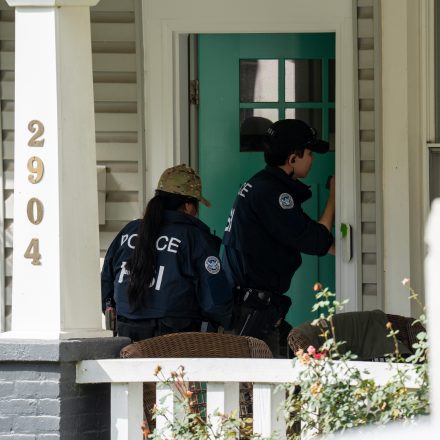

Pushback on Project 2025
Much of the debate over the document’s 900 pages has centered on reproductive rights, the gutting of civil service protections, and downsizing Medicaid.
Along with expanding the death penalty, however, Project 2025 also offers a road map for criminal justice policies that include fighting reform-minded prosecutors such as Krasner.

Ominously for prosecutors such as Krasner who have exercised their prosecutorial discretion, it suggests initiating “legal action against local officials — including District Attorneys — who deny American citizens the ‘equal protection of the laws’ by refusing to prosecute criminal offenses in their jurisdictions.”
Holbrook’s group has not endorsed in the presidential election, but Project 2025 comes up often when its canvassers hit the streets to encourage the formerly incarcerated and their communities to vote.

Sergio Hyland, a 43-year-old Philadelphia native, spent more than 20 years in prison before his release in 2022. Now he’s an organizer with Straight Ahead, visiting communities where many people have been to prison or know someone who has.
If Project 2025 is implemented, Hyland warns voters, “criminal justice reform would be all but wiped out. We could forget about any progress we have made.”
Low Former Incarcerated Turnout
Straight Ahead is part of a larger cohort of groups across the country encouraging the formerly incarcerated to vote, said Ariel White, an associate professor of political science at the Massachusetts Institute of Technology.
“You see groups all over the place doing this now, and I think particularly in places where people have previously organized to expand or regain the right to vote,” White said.
State laws on voting rights for the formerly incarcerated vary widely. Even in places that have expanded those rights in recent years, however, White said that registration and turnout rates are still “substantially lower” than the general population.
“The biggest challenge is apathy,” Holbrook said. “And that’s not just this election cycle, that’s every election cycle, because people do feel like the system is not working for them.”
“The biggest challenge is apathy.”
Going door to door, the presidential campaign inevitably comes up in conversations with voters, Hyland said. What does he focus on? “The issues: ‘This is what our community needs, this is what you’re telling us you need,’” he said. “‘This is what this candidate represents, this is what that candidate represents.’”
Nationally, there isn’t good data on how the formerly incarcerated are planning to vote, White said. A survey of 54,000 people behind bars conducted by the Marshall Project found surprisingly strong support for Donald Trump, given his often draconian rhetoric about law and order.
Polls show Kamala Harris losing support among the Black and brown men whose communities have been most affected by mass incarceration, although Holbrook said his experience has been that she is not losing support “en masse.”
“It’s the misinformation that is driving some Black men to go over to Donald Trump, and that is the importance of us being out on the streets, talking to them about real issues,” said Holbrook. “Don’t get me wrong, there are legitimate complaints about how Democrats have engaged or moved in Black and brown communities.”
“We don’t sugarcoat that.”
IT’S EVEN WORSE THAN WE THOUGHT.
What we’re seeing right now from Donald Trump is a full-on authoritarian takeover of the U.S. government.
This is not hyperbole.
Court orders are being ignored. MAGA loyalists have been put in charge of the military and federal law enforcement agencies. The Department of Government Efficiency has stripped Congress of its power of the purse. News outlets that challenge Trump have been banished or put under investigation.
Yet far too many are still covering Trump’s assault on democracy like politics as usual, with flattering headlines describing Trump as “unconventional,” “testing the boundaries,” and “aggressively flexing power.”
The Intercept has long covered authoritarian governments, billionaire oligarchs, and backsliding democracies around the world. We understand the challenge we face in Trump and the vital importance of press freedom in defending democracy.
We’re independent of corporate interests. Will you help us?
IT’S BEEN A DEVASTATING year for journalism — the worst in modern U.S. history.
We have a president with utter contempt for truth aggressively using the government’s full powers to dismantle the free press. Corporate news outlets have cowered, becoming accessories in Trump’s project to create a post-truth America. Right-wing billionaires have pounced, buying up media organizations and rebuilding the information environment to their liking.
In this most perilous moment for democracy, The Intercept is fighting back. But to do so effectively, we need to grow.
That’s where you come in. Will you help us expand our reporting capacity in time to hit the ground running in 2026?
We’re independent of corporate interests. Will you help us?

I’M BEN MUESSIG, The Intercept’s editor-in-chief. It’s been a devastating year for journalism — the worst in modern U.S. history.
We have a president with utter contempt for truth aggressively using the government’s full powers to dismantle the free press. Corporate news outlets have cowered, becoming accessories in Trump’s project to create a post-truth America. Right-wing billionaires have pounced, buying up media organizations and rebuilding the information environment to their liking.
In this most perilous moment for democracy, The Intercept is fighting back. But to do so effectively, we need to grow.
That’s where you come in. Will you help us expand our reporting capacity in time to hit the ground running in 2026?
We’re independent of corporate interests. Will you help us?
Contact the author:

Related

Kamala Harris Once Sought to Reform Mass Incarceration. Does That Matter to Prison Families?

Republicans Can’t Decide: Do They Hate Prosecutors Because of Bail Reform or Abortion?

“Crime Has Been a Euphemism for Race”: Alameda County’s Reform DA Rejects Recall Narrative

Prosecute a Cop? You’ll Face Removal From Office
Latest Stories

DHS Was Designed as a Weapon
Rep. Delia Ramirez and writers Rozina Ali and Will Sommer discuss the ICE raid on Ilhan Omar and the years of “counterterror” surveillance that paved the way for the Trump administration’s abuses.

Long After the Maui Fires, Toxic Metals Linger in Residents’ Bodies
The toxic exposures didn’t begin with the flames. Researchers are examining how fires affected a community already harmed by plantation agriculture, development, and colonialism.

Midterms 2026
Lockheed Martin Showered Susan Collins With Cash as F-35 Program Hit Turbulence
Collins received tens of thousands from Lockheed during a two-month period surrounding a critical 2023 watchdog report.