
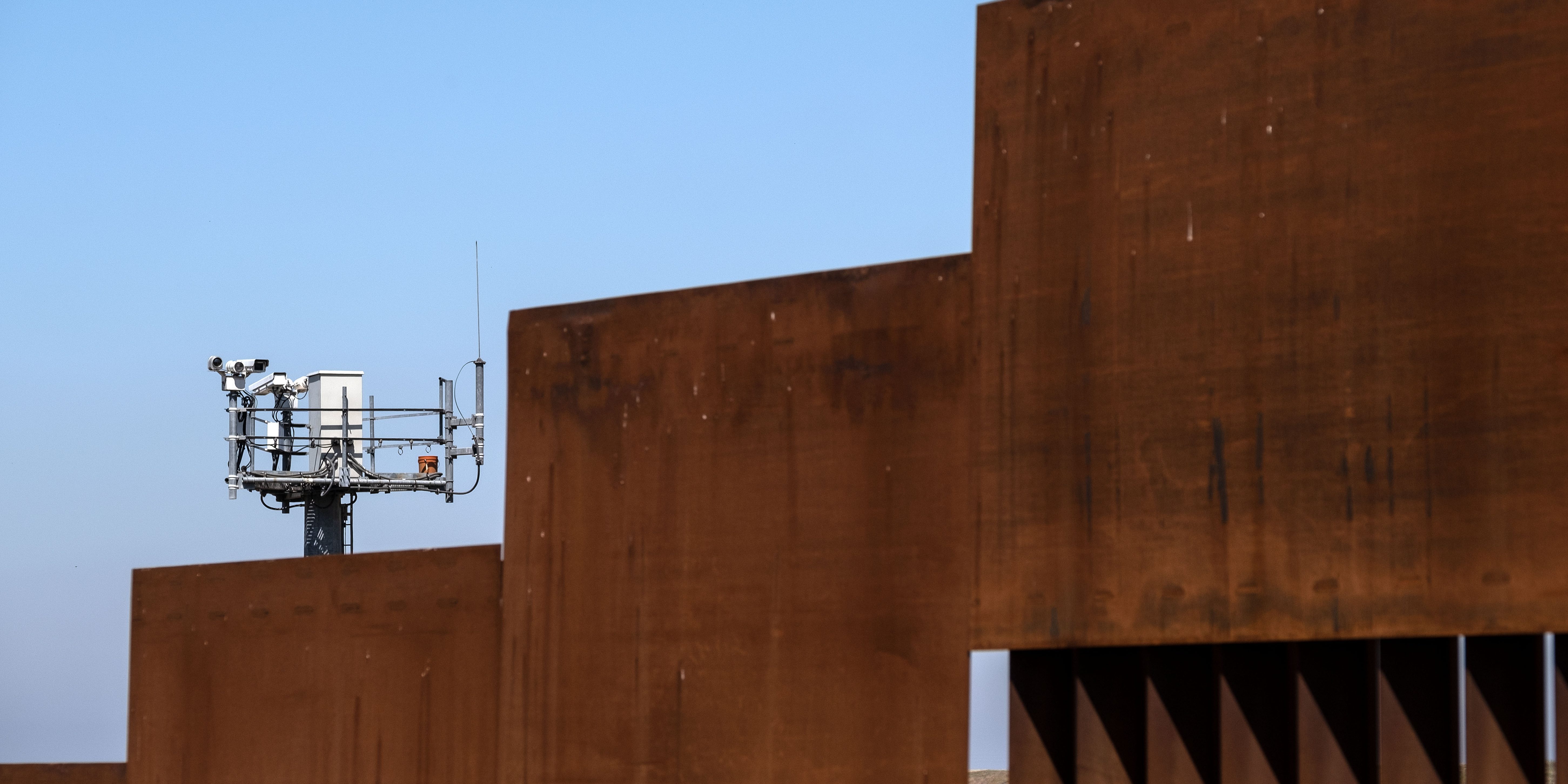
Five years after Google Cloud CEO Thomas Kurian assured employees that the company was “not working on any projects associated with immigration enforcement at the southern border,” federal contract documents reviewed by The Intercept show that the tech giant is at the center of project to upgrade the so-called virtual wall.
U.S. Customs and Border Protection is planning to modernize older video surveillance towers in Arizona that provide the agency an unblinking view of the border. A key part of the effort is adding machine-learning capabilities to CBP cameras, allowing the agency to automatically detect humans and vehicles as they approach the border without continuous monitoring by humans. CBP is purchasing computer vision powers from two vendors, IBM and Equitus. Google, the documents show, will play a critical role stitching those services together by operating a central repository for video surveillance data.

The work is focused on older towers purchased from Israeli military defense contractor Elbit. In all, the document notes “50 towers with up to 100 cameras across 6 sites in the Tucson Sector” will be upgraded with machine learning capabilities.
IBM will provide its Maximo Visual Inspection software, a tool the company generally markets for industrial quality control inspections — not tracking humans. Equitus is offering its Video Sentinel, a more traditional video surveillance analytics program explicitly marketed for border surveillance that, according to a promotional YouTube video, recently taken offline, featuring a company executive, can detect “people walking caravan style … some of them are carrying backpacks and being identified as mules.”
“Within 60 days from the start of the project, real life video from the southern border is available to train and create AI/ML models to be used by the Equitus Video Sentinel.”
Tying together these machine learning surveillance tools is Google, which the document reveals is supplying CBP with a cloud computing platform known as MAGE: the ModulAr Google Cloud Platform Environment. Based on the document, Google is providing a hub for video surveillance data and will directly host the Equitus AI analysis tool. It appears every camera in CBP’s Tucson Sector will pipe data into Google servers: “This project will focus initially on 100 simultaneous video streams from the data source for processing,” the document reads, and “the resulting metadata and keyframes will be sent to CBP’s Google Cloud.”
The diagram also notes that one of Google’s chief rivals, Amazon Web Services, provides CBP with unspecified cloud computing services.



During President Trump’s first term, border surveillance and immigration enforcement work carried a stigma in the tech sector it has in part shed today.

In 2020, The Intercept revealed a document produced by the CBP Innovation Team, known as INVNT, that stated Google Cloud services would be used in conjunction with AI-augmented surveillance towers manufactured by defense contractor Anduril: “Google Cloud Platform (GCP) will be utilized for doing innovation projects for C1’s INVNT team like next generation IoT, NLP (Natural Language Processing), Language Translation and Andril [sic] image camera and any other future looking project for CBP. The GCP has unique product features which will help to execute on the mission needs.” (A CBP spokesperson confirmed to The Intercept that “Andril” was a misspelling of Anduril.)
After the Anduril work came to light, Google’s cloud computing chief Thomas quickly attempted damage control, directly contradicting the Department of Homeland Security and telling concerned employees that the company was not involved in immigration enforcement on the Mexican border, CNBC reported at the time. “We have spoken directly with Customs and Border Patrol and they have confirmed that they are not testing our products for those purposes,” Kurian added.
If this was true then, it’s certainly not now; references to Google services appear repeatedly throughout the tower modernization project document. A technical diagram showing how video data flows between various CBP servers shows Google’s MAGE literally in the middle.
Customs and Border Protection did not respond to a request for comment about its use of Google Cloud.
Google did not respond to specific questions about the project, nor address Kurian’s prior denial.
In a statement provided to The Intercept, Google Public Sector executive Jim Kelly attempted to distance the company slightly from the border surveillance work. “CBP has been public about how it has a multicloud strategy and has used Google Cloud for work like translation,” Kelly wrote. “In this case, Google Cloud is not on the contract. That said, customers or partners can purchase Google Cloud’s off-the-shelf compute, storage, and networking products for their own use, much like they might use a mobile network or run their own computer hardware.”
Kelly’s statement indicates the government is acquiring Google Cloud services through a reseller, as is common in federal procurement. But Kelly’s comparison of Google Cloud technology to buying off-the-shelf computer hardware is misleading. Even if it’s supplied through a subcontractor or reseller, CBP’s use of Google’s service still requires a constant and ongoing connection to the company’s cloud infrastructure. Were Google still serious about “not working on any projects associated with immigration enforcement at the southern border,” as Kurian claimed in 2020, it would be trivial to prevent CBP from using Google Cloud.
“Border communities end up paying the price with their privacy.”
Industry advocates and immigration hard-liners have long touted the “virtual wall” initiative, which substitutes iron and concrete barriers and Border Patrol agents for a 2,000 mile array of sensors, cameras, and computers. But critics say advanced technology is no substitute for policy reforms.
“On top of the wasted tax dollars, border communities end up paying the price with their privacy, as demonstrated by the recent findings by the Government Accountability Office that CBP had failed to implement six out of six key privacy policy requirements,” Dave Maass, director of investigations at the Electronic Frontier Foundation, told The Intercept, referring to the tower program’s dismal privacy protections record. “For more than two decades, surveillance towers at the border have proven to be a boondoggle, and adding AI isn’t going to make it any less of a boondoggle — it will just be an AI-powered boondoggle.”
IT’S EVEN WORSE THAN WE THOUGHT.
What we’re seeing right now from Donald Trump is a full-on authoritarian takeover of the U.S. government.
This is not hyperbole.
Court orders are being ignored. MAGA loyalists have been put in charge of the military and federal law enforcement agencies. The Department of Government Efficiency has stripped Congress of its power of the purse. News outlets that challenge Trump have been banished or put under investigation.
Yet far too many are still covering Trump’s assault on democracy like politics as usual, with flattering headlines describing Trump as “unconventional,” “testing the boundaries,” and “aggressively flexing power.”
The Intercept has long covered authoritarian governments, billionaire oligarchs, and backsliding democracies around the world. We understand the challenge we face in Trump and the vital importance of press freedom in defending democracy.
We’re independent of corporate interests. Will you help us?
IT’S BEEN A DEVASTATING year for journalism — the worst in modern U.S. history.
We have a president with utter contempt for truth aggressively using the government’s full powers to dismantle the free press. Corporate news outlets have cowered, becoming accessories in Trump’s project to create a post-truth America. Right-wing billionaires have pounced, buying up media organizations and rebuilding the information environment to their liking.
In this most perilous moment for democracy, The Intercept is fighting back. But to do so effectively, we need to grow.
That’s where you come in. Will you help us expand our reporting capacity in time to hit the ground running in 2026?
We’re independent of corporate interests. Will you help us?

I’M BEN MUESSIG, The Intercept’s editor-in-chief. It’s been a devastating year for journalism — the worst in modern U.S. history.
We have a president with utter contempt for truth aggressively using the government’s full powers to dismantle the free press. Corporate news outlets have cowered, becoming accessories in Trump’s project to create a post-truth America. Right-wing billionaires have pounced, buying up media organizations and rebuilding the information environment to their liking.
In this most perilous moment for democracy, The Intercept is fighting back. But to do so effectively, we need to grow.
That’s where you come in. Will you help us expand our reporting capacity in time to hit the ground running in 2026?
We’re independent of corporate interests. Will you help us?
Contact the author:

Related

Crossing the U.S. Border? Here’s How to Protect Yourself

How a Landlord and a Florida PR Firm Helped Trump Kick Off the Tren de Aragua Gang Panic

Google Won’t Say Anything About Israel Using Its Photo Software to Create Gaza “Hit List”

LexisNexis Sold Powerful Spy Tools to U.S. Customs and Border Protection
Latest Stories

Google DeepMind Engineer Resigns in Protest of Pentagon Contract
Sofia Liguori stepped down from DeepMind due to current military contracts — not speculative fears of an AI apocalypse.

The War on Immigrants
Trump’s Obsession With Somalia Isn’t Just Racist. It’s Been Lethal.
Beyond targeting Rep. Ilhan Omar, the Trump administration has killed, arrested, deported, and demonized Somalis at home and abroad.

Kohen Wiley’s Family Says Investigators Didn’t Contact Them Before Concluding Cops Did No Wrong
Mississippi has yet to release any support for its claim that a “thorough and impartial” review showed the shooting was “justified.”