
Top Democrats in Congress are turning against a deal that some of their caucuses’ most powerful members reached with Republicans over the weekend to maintain steady funding for U.S. Immigrations and Customs Enforcement.
Only a day after Senate and House Democratic appropriations leaders said the bill was the best they could do, some of the Democrats, including House Minority Leader Hakeem Jeffries, D-N.Y., said Wednesday they would oppose it during a final vote.
Civil rights advocates worried that, if the bipartisan deal the appropriations committees reached passes, it will provide cover for ICE after the killing of Renee Good.
“Every dollar more is a dollar that is enabling this bad behavior, and every dollar emboldens these agencies.”
“Every dollar more is a dollar that is enabling this bad behavior, and every dollar emboldens these agencies,” said Kate Voigt, a senior policy counsel at the American Civil Liberties Union. “Giving these agencies this much money right now in a business-as-usual appropriations bill is a stamp of approval on their behavior.”
The House could vote on the measure Thursday, with a make-or-break Senate vote coming next week.
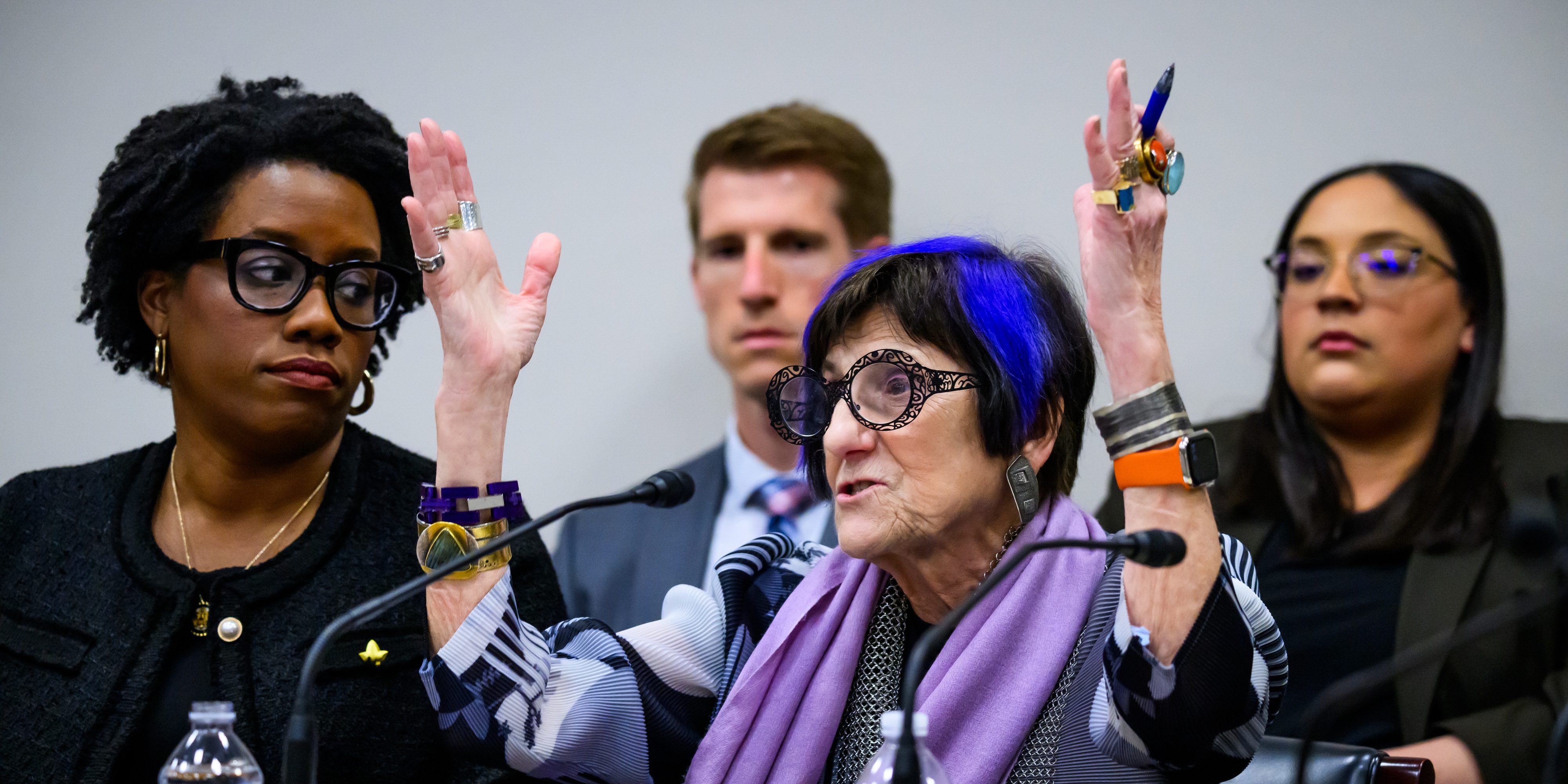
Even the ranking member of the House Appropriations Committee who led negotiations on the compromise, Rep. Rosa DeLauro, D-Conn., offered a tepid defense at a House Rules Committee meeting later in the day.
“It is complicated,” she said, “when you’re both trying to govern and you’re trying to resist what may be infringements, to thread that needle and try to be able to move forward.”



Primary Bait
The compromise on funding ICE had barely been announced before drawing a furious response from progressives.
Congress is trying to craft a package of bills that will provide continued funding for the federal government past a January 30 deadline, which was set at the end of the last government shutdown.
The package includes the Department of Homeland Security, the parent agency for ICE and U.S. Customs and Border Protection, which itself houses Border Patrol.

Instead of defunding or abolishing ICE, as some progressives have demanded, the bill keeps the agency’s funding flat. Customs and Border Protection would see its regular funding drop by $1.3 billion.
Democratic leaders in the House heard an earful about the bill at a caucus meeting Wednesday. During the meeting, Jeffries said he would vote against it, according to multiple reports.
The bill is already playing into Democratic primaries, where challengers have seized on it as an example of out-of-touch Democratic incumbents.
Chuck Park, a former New York City Council staffer who is challenging Rep. Grace Meng, D-N.Y., said the bill was “not a compromise. It funds ICE at current levels and offers reforms that don’t get anywhere near solving the problem.”
“Any Democrat who supports this needs to be primaried.”
He continued, “Any Democrat who supports this needs to be primaried.”
Meng, a House Appropriations Committee member, said in a statement that she would oppose the bill on the House floor.
“It’s clear that ICE must be held accountable. This bill fails to meet this moment,” Meng said. “For the constituents in my community who have been violently detained, for Renee Good and other U.S. Citizens who have been wrongfully targeted by ICE agents, and for the law-abiding immigrants throughout the United States whose rights have been trampled on, I cannot in good conscience vote for this bill.”
Guardrails That Aren’t
In defense of the bill, Democratic leaders on the House and Senate appropriations committees have pointed to a handful of provisions they say could provide a check on some of ICE and CBP’s worst abuses.
The bill would increase reporting requirements when DHS shuffles funds between agencies. It boosts funding for oversight offices that President Donald Trump’s administration has tried to gut. It would also provide $20 million in additional funding for body cameras.

In a statement, Senate Appropriations Committee Vice Chair Patty Murray, D-Wash., said that even if Democrats were successful in tanking the bill, another shutdown would be worse.
“The suggestion that a shutdown in this moment might curb the lawlessness of this administration is not rooted in reality: under a CR” — a continuing resolution that funds the government for a limited period — “and in a shutdown, this administration can do everything they are already doing — but without any of the critical guardrails and constraints imposed by a full-year funding bill,” Murray said.
Murray pointed to the $75 billion that congressional Republicans gave to DHS to spend over four years as it likes as part of the One Big Beautiful Bill Act.
Murray and DeLauro argue that Democrats in the minority have limited tools to block funding for DHS, and that even preventing additional funding for the agency represents a win.
Still, it remained unclear Wednesday whether some appropriations leaders — including DeLauro — will themselves vote for the bills. Others, such as Sen. Chris Murphy, D-Conn., have said they will vote against the DHS funding bill.
There do appear to be some centrist Democrats open to voting for the measure. Appropriations Committee member Rep. Henry Cuellar, D-Texas, told The Hill that he would vote for the bill, citing the oversight and body-camera provisions.
The purported guardrails will do little to curb ICE and CBP, advocates said on a press call on Wednesday.
ICE is already flouting transparency requirements such as a law allowing members of Congress to inspect detention facilities. The body-camera funding is also toothless, civil rights groups said.

“Agents are committing egregious abuses day in and day out while wearing body cameras, and I would remind everyone that Jonathan Ross was in fact holding up his phone and voluntarily filming in the moments before he shot Renee Good,” said Heidi Altman, vice president of policy at the National Immigration Law Center.
Moreover, DHS can still shuttle funds within and between agencies, with some restrictions. Altman said members of Congress cannot “wash their hands” of fighting funding for DHS by pointing to the One Big Beautiful Bill Act.
“Every member of Congress is responsible to their constituents,” she said, “and right now, we are hearing quite the outcry from across the country to do every single thing in their authority to take away power and take away money from this agency that is hurting their community members.”
IT’S EVEN WORSE THAN WE THOUGHT.
What we’re seeing right now from Donald Trump is a full-on authoritarian takeover of the U.S. government.
This is not hyperbole.
Court orders are being ignored. MAGA loyalists have been put in charge of the military and federal law enforcement agencies. The Department of Government Efficiency has stripped Congress of its power of the purse. News outlets that challenge Trump have been banished or put under investigation.
Yet far too many are still covering Trump’s assault on democracy like politics as usual, with flattering headlines describing Trump as “unconventional,” “testing the boundaries,” and “aggressively flexing power.”
The Intercept has long covered authoritarian governments, billionaire oligarchs, and backsliding democracies around the world. We understand the challenge we face in Trump and the vital importance of press freedom in defending democracy.
We’re independent of corporate interests. Will you help us?
IT’S BEEN A DEVASTATING year for journalism — the worst in modern U.S. history.
We have a president with utter contempt for truth aggressively using the government’s full powers to dismantle the free press. Corporate news outlets have cowered, becoming accessories in Trump’s project to create a post-truth America. Right-wing billionaires have pounced, buying up media organizations and rebuilding the information environment to their liking.
In this most perilous moment for democracy, The Intercept is fighting back. But to do so effectively, we need to grow.
That’s where you come in. Will you help us expand our reporting capacity in time to hit the ground running in 2026?
We’re independent of corporate interests. Will you help us?

I’M BEN MUESSIG, The Intercept’s editor-in-chief. It’s been a devastating year for journalism — the worst in modern U.S. history.
We have a president with utter contempt for truth aggressively using the government’s full powers to dismantle the free press. Corporate news outlets have cowered, becoming accessories in Trump’s project to create a post-truth America. Right-wing billionaires have pounced, buying up media organizations and rebuilding the information environment to their liking.
In this most perilous moment for democracy, The Intercept is fighting back. But to do so effectively, we need to grow.
That’s where you come in. Will you help us expand our reporting capacity in time to hit the ground running in 2026?
We’re independent of corporate interests. Will you help us?
Contact the author:

Related


Latest Stories

Bodycam: Cop Was Not in Danger When He Fired Shots That Killed 1-Year-Old Kohen Wiley
Mississippi investigators said the shooting was “justified,” but new body camera footage shows the cop firing into the passenger’s side as the car passed by him.

The Intercept Briefing
The Intercept Live in Conversation With Robert Reich
Inequality Media co-founder Robert Reich and The Intercept’s Akela Lacy break down the most pressing issues of the midterm elections.

Midterms 2026
Giant Crypto Super PAC Funnels Big Money to Former Trump Official’s Firm to Support… Democrats?
The Fellowship PAC routed more than half a million dollars in support of Democrats through a firm co-founded by former Trump crypto adviser Bo Hines.