Jaafar Annan has been posted up on the sidewalk outside the emergency room of Rafik Hariri University Hospital, on the southern edge of Beirut, for so long that he’s become a permanent fixture.
“The hospital has become my home,” Annan said, exhausted.
Last week, an Israeli strike leveled the building where Annan’s family lived in Kayfoun, a town in the Mount Lebanon governorate, west of the Lebanese capital.
“I buried my father,” he said, “but my mother is still missing.”
Since then, his days have become a single-minded search for any sign of his mother, Fatima, who is 56. Like several others searching for missing family members, Annan gave a sample of his blood to the hospital, hoping he can get some closure with a DNA match to unidentified remains.
“I walk through hospitals in the Mount Lebanon region. I stare at injured faces. I go to the morgues. I look for a mole, a mark,” Annan said. “Then I come back here. Waiting for the sample results.”
“We are dealing with human fragments that the force of the explosions has turned into medical puzzles.”
The cold-storage units at the Hariri hospital have been fashioned into ad hoc laboratories to identify a relentless influx of dead bodies.
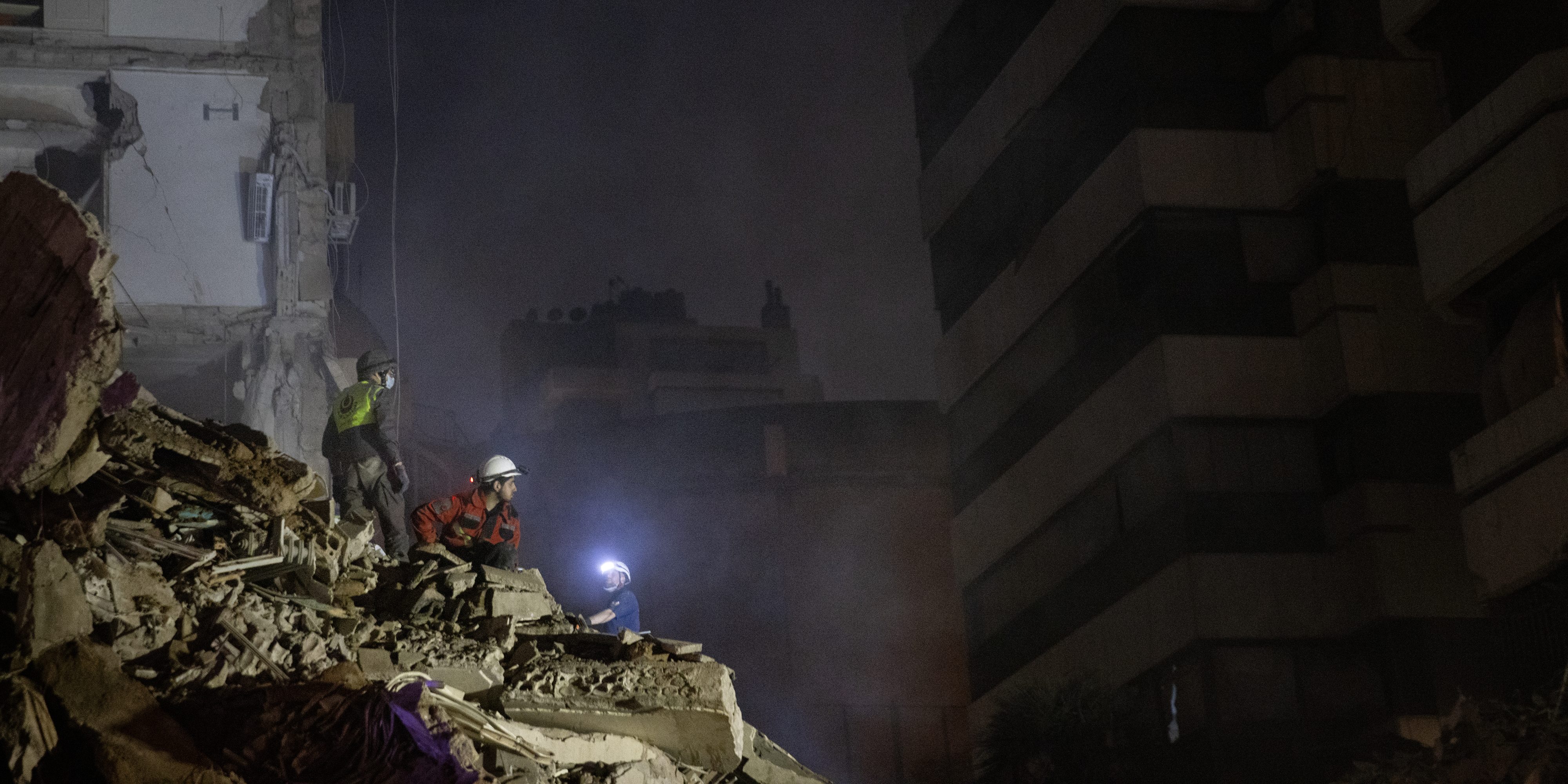
The unprecedented scales of DNA identification of corpses is born of a macabre need. Last week, after Iran and the U.S. agreed to a ceasefire, Israel pressed on in its Lebanese front with a ferocious blitz of airstrikes. The toll was staggering, leaving demolished buildings and infrastructure, along with the attendant skyrocketing casualties — the violence rending people into unrecognizable forms.
“The bodies arrive completely disfigured,” said Hisham Fawwaz, director of the hospitals and dispensaries department at the Lebanese Ministry of Health, which operates the hospital. “The remains are scattered and the features obliterated. We are often not dealing with whole bodies. We are dealing with human fragments that the force of the explosions has turned into medical puzzles.”
After the Iran–U.S. truce, Israel launched more than 100 strikes on Lebanon in just 10 minutes, with the Israeli government taking to social media to brag about its assault. The latest round of hostilities between with Israel had already brought weeks of ravages to Lebanon, but last week’s onslaught, dubbed “Black Wednesday” by the Lebanese, razed densely populated neighborhoods in the capital. At least 357 were killed and more than 1,000 were injured, according to the health ministry.
A week later, dozens of people are still missing. The ceasefire in Lebanon announced by President Donald Trump on Thursday will hopefully lead to fewer bombings, but it won’t slow families’ attempts to find their loved ones and, if worse comes to worst, identify their remains.
The families remain on a desperate quest to track them down, whether they’re pinned under the wreckage or hidden among the dismembered bodies at the morgues like the one at Hariri Hospital.
At one point, more than 90 unidentified bodies were held there, some stretching back to the initial days of Israeli bombardment. Each body has been assigned a temporary number, waiting for someone to claim it.
The Health Ministry established a central triage center to absorb the uninterrupted flow of bodies, along with a protocol: document tattoos, distinguishing marks, and remnants of burned clothing that a family member might remember. Hospital workers also cross-reference physical descriptions from families with what is recorded of unidentified remains.
If that proves too difficult, doctors draw blood from living relatives to match the DNA against the unclaimed fragments of victims.
“Suspended Loss”
Zahraa Aboud had just recently fled her hometown of Anqoun in southern Lebanon. Israeli ground troops had invaded the town in March, razing entire villages and displacing hundreds of thousands as they set up a buffer zone intended to stop Hezbollah from lobbing rockets into northern Israel.
When the Israeli airstrikes grew relentless, Aboud, 29, and her sister traveled to Beirut, to their aunts’ apartment in the Ain Al-Mrayseh neighborhood. In the capital, she thought, they would be out of reach of the violence.
Israel’s missiles would soon come down on her.
According to Aboud’s father, Qassem, when an airstrike hit the upper floors of the aunts’ building, everyone in the apartment upstairs — including six children — was instantly killed. A floor below, Aboud’s aunts were killed in the same strike, and her sister was taken to Clemenceau Medical Center with serious wounds.
Zahraa Aboud, though, hasn’t been seen since.
“We are not looking for rubble,” said Qassem, 56. “We are looking for life. Or at least for the certainty that will put out the fire in our hearts.”
Rescue teams gave up after a few days of searching, but families of those missing in the rubble refused to leave the scene and pressured them to keep going.
Qassem Aboud, meanwhile, hasn’t stopped circling Beirut for traces of his daughter. Back and forth, he checks private hospitals, government hospitals, and lists of unidentified patients. In ICU wards across the city, he peers at any face behind an oxygen mask that might be hers.
The Aboud family calls the tragic situation “suspended loss”: They can’t find a sign of life to suggest they may get Zahraa back, but they’ve also been denied a final farewell and the chance to see their daughter off.
Like the others, Qassem submitted a blood sample to the hospital in hopes of later finding a DNA match — and closure.
After days of searching, Qassem came to suspect that the force of the explosion may have thrown his daughter’s body into a neighboring building. When he checked, he found the apartments were either locked or abandoned by departed residents. So far, he can’t find anyone to let him in.
“I feel very helpless every day, but will keep searching until I bury her,” he said.
The rubble itself has become a legal obstacle.
Buildings destroyed by Israeli strikes are classified, under Lebanese law, as private property. Civil defense teams and relief organizations cannot fully clear or demolish them without prior judicial authorization. The red tape is meant to protect property rights, to preserve the legal record, and to avoid tampering with what the law considers a crime scene, according to a source at the public prosecutor’s office who asked to stay anonymous as he’s not authorized to talk to the media.
Some of the legal restrictions have slowed rescues. Families that want to utilize specialized search dogs, which can move through the wreckage faster than people, must file formal requests at the public prosecutor’s office.
“We submitted the requests. We begged the relevant authorities to expedite the judicial procedures,” said a relative of a missing woman who asked not to be identified. “But the Lebanese judiciary has not moved. Every minute that passes is a nail in the coffin of our loved ones, while the judiciary is still reviewing paperwork.”
When families sought exceptional permissions to allow rescue teams to remove the rubble, judicial authorities did not respond to their requests, families of missing people said. (Judicial authorities did not respond to a request for comment.)
“The goal is not accounting. It is to return to each victim their name, and to give their families the right to a farewell.”
Back at Hariri Hospital, families continued filing into a makeshift office opened by the Health Ministry designed to help families identify their lost loved ones. Inside, they recalled the tiniest details of their missing relative, from birthmarks to unique articles of clothing — anything that may lead to closing a case. Then they give their blood. And they wait.
“The goal is not accounting,” said Fawwaz, the Lebanese Ministry of Health official. “It is to return to each victim their name, and to give their families the right to a farewell that ends the spiral of doubt.”
This article is published in collaboration with Egab.
IT’S EVEN WORSE THAN WE THOUGHT.
What we’re seeing right now from Donald Trump is a full-on authoritarian takeover of the U.S. government.
This is not hyperbole.
Court orders are being ignored. MAGA loyalists have been put in charge of the military and federal law enforcement agencies. The Department of Government Efficiency has stripped Congress of its power of the purse. News outlets that challenge Trump have been banished or put under investigation.
Yet far too many are still covering Trump’s assault on democracy like politics as usual, with flattering headlines describing Trump as “unconventional,” “testing the boundaries,” and “aggressively flexing power.”
The Intercept has long covered authoritarian governments, billionaire oligarchs, and backsliding democracies around the world. We understand the challenge we face in Trump and the vital importance of press freedom in defending democracy.
We’re independent of corporate interests. Will you help us?
IT’S BEEN A DEVASTATING year for journalism — the worst in modern U.S. history.
We have a president with utter contempt for truth aggressively using the government’s full powers to dismantle the free press. Corporate news outlets have cowered, becoming accessories in Trump’s project to create a post-truth America. Right-wing billionaires have pounced, buying up media organizations and rebuilding the information environment to their liking.
In this most perilous moment for democracy, The Intercept is fighting back. But to do so effectively, we need to grow.
That’s where you come in. Will you help us expand our reporting capacity in time to hit the ground running in 2026?
We’re independent of corporate interests. Will you help us?

I’M BEN MUESSIG, The Intercept’s editor-in-chief. It’s been a devastating year for journalism — the worst in modern U.S. history.
We have a president with utter contempt for truth aggressively using the government’s full powers to dismantle the free press. Corporate news outlets have cowered, becoming accessories in Trump’s project to create a post-truth America. Right-wing billionaires have pounced, buying up media organizations and rebuilding the information environment to their liking.
In this most perilous moment for democracy, The Intercept is fighting back. But to do so effectively, we need to grow.
That’s where you come in. Will you help us expand our reporting capacity in time to hit the ground running in 2026?
We’re independent of corporate interests. Will you help us?
Contact the author:
Related
“I Want to Occupy”: Inside the Israeli Movement Pushing to Raze and Settle Southern Lebanon

Putting Fuel on a Ceasefire: Israel Tries to Kill U.S.–Iran Talks
More Than 1 Million People in Lebanon Have Been Displaced. These Are Their Stories.

“Liberate Their Bodies From Their Souls”: The Lies That Sell the Iran War

Gaza’s Civil Defense Forces Keep Digging for 10,000 Missing Bodies
Latest Stories

Israel’s War on Gaza
A C-Section in Shackles: A Palestinian Woman’s Harrowing Birth in Israeli Detention
Dana Joudeh was denied proper food and medical care throughout her pregnancy in an Israeli prison. She gave birth to a premature baby surrounded by armed guards.

ICE Shooting in NYC Inflames Mamdani’s Policing Problem
After ICE shot a young father in Manhattan, New Yorkers asked the mayor to protect them from his police department and federal agents alike.

Where Are the Iran War Protests?
Despite a wildly unpopular war with Iran, a mass protest movement for peace hasn’t materialized — at least in the ways we’ve been taught to recognize.