
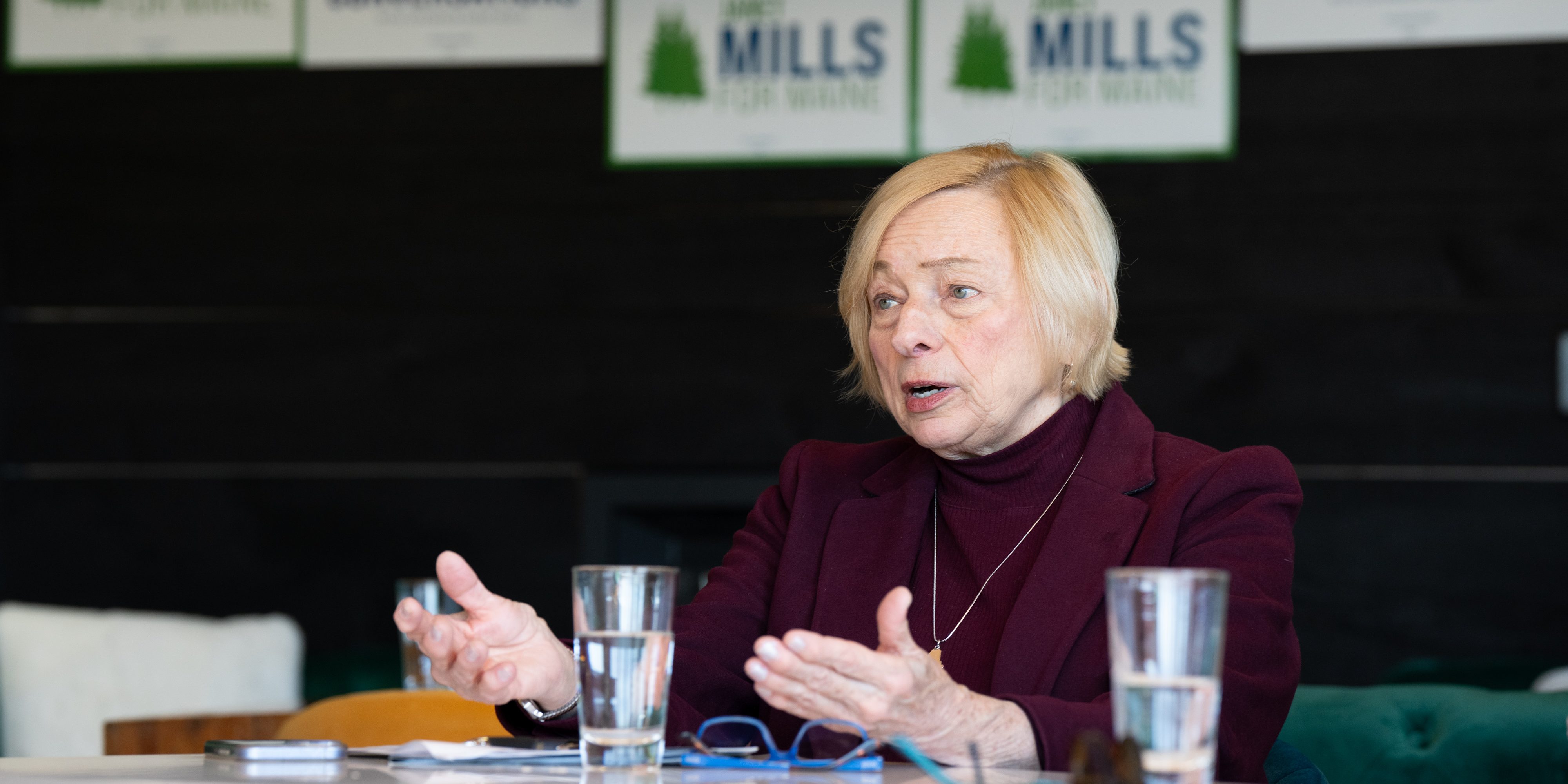
The Democratic Party’s pick for Maine senator suspended her candidacy on Thursday. Democratic Gov. Janet Mills, who entered the race as the establishment pick and assumed favorite, announced her campaign did not have the financial resources to continue.
Mills’s exit less than six weeks before the June primary clears the path for populist candidate Graham Platner, now the presumed nominee, to face off against incumbent Republican Sen. Susan Collins in the November general election after the party worked to subdue Platner’s campaign. The Democratic Party’s decision to wade into the primary at all had reignited a criticism that the Democratic establishment would stop at nothing to keep progressives out of Congress.
“The Democratic establishment — and especially calcified Senate leadership — is learning in real time that they are wildly out of touch with what Democratic primary voters want,” said Amanda Litman, co-founder of Run for Something, which recruits young progressive candidates for office. “The establishment simply doesn’t have the juice (or the trust) anymore.”


By the time Mills, 78, ended her campaign on Thursday, party leaders had changed their tune on Platner. Senate Minority Leader Chuck Schumer, who backed Mills early in the race, released a statement with New York Sen. Kirsten Gillibrand, the chair of Democratic Senatorial Campaign Committee, saying that Collins “has never been more vulnerable” and that they would work with Platner to beat her. The DSCC had financially backed Mills’s campaign, forming a joint fundraising committee with her in October. And they stuck by Mills even as her campaign appeared to languish.
Platner, once considered a long-shot candidate marred by controversy, has surged this year in fundraising and polling. In a statement in January, Gillibrand said she was “very optimistic” about Mills’s race. In February, when polling numbers came out showing Platner beating Mills with 64 percent support to her 26, Schumer remained in her corner.
The upset marks “a massive embarrassment for Chuck Schumer and DSCC operatives,” a Democratic strategist told The Intercept, speaking on the condition of anonymity for fear of professional reprisal. “This was their star recruit and she couldn’t even make it to the election. No longer can they be the gatekeepers.”
Platner has faced a slew of controversies since launching his campaign last year, including revelations that he had a Nazi tattoo and had posted a series of regrettable comments on Reddit. Those pitfalls led many of Platner’s critics to compare him to another populist Democratic darling who took a hard turn to the right after entering Congress: Sen. John Fetterman, D-Pa.

On Thursday, Fetterman made clear that he would not welcome the comparison. While other members of his party prepared to embrace Platner, Fetterman told reporters: “Democrats really, really like Platner in Maine, but the Republicans fucking love him. If Maine wants an asshole with a Nazi tattoo on his chest, they get him.”
In a statement on Thursday, Platner said he looked forward to working with Mills to defeat Collins in November. “This race has never been about me or about any one person. It’s about a movement of working Mainers who are fed up with being robbed by billionaires and the politicians they own, and who are taking back their power.”
The day before she dropped out of the race, The Associated Press published an article about Mills campaigning as an underdog in the race despite having the resume for the job. On Thursday, Mills’s campaign was over.
IT’S EVEN WORSE THAN WE THOUGHT.
What we’re seeing right now from Donald Trump is a full-on authoritarian takeover of the U.S. government.
This is not hyperbole.
Court orders are being ignored. MAGA loyalists have been put in charge of the military and federal law enforcement agencies. The Department of Government Efficiency has stripped Congress of its power of the purse. News outlets that challenge Trump have been banished or put under investigation.
Yet far too many are still covering Trump’s assault on democracy like politics as usual, with flattering headlines describing Trump as “unconventional,” “testing the boundaries,” and “aggressively flexing power.”
The Intercept has long covered authoritarian governments, billionaire oligarchs, and backsliding democracies around the world. We understand the challenge we face in Trump and the vital importance of press freedom in defending democracy.
We’re independent of corporate interests. Will you help us?
IT’S BEEN A DEVASTATING year for journalism — the worst in modern U.S. history.
We have a president with utter contempt for truth aggressively using the government’s full powers to dismantle the free press. Corporate news outlets have cowered, becoming accessories in Trump’s project to create a post-truth America. Right-wing billionaires have pounced, buying up media organizations and rebuilding the information environment to their liking.
In this most perilous moment for democracy, The Intercept is fighting back. But to do so effectively, we need to grow.
That’s where you come in. Will you help us expand our reporting capacity in time to hit the ground running in 2026?
We’re independent of corporate interests. Will you help us?

I’M BEN MUESSIG, The Intercept’s editor-in-chief. It’s been a devastating year for journalism — the worst in modern U.S. history.
We have a president with utter contempt for truth aggressively using the government’s full powers to dismantle the free press. Corporate news outlets have cowered, becoming accessories in Trump’s project to create a post-truth America. Right-wing billionaires have pounced, buying up media organizations and rebuilding the information environment to their liking.
In this most perilous moment for democracy, The Intercept is fighting back. But to do so effectively, we need to grow.
That’s where you come in. Will you help us expand our reporting capacity in time to hit the ground running in 2026?
We’re independent of corporate interests. Will you help us?
Contact the author:

Related

Progressive Group Founded by Bernie Sanders Endorses Billionaire for California Governor

The Dam Breaks: Democratic Senators Overwhelmingly Reject Arms Sales to Israel

The Democrats Don’t Know Who They’ll Be in 2028. Michigan May Offer an Answer.

GOP Megadonor Leonard Leo Is Bankrolling a Website on the Warpath Against Somalis
Latest Stories

Israel’s War on Gaza
A C-Section in Shackles: A Palestinian Woman’s Harrowing Birth in Israeli Detention
Dana Joudeh was denied proper food and medical care throughout her pregnancy in an Israeli prison. She gave birth to a premature baby surrounded by armed guards.

ICE Shooting in NYC Inflames Mamdani’s Policing Problem
After ICE shot a young father in Manhattan, New Yorkers asked the mayor to protect them from his police department and federal agents alike.

Where Are the Iran War Protests?
Despite a wildly unpopular war with Iran, a mass protest movement for peace hasn’t materialized — at least in the ways we’ve been taught to recognize.