
The bitter Michigan Senate primary was heating up earlier this month when a mystery group bought $5 million in TV ads boosting the American Israel Public Affairs Committee’s preferred candidate in the Democratic race, Haley Stevens.
The group had an anodyne name — the Center for Democratic Priorities — and no track record in Michigan politics. It was incorporated in Delaware seven months ago under a shroud of secrecy.
Online sleuths soon discovered, however, that whoever was behind the group had used the same consulting firm employed by a super PAC affiliated with AIPACs to buy the ads. Suspicions fell on the pro-Israel lobbying shop or its super PAC affiliate, which has repeatedly created so-called “pop-up” super PACs to influence elections elsewhere. AIPAC issued a denial that it was funding the ads.
Thanks to Federal Election Commission rules, voters may not know the true source of the ad campaign for months.
With the Supreme Court’s Citizens United decision 16 years ago, special interest groups began using a raft of loopholes to pour money into elections without disclosing who was doing the spending. Super PACs can take in unlimited donations and spend unlimited amounts — as long as they do not coordinate directly with candidates. Now, big money forces in politics are growing ever more sophisticated about exploiting legal loopholes to obscure their identity.
Today, groups are setting up pop-up affiliates, gaming disclosure deadlines, and using party-specific conduits — akin to a sub-political action committee — to help deflect attention away from the origins of their cash.
“All their spending on election ads immediately before a primary or general election is anonymous to voters — particularly when they use names that have no meaning.”
“All their spending on election ads immediately before a primary or general election is anonymous to voters — particularly when they use names that have no meaning and have no indication of the broader groups they are tied to,” said Shanna Ports, senior legal counsel at the Campaign Legal Center and a former attorney in the Federal Election Commission’s enforcement division. “They are very damaging to transparency for that reason.”
In the 2026 election cycle, front groups are proliferating, with cryptocurrency and artificial intelligence industries getting in on AIPAC’s game.
Groups aligned with the two tech industries have split their operations into Democratic- and Republican-aligned affiliates. The benefit can be twofold: obscuring the ultimate source of the donations, while also attracting from the large pool of partisan funders who want to give donations solely to one party.

The “pop-up” super PACs and party-affiliate PACs are not always “dark money” — a loosely defined term that generally refers to political operations that don’t disclose their donors’ identities. Nevertheless, the way they are set up can make it much more difficult for voters to follow the lavish campaign spending.
Campaign finance experts say the trend is poised to continue unless Congress and the FEC decide to act. Until then, here is a guide to who is funding the groups, what they are called and how they work.
Pop-Up Politics
AIPAC used a complicated web of political committees to influence the Illinois primary elections in March. Whether or not it is using the same tactics in Michigan — the group did not respond to a request for comment — observers expect it to continue to hide its campaign spending in the months to come, as primary candidates battle over AIPAC’s influence.
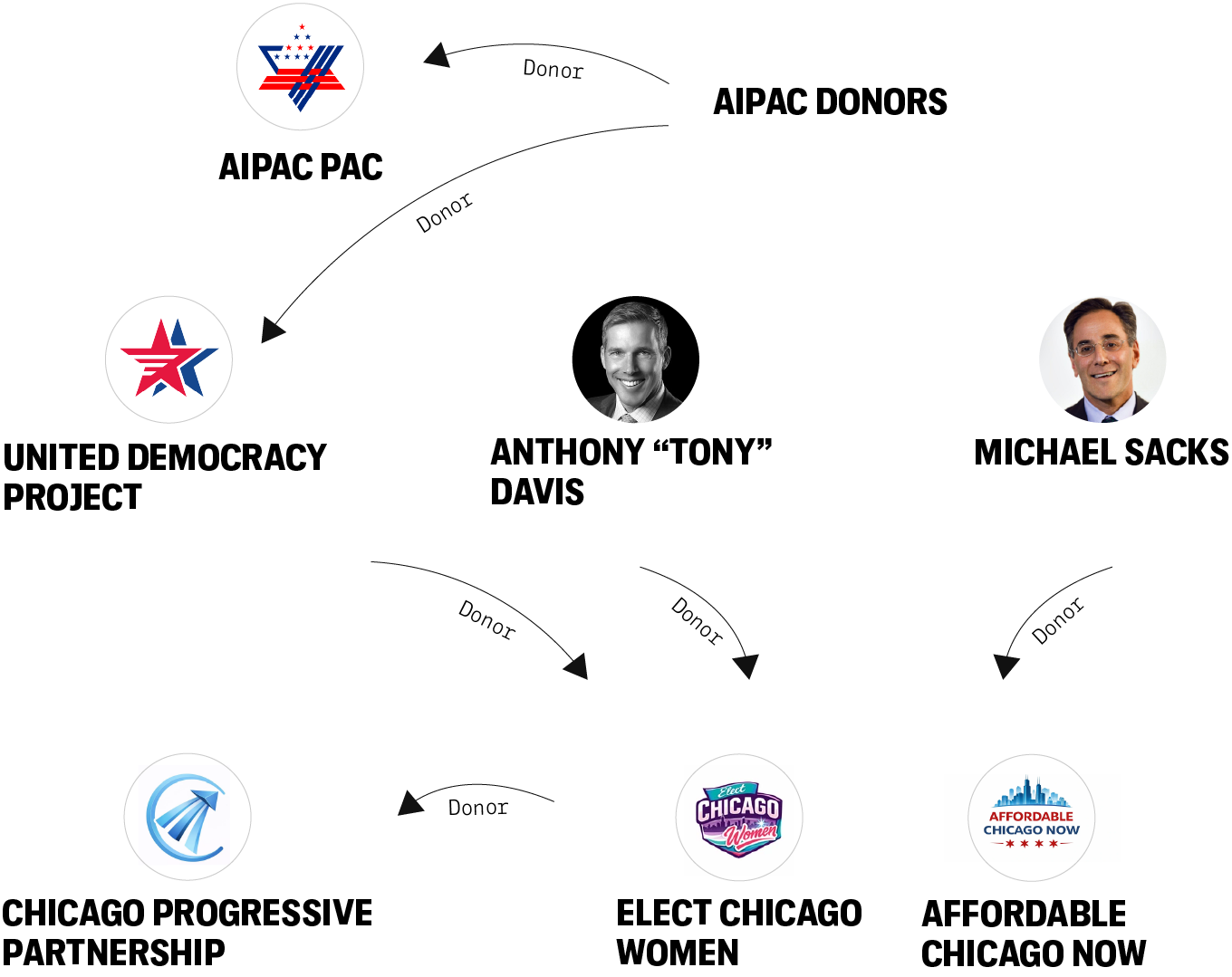
AIPAC itself is a tax-exempt nonprofit, which prohibits direct engagement with electoral politics. But the group is publicly affiliated with a traditional political action committee that can take donations of up to $5,000 per year; AIPAC PAC can donate directly to candidate campaigns.
AIPAC’s supporters can also give to United Democracy Project, a so-called “super PAC.” United Democracy Project is openly affiliated with AIPAC, an increasingly toxic brand among Democrats.
As AIPAC weighed involvement in the recent Illinois primaries, three new “pop-up” super PACs took advantage of campaign finance reporting loopholes to hide their donors’ identities. The groups — Elect Chicago Women, Affordable Chicago Now, and Chicago Progressive Partnership — were created so late in the campaign that they were only required to disclose their donors after voting in the primary was over.
The groups were created so late in the campaign that they were only required to disclose their donors after voting in the primary was over.
The groups’ donors were finally revealed after the election. They included two wealthy Chicago political donors: Michael Sacks, the CEO of an asset management firm, and Anthony “Tony” Davis, the co-founder of a private equity firm.
Before those groups filed official campaign finance reports, journalists had built a circumstantial case linking them to AIPAC through the use of campaign vendors linked to the pro-Israel lobby group.
Eventually, the hard truth emerged. FEC reports filed after the election revealed that Elect Chicago Women and Affordable Chicago Now got funds from United Democracy Project. Then Elect Chicago Women turned around and handed $1 million to the third group, Chicago Progressive Partnership.

That complicated two-step helped Chicago Progressive Partnership conceal its donors as it was running ads that many observers said were misleading. In Illinois’s 9th Congressional District, the group attempted to boost one pro-Palestinian candidate in an apparent attempt to harm another, the influencer Kat Abughazaleh. Abughazaleh ultimately lost.
In the same congressional race, Elect Chicago Women spent money to support state Sen. Laura Fine and oppose progressive Evanston Mayor Daniel Biss, who won.
In other races, it was easier for voters to track how AIPAC-aligned groups were spending their money. In some of the contests, the pop-up super PACs never popped up. Instead, United Democracy Project spent directly.
In Michigan, the new group Center for Democratic Priorities has yet to file any registration documents with the FEC. If it is classifying itself as a super PAC, it will not have to file disclosures revealing its donors until July 15, according to Ports.
Gambling on Races
With AI and crypto becoming increasingly ubiquitous, Washington is trying to sort out the regulations that could have huge impacts on these industries. In turn, crypto and AI businesses are making huge investments in electoral politics. So far, however, crypto and AI have taken a different approach to influencing elections than AIPAC. Rather than using “pop-up” super PACs, they have divided their influence operations into Republican and Democratic affiliates.
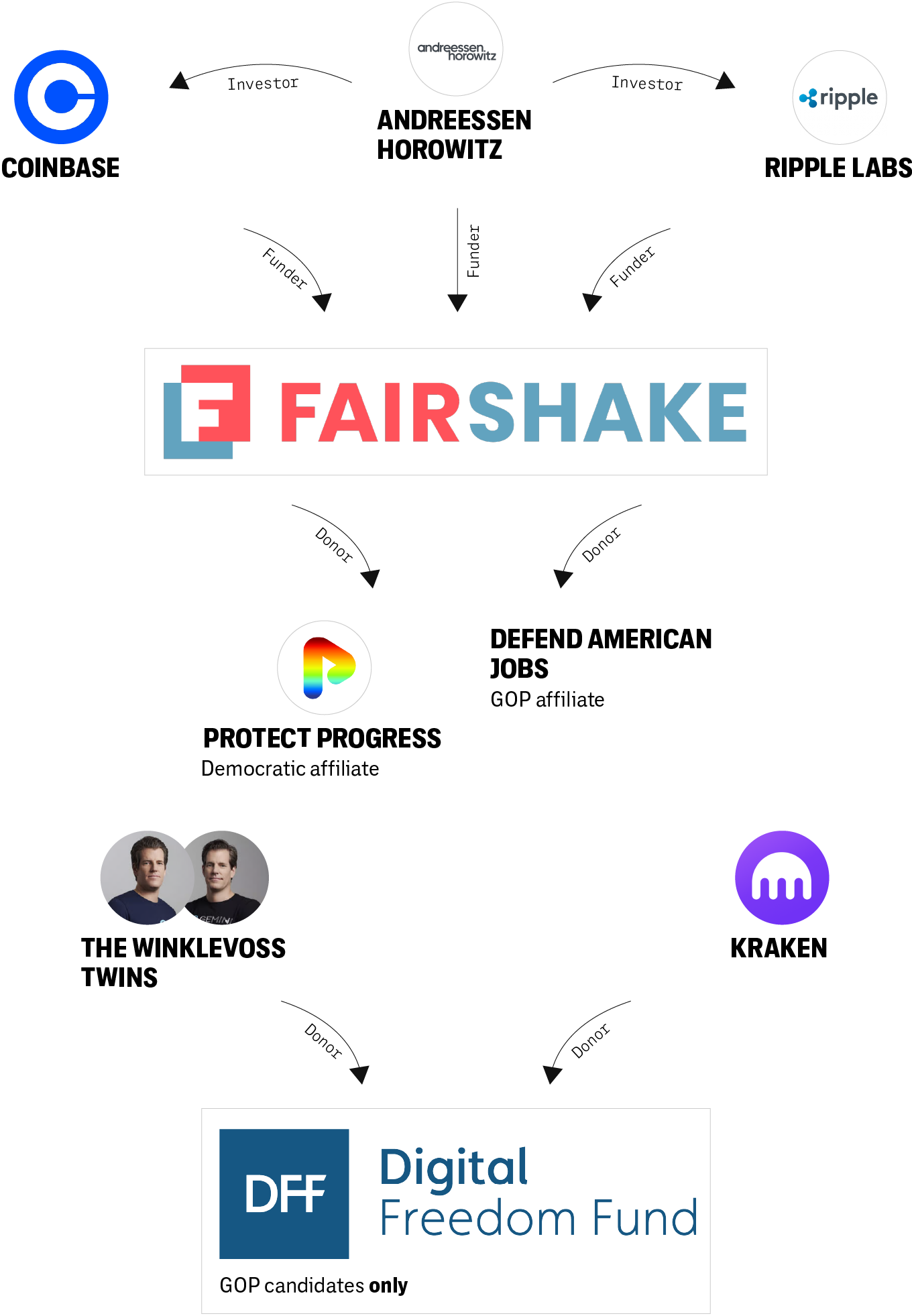
The biggest crypto super PAC is called Fairshake. The group is funded by Silicon Valley venture capital firm Andreessen Horowitz, as well as two crypto companies the firm has invested in, Coinbase and Ripple Labs.
The venture capital firm’s co-founder Marc Andreessen rose to fame in the 1990s for co-founding the web browser Netscape. More recently he has become notable as one of Donald Trump’s biggest defenders in the tech world and a frequent visitor to Trump’s Florida estate Mar-a-Lago.
Fairshake spends money on Republican primaries through its GOP affiliate, Defend American Jobs, and Democratic races through an outfit called Protect Progress. Fairshake has portrayed itself as an equal-opportunity shop, but the group’s extraordinary spending in favor of Republican candidate Bernie Moreno in 2024, when he ousted former Democratic Sen. Sherrod Brown in Ohio, opened it up to accusations of partisanship.
Brown is now running to return to the Senate against JD Vance’s Republican replacement, Jon Husted. His rhetoric this time around has been notably more muted when it comes to crypto.
Fairshake’s split personality allows donors to pick a single-party affiliate for its campaign giving. Democratic megadonor and angel investor Ron Conway donated to Protect Progress in 2024, for instance, only to announce later that year that he was breaking from the network over its support of Moreno.
The model of using party-specific affiliates may be less deceptive than “pop-up” super PACs, Ports said, but it is still misleading.
“They know that a Republican voter doesn’t want to hear from a super PAC that supports Democratic candidates. [Republican voters] are not going to trust that messaging as much, or vice versa,” she said. “They are dividing this money up to try to present their message as persuasively as possible to their target audiences.”
Fairshake’s spending on Republicans has not gone far enough for some figures in the fractious crypto world. The Winklevoss twins — the brothers behind a top Coinbase competitor, a cryptocurrency exchange called Gemini, which is distinct from Google’s AI assistant — have given millions’ worth of bitcoin to the Digital Freedom Fund PAC, which is explicitly opposed to the Democratic Party. The Digital Freedom Fund has also drawn donations from crypto exchange Kraken, another Coinbase competitor. So far the PAC has not spent heavily on political campaigns, but that could change as the midterm election season heats up.
Yet another crypto political action committee, The Fellowship PAC, is chaired by an executive at the domestic affiliate of the international stablecoin company Tether, which has recently begun mounting a push into the U.S. market. The company is backed by $10 million in donations from Cantor Fitzgerald, the bank that holds the U.S. Treasury notes backing Tether’s stablecoins. Former Cantor Fitzgerald chief Howard Lutnick serves as Trump’s commerce secretary. The PAC has endorsed only Republican candidates thus far.
Artificial Interference
Two of the artificial intelligence industry’s biggest players are backing rival political influence operations. OpenAI and Anthropic have picked their fighters in a battle over how much of a role the government should play in regulating AI.
On one side, OpenAI President Greg Brockman and his wife have donated to Leading the Future, a super PAC that aims to be an umbrella organization for the industry along the lines of Fairshake.
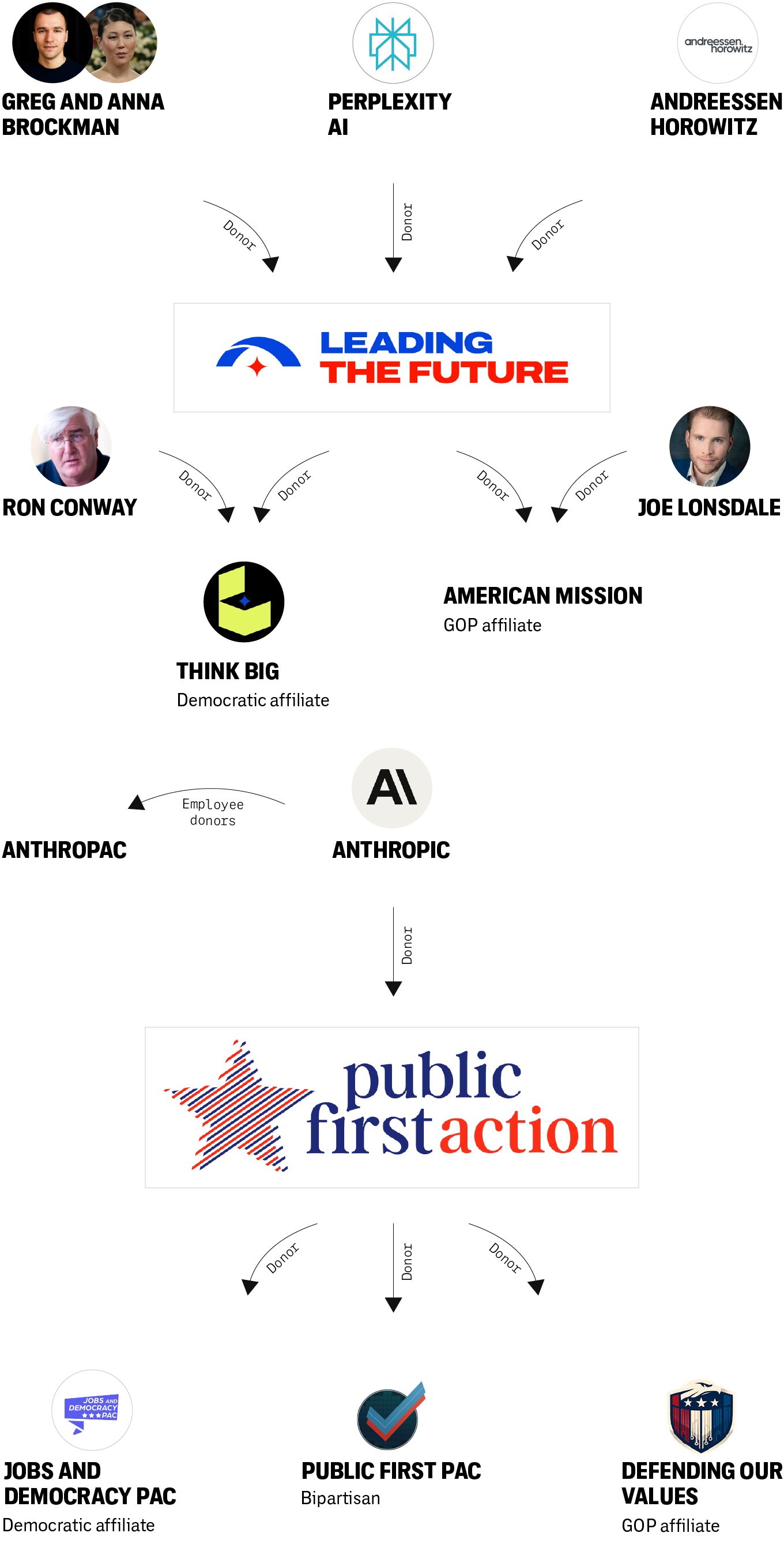
Perplexity AI and Andreessen Horowitz — which was an early investor in OpenAI — have also given money to the umbrella super PAC.
Leading the Future has a Democratic affiliate, Think Big, as well as a Republican arm, American Mission. Conway, the Democratic megadonor, has given only to Think Big, while Joe Lonsdale, the voluble right-wing venture capitalist, has given to American Mission.
If that structure sounds eerily similar to Fairshake, that is no accident. One of Leading the Future’s shot-callers is Josh Vlasto, a political operative who once worked for two powerful New York Democrats: former Gov. Andrew Cuomo and Senate Minority Leader Chuck Schumer.
OpenAI has generally favored a more relaxed approach to AI regulation. One of its top competitors, Anthropic, has staked out a position — at least rhetorically — in favor of stricter rules.
To pursue that aim, Anthropic recently created a traditional corporate political action committee, AnthroPAC, that can donate directly to politicians.
The $380 billion company has also made a major donation to a political nonprofit called Public First Action. That group sits at the heart of a network of affiliated super PACs: the bipartisan Public First PAC, the Democratic-aligned Jobs and Democracy PAC, and the Defending Our Values PAC for Republican causes.
The Republican and Democratic affiliates are led respectively by former Reps. Chris Stewart, R-Utah, and Brad Carson, D-Okla.
Public First Action has donated to all three super PACs. In a statement to The Intercept, a spokesperson called the three PACs “aligned” but said they all operate independently and that Anthropic does not play a role in directing any of the groups’ political spending.
“Public First Action did not establish Jobs and Democracy PAC, Public First PAC, or Defending Our Values PAC, all of which are independent from Public First Action and were established separately,” said the spokesperson, Anthony Rivera-Rodriguez.
In a recent North Carolina primary, Public First Action’s Democratic affiliate spent $1.6 million boosting incumbent Rep. Valerie Foushee over her opponent Nida Allam, a Durham County commissioner who has supported a moratorium on AI data center construction.
Allam told The Intercept that she believes the Anthropic-backed super PAC network has split its spending arms into Democratic and Republican affiliates to blunt attacks like those that have dogged United Democracy Project. AIPAC’s super PAC has long faced criticism in Democratic primaries for drawing donations from Trump-supporting billionaires.
Anthropic and its backers “are trying to confuse folks to say, ‘we’re not the same,’ so that their spending is not on the same FEC reports,” she said.
Anthropic voluntarily disclosed its donation to Public First Action. But since the group is set up as a nonprofit rather than a campaign committee, voters may never know who Public First Action’s other donors are. And the group does not intend to disclose them, Rivera-Rodriguez said.
“We’d welcome a broader conversation about transparency in political spending, starting with the hundreds of millions Big Tech companies are spending to prevent any regulation of AI whatsoever,” he said. “That said, Public First Action, Jobs and Democracy PAC, Public First PAC, and Defending Our Values PAC make all public disclosures required by law either to the FEC or the IRS, and those filings are publicly available online. Additionally, all advertisements by those groups include the required disclaimers identifying who is paying for the advertisement.”
Allam is convinced that spending from AIPAC and the Anthropic-backed groups helped tip her race. She claimed 48.2 percent of the vote compared to Foushee’s 49.2 percent.
“For the incumbent to not receive more than 50 percent of her district’s support, that shows you that working families want change, they want something different,” she said. “We can build a progressive grassroots movement without being aligned with the same people who gave us Trump and MAGA Republicans.”
Correction: May 18, 2026, 12:53 p.m. ET
A graphic previously featured the Winklevoss twins as represented in the 2010 movie “The Social Network”; the images have been replaced with photos of the Winklevoss twins.
IT’S EVEN WORSE THAN WE THOUGHT.
What we’re seeing right now from Donald Trump is a full-on authoritarian takeover of the U.S. government.
This is not hyperbole.
Court orders are being ignored. MAGA loyalists have been put in charge of the military and federal law enforcement agencies. The Department of Government Efficiency has stripped Congress of its power of the purse. News outlets that challenge Trump have been banished or put under investigation.
Yet far too many are still covering Trump’s assault on democracy like politics as usual, with flattering headlines describing Trump as “unconventional,” “testing the boundaries,” and “aggressively flexing power.”
The Intercept has long covered authoritarian governments, billionaire oligarchs, and backsliding democracies around the world. We understand the challenge we face in Trump and the vital importance of press freedom in defending democracy.
We’re independent of corporate interests. Will you help us?
IT’S BEEN A DEVASTATING year for journalism — the worst in modern U.S. history.
We have a president with utter contempt for truth aggressively using the government’s full powers to dismantle the free press. Corporate news outlets have cowered, becoming accessories in Trump’s project to create a post-truth America. Right-wing billionaires have pounced, buying up media organizations and rebuilding the information environment to their liking.
In this most perilous moment for democracy, The Intercept is fighting back. But to do so effectively, we need to grow.
That’s where you come in. Will you help us expand our reporting capacity in time to hit the ground running in 2026?
We’re independent of corporate interests. Will you help us?

I’M BEN MUESSIG, The Intercept’s editor-in-chief. It’s been a devastating year for journalism — the worst in modern U.S. history.
We have a president with utter contempt for truth aggressively using the government’s full powers to dismantle the free press. Corporate news outlets have cowered, becoming accessories in Trump’s project to create a post-truth America. Right-wing billionaires have pounced, buying up media organizations and rebuilding the information environment to their liking.
In this most perilous moment for democracy, The Intercept is fighting back. But to do so effectively, we need to grow.
That’s where you come in. Will you help us expand our reporting capacity in time to hit the ground running in 2026?
We’re independent of corporate interests. Will you help us?
Contact the author:

Related

AIPAC Head Hosts Fundraiser for House Candidate Who Swears AIPAC Isn’t Backing Her

Trump Is Rewriting History to Justify His Sketchy Pardon of a Crypto King

Progressives on AIPAC’s Defeat of Bowman: “Now We Know How Much It Costs to Buy an Election”

A People-Powered Insurgency Threatened to Reshape the Democratic Party. Then Came AIPAC and Its Allied Super PAC, Democratic Majority for Israel.
Latest Stories

Israel’s War on Gaza
A C-Section in Shackles: A Palestinian Woman’s Harrowing Birth in Israeli Detention
Dana Joudeh was denied proper food and medical care throughout her pregnancy in an Israeli prison. She gave birth to a premature baby surrounded by armed guards.

ICE Shooting in NYC Inflames Mamdani’s Policing Problem
After ICE shot a young father in Manhattan, New Yorkers asked the mayor to protect them from his police department and federal agents alike.

Where Are the Iran War Protests?
Despite a wildly unpopular war with Iran, a mass protest movement for peace hasn’t materialized — at least in the ways we’ve been taught to recognize.