
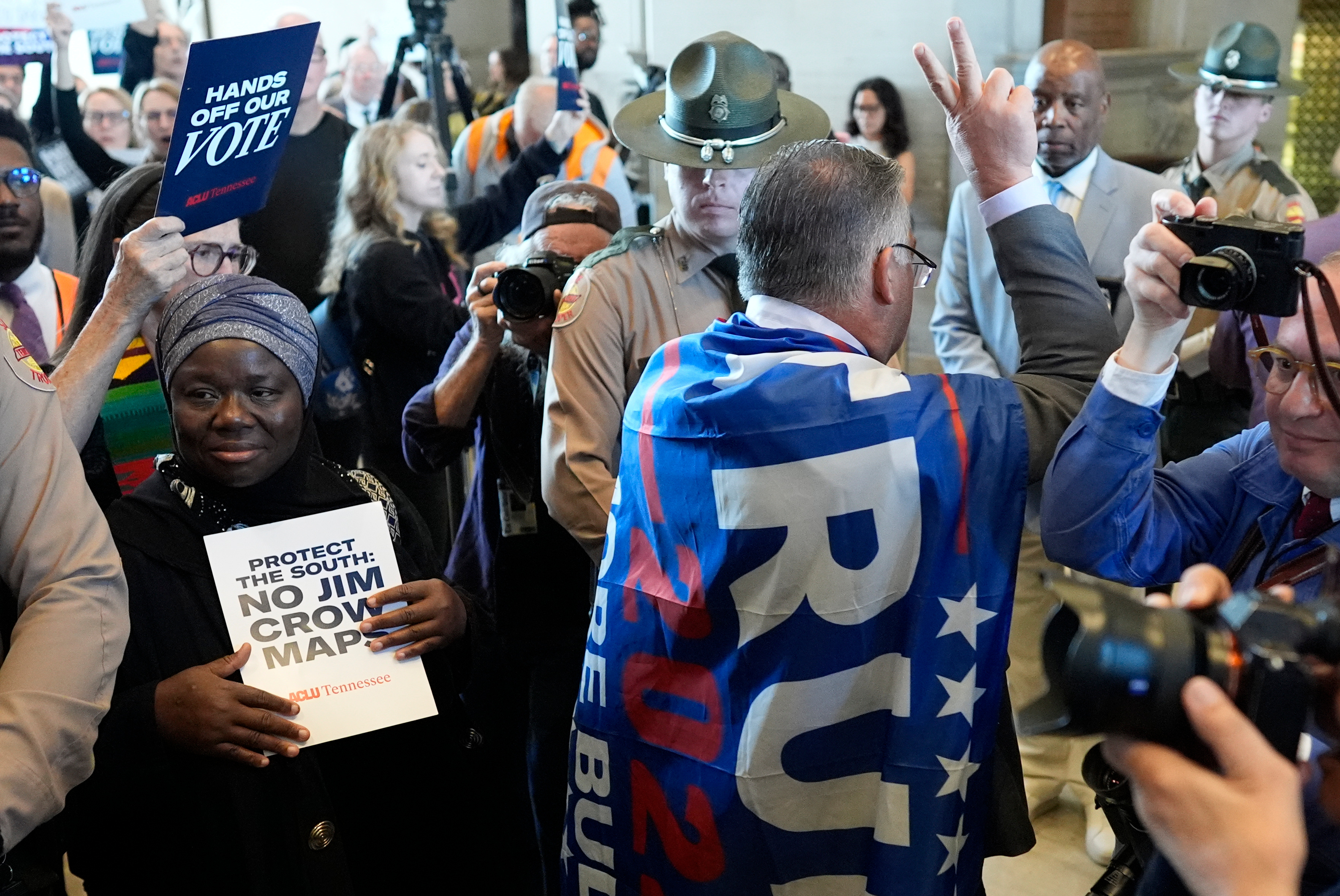
The ink had barely dried on the Supreme Court’s ruling to gut the Voting Rights Act when Republican lawmakers raced to deliver on the barely veiled promises of the court’s decision: the decimation of Black political power and a revival of Jim Crow-era racist voter suppression.
In Tennessee on Thursday, Gov. Lee signed a bill that repealed a half-century-old law prohibiting mid-decade redistricting, and then the overwhelmingly Republican legislature passed new redistricting maps that eliminate the state’s only Black-majority district. The 9th Congressional District, also Tennessee’s only reliable Democratic seat, will be carved into three — purposefully redrawn for each piece to have a white-majority and Republican-leaning electorate. The votes of Memphis’s 63 percent Black population will be diluted to near irrelevance; the entire state will be handed to Republicans.
With the right-wing justices’ blessing, Republican lawmakers can now enact segregationist gerrymandering.
No one can act surprised. This was the predicted outcome of the Supreme Court’s Louisiana v. Callais decision, which decimated Section 2 of the embattled Voting Rights Act, a provision that had protected minority voters from redistricting. With the right-wing justices’ blessing, Republican lawmakers can now enact segregationist gerrymandering and reestablish the pre-civil-rights-era status quo ante.
It stands to reason that Republicans are not representing the interests of Black Tennesseans, some 17 percent of the population, overwhelmingly Democrats. These residents only have one representative in Washington, Rep. Steve Cohen — the lone Democrat among the state’s nine congressional seats. That is the seat being eliminated by the new maps passed by Tennessee’s largely white legislature.
The situation is already one in which Black working-class interests are hardly represented — and nor would greater Black representation in the state necessarily ensure the delivery of racial justice and the economic justice it requires.
The point is that Black disenfranchisement both reflects and produces conditions of white supremacist rule, wherein greater anti-Black oppression is assured.
“These maps are racist tools of white supremacy, at the behest of the most powerful white supremacist in the United States of America, Donald J. Trump,” said Democratic state Rep. Justin Pearson at the Tennessee statehouse on Thursday. Pearson, a progressive activist and one of the state’s few Black representatives, is running for a seat in Congress and was neck and neck in polling for his August primary against Cohen, the 76-year-old incumbent. The redrawn maps would likely foreclose his chance to represent South Memphis in Washington.
Pearson called the gerrymandered maps a “political lynching” that “set our state back over 150 years.”


Trump’s Larger Project
Trump, who is historically unpopular, has every reason to push his GOP to use newly unconstrained gerrymandering capacities in advance of the midterms. Right-wing redistricting efforts go beyond a scramble for November, though, and sit within a larger project of white supremacist backlash.
Like in Tennessee, Republicans in Alabama, Louisiana, Mississippi, and South Carolina all called special legislative sessions — as explicitly ordered by Trump — to push new redistricting maps that will decimate majority-Black districts and deliver congressional seats to Republicans.
According to the cynical rationale of the Supreme Court conservatives, such maps would not violate what’s left of the Voting Rights Act, because the GOP is not openly describing their gerrymander as targeting Black voters.
“The more racist you are as a party, the more insulated you are from Voting Rights Act liability under this decision,” Justin Levitt, a professor at Loyola Law School, told Bolts Magazine about the Callais ruling. “If there were a party called the Klan party, right now, it would trigger an awful lot of nonwhite opposition based on the party’s platform. But this opinion says, you have to set the party’s platform entirely aside to figure out if there’s been any damage based on race. So the more you can tie the two together, the more insulated you are.”
In short, as Levitt put it, “the most racist partisan gerrymandering is going to be the most immune from a VRA challenge.”
Tennessee Republicans proved precisely this point on Thursday. Striding into the statehouse to disenfranchise Black voters, Republican state Rep. Todd Warner wore a giant Trump 2024 flag as a cape.
Striding into the statehouse to disenfranchise Black voters, Republican state Rep. Todd Warner wore a giant Trump 2024 flag.
As other states follow Tennessee’s example, the consequences of Callais could see the largest-ever drop in the number of Black lawmakers in Congress. The previous record was set, NPR reported, in the post-Reconstruction backlash, by the Congress that began in 1877 with four fewer House districts represented by Black lawmakers than the previous session.
In response to racist Republican gerrymandering, Democrats can play their own game of redistricting — but there’s a reason the Callais decision is understood as a gift to Republicans.
“The states controlled by Republicans where there are majority-minority districts have no internal constraint on how much they can screw over Black voters, because Black voters are not voting for that party,” Pamela Karlan, law professor at Stanford University and co-director of Stanford’s Supreme Court Litigation Clinic, told Slate.
Democrats could expand a small number of safe seats in New York and California, for example, by eliminating minority voter districts. As Karlan noted, however, this would be politically unpalatable because “the politics of the state are not going to look favorably on that, and the Democrats in those states depend on Black and Latino voters in statewide races.”
According to Karlan, in this race to the bottom, Republican-led election fixing will not be addressed without a different Congress, a different president, and a powerful political movement to hold politicians accountable.
“Voters have to first build a political movement around this that makes elected officials afraid to do this,” she said.
Meanwhile, Democratic redistricting efforts in Virginia were dealt a blow on Friday, when they were struck down by the state’s Supreme Court. Voters had approved in a referendum to redraw the state’s congressional map, but the court’s ruling hands Republicans a fierce electoral advantage.
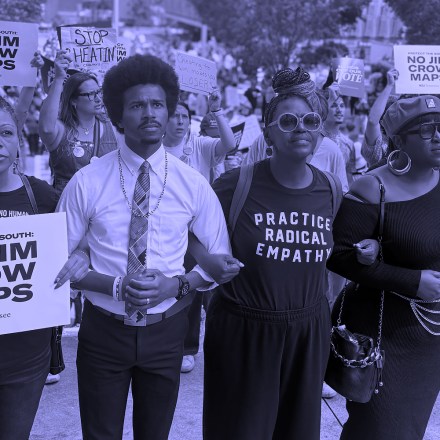
After Thursday’s vote, Tennessee Democratic state Rep. Justin Jones burned a paper Confederate flag in the statehouse rotunda, surrounded by protesters who had gathered to decry the racist gerrymandering.
“We saw a time like this, in this building before,” Jones told his fellow lawmakers earlier this week during the unprecedented redistricting special session. “If you study Reconstruction. We had Black lawmakers after the Civil War, then from the end of the 1800s to the 1960s, we had no Black folks here” — meaning the statehouse.
On Thursday afternoon, the NAACP’s Tennessee chapter filed a lawsuit challenging the legality of the new congressional map, which is likely to be the first of several legal efforts against the rushed, conniving, and unrepentantly racist gerrymander.
IT’S EVEN WORSE THAN WE THOUGHT.
What we’re seeing right now from Donald Trump is a full-on authoritarian takeover of the U.S. government.
This is not hyperbole.
Court orders are being ignored. MAGA loyalists have been put in charge of the military and federal law enforcement agencies. The Department of Government Efficiency has stripped Congress of its power of the purse. News outlets that challenge Trump have been banished or put under investigation.
Yet far too many are still covering Trump’s assault on democracy like politics as usual, with flattering headlines describing Trump as “unconventional,” “testing the boundaries,” and “aggressively flexing power.”
The Intercept has long covered authoritarian governments, billionaire oligarchs, and backsliding democracies around the world. We understand the challenge we face in Trump and the vital importance of press freedom in defending democracy.
We’re independent of corporate interests. Will you help us?
IT’S BEEN A DEVASTATING year for journalism — the worst in modern U.S. history.
We have a president with utter contempt for truth aggressively using the government’s full powers to dismantle the free press. Corporate news outlets have cowered, becoming accessories in Trump’s project to create a post-truth America. Right-wing billionaires have pounced, buying up media organizations and rebuilding the information environment to their liking.
In this most perilous moment for democracy, The Intercept is fighting back. But to do so effectively, we need to grow.
That’s where you come in. Will you help us expand our reporting capacity in time to hit the ground running in 2026?
We’re independent of corporate interests. Will you help us?

I’M BEN MUESSIG, The Intercept’s editor-in-chief. It’s been a devastating year for journalism — the worst in modern U.S. history.
We have a president with utter contempt for truth aggressively using the government’s full powers to dismantle the free press. Corporate news outlets have cowered, becoming accessories in Trump’s project to create a post-truth America. Right-wing billionaires have pounced, buying up media organizations and rebuilding the information environment to their liking.
In this most perilous moment for democracy, The Intercept is fighting back. But to do so effectively, we need to grow.
That’s where you come in. Will you help us expand our reporting capacity in time to hit the ground running in 2026?
We’re independent of corporate interests. Will you help us?
Contact the author:
Related



Latest Stories

The War on Immigrants
ICE Agent on Scene of NYC Shooting Was Posing as Construction Worker, Eyewitness Says
A member of Congress at the scene confirmed to The Intercept that there was a child in the victim’s car when ICE agents shot at it.

Pete Hegseth’s Military of the Future: Defined by AI and an Utter Lack of Oversight
In announcing Project Meridian and a new Autonomous Warfare Command, War Secretary Pete Hegseth is inviting conflicts of interest.

Voices
Armed Border Agents Arrest Protesters, Bulldoze 200-Year-Old Tree to Build Border Wall
Despite at least 10 arrests and the destruction of the tree at the center of the protest, the standoff continues.