
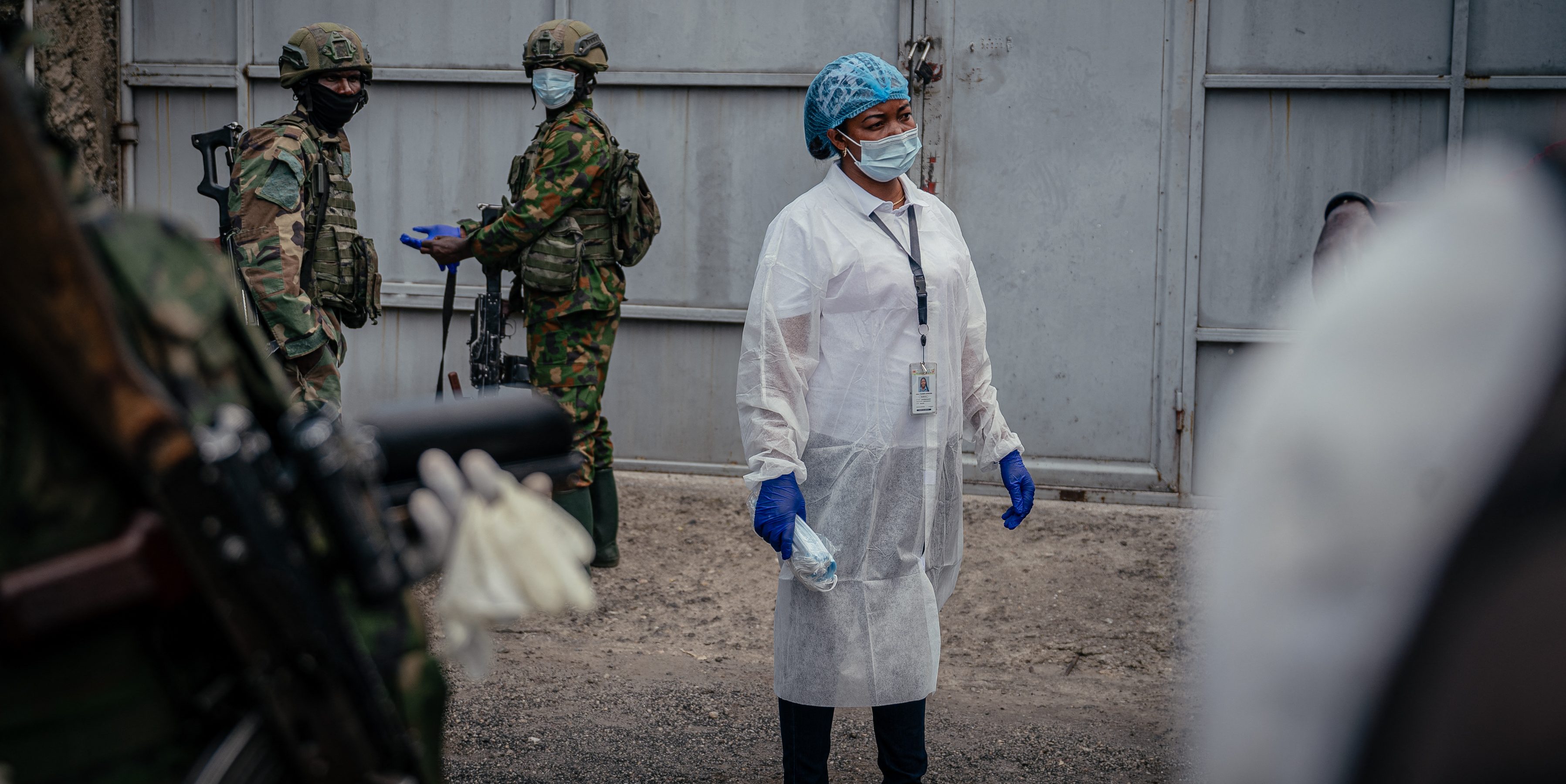
The World Health Organization’s chief said on Tuesday that he was “deeply concerned about the scale and speed” of an Ebola outbreak in the Democratic Republic of Congo and Uganda that has resulted in a spike in deaths — to at least 130 — and more than 500 suspected cases. The outbreak is complicated by the rare strain of the disease, known as Bundibugyo, that standard field tests often miss and for which there are no vaccines or therapeutics.
Experts say Trump administration policies — like dismantling the U.S. Agency for International Development and withdrawing from WHO — have further undermined global health security and negatively impacted the response to the outbreak. WHO Director-General Tedros Adhanom Ghebreyesus warned of emerging cases in urban areas, including reports of cases in Uganda’s capital, Kampala, and Goma, a crossroads city in Congo that borders Rwanda.

The Intercept reported on the porous borders and worrying public health responses in Goma during an Ebola outbreak in 2019. At the time Anthony Fauci — then the head of the U.S. National Institute of Allergy and Infectious Diseases — laid out the dangers of Ebola spreading in that urban center. “Since Goma is a city of millions of people, and since it has an international airport, it is a great concern,” he explained. “If Ebola could get into Goma and spread in Goma, that increases the likelihood that it could spread beyond the DRC into neighboring and distant countries.”
Experts have expressed alarm that the virus has been spreading undetected for weeks at least — and likely months — in Ituri Province, a remote area of eastern Congo that borders South Sudan and Uganda. The region, long riven by conflict, is home to many displaced persons and a haven for itinerant workers and smuggling operations. It has weak medical and public health infrastructure, making contact tracing is extremely difficult.
“The province of Ituri is highly insecure. … Conflict has intensified since late 2025, and fighting has escalated significantly over the past two months, resulting in civilian deaths. Over 100,000 people have been newly displaced, and in Ebola outbreaks, you know what displacement means,” said Tedros. “The area is also a mining zone, with high levels of population movement that increase the risk of further spread.”
Previously, USAID supported NGOs and healthcare workers in rural communities on the front lines of such outbreaks. “They’re the people standing between us and disaster,” said Margaret Harris, a former senior WHO official and a medical doctor who responded to Ebola outbreaks in West Africa in the mid-2010s and Congo in the late 2010s.
Harris praised the past work of USAID, and the U.S. in general, in responding to previous outbreaks of Ebola. This current outbreak can be managed, she said, but that it will take funding, training, equipment, and supplies — like personal protective equipment, medications, and fluids — for local healthcare workers. Harris, now a global health specialist at the United Nations Institute for Training and Research said that while some might argue that governments should pay for their own healthcare workers, she noted such front-line personnel provide a service that extends far beyond a nation’s borders. “They are protecting global health security,” she told The Intercept, adding: “And they were also simply doing good for ordinary people.”
A U.S. government official with experience working with foreign non-governmental organizations, who spoke on background because they were not authorized to talk with the press on the subject, told The Intercept on Tuesday that there was “no question” Trump administration policies have helped to undermine the global public health response. This indictment was echoed by Rep. Rosa DeLauro, D-Conn, the ranking member on the House Labor, Health and Human Services, Education, and Related Agencies subcommittee.
“Infectious diseases do not respect political borders.”
“The Trump administration has systematically dismantled much of our global health infrastructure, without giving a thought to the consequences. Now, we are seeing those consequences play out,” DeLauro told The Intercept, noting that the administration dissolved USAID, cut the United States off from the WHO, and carried out mass layoffs across the domestic global public health space.
“This will not be the last outbreak of a deadly infectious disease,” DeLauro said. “We must invest in global health infrastructure. Not only to be reliable and effective partners, but to be prepared for the next outbreak. In public health, isolation is not a strategy. Infectious diseases do not respect political borders.”
On Monday, the State Department announced that on “May 15, 2026, within 24 hours of learning of the confirmed cases, the Department leveraged its outbreak response and humanitarian assistance capabilities.” The WHO actually issued an alert of a high-mortality outbreak in Ituri, which included deaths among healthcare workers, 10 days prior. On May 14, blood samples were finally analyzed across the country, in Congo’s capital, Kinshasa. A day later, the analysis confirmed Bundibugyo virus disease, a strain of Ebola.
“I cannot help but wonder if the administration had not taken such drastic action to dismantle so much of our global health infrastructure, that we would have been able to identify this outbreak earlier and stop it from spreading as much as it has,” DeLauro said in a separate press release.
“It is false to claim that the USAID reform has negatively impacted our ability to respond to Ebola,” a State Department spokesperson told The Intercept. “In fact, by bringing USAID global health functions under the new GHSD bureau at the State Department, our efforts are more aligned and effective. Funding and support to combat Ebola continue, working with allies and partners.”
When asked about the lag between the first notification of a disease outbreak and the U.S. response, the spokesperson did not reply to multiple requests for comment.
On his first day back in office last year, Trump began the process of withdrawing the U.S. from the WHO and cutting all funding for the U.N. health agency. “World Health ripped us off,” Trump said at the time. The withdrawal process was completed January of this year.
Tedros announced that WHO has a team on the ground supporting the national responses to the African outbreak, noting his organization had “deployed people, supplies, equipment and funds,” including millions from an emergency fund.
“The outbreaks of Ebola and hantavirus in the past two weeks show why international threats need an international response,” Tedros said on Tuesday, also referring to the recent outbreak on an expedition cruise ship of a rare virus carried by rodents. “They show why the world needs the international health regulations, and why it needs WHO.”
IT’S EVEN WORSE THAN WE THOUGHT.
What we’re seeing right now from Donald Trump is a full-on authoritarian takeover of the U.S. government.
This is not hyperbole.
Court orders are being ignored. MAGA loyalists have been put in charge of the military and federal law enforcement agencies. The Department of Government Efficiency has stripped Congress of its power of the purse. News outlets that challenge Trump have been banished or put under investigation.
Yet far too many are still covering Trump’s assault on democracy like politics as usual, with flattering headlines describing Trump as “unconventional,” “testing the boundaries,” and “aggressively flexing power.”
The Intercept has long covered authoritarian governments, billionaire oligarchs, and backsliding democracies around the world. We understand the challenge we face in Trump and the vital importance of press freedom in defending democracy.
We’re independent of corporate interests. Will you help us?
IT’S BEEN A DEVASTATING year for journalism — the worst in modern U.S. history.
We have a president with utter contempt for truth aggressively using the government’s full powers to dismantle the free press. Corporate news outlets have cowered, becoming accessories in Trump’s project to create a post-truth America. Right-wing billionaires have pounced, buying up media organizations and rebuilding the information environment to their liking.
In this most perilous moment for democracy, The Intercept is fighting back. But to do so effectively, we need to grow.
That’s where you come in. Will you help us expand our reporting capacity in time to hit the ground running in 2026?
We’re independent of corporate interests. Will you help us?

I’M BEN MUESSIG, The Intercept’s editor-in-chief. It’s been a devastating year for journalism — the worst in modern U.S. history.
We have a president with utter contempt for truth aggressively using the government’s full powers to dismantle the free press. Corporate news outlets have cowered, becoming accessories in Trump’s project to create a post-truth America. Right-wing billionaires have pounced, buying up media organizations and rebuilding the information environment to their liking.
In this most perilous moment for democracy, The Intercept is fighting back. But to do so effectively, we need to grow.
That’s where you come in. Will you help us expand our reporting capacity in time to hit the ground running in 2026?
We’re independent of corporate interests. Will you help us?
Contact the author:

Related

By Slashing Foreign Aid, Trump Is Fueling the Spread of HIV in Uganda

Gaza Humanitarian Foundation Calls It Quits After Thousands Die Seeking Its Aid

Trump Would Rather Let Birth Control Expire Than Give It to Africans as Aid

Network of Right-Wing Health Care Providers Is Making Millions Off Hydroxychloroquine and Ivermectin, Hacked Data Reveals
Latest Stories

Where Are the Iran War Protests?
Despite a wildly unpopular war with Iran, a mass protest movement for peace hasn’t materialized — at least in the ways we’ve been taught to recognize.

The Intercept Briefing
Prediction Markets Have a Lock on the Midterms
As Kalshi and Polymarket dodge state regulations, prediction markets are upping the ante on next month’s elections.

The War on Immigrants
ICE Agent on Scene of NYC Shooting Was Posing as Construction Worker, Eyewitness Says
A member of Congress at the scene confirmed to The Intercept that there was a child in the victim’s car when ICE agents shot at it.