
Democratic Party leaders in the House reversed course and moved to back a resolution against U.S. involvement in Israel’s war on Lebanon on Tuesday, giving the bill overwhelming support from Democrats for the first time since Congress began seeking to address the conflict.
The resolution sponsored by Rep. Rashida Tlaib, D-Mich., failed 235–189, with near-universal opposition from Republicans.
The vote was another sign of changing attitudes among Democrats about Israel.
Still, the vote was another sign of changing attitudes among Democrats about Israel: 187 Democrats voted in favor of it, and only 22 voted against.
Tlaib’s resolution marked the second time she has forced the House to go on the record about the war on Lebanon, which Israel says is aimed at Hezbollah but has left a fifth of the country displaced and thousands dead.

Under the 1973 War Powers Act, any member of Congress can force a vote on U.S. involvement in hostilities. Critics of Israel suspect the U.S. military has supported Israel’s attacks on Lebanon through help with developing target lists or refueling military aircraft. (U.S. Central Command, which oversees military operations in the region, did not immediately respond to a request for comment.)
On June 4, Tlaib’s first attempt to pass a war powers resolution about Lebanon failed on a 324–92 vote.
House Democratic leaders opposed that earlier resolution because of what they said were drafting errors that might have inadvertently forced the U.S. to stop protecting its embassy in Beirut or providing aid to the Lebanese Armed Forces, the regular military of the Lebanese government.
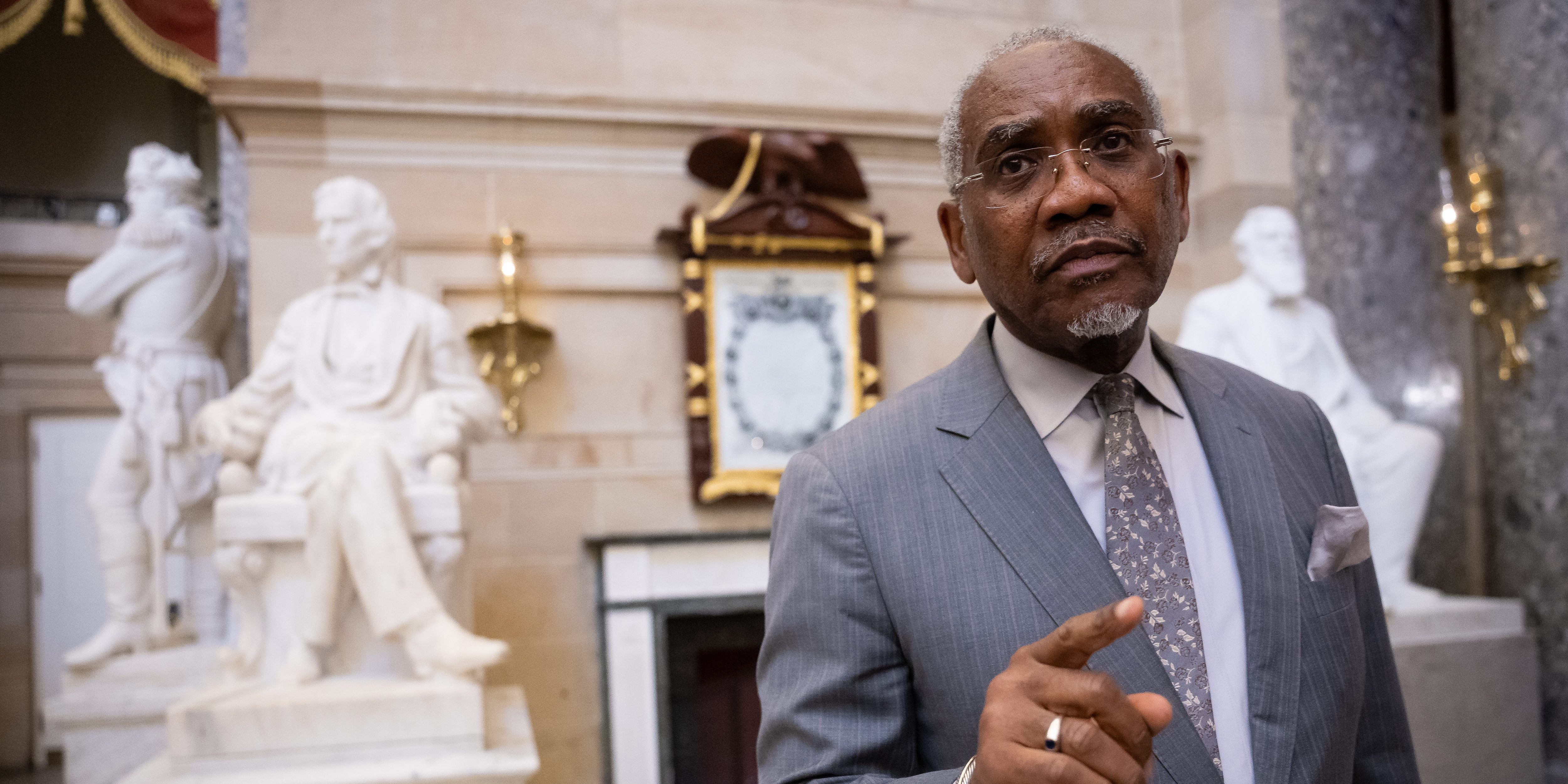
The more recent version of the legislation gained the support of Democratic leaders by including explicit carveouts for those activities. While leadership did not officially whip the vote, the ranking member of the House Foreign Affairs Committee, Rep. Gregory Meeks, D-N.Y., who is close to Minority Leader Hakeem Jeffries, D-N.Y., spoke in support of the measure on Monday.
Speeches from Meeks and Tlaib, however, revealed a divide in what Democrats thought the measure might accomplish.
Meeks criticized the conduct of Hezbollah and Israel alike, adding that, to his knowledge, no U.S. forces were directly involved in combat in Lebanon. The resolution would prevent the Trump administration from joining in the war, he said.
Tlaib, meanwhile, cast the resolution as a way to cut off U.S. support for Israeli forces. She pointed to Israeli National Security Minister Itamar Ben-Gvir’s call “to burn all of Lebanon” as proof of the Israeli government’s intent there.
“I want to make this very, very clear: The United States is not a bystander to these war crimes,” Tlaib said. “It is an active participant. The United States is currently engaged in illegal and unauthorized hostilities supporting the Israeli invasion of Lebanon, in violation of the War Powers Act.
“The United States is not a bystander to these war crimes.”
“Without that support,” she added, “those jets cannot drop bombs to kill Lebanese children. Congress must reassert its constitutional authority and immediately vote to end all unauthorized U.S. participation in the destruction of Lebanon.”
Only two Republicans, Reps. Thomas Massie of Kentucky and Lauren Boebert of Colorado, voted in favor of the resolution. The Republican caucus was officially represented during the Monday floor debate by Rep. Brian Mast, R-Fla., the chair of the House Foreign Affairs Committee.
“This resolution only seeks to embolden Hezbollah. That is the only thing that it does,” Mast said. “There are no U.S. forces engaged in hostilities. Do we train Lebanese Armed Forces? Yes, we do. Do we provide intelligence? Yes, we do. But we don’t have forces engaged there.”
Ahead of the vote, Erik Sperling, the executive director of Just Foreign Policy, a group that is sharply critical of Israel, said he was pleased to see more Democrats backing Tlaib’s resolution.
“Democrats have been pretty unified about speaking out against the killing of innocents and all of the harm by the Iran war, but there has been less vocal outrage about the mass killing and occupation in Lebanon,” Sperling said. “This is just an important signal that Democrats are aware of the way the Lebanon war is a humanitarian crisis and is the key roadblock to ending this war and delivering the peace that Americans are demanding.”
IT’S EVEN WORSE THAN WE THOUGHT.
What we’re seeing right now from Donald Trump is a full-on authoritarian takeover of the U.S. government.
This is not hyperbole.
Court orders are being ignored. MAGA loyalists have been put in charge of the military and federal law enforcement agencies. The Department of Government Efficiency has stripped Congress of its power of the purse. News outlets that challenge Trump have been banished or put under investigation.
Yet far too many are still covering Trump’s assault on democracy like politics as usual, with flattering headlines describing Trump as “unconventional,” “testing the boundaries,” and “aggressively flexing power.”
The Intercept has long covered authoritarian governments, billionaire oligarchs, and backsliding democracies around the world. We understand the challenge we face in Trump and the vital importance of press freedom in defending democracy.
We’re independent of corporate interests. Will you help us?
IT’S BEEN A DEVASTATING year for journalism — the worst in modern U.S. history.
We have a president with utter contempt for truth aggressively using the government’s full powers to dismantle the free press. Corporate news outlets have cowered, becoming accessories in Trump’s project to create a post-truth America. Right-wing billionaires have pounced, buying up media organizations and rebuilding the information environment to their liking.
In this most perilous moment for democracy, The Intercept is fighting back. But to do so effectively, we need to grow.
That’s where you come in. Will you help us expand our reporting capacity in time to hit the ground running in 2026?
We’re independent of corporate interests. Will you help us?

I’M BEN MUESSIG, The Intercept’s editor-in-chief. It’s been a devastating year for journalism — the worst in modern U.S. history.
We have a president with utter contempt for truth aggressively using the government’s full powers to dismantle the free press. Corporate news outlets have cowered, becoming accessories in Trump’s project to create a post-truth America. Right-wing billionaires have pounced, buying up media organizations and rebuilding the information environment to their liking.
In this most perilous moment for democracy, The Intercept is fighting back. But to do so effectively, we need to grow.
That’s where you come in. Will you help us expand our reporting capacity in time to hit the ground running in 2026?
We’re independent of corporate interests. Will you help us?
Contact the author:

Related

Latest Stories

ICE Shooting in NYC Inflames Mamdani’s Policing Problem
After ICE shot a young father in Manhattan, New Yorkers asked the mayor to protect them from his police department and federal agents alike.

Where Are the Iran War Protests?
Despite a wildly unpopular war with Iran, a mass protest movement for peace hasn’t materialized — at least in the ways we’ve been taught to recognize.

The Intercept Briefing
Prediction Markets Have a Lock on the Midterms
As Kalshi and Polymarket dodge state regulations, prediction markets are upping the ante on next month’s elections.