
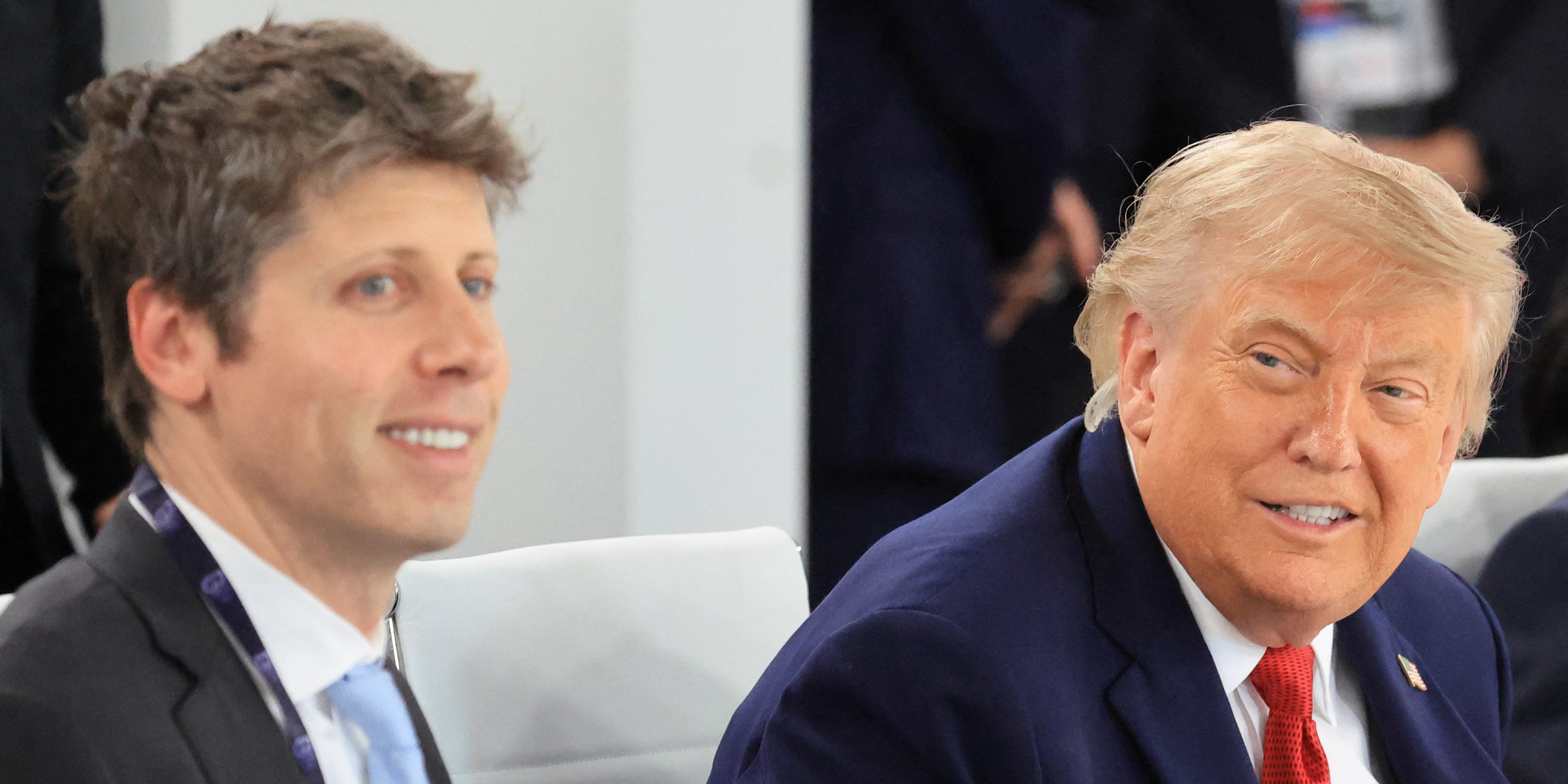
President Donald Trump’s Justice Department took the side of tech giant OpenAI in its court battle with The Intercept and other media companies over the company’s use of others’ creative work to train its artificial intelligence tools.
In a federal court filing in New York, the Justice Department argued that the U.S. has a vested interest in OpenAI having access to a vast array of intellectual property. The Trump administration warned that restricting OpenAI’s access to the data could hamper scientific progress and harm the country’s dominance in the race for artificial intelligence.
“The United States has a strong interest in continuing to develop a robust and competitive artificial intelligence industry that sets the standard for the practice and procedure of AI use globally,” said the filing, which was signed by associate attorneys general Stanley Woodward Jr. and Brett Shumate, along with the attorney general’s senior counsel Michael Weisbuch.
Matt Topic, the litigating attorney representing The Intercept in its lawsuit, warned that the Trump administration’s position was out of touch and a threat to the financial survival of media outlets.
“This is pretty reflective of the administration’s pro-AI policies, which are out of step with the public skepticism of AI and out of step with our long tradition in this country of protecting human expression,” said Topic. “If the administration’s position was accepted, it would result in an unprecedented, uncompensated transfer of IP rights from news organizations to tech companies.”
“If the administration’s position was accepted, it would result in an unprecedented, uncompensated transfer of IP rights from news organizations to tech companies.”
The Intercept originally filed its lawsuit against OpenAI and its partner Microsoft in February 2024, arguing that OpenAI’s use of work reported and written by its journalists constituted a breach of copyright law. In November 2024, the judge then presiding over the case dismissed all of The Intercept’s claims against Microsoft, but allowed its claim against OpenAI to proceed under the Digital Millennium Copyright Act.
The Intercept’s case was later consolidated under U.S. District Judge Sidney Stein alongside a number of other media plaintiffs, including the New York Times, Tribune Media Company, and Ziff Davis.
OpenAI has argued that its practice of hoovering up staggering amounts of copyright-protected materials to feed its large language models — the underlying technology powering generative AI tools like ChatGPT — falls under the domain of “fair use,” a doctrine protecting the unlicensed use of copyrighted material under certain circumstances.
In its filing, the Justice Department supported OpenAI’s fair-use defense, accusing the Times and other plaintiffs of taking an overly narrow definition of the doctrine. OpenAI’s use of the material, the government argued, met the criteria for “transformative” use, one of the ways in which “fair use” comes into play.
“In this litigation, the New York Times seeks to narrow fair-use doctrine to exclude the training of OpenAI’s large language models (LLMs). That result would be inconsistent with basic copyright law principles and severely hamper ‘the Progress of Science and useful Arts,’” the filing says. “An erroneous fair use ruling would hamper competition in the market for LLMs, because only the largest technology companies might have the capital necessary to pay licensing fees.”

The filing is the latest move from the Trump administration to protect the interests of U.S.-based artificial intelligence companies amid an AI arms race with companies based in other countries, most notably China.
In December 2025, Trump signed an executive order aimed at creating a federal standard, applicable in all 50 states, to “ensure that the United States wins the AI race, as we must.”
Topic, The Intercept’s attorney, said this position — combined with the fact that the Justice Department has not been privy to any discovery in the case — shows that the Trump administration is operating from a fixed position in support of tech companies, rather than arguing the merits of the case.
“What they’re saying isn’t based on any understanding of actual facts,” Topic said. “It just reflects what Microsoft’s and OpenAI’s PR machines have been putting out into the public.”
IT’S EVEN WORSE THAN WE THOUGHT.
What we’re seeing right now from Donald Trump is a full-on authoritarian takeover of the U.S. government.
This is not hyperbole.
Court orders are being ignored. MAGA loyalists have been put in charge of the military and federal law enforcement agencies. The Department of Government Efficiency has stripped Congress of its power of the purse. News outlets that challenge Trump have been banished or put under investigation.
Yet far too many are still covering Trump’s assault on democracy like politics as usual, with flattering headlines describing Trump as “unconventional,” “testing the boundaries,” and “aggressively flexing power.”
The Intercept has long covered authoritarian governments, billionaire oligarchs, and backsliding democracies around the world. We understand the challenge we face in Trump and the vital importance of press freedom in defending democracy.
We’re independent of corporate interests. Will you help us?
IT’S BEEN A DEVASTATING year for journalism — the worst in modern U.S. history.
We have a president with utter contempt for truth aggressively using the government’s full powers to dismantle the free press. Corporate news outlets have cowered, becoming accessories in Trump’s project to create a post-truth America. Right-wing billionaires have pounced, buying up media organizations and rebuilding the information environment to their liking.
In this most perilous moment for democracy, The Intercept is fighting back. But to do so effectively, we need to grow.
That’s where you come in. Will you help us expand our reporting capacity in time to hit the ground running in 2026?
We’re independent of corporate interests. Will you help us?

I’M BEN MUESSIG, The Intercept’s editor-in-chief. It’s been a devastating year for journalism — the worst in modern U.S. history.
We have a president with utter contempt for truth aggressively using the government’s full powers to dismantle the free press. Corporate news outlets have cowered, becoming accessories in Trump’s project to create a post-truth America. Right-wing billionaires have pounced, buying up media organizations and rebuilding the information environment to their liking.
In this most perilous moment for democracy, The Intercept is fighting back. But to do so effectively, we need to grow.
That’s where you come in. Will you help us expand our reporting capacity in time to hit the ground running in 2026?
We’re independent of corporate interests. Will you help us?
Contact the author:

Related


Latest Stories

Pentagon Finally Counts an Iran War Death — Six Months Late
After months of questions from The Intercept, the U.S. military finally acknowledged the March death of Maj. Sorffly Davius.

Chilling Dissent
Trump Wanted Minneapolis 15 Case to Be Another Prairieland. Instead, Twin Cities Rallied Behind Anti-ICE Activists.
The mainstream of Minnesota’s left-of-center politics — including unions, the backbone of Democratic power — are behind the radical left.

Israel’s War on Gaza
A C-Section in Shackles: A Palestinian Woman’s Harrowing Birth in Israeli Detention
Dana Joudeh was denied proper food and medical care throughout her pregnancy in an Israeli prison. She gave birth to a premature baby surrounded by armed guards.