
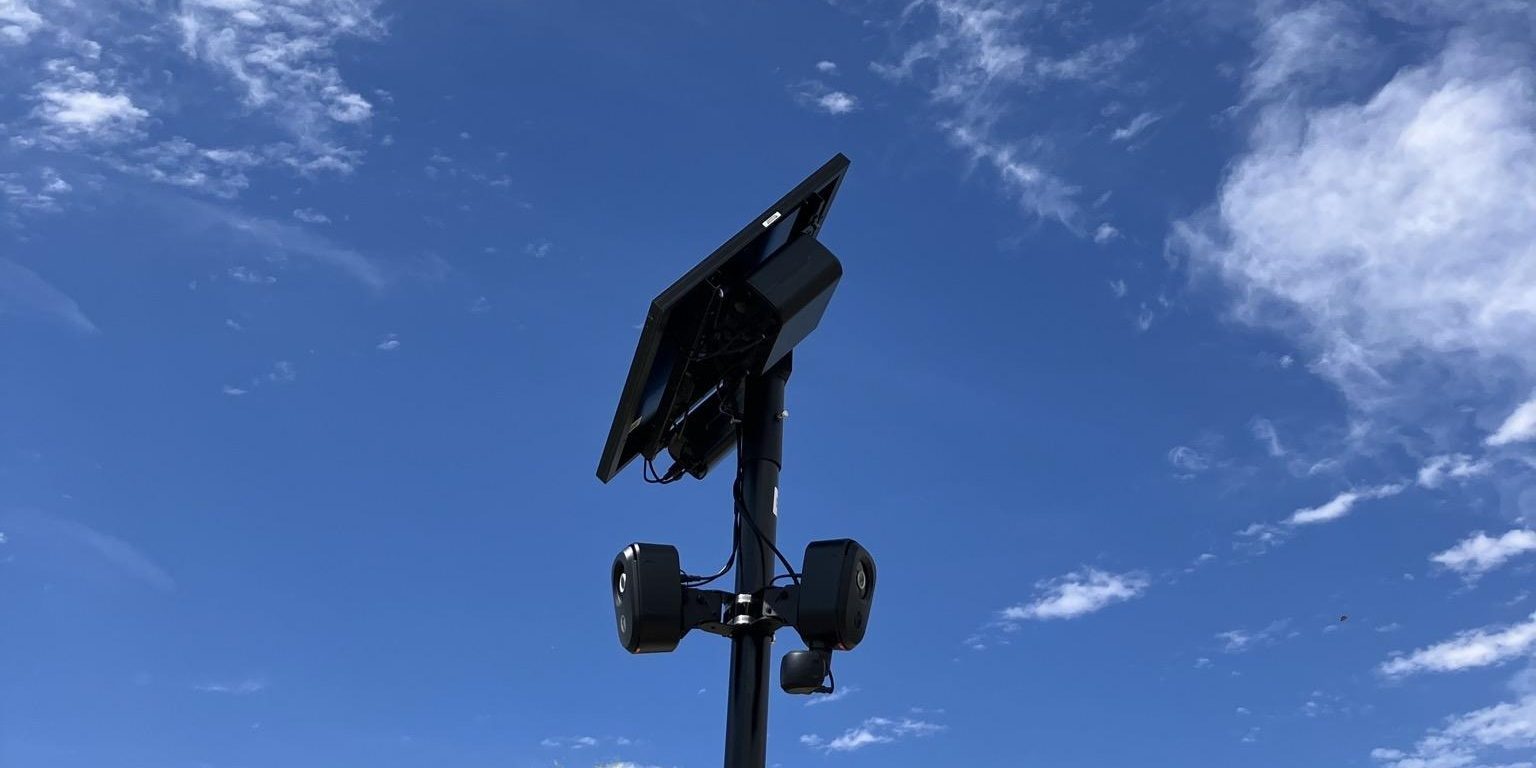
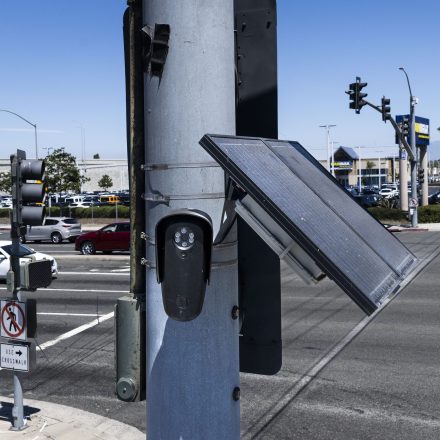
Amid mounting concerns about its sprawling surveillance camera network, Flock Security told the press this summer that it operates more than 120,000 cameras nationwide.
But a new map published Wednesday by a cybersecurity researcher reveals Flock’s nationwide reach is even bigger. Based on location coordinates from Flock’s own database, the map shows more than 170,000 cameras, plus more than 130,000 accompanying gadgets that play a part in the company’s expansive American surveillance network.
Joshua Michael’s Flock Surveillance Map highlights the locations of what he says are 300,000 Flock surveillance devices spread across the country. His findings — which were cited in Wednesday’s Senate Subcommittee on Crime and Counterterrorism hearing on Flock — differ from existing maps of Flock’s automated license plate readers in scope and methodology.
“These cameras form a nationwide surveillance network that tracks where everyone drives.”
Unlike crowd-sourced projects such as DeFlock, which are built on locations submitted by users, the Flock Surveillance Map relies on location data culled from a snapshot, archived by Michael in December 2025, of Flock’s own records. In addition to cameras, it maps supplemental devices — including 27,000 acoustic detection devices, as well as networking equipment that integrates third-party cameras — to illustrate the scale of Flock’s surveillance web.
“These cameras form a nationwide surveillance network that tracks where everyone drives,” Michael told The Intercept, “so foreign nations don’t need to send spies to harm our country. They can simply watch where our soldiers, federal agents, and politicians go.”
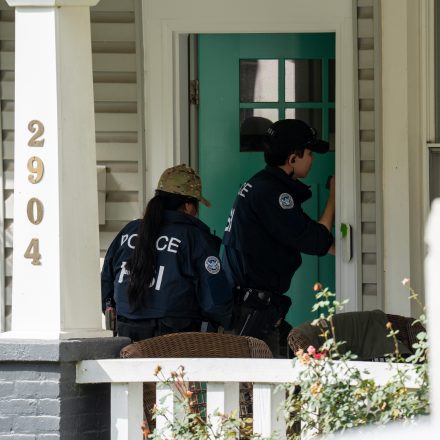

The Intercept visited six random Arizona locations on Michael’s map; each location had a Flock camera present at the indicated coordinates.
The Flock Surveillance Map also color-codes each Flock device according to its model — showing, for instance, whether the device is a Flock camera, known as a Falcon, or an accompanying processing unit known as a Picard. (Flock did not immediately respond to a request for comment.)
The accompanying searchable dataset table also lists each camera’s individual name, as outlined in Flock’s database, which typically includes a street address and sometimes other identifying characteristics. A camera with the name “FBI Pilot Camera,” for example, is shown to be located at the J. Edgar Hoover Building — the FBI headquarters in Washington.

The map illustrates Flock’s national spread, but also its clustering in certain areas. For example, 860 Flock devices appear to be concentrated just outside Chicago O’Hare International Airport, at the Rosemont Public Safety Department, which provides police, fire, and emergency medical services in the Chicago suburb.
Numerous Flock cameras appear to be installed inside detention centers. A camera titled “C-F-23 FOXTROT MALE HOLDING 2/SHOWERS” appears at the coordinates of the Silverdale Detention Center in Chattanooga, Tennessee.
In November 2025, Michael discovered a novel way to identify the location of Flock’s devices. Trawling the company’s website, he realized that Flock’s servers were publicly leaking data in the form of an access token that could be acquired without needing to log in. With that token, Michael said he could query ArcGIS, a third-party geographic information system platform used by Flock, to retrieve the locations of Flock devices.
Michael told The Intercept he promptly contacted Flock and described his findings. As Michael wrote in his initial email to Flock on November 13, 2025: “all testing was strictly non-intrusive, limited to open unauthenticated endpoints, and did not involve bypassing authentication, modifying data, or invoking any billable ArcGIS or Google operations.” Michael said he didn’t receive a reply, so he followed up with Flock the next day, and a third time several days later.
After his third attempt to inform Flock of the discovered vulnerability, Michael received a reply from a Flock that said, “Thank you for the findings. We are internally triaging them and will reach back out with next steps soon.”

Michael said he never heard back about it from Flock.
In December 2025, Michael downloaded the Flock device location data, and in January wrote an in-depth technical blog post about what he had found. After Michael’s post, it appears that Flock fixed the vulnerability.
Despite being alerted of Michael’s findings in November 2025, Flock published its own blog post the following January saying it hadn’t had any data breaches. “Flock has never been hacked, and there has not been a leak of Flock information,” the company claimed. “Flock Safety’s cloud platform has never experienced a data breach.”
The Atlanta-based startup has faced mounting criticism for its practices and lack of transparency in recent months. An American Civil Liberties Union report found “a pattern of Flock regularly misleading or even lying about its business practices, safety record, commitment to privacy, and efforts to protect vulnerable populations.”
Michael told The Intercept that Flock’s recent claims about its data security record don’t reflect reality. Flock has publicly claimed multiple times that the company has never experienced a data breach, “and this was after I pulled their database of devices.”
“That leaves two possibilities,” he said. “Either they knew and chose not to disclose it for fear of bad press, or they didn’t know I exfiltrated the data at all. The first is a transparency failure. The second is a detection failure with national security implications.”
On Thursday, Michael was notified that Doppel, which describes itself as an “AI-native social engineering defense platfom,” filed a trademark infringement complaint regarding his site, claiming to be working on Flock’s behalf. Doppel says that the site is using the trademark “FLOCK SAFETY” without authorization, which “may cause customer confusion / harm.” Doppel requested the site be taken down.
When he posted the Flock Surveillance Map, Michael included a pop-up disclaimer saying that the site is “not affiliated with or endorsed by Flock.”
IT’S EVEN WORSE THAN WE THOUGHT.
What we’re seeing right now from Donald Trump is a full-on authoritarian takeover of the U.S. government.
This is not hyperbole.
Court orders are being ignored. MAGA loyalists have been put in charge of the military and federal law enforcement agencies. The Department of Government Efficiency has stripped Congress of its power of the purse. News outlets that challenge Trump have been banished or put under investigation.
Yet far too many are still covering Trump’s assault on democracy like politics as usual, with flattering headlines describing Trump as “unconventional,” “testing the boundaries,” and “aggressively flexing power.”
The Intercept has long covered authoritarian governments, billionaire oligarchs, and backsliding democracies around the world. We understand the challenge we face in Trump and the vital importance of press freedom in defending democracy.
We’re independent of corporate interests. Will you help us?
IT’S BEEN A DEVASTATING year for journalism — the worst in modern U.S. history.
We have a president with utter contempt for truth aggressively using the government’s full powers to dismantle the free press. Corporate news outlets have cowered, becoming accessories in Trump’s project to create a post-truth America. Right-wing billionaires have pounced, buying up media organizations and rebuilding the information environment to their liking.
In this most perilous moment for democracy, The Intercept is fighting back. But to do so effectively, we need to grow.
That’s where you come in. Will you help us expand our reporting capacity in time to hit the ground running in 2026?
We’re independent of corporate interests. Will you help us?

I’M BEN MUESSIG, The Intercept’s editor-in-chief. It’s been a devastating year for journalism — the worst in modern U.S. history.
We have a president with utter contempt for truth aggressively using the government’s full powers to dismantle the free press. Corporate news outlets have cowered, becoming accessories in Trump’s project to create a post-truth America. Right-wing billionaires have pounced, buying up media organizations and rebuilding the information environment to their liking.
In this most perilous moment for democracy, The Intercept is fighting back. But to do so effectively, we need to grow.
That’s where you come in. Will you help us expand our reporting capacity in time to hit the ground running in 2026?
We’re independent of corporate interests. Will you help us?
Contact the author:
Related

Apocalypse Now: Naomi Klein and Astra Taylor Investigate the End-Timers Alliance
Facing Outraged Residents, Flock Got Help From Group That Uses AI to Rally Public Support

The AI Doomsday Future Is Not Inevitable
Flock Donations to Local Politicians’ Groups Skyrocket as Protests Against AI Cameras Mount
Latest Stories

DHS Was Designed as a Weapon
Rep. Delia Ramirez and writers Rozina Ali and Will Sommer discuss the ICE raid on Ilhan Omar and the years of “counterterror” surveillance that paved the way for the Trump administration’s abuses.

Long After the Maui Fires, Toxic Metals Linger in Residents’ Bodies
The toxic exposures didn’t begin with the flames. Researchers are examining how fires affected a community already harmed by plantation agriculture, development, and colonialism.

Midterms 2026
Lockheed Martin Showered Susan Collins With Cash as F-35 Program Hit Turbulence
Collins received tens of thousands from Lockheed during a two-month period surrounding a critical 2023 watchdog report.