
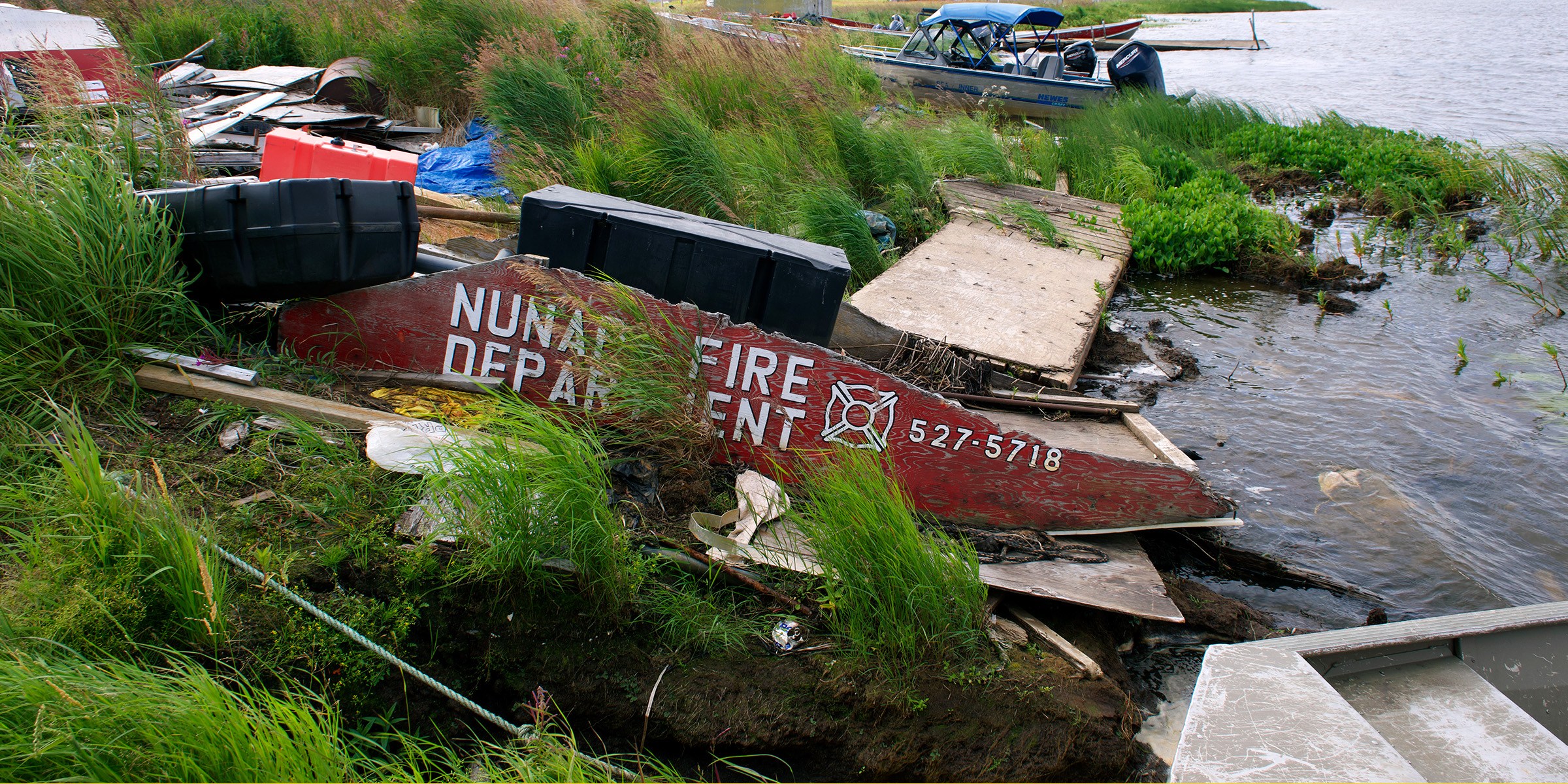
The place where the village of Nunapitchuk remembers its dead is disappearing.
Vincent Wassilie remembers pointing it out to his adult nephew while bringing memorial flowers to their relatives’ graves, which sit on a cemetery hill overlooking the Indigenous Alaskan village.
“Look at that,” he recalled saying. “We used to play on it.”
Wassilie’s nephew looked over and did a double take. The hill beneath the graves, which the two men remembered towering over the surrounding tundra, had sunk by what they estimated to be nearly 10 feet since they were children.
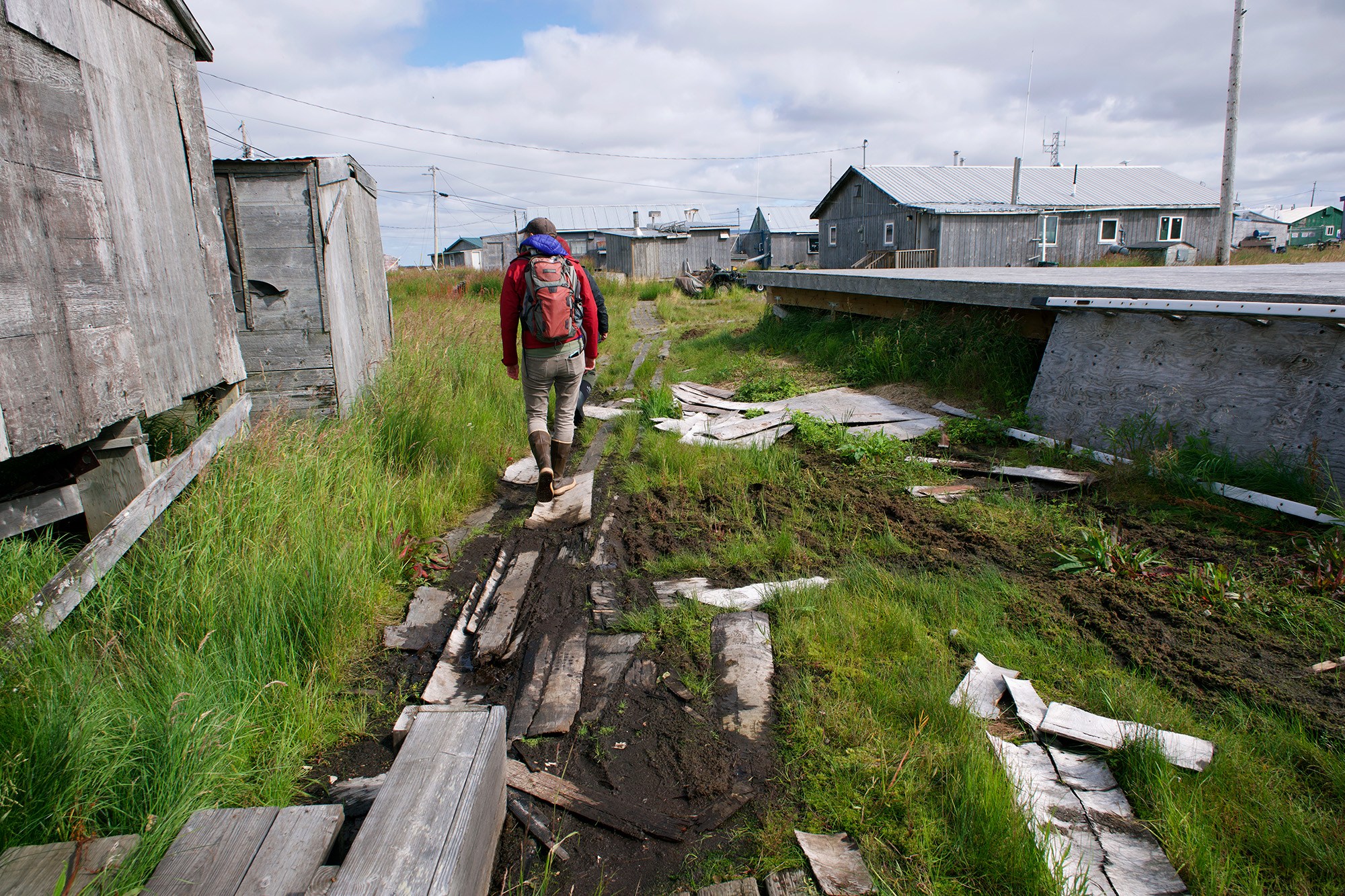
In fact, almost all of Nunapitchuk’s roughly 7 square miles of land is sinking. Government records and scientific assessments obtained by The Intercept via a Freedom of Information Act request reveal sinking homes, damaged infrastructure, thawing permafrost, and growing flood risks across the village of approximately 620 Alaska Native Yup’ik people. One federal analysis found that almost the entire village could be inundated during a 100-year flood under projections for 2030 to 2050.
The federal government has been aware of this for almost a decade. The documents show that tribal leaders have spent years navigating proposed studies, unimplemented scopes of work, and funding constraints. They aren’t asking the government to somehow fortify their land or stop the thaw of permafrost. They just want its help to pick up the village and move it about a mile uphill, where higher ground would keep residents safer from increased risks of flooding and erosion.
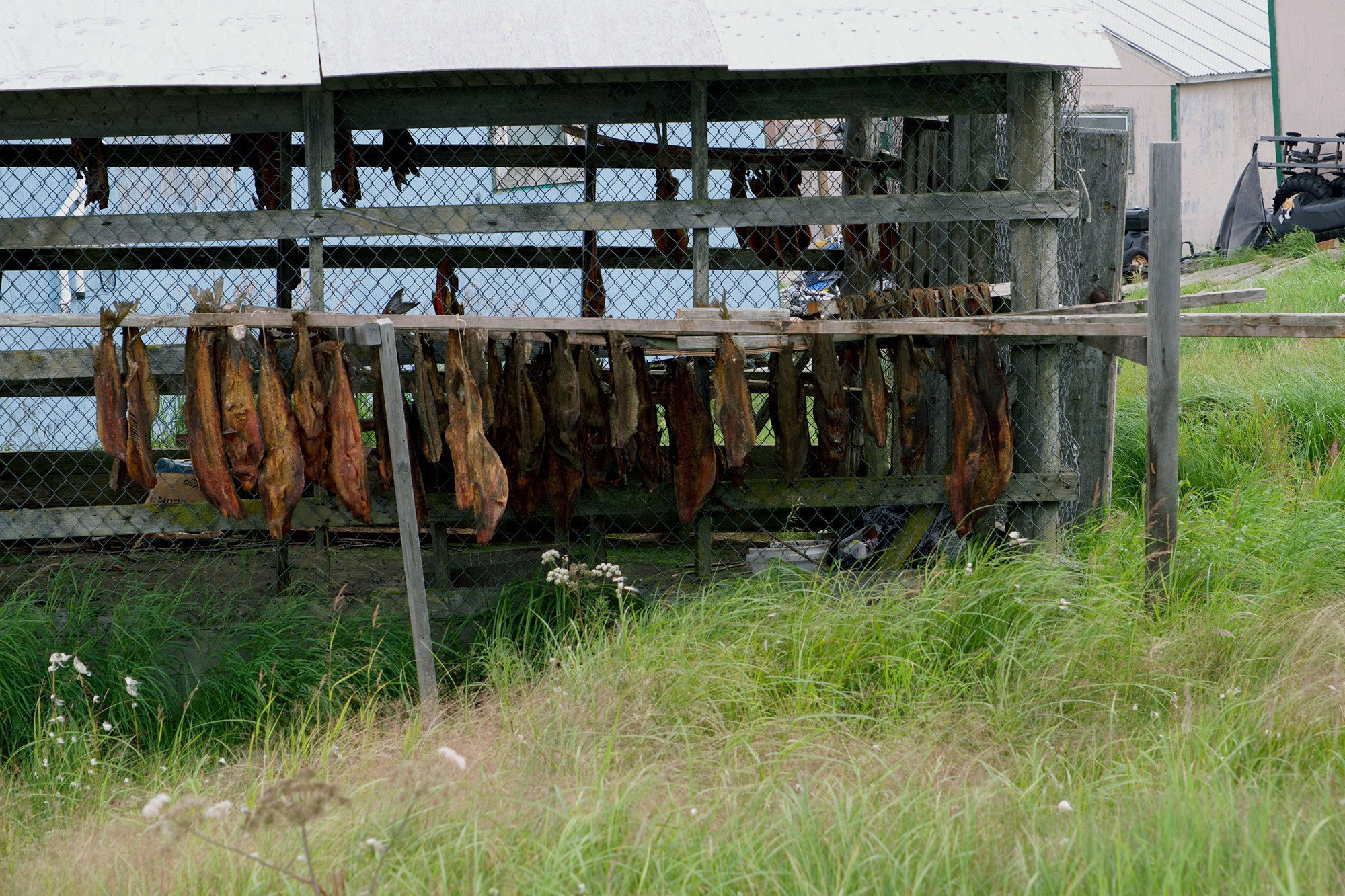
“Every spring, my parents’ house turns into an island,” said Tia Tobeluk, who grew up in the village and has since moved to Utah. Tobeluk, now 25, started noticing the devastating effects of climate change when she was 14 or 15, and she remembers moving her parents’ fish racks, traditionally used to smoke and preserve wild-caught fish, up to higher ground.
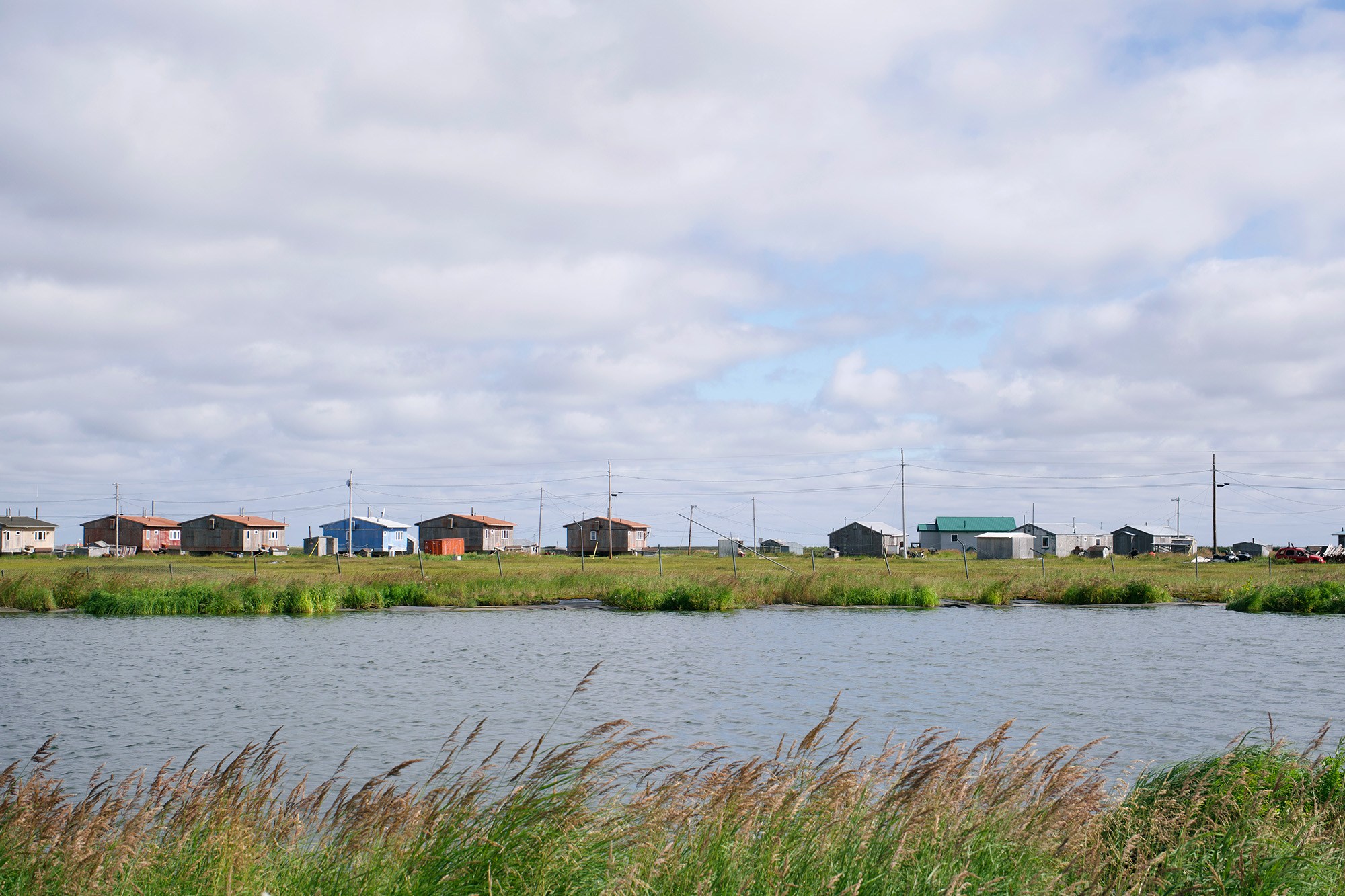
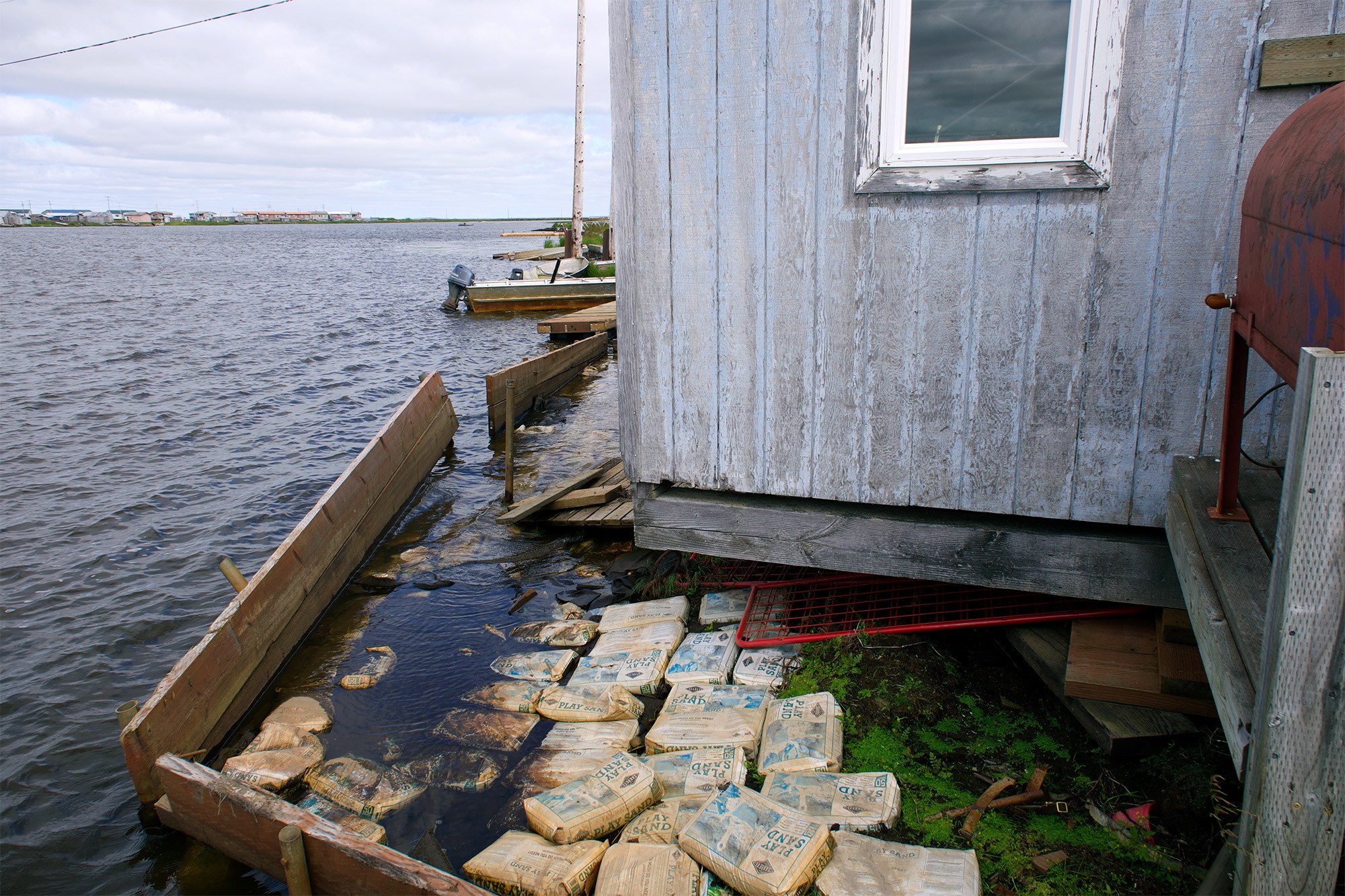
Photos: Sheryl Musgrove
Nunapitchuk tribal leaders formally warned the U.S. Army Corps of Engineers that the community was “highly vulnerable to environmental hazards” and “may not be habitable in the future” in 2018. They asked the Corps to help identify a safer place for the village and determine whether it could withstand future flooding, erosion, and thawing permafrost. But the village faced an obstacle from the beginning: Nunapitchuk was considered economically distressed, and the Army Corps imposes cost-sharing requirements that the village could not afford.
The Corps produced no records showing it conducted any relocation planning in response to the tribe’s 2018 request, suggesting that the federal entity did nothing. The request was the start of a maddening multi-agency pursuit that has forced tribal leaders to repeatedly ask for help, search for funding, and wait on federal studies and proposed plans, even after selecting where they want to move and documenting why the new site is safer.
Part of the problem is that there’s no single agency responsible for relocating a threatened village like Nunapitchuk. For all its issues, the Federal Emergency Management Agency at least has a clear mandate to help communities rebuild after disaster strikes. In the case of climate relocation, there’s a patchwork of more than 20 federal agencies that could have some role, according to previous reporting by The Guardian, including the Army Corps, FEMA, Bureau of Indian Affairs, Department of Housing and Urban Development, and Denali Commission. The Government Accountability Office has repeatedly recommended that the federal government establish clearer leadership for communities facing climate-driven relocation.
“It’s up to the tribe to kind of bring together all these different resources to try and get relocated,” said Sheryl Musgrove, until recently the climate justice director at the Alaska Institute for Justice. “There’s no central funding source.”
Nunapitchuk’s isolation compounds those challenges. The village is inaccessible by road, and reaching it requires air travel into remote western Alaska. There are days when changing conditions make travel difficult even within the village, keeping children from safely crossing the Johnson River to school and complicating residents’ access to the airport during medical emergencies. Hundreds of miles away, in Alaska’s larger tourist destinations, museums and souvenir shops market the state’s proud Alaska Native culture.
“You’re talking about Alaska Native tribes that have subsisted on these lands for thousands of years,” Musgrove said. “To say that we can’t afford to help them is wrong. The federal government has a trust responsibility to them to protect them and their lands. And the federal government isn’t doing that.”

Nunapitchuk is not alone. The Guardian, citing a 2020 Bureau of Indian Affairs report, noted that 144 Alaska Native villages face potential relocation because of infrastructure damage associated with the changing climate. Estimates placed the cost of relocating Nunapitchuk alone at approximately $230 million.
Wassilie wonders whether the federal government will act before the village experiences the kind of disaster residents are trying to avoid.
“Maybe they’re waiting for something catastrophic to happen before they do anything,” Wassilie said.
The Johnson River splits Nunapitchuk between its west side and its east, or “main,” side, where the village’s school and businesses are located. Historically, winter transformed the river into a route between the two sides once the ice became thick enough to bear a person’s weight.
Older generations, including his mother, remember it freezing quickly every winter, Wassilie said. Sometimes, a single cold Arctic night was enough for the river to become safe to walk across.
“Nowadays, it takes a week or more, depending on how the weather is going,” Wassilie said. Often, the river thaws again quickly after the freeze. “During spring and fall, kids miss school due to unsafe river conditions when it’s freezing up.”
In one instance, a resident needed urgent medical attention while the Johnson River was unsafe to cross. The village’s airport sits beyond the river on the west side, leaving residents to improvise a way to get the patient across.
“They had to figure out a way to bring that patient to the airport because the river wasn’t safe to walk on,” Wassilie said. “One solution was to put that patient in a boat and push the sick person in the boat across the river to the west side.”
Even after crossing the river, residents have historically relied on a wooden bridge to reach the airstrip. Wassilie said the bridge’s pilings shifted and several large wooden boards broke, leaving that route unusable as well.
And at the school, an employee was walking near a back entrance when the structure beneath her gave way, causing her to fall and break her leg. While Wassilie said he did not know whether thawing permafrost contributed to the collapse, researchers have documented extensive thaw beneath the village — extending from roughly 1.5 feet to more than 7 feet below the surface, according to a 2023 permafrost vulnerability assessment cited by the Woodwell Climate Research Center.
The Yup’ik have already determined where else they would like to go. Tribal leaders wrote again to the Army Corps in December 2022, warning that the existing village was “no longer sustainable” and again seeking federal assistance with relocation planning. By November 2023, the village had confirmed its preferred relocation site, and federal officials were exchanging data covering the proposed community site, barge landing and river access.

At the proposed relocation site, which sits approximately 50 feet higher, scientists at the Woodwell Climate Research Center measured substantially shallower thaw, ranging from 14 to 31 inches, with an average of 19 inches.
But the community’s attempts to move there have stalled.
By June 2024, the Army Corps’ own documents reflected both how far the process had advanced and how little ambiguity remained about what the village wanted. An internal presentation stated that Nunapitchuk had “resolved relocation to new site” and identified the community’s goal as being “moved within 5 years.” The presentation documented sinking houses, damaged boardwalks, melting permafrost, and flooding at the village airport while identifying a relocation site on higher ground.
Yet the engineering assistance needed to begin developing that site never materialized. Musgrove said the Corps proposed multiple scopes of work, but none were finalized, and the assistance under discussion became progressively more limited.
“It just kept getting narrowed down,” Musgrove said. Eventually, the ambition was limited to “OK, maybe we can build the road.”
In June 2025, more than a year after the Corps documented the village’s goal of moving within five years, Musgrove emailed officials asking when they would provide a proposed scope of work discussed during a meeting that March. The Corps proposal included a survey of the riverbed to determine where barges could safely land, an assessment of flooding at the relocation site, an investigation into possible drinking-water sources, and an effort to identify gravel needed for construction.
Musgrove noted that the work needed to remain within a $658,000 budget so the economically distressed tribe would not trigger a federal cost-sharing requirement it could not afford.
She did not receive a reply.
Two months later, she followed up again.
“I wanted to reach out again to see if you have made any progress on your scope of work,” Musgrove wrote in August 2025.
Despite years of studies, proposed scopes of work, scientific assessments, and planning meetings, no active relocation has begun.
In a statement to The Intercept, the Army Corps of Engineers acknowledged receiving the village’s 2018 letter and said it had worked with the community to develop potential technical assistance through its Planning Assistance to States and Tribes program. Discussions included possible site assessments and support for a relocation master plan, the agency said, but they didn’t have a final request on the books.
The Corps did not say when it began working with Nunapitchuk following the 2018 warning or explain why years of discussions had failed to produce a finalized scope of work.
“The Alaska District remains ready to assist our partners with their needs,” the agency said.
In Anchorage, a city of nearly 300,000 about 420 miles east of Nunapitchuk, tourist shops sell carvings and decorations depicting ravens, salmon, and whales in the vivid red, green, and black associated with Indigenous artistic traditions of Alaska and the Pacific Northwest.
Some sellers can identify the Alaska Native artists behind individual pieces and connect their work to the communities they came from. Others offer inexpensive imitations. In shops throughout Anchorage and surrounding cities, The Intercept repeatedly encountered Native-inspired souvenirs that, when turned over, bore small labels showing they had been manufactured thousands of miles from Alaska, including in Indonesia.
For many visitors, those commercial corridors are among their most accessible encounters with the cultures Alaska uses to represent itself. But Nunapitchuk residents told The Intercept that each village is distinct, with its own history worthy of preservation. “It’s sort of like our own unique story,” Wassilie said. “There are different traditions in every village.”
Alaska’s economy has long depended on extracting value from its enormous landscape, with exports of oil, fish, minerals, and timber. But the state’s marketing of Indigenous culture while the federal government neglects Indigenous requests for support presents an uncomfortable version of Alaska’s extraction economy: The imagery and traditions of Alaska Native people can be packaged, reproduced and carried away by visitors, even as some of the communities from which those cultures emerged struggle to secure the infrastructure necessary to survive.
The disparity is visible just outside the stores.
In Anchorage, Alaska Native people account for 53.5 percent of people experiencing homelessness, according to the Anchorage Coalition to End Homelessness, which has warned that Alaska Native residents are “not receiving timely or equitable solutions to address their needs.”
In many cases, the threat of poverty drives people away alongside the changing environment. Tobeluk eventually left Nunapitchuk, long before the village became physically uninhabitable.
“There’s no housing, not a lot of jobs,” she said. “I didn’t want to become a cashier for the rest of my life.”
Today, Tobeluk, a Yup’ik woman who grew up surrounded by the wet tundra of western Alaska, is raising her family in the high desert of Utah, thousands of miles from the village where generations of her family lived. In addition to the lack of housing and economic opportunities, she described a decline in the use of the Yup’ik language among people of her generation.
“There’s a handful of people who still speak Yup’ik,” she said. “But the language is dying, so it’s mostly English.”
Her parents, she noted, don’t want to relocate. “They love the village right now,” Tobeluk said. “Even if it’s sinking.”
But moving just a mile away would allow residents to escape increasingly unstable ground without abandoning the community itself. Families could remain together rather than dispersing across Alaska and the lower 48 states, while preserving a way of life tied to the surrounding land and water.
For some residents, that choice is already disappearing.
“There’s no more room to build infrastructure here anymore,” Wassilie said. “So some people are forced to move into bigger cities.”
Others have nowhere to go. Wassilie described two houses inundated by flooding in 2020 whose occupants continued living in them years later. Some homes, he said, have developed large gaps as their structures shift. But the inhabitants “have no choice but to live in those houses,” Wassilie said.
While the ground sinks beneath them, Wassilie said, “We just keep going forward.”
IT’S EVEN WORSE THAN WE THOUGHT.
What we’re seeing right now from Donald Trump is a full-on authoritarian takeover of the U.S. government.
This is not hyperbole.
Court orders are being ignored. MAGA loyalists have been put in charge of the military and federal law enforcement agencies. The Department of Government Efficiency has stripped Congress of its power of the purse. News outlets that challenge Trump have been banished or put under investigation.
Yet far too many are still covering Trump’s assault on democracy like politics as usual, with flattering headlines describing Trump as “unconventional,” “testing the boundaries,” and “aggressively flexing power.”
The Intercept has long covered authoritarian governments, billionaire oligarchs, and backsliding democracies around the world. We understand the challenge we face in Trump and the vital importance of press freedom in defending democracy.
We’re independent of corporate interests. Will you help us?
IT’S BEEN A DEVASTATING year for journalism — the worst in modern U.S. history.
We have a president with utter contempt for truth aggressively using the government’s full powers to dismantle the free press. Corporate news outlets have cowered, becoming accessories in Trump’s project to create a post-truth America. Right-wing billionaires have pounced, buying up media organizations and rebuilding the information environment to their liking.
In this most perilous moment for democracy, The Intercept is fighting back. But to do so effectively, we need to grow.
That’s where you come in. Will you help us expand our reporting capacity in time to hit the ground running in 2026?
We’re independent of corporate interests. Will you help us?

I’M BEN MUESSIG, The Intercept’s editor-in-chief. It’s been a devastating year for journalism — the worst in modern U.S. history.
We have a president with utter contempt for truth aggressively using the government’s full powers to dismantle the free press. Corporate news outlets have cowered, becoming accessories in Trump’s project to create a post-truth America. Right-wing billionaires have pounced, buying up media organizations and rebuilding the information environment to their liking.
In this most perilous moment for democracy, The Intercept is fighting back. But to do so effectively, we need to grow.
That’s where you come in. Will you help us expand our reporting capacity in time to hit the ground running in 2026?
We’re independent of corporate interests. Will you help us?
Contact the author:

Related
Just Rinse It Off, Army Says Before Blowing Up Five Tons of Lead Compound
Armed Border Agents Arrest Protesters, Bulldoze 200-Year-Old Tree to Build Border Wall

Apocalypse Now: Naomi Klein and Astra Taylor Investigate the End-Timers Alliance

Migrants Fleeing Hurricanes and Drought Face New Climate Disasters in ICE Detention
Latest Stories

Voices
An Air Force Major Is Being Held in Solitary Confinement for Criticizing Trump on CNN
The administration is weaponizing military law to hold Maj. Jason Watson in extreme isolation awaiting a “contemptuous words” trial.

Establishment Dems Want to Renew Trump’s Domestic Spy Powers Before New Congress
Rep. Jim Himes and Sen. Mark Warner are spurning the will of midterm voters by pushing warrantless spying in the lame-duck Congress, privacy advocates say.

The Intercept Briefing
Sean Duffy’s FAA Fiasco
Aviation journalist Jeff Wise breaks down some misconceptions about air traffic control while the nation waits for answers on the ground stop.