
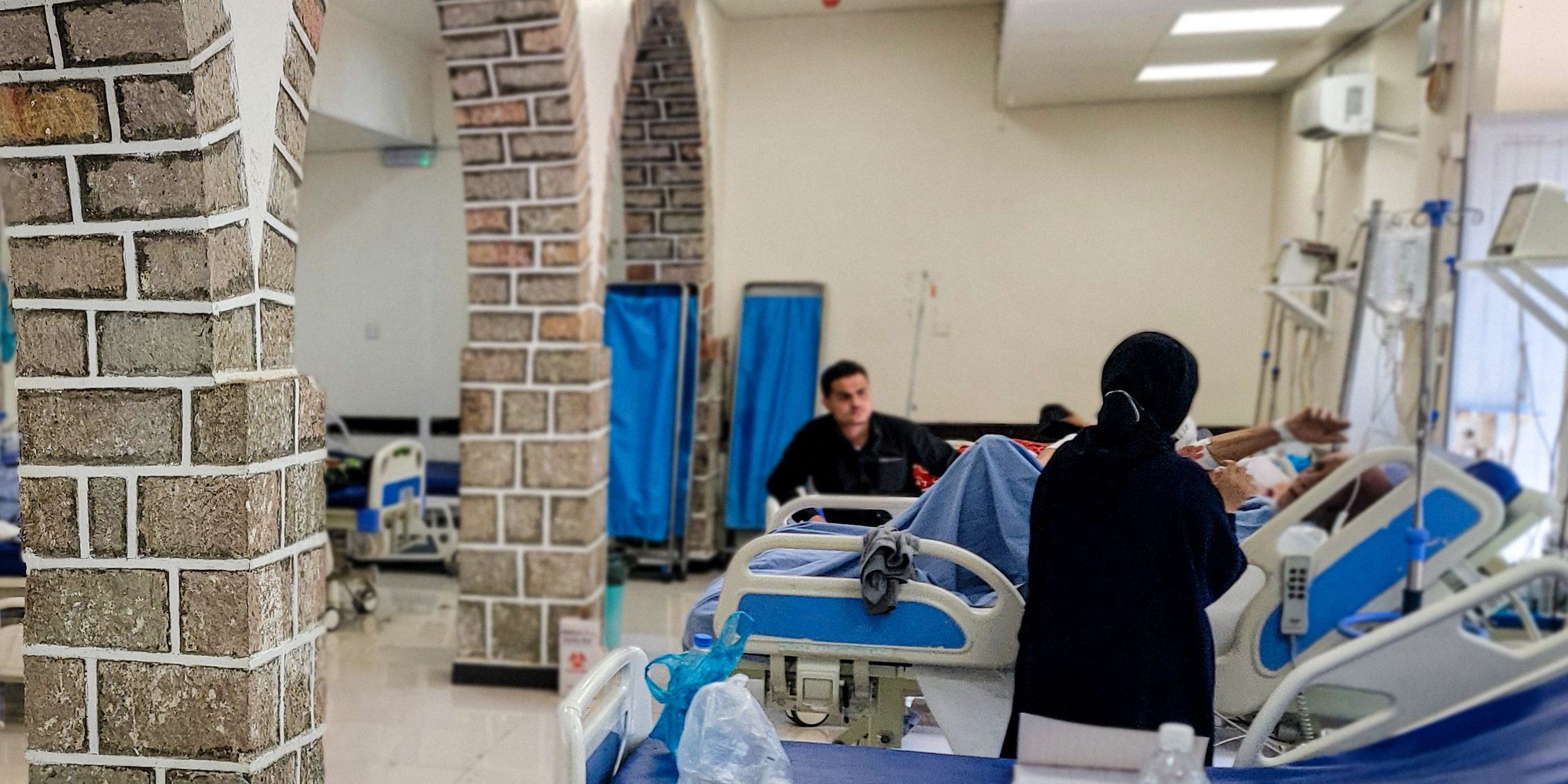

SANA’A, Yemen — For more than two weeks, Abdullah laid at home in al-Silw district, in Yemen’s besieged southwestern governorate of Taiz, as his body slowly failed.
The 58-year-old had lived with kidney failure for two years, and his doctor had prescribed dialysis twice a week.
Since the siege, however, the fighting stood between al-Eissi and the dialysis center in Taiz city that kept him alive. Al-Eissi wouldn’t let his family risk their lives to take him to the center.
“My father’s condition deteriorated badly,” said his son, Muadh, 38. “We couldn’t move him to Taiz because the fighting had intensified.”
About a week ago, al-Eissi died at home in his bed.
“When I saw my mother weeping for her husband, I felt helpless,” Muadh said. “It might have been avoided if my father had reached his dialysis sessions on time.”
Abdullah is one of at least 10 dialysis patients who have died since the siege on Taiz began because they could not reach treatment, according to Dr. Issam Mahyoub, director of the kidney dialysis center at al-Jumhuri Hospital in Taiz. Doctors warn that many more could follow.
“About 60 percent of kidney failure patients in Taiz face the risk of death because they cannot reach the dialysis center.”
“About 60 percent of kidney failure patients in Taiz face the risk of death because they cannot reach the dialysis center,” said Dr. Fouad al-Haddad, the hospital’s director. “Behind every number is a human being and a family living in anxiety, waiting for a chance to continue treatment that may never come.”
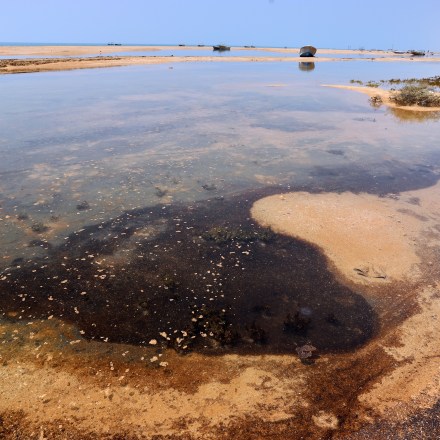
The kidney-failure deaths are part of the toll of a wider regional war set off by an unprovoked February attack against Iran by Israel and the United States. Estimates hold that 10,000 or more people have died during the war, including both military and civilian deaths across the region. Since the regional war reignited in Yemen this summer, according to the World Health Organization, at least 800 people have been killed, with thousands wounded and tens of thousands displaced.
“The plight of dialysis patients in Taiz illustrates how geopolitical struggles over deterrence, energy security, and regional leverage translate into blocked transit, disrupted medical care, and preventable deaths,” said Sina Toossi, a senior non-resident fellow at the Center for International Policy. “Yemen’s population has already endured more than a decade of devastating war, and the tragedy is that this wider regional conflict is now threatening to plunge it back into another humanitarian catastrophe.”
Yemen in the Iran War
Yemen entered the war in March, when the Iran-aligned Ansarallah armed group, more commonly known as the Houthis, began firing missiles into Israel in retaliation for its attacks on Iran. The Houthis, who gained control of various portions of Yemen during a two-decade-long insurgency, including the capital of Sana’a, saw their prominence in the Iran war grow with attacks against shipping channels surrounding the Arabian Peninsula.
The Yemeni civil war itself had been a long-simmering conflict when the Iran war broke out, straining a 2022 truce signed by the Houthis and their rivals, including Saudi Arabia, which was broken this July when the Houthis attacked a regional Saudi airport. Throughout August, the Houthis launched missile, drone, and ground attacks across the front lines against the internationally recognized, Saudi-backed Yemeni government.
In September, the Houthis seized strategic areas on Yemen’s coast and imposed a naval blockade that cut off the Bab al-Mandeb Strait, while firing missiles deeper into Saudi Arabia.
In early October, Yemeni government forces backed by the Saudi-led coalition launched an operation aimed at retaking the coast and pushing into Sana’a.
As they moved inland to consolidate their coastal gains, Houthi forces pushed into the highlands around Taiz, a strategically located city controlled by the government. In short order, the insurgents severed the main mountain road linking Taiz to Aden, another city also controlled by the government.
The blockade trapped more than 600,000 residents and sent food and fuel prices soaring. The U.N. World Food Program warned that Taiz’s wheat and flour stocks are close to running out.
“We have confirmed cases of death and cases of severe impact,” said Tawfiq al-Humaidi, head of the SAM Organization for Rights and Liberties, a Geneva-based international body monitoring violence in Yemen, who said fighting on roads near Taiz has cut off medical supplies from the city. “Those who are dying and suffering are among the victims of the Iranian war, which drove the Houthis to expand toward Taiz and Bab al-Mandeb.”
On October 14, the Yemeni government formally petitioned the U.N. Security Council for immediate, practical intervention to lift the “suffocating siege.”
Any action would be too late for families like the al-Eissis.
Cut Off From Care
Taiz is Yemen’s cultural capital and its third-largest city. Healthcare facilities there serve a huge geographical area. Al-Haddad, the head of the al-Jumhuri Hospital, said patients hail from across the governorate.
“They come from the West Coast, al-Mawasit, Jabal Habashi, al-Shamayatayn, Sama, al-Silw, al-Misrakh, and al-Maafer areas,” he said, “where distances are long and the hardship of travel is multiplied by rough roads and security conditions.”
The kidney dialysis center has 270 registered patients.

“That doesn’t count the patients from outside the city who haven’t been able to reach us,” said Mahyoub, the head of the dialysis center. “Patients from al-Misrakh, al-Aqroud, al-Shamayatayn, al-Hujariya, al-Turba, and Jabal Habashi localities used to come to us. Now getting here has become extremely difficult, with the fighting and the restrictions on movement into the city.”
Ahlam Ali Abdo, 33, walks about 30 kilometers from her village in Jabal Habashi to reach the center, crossing rough roads and areas where gunfire and shelling ring out. The walk, extremely risky for a kidney failure patient, takes between 5 to 9 hours. After treatment, she faces the same distance back, uphill, to her three children. Some days the road is too dangerous, and Abdo waits for hours in the city.
“I cry constantly of pain and exhaustion and worry that I wouldn’t be able to see my children again. My condition is miserable,” she said.
Her husband stays home with the children. Bringing any of them with her, she said, would put the whole family in danger.
Mahyoub’s center tried and failed to find her housing in the city. Yesterday, on Friday, another dialysis patient took her in, for fear she would be killed on the road.
Reaching the center doesn’t guarantee treatment.
“The shortage of diesel needed to run the generators forced us to cut dialysis sessions from 4 hours to 2,” said Mahyoub. Supplies from the Ministry of Health in Aden “no longer arrive regularly, and the remaining stock is nearly gone.”
“Dialysis is a lifeline for these patients,” he said.
Haddad, the hospital director, said of the dialysis center doctors: “They are expected to save patients, but the means available are not always enough.”

The Office of Public Health and Population in Aden has warned of an imminent health and humanitarian catastrophe in Taiz caused by the continuing siege and the obstruction of supplies.
In a statement, it said “medicines, solutions, medical supplies and fuel in the city’s health facilities were close to running out. That threatens emergency services, surgery, intensive care, dialysis and neonatal incubators.”
No Road to Aden
For patients who can no longer reach Taiz’s center, Aden is the fallback, whether for treatment or for its airport to travel abroad. The Taiz–Aden road, however, is unusable, according to patients and Mahyoub. The detours wind through mountain bends and rough terrain, add hours and transport costs, and in places run through active clashes.
The crisis extends beyond Taiz.
Dr. Anis al-Asbahi, spokesperson for the Health Ministry in Sana’a, said that “more than 8,000 kidney failure patients in Houthi-controlled governorates are suffering because hemodialysis machines and dialysis medicines can’t get in.”
He blamed the blockade and the closure of Sana’a airport.
“Kidney failure knows no political barriers,” Mahyoub said. “Patients cannot wait for disputes to be settled or for circumstances to change before they get treatment.”
For Muadh al-Eissi, whose father died from kidney failure, the question is simpler.
“How can the parties using heavy weapons in populated areas ignore what the fighting does to patients,” he asked, “to the children, women and elderly people who need medicine and treatment? People, like my father, are losing their lives for what?”
IT’S EVEN WORSE THAN WE THOUGHT.
What we’re seeing right now from Donald Trump is a full-on authoritarian takeover of the U.S. government.
This is not hyperbole.
Court orders are being ignored. MAGA loyalists have been put in charge of the military and federal law enforcement agencies. The Department of Government Efficiency has stripped Congress of its power of the purse. News outlets that challenge Trump have been banished or put under investigation.
Yet far too many are still covering Trump’s assault on democracy like politics as usual, with flattering headlines describing Trump as “unconventional,” “testing the boundaries,” and “aggressively flexing power.”
The Intercept has long covered authoritarian governments, billionaire oligarchs, and backsliding democracies around the world. We understand the challenge we face in Trump and the vital importance of press freedom in defending democracy.
We’re independent of corporate interests. Will you help us?
IT’S BEEN A DEVASTATING year for journalism — the worst in modern U.S. history.
We have a president with utter contempt for truth aggressively using the government’s full powers to dismantle the free press. Corporate news outlets have cowered, becoming accessories in Trump’s project to create a post-truth America. Right-wing billionaires have pounced, buying up media organizations and rebuilding the information environment to their liking.
In this most perilous moment for democracy, The Intercept is fighting back. But to do so effectively, we need to grow.
That’s where you come in. Will you help us expand our reporting capacity in time to hit the ground running in 2026?
We’re independent of corporate interests. Will you help us?

I’M BEN MUESSIG, The Intercept’s editor-in-chief. It’s been a devastating year for journalism — the worst in modern U.S. history.
We have a president with utter contempt for truth aggressively using the government’s full powers to dismantle the free press. Corporate news outlets have cowered, becoming accessories in Trump’s project to create a post-truth America. Right-wing billionaires have pounced, buying up media organizations and rebuilding the information environment to their liking.
In this most perilous moment for democracy, The Intercept is fighting back. But to do so effectively, we need to grow.
That’s where you come in. Will you help us expand our reporting capacity in time to hit the ground running in 2026?
We’re independent of corporate interests. Will you help us?
Contact the author:
Related

Latest Stories

Midterms 2026
Mike Rogers Spent $100K on Private Jets and Luxury Travel Last Quarter
The Republican running for Senate in Michigan is directing campaign funds toward chartered flights, a Miami car service, and BMW repairs.

The Army Wants to Sic AI Agents on Its Enemies. What Could Go Wrong?
Documents obtained by The Intercept show the military is trying to deploy autonomous AI agents to hack its adversaries.

President Apocalypse
While Trump campaigns for a Nobel Peace Prize, his war on humanity’s only home continues unabated.