
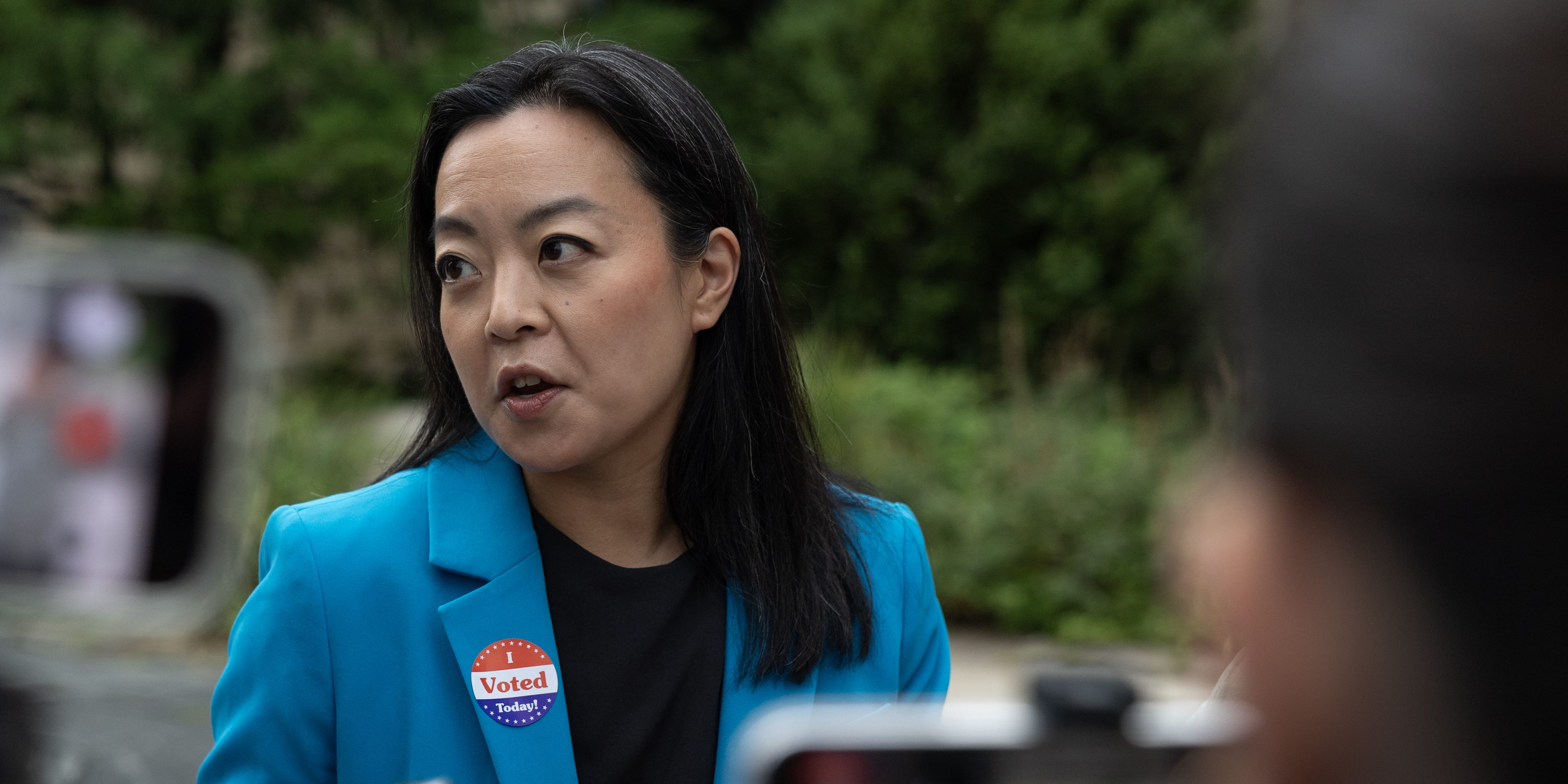
Democratic Socialist Francesca Hong’s narrow defeat in Wisconsin’s Democratic gubernatorial primary on Tuesday night wasn’t just a stinging blow to the left — it marks a political loss for a nonpartisan anti-data center movement that has been picking up significant steam across the country.
Milwaukee County Executive David Crowley beat the odds to eke out a victory by less than 1 percentage point on election night, a surprise upset after Crowley, who would be Wisconsin’s first Black governor if he wins in November, dropped out of the race and then reentered with the support of outgoing Democratic Wisconsin Gov. Tony Evers.
The race became dominated in the final days by inane issues like whether Hong believed that Thanksgiving should exist, based on old tweets criticizing the holiday, echoing and accelerating the annual Fox News “War on Christmas” panic. The sudden fury over old tweets was a distraction from a concrete issue that Hong had made a key focus of her public talking points and likely drove her surge in popularity: data centers.

Hong’s campaign repeatedly emphasized that she was the only candidate in the race to support a data center moratorium, which would pause construction of any new data centers, giving the state time to create regulations and study their environmental and energy impact. The moratorium would not extend to data center projects already underway in the state.
“It’s time to press control+alt+delete to put a stop to this AI data center crisis, a full moratorium until we have the new regulations we need to protect our energy costs, our economy, our environment,” Hong said in a campaign video.

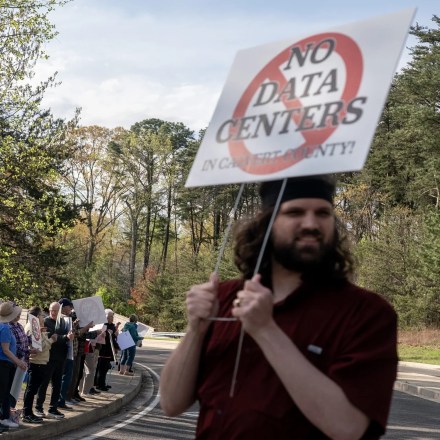
By all indications, it’s a popular position: A Gallup poll in May found that seven in 10 Americans oppose the construction of data centers in their area, and politicians from Maine to Texas have had to grapple with the public’s calls to bar the resource-hungry projects from their backyards.
Hong’s narrow defeat is a loss for the data center moratorium movement, particularly in Wisconsin, which already has dozens of centers littering the state. Crowley, now the Democratic nominee, has called for more regulation of data centers, but has explicitly denounced a data center moratorium, calling it a “short-term” solution. “I don’t think he’s going to make [data centers] a front and center issue,” said Michael Ceraso, a democratic strategist and founder and director of Winning Margins. “It might pop up peripherally.”
But Hong’s loss is far from a death knell for the anti-data center movement. While most voters would be hard-pressed to tell you what a data center was a few years ago, it has slowly become a major political issue that has helped to fuel the rise of insurgent progressives across the country. In this year’s midterm primaries, anti-data center candidates from Colorado to Kansas have been running and winning on the issue.
The data center issue has distilled multiple grievances with establishment politicians into a simple message: The people who represent you are selling you and your community out to the highest bidder.
“It turns out that if you’re not taking money from Silicon Valley, you can fight hard for a federal moratorium on data centers,” said William Lawrence, co-founder of the Sunrise Movement, in a victory speech last week after he won his House primary race in Michigan’s 7th Congressional District.
In his Michigan Senate race, Abdul El-Sayed won after vehemently opposing the construction of new data centers. At a rally in front of a massive new OpenAI and Oracle data center campus in Saline Township, Michigan, El-Sayed denounced the proliferation of data centers. “I stand with local and state elected officials saying that we cannot approve any more of these until we have federal-level guardrails,” El-Sayed told the crowd.
In Kansas, Democratic state Sen. Cindy Holscher won her Democratic gubernatorial race after calling for a moratorium on data centers. Holscher had previously voted for a bill that would have expanded the centers. And in Colorado, Melat Kiros unseated a 15-term incumbent, Rep. Diana DeGette, D-Colo., while running on a data center moratorium platform.
Amanda Litman, co-founder and president of the political recruitment group Run for Something, told The Intercept that Hong’s formidable campaign underscored how motivating data center opposition is for voters.
“Francesca Hong went from unknown state legislator to within a half point of winning the Democratic nomination in large part because she clearly spoke to the frustration and fear people have about what’s happening in the economy, especially around data centers,” Litman said.

The Sunrise Movement, which has backed anti-data center candidates, including El-Sayed, Lawrence, Kiros, and Tennessee state Rep. Justin J. Pearson, who won his House race last week, said that Democrats need to be at the forefront of this issue.
“The fight against unchecked data center expansion is quickly becoming a defining political issue,” said Denae Ávila-Dickson, a spokesperson for the Sunrise Movement. “Democrats must be the party that stands up for people over the corporations profiting from data center expansion in our backyards, and progressive candidates are leading the way in that fight.”
IT’S EVEN WORSE THAN WE THOUGHT.
What we’re seeing right now from Donald Trump is a full-on authoritarian takeover of the U.S. government.
This is not hyperbole.
Court orders are being ignored. MAGA loyalists have been put in charge of the military and federal law enforcement agencies. The Department of Government Efficiency has stripped Congress of its power of the purse. News outlets that challenge Trump have been banished or put under investigation.
Yet far too many are still covering Trump’s assault on democracy like politics as usual, with flattering headlines describing Trump as “unconventional,” “testing the boundaries,” and “aggressively flexing power.”
The Intercept has long covered authoritarian governments, billionaire oligarchs, and backsliding democracies around the world. We understand the challenge we face in Trump and the vital importance of press freedom in defending democracy.
We’re independent of corporate interests. Will you help us?
IT’S BEEN A DEVASTATING year for journalism — the worst in modern U.S. history.
We have a president with utter contempt for truth aggressively using the government’s full powers to dismantle the free press. Corporate news outlets have cowered, becoming accessories in Trump’s project to create a post-truth America. Right-wing billionaires have pounced, buying up media organizations and rebuilding the information environment to their liking.
In this most perilous moment for democracy, The Intercept is fighting back. But to do so effectively, we need to grow.
That’s where you come in. Will you help us expand our reporting capacity in time to hit the ground running in 2026?
We’re independent of corporate interests. Will you help us?

I’M BEN MUESSIG, The Intercept’s editor-in-chief. It’s been a devastating year for journalism — the worst in modern U.S. history.
We have a president with utter contempt for truth aggressively using the government’s full powers to dismantle the free press. Corporate news outlets have cowered, becoming accessories in Trump’s project to create a post-truth America. Right-wing billionaires have pounced, buying up media organizations and rebuilding the information environment to their liking.
In this most perilous moment for democracy, The Intercept is fighting back. But to do so effectively, we need to grow.
That’s where you come in. Will you help us expand our reporting capacity in time to hit the ground running in 2026?
We’re independent of corporate interests. Will you help us?
Contact the author:

Related

Rubio Is Trying to Keep Leftists Out of U.S. by Banning Supporters of “Economic Sabotage”

There’s No Time for Centrists to Be Doomers About El-Sayed’s Victory

William Lawrence Is Running in a Purple Michigan District — on His Pro-Palestine Credentials

There’s a New Democratic Machine. It’s Unabashedly Socialist.
Latest Stories

Voices
An Arkansas Mom Obtained Public Records About a New Data Center. Then She Got Sued.
Cases in Arkansas and California show how desperately we need a federal law against lawsuits intended to chill free speech.

The War on Immigrants
Don’t Stop at ICE, Says Progressive Dem: Abolish the Department of Homeland Security
Rep. Delia Ramirez is bringing a bill to eliminate DHS a day after the raid on Rep. Ilhan Omar’s home.

Voices
ICE Raid on Ilhan Omar Shows How Dangerous Two Years of Flailing Trump Could Get
With his popularity tanking and his grip on power growing tenuous, Trump is becoming a decrepit tyrant — and the checks to stop him are failing.