


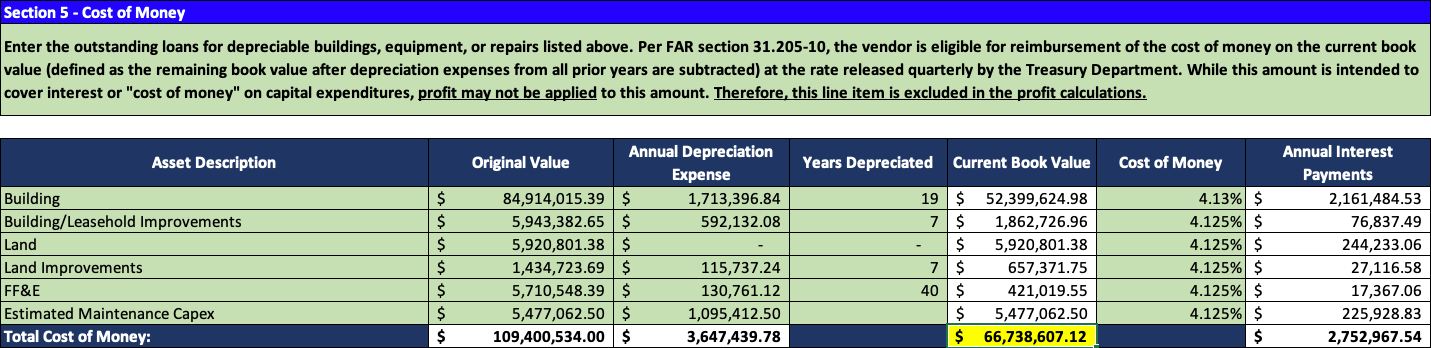
As it eyed a sale of a jail in Tacoma, Washington, the private prison giant GEO Group valued the facility in March 2026 at $67 million, according to U.S. Immigration and Customs Enforcement records obtained exclusively by The Intercept.
The federal government just paid GEO almost seven times that — $453 million — when it purchased the facility, the Northwest ICE Processing Center.
The chasm between GEO’s March 2026 asset appraisal and the sale price just eight months later represents a “massive increase,” according to Michael Wriston, co-founder of the government watchdog Project Salt Box, which tracks ICE spending and contracts.
“ICE should explain how it arrived at $453 million and release the appraisal behind that price,” Wriston told The Intercept.
“I think this is what happens when you move too fast without sufficient internal controls,” John Roth, the former inspector general of the Department of Homeland Security, ICE’s parent agency, told The Intercept. “You’re going to waste a lot of money. And that assumes everyone has the best intentions and hasn’t got some sort of side deal or corrupt motive.”
Neither ICE nor GEO responded to requests for comment about the sale. Without answering questions about the sale price, the Department of Homeland Security told The Intercept the purchase was “to strengthen America’s ability to enforce its immigration laws and carry out the American people’s mandate for mass deportations.”
With Democrats set to take control of Congress, ICE’s real estate purchases are already coming under intense scrutiny on Capitol Hill.
“These deals raise serious questions about pay-to-play schemes and corruption at DHS.”
“This new report is worthy of serious investigation and is part of a pattern of Department of Homeland Security purchases of detention facilities for hundreds of millions of dollars more than they seem to be worth,” Sen. Maggie Hassan, D-N.H., the incoming chair of the Senate Committee on Homeland Security and Governmental Affairs, told The Intercept in a statement. “These deals raise serious questions about pay-to-play schemes and corruption at DHS.”
Hassan opened a probe earlier this month into ICE’s $495 million purchase of a detention center the private prison giant CoreCivic previously offered to the state of Minnesota for $75 million — a sale the state’s corrections commissioner told the news site Punch Up was being discussed for $3 million.

GEO Group’s March 2026 valuation for Northwest ICE Processing Center, which the company purchased in 2005 as part of its acquisition of another private prison firm, was submitted to the Department of Homeland Security in accordance with its contract with ICE.
According to a chart in the document, GEO calculated the current $67 million value of the detention facility, which is not the same as its market value, by subtracting annual depreciation figures from its original value of $109 million.
Roth, the former Homeland Security inspector general, expects scrutiny into the nearly half-billion-dollar sale’s paper trail.
“I’d be curious to know,” he said, “what sort of due diligence they did before they put that number down.”


Cost of Avoiding Regulations
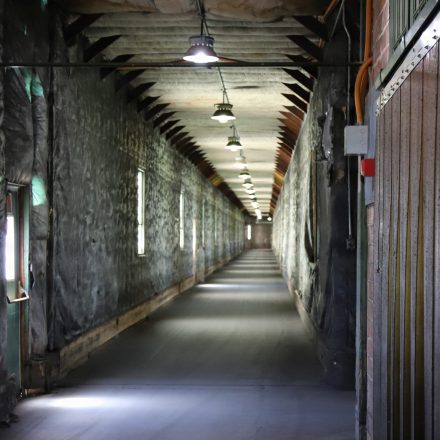
ICE officials told Government Accountability Office investigators that their robust plans for purchasing existing immigration detention facilities was not to save money, but to avoid issues with local governments.
“Officials noted that while they do not expect this effort to result in cost savings, it will help ICE fulfill its mission in locations where state governments may resist expanded detention efforts,” said a Government Accountability Office report released this month.
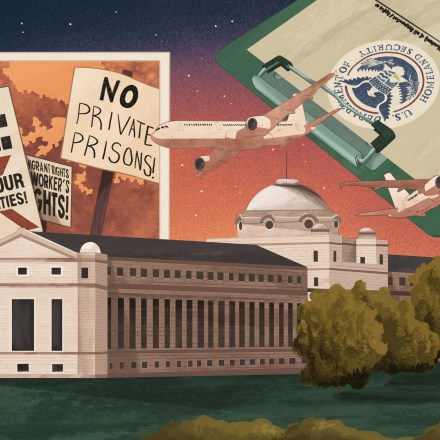
Like other private prison firms across the country, GEO’s efforts to build and operate facilities it owns have met obstacles in local rules and regulations.
In some cases, state-level regulators have gone after GEO for violations of labor laws like minimum wage and occupational safety regulations. Earlier this year in California, the company paid a $100,000 fine and agreed to extend worker protections to immigrant laborers over alleged violations of California worker safety standards.
One of the cases focused on the Northwest ICE Processing Center, the Tacoma facility that GEO just sold to ICE. In 2021, a judge ordered GEO to pay $26 million to former detainees and the state of Washington for, among other allegations, state minimum wage violations. (Andrew Free, one of the authors of this article, was an attorney for the ICE detainees in the lawsuit.)
The verdict was upheld by a federal appeals court in 2025 after GEO sought the same immunity from state minimum wage laws enjoyed by the federal government. The Supreme Court is currently deciding whether it will hear GEO’s appeal.
In a May earnings call, GEO chair George Zoley noted the problem in areas with Democrats in charge of regulation.
“I think the logical solution to much of that is federal ownership of the facilities,” Zoley told the earnings call, according to the Philadelphia Inquirer.
Lucibeth Mayberry, the CEO of CoreCivic, told investors during the company’s most recent earnings call that ICE should “move quickly” to complete several more purchases before the end of the current Congress’s term.
“Someone needs to come clean about why ICE is paying hundreds of millions for facilities that are worth a fraction of that amount.”
Taking federal ownership of the facilities could lead to massive new expenses for the government — and not only due to the enormous sticker prices, according to the Government Accountability Office report.
“ICE did not manage detention facility investments in accordance with DHS acquisition practices, which include the development of life-cycle cost estimates,” the report said.
According to the Government Accountability Office, ICE violated its own guidelines by failing to update its spending plans to account for the costs of a plan to purchase warehouses to convert them into immigrations jails, as well as its acquisitions of existing detention facilities.
“In purchasing facilities like the one in Tacoma, the administration is not only sticking the American taxpayer with the massive bill — but also escalating costs for operating them for years to come,” Rep. Bennie Thompson, D-Miss., who is slated to resume his perch atop the House Homeland Security Committee in January, told The Intercept. “DHS must answer for its actions.”
“Laughing to the Bank”
After the sale of the Northwest ICE Processing Center to ICE, GEO plans to use the $340 million net profits from the sale to buy back shares of stock, thus increasing their value, the firm told its shareholders.
“It is unfathomable that GEO has announced it intends to use the net proceeds from this sale for stock buybacks.”
“I am deeply concerned by what appears to be a gross misuse of taxpayer dollars to pad the pockets of the GEO Group, a private, for-profit company that has overseen real mistreatment and abuses of detained people across the country,” Rep. Pramila Jayapal, D-Wash., the ranking member of the House Judiciary’s Immigration subcommittee, told The Intercept. “It is unfathomable that GEO has announced it intends to use the net proceeds from this sale for stock buybacks, in yet another move to put profits over the safety and health of the people it detains.”
The sale of the immigration jail is just the latest means by which GEO is extracting super-profits from public funds.
Days before announcing the nearly half-billion-dollar deal that would turn the Northwest ICE Processing Center into a federally owned property, ICE also awarded GEO a $1.5 billion contract to continue its detention services there, according to Project Salt Box.

While eye-popping ICE contracts are nothing new for major private prison firms, ICE’s purchase of the companies’ facilities at such high prices is raising eyebrows among government accountability advocates.
“Someone needs to come clean about why ICE is paying hundreds of millions for facilities that are worth a fraction of that amount,” said Scott Amey, general counsel of the Project on Government Oversight, a government watchdog.
“Who is minding the store and is anyone conducting market research or talking to commercial realtors to figure out the fair price?” asked Amey. “I don’t think so, and the public is now on the hook for years to come while the companies are truly laughing to the bank.”
IT’S EVEN WORSE THAN WE THOUGHT.
What we’re seeing right now from Donald Trump is a full-on authoritarian takeover of the U.S. government.
This is not hyperbole.
Court orders are being ignored. MAGA loyalists have been put in charge of the military and federal law enforcement agencies. The Department of Government Efficiency has stripped Congress of its power of the purse. News outlets that challenge Trump have been banished or put under investigation.
Yet far too many are still covering Trump’s assault on democracy like politics as usual, with flattering headlines describing Trump as “unconventional,” “testing the boundaries,” and “aggressively flexing power.”
The Intercept has long covered authoritarian governments, billionaire oligarchs, and backsliding democracies around the world. We understand the challenge we face in Trump and the vital importance of press freedom in defending democracy.
We’re independent of corporate interests. Will you help us?
IT’S BEEN A DEVASTATING year for journalism — the worst in modern U.S. history.
We have a president with utter contempt for truth aggressively using the government’s full powers to dismantle the free press. Corporate news outlets have cowered, becoming accessories in Trump’s project to create a post-truth America. Right-wing billionaires have pounced, buying up media organizations and rebuilding the information environment to their liking.
In this most perilous moment for democracy, The Intercept is fighting back. But to do so effectively, we need to grow.
That’s where you come in. Will you help us expand our reporting capacity in time to hit the ground running in 2026?
We’re independent of corporate interests. Will you help us?

I’M BEN MUESSIG, The Intercept’s editor-in-chief. It’s been a devastating year for journalism — the worst in modern U.S. history.
We have a president with utter contempt for truth aggressively using the government’s full powers to dismantle the free press. Corporate news outlets have cowered, becoming accessories in Trump’s project to create a post-truth America. Right-wing billionaires have pounced, buying up media organizations and rebuilding the information environment to their liking.
In this most perilous moment for democracy, The Intercept is fighting back. But to do so effectively, we need to grow.
That’s where you come in. Will you help us expand our reporting capacity in time to hit the ground running in 2026?
We’re independent of corporate interests. Will you help us?
Contact the author:
Related



Latest Stories

Losing to the Mud: Feds Drag Their Feet as an Alaskan Village Sinks
As communities seek relocation spurred by climate change, the Yup’ik people in the remote village of Nunapitchuk have struggled to get help moving a mile uphill.

Voices
An Air Force Major Is Being Held in Solitary Confinement for Criticizing Trump on CNN
The administration is weaponizing military law to hold Maj. Jason Watson in extreme isolation awaiting a “contemptuous words” trial.

Establishment Dems Want to Renew Trump’s Domestic Spy Powers Before New Congress
Rep. Jim Himes and Sen. Mark Warner are spurning the will of midterm voters by pushing warrantless spying in the lame-duck Congress, privacy advocates say.