
The U.S. military is struggling to protect its overseas bases amid a conflict with Iran that has spun out of self-styled War Secretary Pete Hegseth’s control.
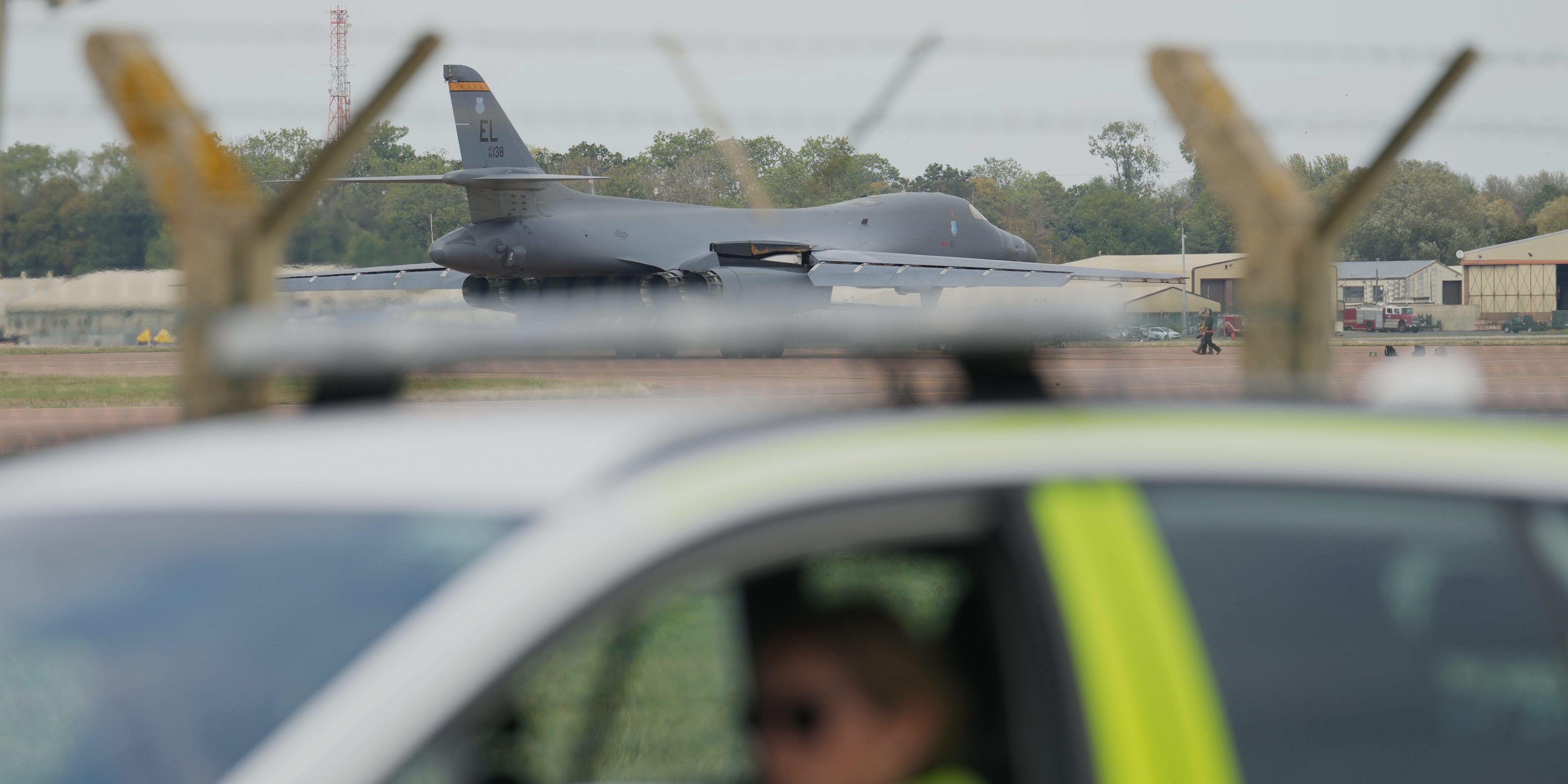
After a string of damaging attacks on bases throughout the Middle East, U.S. long-range bombers stationed in the United Kingdom fled back to their American home bases on Sunday amid fears of an impending Iranian strike.
A U.S. official described the threat as a “sophisticated plot to attack” Royal Air Force Fairford air base with “multiple drones” that could have turned into a military and public relations nightmare. The U.S. official suggested that Iran’s Islamic Revolutionary Guard Corps may have recruited U.K. nationals to play roles in the plot, which so unnerved the Pentagon that they took the extraordinary step of removing 12 B-1 Bombers from the base that has played a key role in the U.S. war. A second official called it a “complex plan” and part of a “hybrid strategy” of asymmetric warfare by Iran that forced the Pentagon to take drastic measures.
“There were some threats,” President Donald Trump admitted on Monday when asked about the bombers, adding that leaving the aircraft would only tempt an attack.
The inability to safeguard U.S. aircraft at a base northwest of London comes at a time of mounting attacks on U.S. outposts around the world.
Complex Iranian drone and ballistic missile strikes have killed and injured U.S. troops, placed many more in harm’s way, and damaged or destroyed numerous outposts across the Middle East. Some crucial bases have sustained so much damage that U.S. operations have been radically disrupted and, according to the second official, “base posture in the region may never recover.”
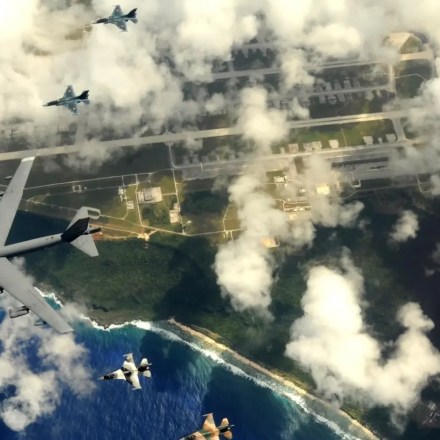
The strikes have also targeted joint facilities operated by U.S. allies. In March, Iran launched a drone attack on a British air base in Akrotiri, Cyprus, causing damage to a facility the U.S. military has long relied on. Iran also targeted a joint U.K.–U.S. base on the Indian Ocean island of Diego Garcia that has become increasingly central to the U.S. war effort.
What Trump called a “little excursion” has become a festering wound for the U.S. military. Despite months of claims by Trump and Hegseth that Iran’s military was annihilated, Iran has attacked more than 15 bases across the Middle East. The official U.S. casualty toll stands at 19 dead and close to 900 wounded, most of the dead occurring since July, after the Trump administration claimed the war had ended. The real casualty toll is higher and has been consistently obscured and manipulated through what one defense official called a “cover-up.”
The first U.S. official said Iran is engaged in a “go for broke” strategy, banking that it can absorb economic ruin longer than the U.S. can sustain a failing war and an expensive and difficult Naval blockade and escort program in the Strait of Hormuz, while dealing with global economic upheaval from stubbornly high fuel prices that have not shrunk to pre-war levels despite the oil flow from other Gulf Nations returning to normal.
The withdrawal of the bombers from Fairford came just days after the British government arrested six suspects in connection with a suspected attack on that same base. U.K. Prime Minister Andy Burnham said there were “strong indications” that Iran played a role in the incident. The men were later released on bail, prompting criticism by Trump.
The IRGC warned in July that “any base used to launch attacks on Iranian territory is a legitimate target for our forces.” On Monday, the commander-in-chief of Iran’s army, Maj. Gen. Amir Hatami, “stressed the need for any creative act capable of disrupting the enemy’s calculations,” according to a report by Iran’s Islamic Republic News Agency. The U.S. officials referenced additional threats against other bases in Europe, including Ramstein Air Base in Germany.
This isn’t the first time the U.S. has scrambled to protect its assets from a supposed Iranian threat. In July, Trump himself snuck into a catering truck and fled Turkey on a military aircraft due to U.S. fears of a possible Iranian attack on Air Force One. Trump had earlier said he was Iran’s “No. 1 target” during the NATO summit in Ankara.
Unlike their commander-in-chief, U.S. troops have been unable to flee their bases and ships when Iran has overwhelmed U.S. air defenses during attacks in the Middle East. A recent Pentagon inspector general report revealed Iranian strikes “damaged and destroyed hundreds of buildings and structures at U.S. bases in Kuwait, Bahrain, Qatar, UAE, Saudi Arabia, Iraq, Oman, and Jordan during the conflict.” Air Force personnel, alone, endured more than 1,200 “alarm reds” — the official code for imminent attack by missiles, aircraft, or ground forces — during just 38 days earlier this year, according to Air Force chief of staff Gen. Ken Wilsbach.
A March 1 drone attack on the Port of Shuaiba in Kuwait killed six U.S. troops, the deadliest known Iranian strike on U.S. personnel during the war; dozens more were wounded. In July, an Iranian attack on Muwaffaq Salti Air Base in Jordan killed three soldiers from air defense units although they were “not actively engaged in anti-aircraft activity” during the attacks, according to a “defense official” who spoke on background because they were not authorized to disclose the information. Multiple U.S. military aircraft were also damaged in the attack, including an A-10 Thunderbolt and eight F-15 fighters. These were among dozens of U.S. aircraft so far destroyed or damaged in the war, including four F-15 fighter aircraft, 12 KC-135 refueling aircraft, and as many as 30 MQ-9 Reaper drones, according to the inspector general report.
The U.S. and its allies burned through more than 11,000 munitions, including large amounts of defensive missiles, in the first 16 days of the war alone, according to a March analysis by the Royal United Services Institute. About 65 percent of Patriot interceptors were expended between February and July, leaving fewer than 830 remaining from a pre-war total of 2,330, according to an analysis by the Center for Strategic and International Studies. The number of THAAD interceptors dropped from more than 450 to less than 270.
Adm. Brad Cooper, the chief of U.S. Central Command, downplayed the risks of depleted stockpiles of such missiles last month, telling CBS’s “60 Minutes” that he wasn’t worried for the safety of U.S. troops. “I’m not concerned at all,” he replied when asked about defending against Iranian attacks. CENTCOM did not reply when asked if Cooper would resign if U.S. troops were killed or wounded in future attacks.
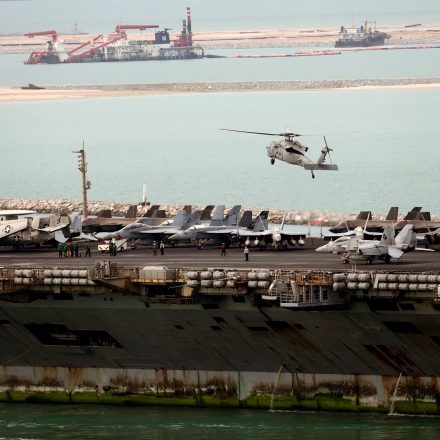
An Iranian missile and drone attack at the start of the war destroyed Navy facilities in Manama, Bahrain, the most critical U.S. logistics hub in the region. The Pentagon claimed for months that the strikes did not significantly impact military operations but acting Navy Secretary Hung Cao admitted last month that “they blew the hell out of Bahrain.” A Wall Street Journal investigation previously found that rebuilding the U.S. Navy’s Fifth Fleet headquarters, barracks, and communication towers at Naval Support Activity Bahrain may cost more than $400 million, which the first U.S. official told The Intercept could be an underestimate if it’s ever attempted. Naval Forces Central Command referred questions about the cost estimate to CENTCOM, which did not respond.
With the home of the Fifth Fleet knocked out and other ports in the region within range of Iranian missiles and drones, the Navy found itself facing the daunting challenge of maintaining a flotilla of more than 24 ships — including two massive aircraft carriers and numerous guided-missile destroyers and cruisers, attack submarines, or supply ships deployed at any one time. This means Navy ships need to haul food and fuel more than 2,000 miles from the base on Diego Garcia. The inspector general report noted that the shift in “naval bases and support ports posed significant challenges,” pointing specifically to the “issue with shifting logistics support and infrastructure to Diego Garcia” and the challenges of “extended sea transit requiring 14- to 18-day logistics cycles.”
Sailors and Marines have been subjected to constant danger as a result. The USS Gerald R. Ford Carrier Strike Group completed a record-breaking 11-month deployment that also included the invasion of Venezuela. (Under normal conditions, a carrier would visit port about once a month to allow its crew to rest.) The ship was, according to a Presidential Unit Citation, under “persistent threat from enemy missiles and one-way attack drones” during its deployment to the Middle East.
More recently, the IRGC targeted another aircraft carrier and guided-missile destroyer with ballistic missiles, according to Central Command. And Marines were injured in an Iranian attack on a commercial vessel in the Strait of Hormuz last month; the two U.S. officials said those Marines potentially suffered brain trauma, among other injuries.
Amid the floundering war with Iran, U.S. forces withdrew from neighboring Iraq last week, ending two-plus decades of U.S. military occupation and operations that unleashed waves of bloodshed and civilian suffering. “The expulsion of America from Iraq was the result of … the country’s steadfastness in its independence,” the IRGC announced, in a missive touting the power of national resistance. Politicians in Baghdad also celebrated the withdrawal, with Iraqi Prime Minister Ali al-Zaidi officially declaring October 1 a “Day of Sovereignty and Independence.”
Despite the Trump administration’s claims, the Iran war continues to expand. Last month, Yemen’s Iran-backed Houthi forces seized virtually all of Yemen’s Red Sea coast, including the shoreline along the crucial shipping lanes of the Bab el-Mandeb Strait, which is the southern entrance to the Red Sea. On Tuesday, the Houthis claimed to have killed or wounded more than 200 Saudi-backed fighters seeking to retake territory.
IT’S EVEN WORSE THAN WE THOUGHT.
What we’re seeing right now from Donald Trump is a full-on authoritarian takeover of the U.S. government.
This is not hyperbole.
Court orders are being ignored. MAGA loyalists have been put in charge of the military and federal law enforcement agencies. The Department of Government Efficiency has stripped Congress of its power of the purse. News outlets that challenge Trump have been banished or put under investigation.
Yet far too many are still covering Trump’s assault on democracy like politics as usual, with flattering headlines describing Trump as “unconventional,” “testing the boundaries,” and “aggressively flexing power.”
The Intercept has long covered authoritarian governments, billionaire oligarchs, and backsliding democracies around the world. We understand the challenge we face in Trump and the vital importance of press freedom in defending democracy.
We’re independent of corporate interests. Will you help us?
IT’S BEEN A DEVASTATING year for journalism — the worst in modern U.S. history.
We have a president with utter contempt for truth aggressively using the government’s full powers to dismantle the free press. Corporate news outlets have cowered, becoming accessories in Trump’s project to create a post-truth America. Right-wing billionaires have pounced, buying up media organizations and rebuilding the information environment to their liking.
In this most perilous moment for democracy, The Intercept is fighting back. But to do so effectively, we need to grow.
That’s where you come in. Will you help us expand our reporting capacity in time to hit the ground running in 2026?
We’re independent of corporate interests. Will you help us?

I’M BEN MUESSIG, The Intercept’s editor-in-chief. It’s been a devastating year for journalism — the worst in modern U.S. history.
We have a president with utter contempt for truth aggressively using the government’s full powers to dismantle the free press. Corporate news outlets have cowered, becoming accessories in Trump’s project to create a post-truth America. Right-wing billionaires have pounced, buying up media organizations and rebuilding the information environment to their liking.
In this most perilous moment for democracy, The Intercept is fighting back. But to do so effectively, we need to grow.
That’s where you come in. Will you help us expand our reporting capacity in time to hit the ground running in 2026?
We’re independent of corporate interests. Will you help us?
Contact the author:

Related
Latest Stories

Trials of Richard Glossip
The Key Witness Against Richard Glossip Just Returned to Court. It Didn’t Go Well.
Decades after blaming Glossip for his own actions, Justin Sneed is less credible than ever — and prosecutors know it.

Susan Collins’s Committee Bought Trucks the Army Didn’t Want. Then Campaign Donations Poured In.
Appropriations committee members saw an influx of campaign contributions after steering $345 million to a military contractor.

Voices
Public Radio Station Forced to Call Gulf of Mexico the “Gulf of America”
The University of Alabama at Birmingham is rolling over to Trump and his acolytes in the state, rather than stand up for editorial independence.