

Mohamedou Slahi, author of a bestselling memoir recounting his imprisonment and torture by the United States government, has been sent home to his native Mauritania after more than 14 years in Guantánamo Bay.
Slahi became the prison’s best-known detainee last year after publishing “Guantánamo Diary,” in which he recounts how he was rendered by the CIA in 2001 to prisons in Jordan and Afghanistan and then taken to Guantánamo. He wrote of being beaten, subjected to sleep deprivation and freezing temperatures, and blasted with music and other abuses, but also described with incredible openness and generosity his relationships with his American guards and interrogators.
Slahi’s lawyers at the American Civil Liberties Union released a statement attributed to him saying, “I feel grateful and indebted to the people who have stood by me. I have come to learn that goodness is transnational, transcultural, and trans-ethnic. I’m thrilled to reunite with my family.”

Mohamedou Slahi in a photo distributed by the International Committee for the Red Cross.
In July, an interagency review board approved Slahi’s release, pending negotiations with his home country of Mauritania. In a hearing before the board in June, Slahi, through his representatives, had asked to be sent to rejoin family members in either Mauritania or Germany. He said he planned to start a small business, make use of computer skills he learned while imprisoned, and continue to write books.
A former guard submitted a letter in support of Slahi’s release to the board, saying that he would be glad to welcome him into his home. Military representatives described him as “one of the most compliant detainees” and “an advocate for peace” who “has pursued a new direction in life.”
“Eleven years ago Mohamedou wrote his ‘Guantánamo Diary’ as a gesture of faith in the power of the truth to overcome injustice,” said the writer Larry Siems, who edited the book, in a statement. “Today that faith has been rewarded.”
Slahi’s release leaves 60 men at Guantánamo, 20 of whom have been approved for transfer out of the prison.
Elizabeth Beavers, a senior campaigner with Amnesty International USA, said in a statement that “Slahi’s accounts of his treatment provided a chilling insight into the reality suffered by those unlawfully held for more than a decade without charge.” Each of the remaining men, she said, “must be charged and tried through fair trial in federal court, or be released to a country that will protect their human rights.”
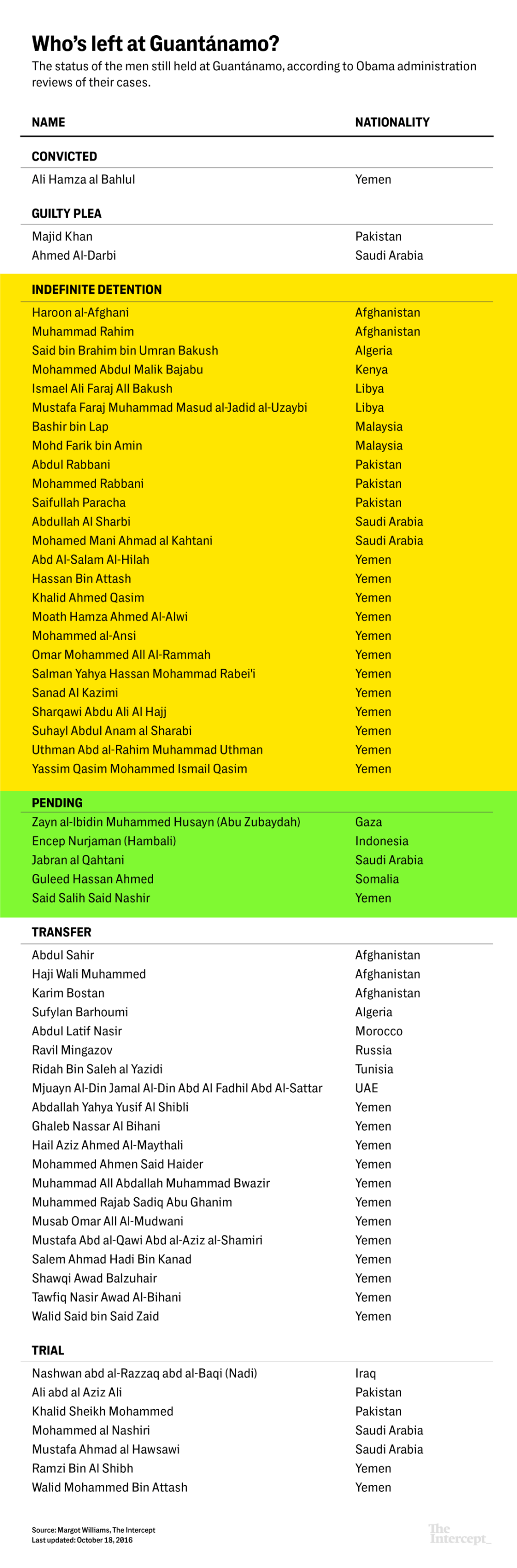
Update, October 18: This piece has been updated to include a chart showing the status of the detainees who remain at Guantánamo.
Top photo: Two pages from “Guantanamo Diary” that were redacted by the U.S. government.
IT’S EVEN WORSE THAN WE THOUGHT.
What we’re seeing right now from Donald Trump is a full-on authoritarian takeover of the U.S. government.
This is not hyperbole.
Court orders are being ignored. MAGA loyalists have been put in charge of the military and federal law enforcement agencies. The Department of Government Efficiency has stripped Congress of its power of the purse. News outlets that challenge Trump have been banished or put under investigation.
Yet far too many are still covering Trump’s assault on democracy like politics as usual, with flattering headlines describing Trump as “unconventional,” “testing the boundaries,” and “aggressively flexing power.”
The Intercept has long covered authoritarian governments, billionaire oligarchs, and backsliding democracies around the world. We understand the challenge we face in Trump and the vital importance of press freedom in defending democracy.
We’re independent of corporate interests. Will you help us?
IT’S BEEN A DEVASTATING year for journalism — the worst in modern U.S. history.
We have a president with utter contempt for truth aggressively using the government’s full powers to dismantle the free press. Corporate news outlets have cowered, becoming accessories in Trump’s project to create a post-truth America. Right-wing billionaires have pounced, buying up media organizations and rebuilding the information environment to their liking.
In this most perilous moment for democracy, The Intercept is fighting back. But to do so effectively, we need to grow.
That’s where you come in. Will you help us expand our reporting capacity in time to hit the ground running in 2026?
We’re independent of corporate interests. Will you help us?

I’M BEN MUESSIG, The Intercept’s editor-in-chief. It’s been a devastating year for journalism — the worst in modern U.S. history.
We have a president with utter contempt for truth aggressively using the government’s full powers to dismantle the free press. Corporate news outlets have cowered, becoming accessories in Trump’s project to create a post-truth America. Right-wing billionaires have pounced, buying up media organizations and rebuilding the information environment to their liking.
In this most perilous moment for democracy, The Intercept is fighting back. But to do so effectively, we need to grow.
That’s where you come in. Will you help us expand our reporting capacity in time to hit the ground running in 2026?
We’re independent of corporate interests. Will you help us?
Contact the author:

Related


Latest Stories

DHS Was Designed as a Weapon
Rep. Delia Ramirez and writers Rozina Ali and Will Sommer discuss the ICE raid on Ilhan Omar and the years of “counterterror” surveillance that paved the way for the Trump administration’s abuses.

Long After the Maui Fires, Toxic Metals Linger in Residents’ Bodies
The toxic exposures didn’t begin with the flames. Researchers are examining how fires affected a community already harmed by plantation agriculture, development, and colonialism.

Midterms 2026
Lockheed Martin Showered Susan Collins With Cash as F-35 Program Hit Turbulence
Collins received tens of thousands from Lockheed during a two-month period surrounding a critical 2023 watchdog report.