

If you purchased $10,000 of stock evenly divided among America’s top five defense contractors on September 18, 2001 — the day President George W. Bush signed the Authorization for Use of Military Force in response to the 9/11 terrorist attacks — and faithfully reinvested all dividends, it would now be worth $97,295.
This is a far greater return than was available in the overall stock market over the same period. $10,000 invested in an S&P 500 index fund on September 18, 2001, would now be worth $61,613.
That is, defense stocks outperformed the stock market overall by 58 percent during the Afghanistan War.
Moreover, given that the top five biggest defense contractors — Boeing, Raytheon, Lockheed Martin, Northrop Grumman, and General Dynamics — are of course part of the S&P 500, the remaining firms had lower returns than the overall S&P returns.
These numbers suggest that it is incorrect to conclude that the Taliban’s immediate takeover of Afghanistan upon the U.S.’s departure means that the Afghanistan War was a failure. On the contrary, from the perspective of some of the most powerful people in the U.S., it may have been an extraordinary success. Notably, the boards of directors of all five defense contractors include retired top-level military officers.
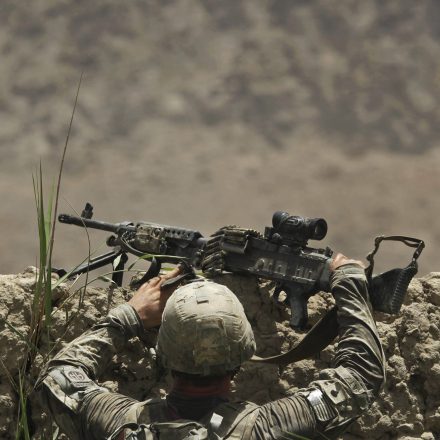
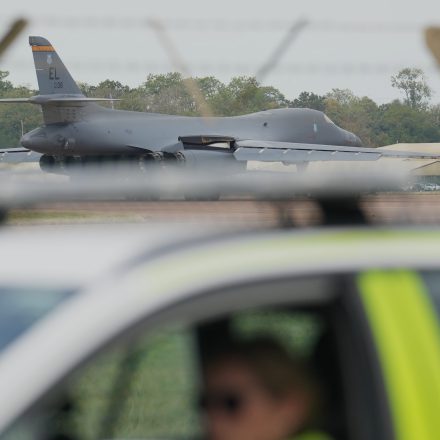
Several commentators address this dynamic in the 2005 documentary “Why We Fight,” about a warning that President Dwight Eisenhower issued about the military-industrial complex. Former CIA contractor and academic Chalmers Johnson states, “I guarantee you, when war becomes that profitable, you’re going to see more of it.” A retired Air Force lieutenant colonel says, “American people who have a son or a daughter that’s going to be deployed … they look at the cost-benefit, and they go, ‘I don’t think that’s good.’ But when politicians who understand contracts, future contracts, when they look at war, they have a different cost-benefit analysis.”
These are the specific results for the relevant contractors since September 2001. All except Boeing receive the vast majority of their revenue from the U.S. government.
S&P 500
- Total return: 516.67 percent
- Annualized return: 9.56 percent
- $10,000 2001 stock purchase today: $61,613.06
Basket of Top Five Contractor Stocks
- Total return: 872.94 percent
- $10,000 2001 stock purchase ($2,000 of each stock) today: $97,294.80
Boeing
- Total return: 974.97 percent
- Annualized return: 12.67 percent
- $10,000 2001 stock purchase today: $107,588.47
- Board includes: Edmund P. Giambastiani Jr. (former vice chair, Joint Chiefs of Staff), Stayce D. Harris (former inspector general, Air Force), John M. Richardson (former navy chief of Naval Operations)
Raytheon
- Total return: 331.49 percent
- Annualized return: 7.62 percent
- $10,000 2001 stock purchase today: $43,166.92
- Board includes: Ellen Pawlikowski (retired Air Force general), James Winnefeld Jr. (retired Navy admiral), Robert Work (former deputy secretary of defense)
Lockheed Martin
- Total return: 1,235.60 percent
- Annualized return: 13.90 percent
- $10,000 2001 stock purchase today: $133,559.21
- Board includes: Bruce Carlson (retired Air Force general), Joseph Dunford Jr. (retired Marine Corps general)
General Dynamics
- Total return: 625.37 percent
- Annualized return: 10.46 percent
- $10,000 2001 stock purchase today: $72,515.58
- Board includes: Rudy deLeon (former deputy secretary of defense), Cecil Haney (retired Navy admiral), James Mattis (former secretary of defense and former Marine Corps general), Peter Wall (retired British general)
Northrop Grumman
- Total return: 1,196.14 percent
- Annualized return: 13.73 percent
- $10,000 2001 stock purchase today: $129,644.84
- Board includes: Gary Roughead (retired Navy admiral), Mark Welsh III (retired Air Force general)
All stock return calculations were made with the Dividend Channel’s DRIP calculator for the period from September 18, 2001 to August 15, 2021. They reflect returns gross of any taxes and fees and are not adjusted for inflation.
IT’S EVEN WORSE THAN WE THOUGHT.
What we’re seeing right now from Donald Trump is a full-on authoritarian takeover of the U.S. government.
This is not hyperbole.
Court orders are being ignored. MAGA loyalists have been put in charge of the military and federal law enforcement agencies. The Department of Government Efficiency has stripped Congress of its power of the purse. News outlets that challenge Trump have been banished or put under investigation.
Yet far too many are still covering Trump’s assault on democracy like politics as usual, with flattering headlines describing Trump as “unconventional,” “testing the boundaries,” and “aggressively flexing power.”
The Intercept has long covered authoritarian governments, billionaire oligarchs, and backsliding democracies around the world. We understand the challenge we face in Trump and the vital importance of press freedom in defending democracy.
We’re independent of corporate interests. Will you help us?
IT’S BEEN A DEVASTATING year for journalism — the worst in modern U.S. history.
We have a president with utter contempt for truth aggressively using the government’s full powers to dismantle the free press. Corporate news outlets have cowered, becoming accessories in Trump’s project to create a post-truth America. Right-wing billionaires have pounced, buying up media organizations and rebuilding the information environment to their liking.
In this most perilous moment for democracy, The Intercept is fighting back. But to do so effectively, we need to grow.
That’s where you come in. Will you help us expand our reporting capacity in time to hit the ground running in 2026?
We’re independent of corporate interests. Will you help us?

I’M BEN MUESSIG, The Intercept’s editor-in-chief. It’s been a devastating year for journalism — the worst in modern U.S. history.
We have a president with utter contempt for truth aggressively using the government’s full powers to dismantle the free press. Corporate news outlets have cowered, becoming accessories in Trump’s project to create a post-truth America. Right-wing billionaires have pounced, buying up media organizations and rebuilding the information environment to their liking.
In this most perilous moment for democracy, The Intercept is fighting back. But to do so effectively, we need to grow.
That’s where you come in. Will you help us expand our reporting capacity in time to hit the ground running in 2026?
We’re independent of corporate interests. Will you help us?
Contact the author:

Related


Latest Stories

The Intercept Briefing
Prediction Markets Have a Lock on the Midterms
As Kalshi and Polymarket dodge state regulations, prediction markets are upping the ante on next month’s elections.

The War on Immigrants
ICE Agent on Scene of NYC Shooting Was Posing as Construction Worker, Eyewitness Says
A member of Congress at the scene confirmed to The Intercept that there was a child in the victim’s car when ICE agents shot at it.

Pete Hegseth’s Military of the Future: Defined by AI and an Utter Lack of Oversight
In announcing Project Meridian and a new Autonomous Warfare Command, War Secretary Pete Hegseth is inviting conflicts of interest.