

The tenor of Montana’s legislative session was evident from the start. In January, less than a week into the biannual, monthslong lawmaking process, Republican state Sen. Keith Regier proposed a study to determine whether the federal government’s system of Native American reservations should be dismantled, suggesting rights to lands given to tribes after generations of dispossession should perhaps cease to exist.
Peppered with racist stereotypes, the proposal ultimately crumbled in the face of local and national backlash, but the tone was set.
In the months since, the Montana GOP’s willingness to push the envelope against perceived cultural enemies has only intensified, culminating this week in the exile of Democratic Rep. Zooey Zephyr, the first transgender lawmaker in the state’s history, from the House chamber.
“They have such anger and disdain and disgust that they can’t control it.”
As policy director for the American Civil Liberties Union’s Montana office, Keegan Medrano has been in the Capitol in Helena day after day for the past four months, meeting with lawmakers and advocate on bills impacting Native American and LGBTQ+ communities. For Medrano, a queer descendant of the Muscogee Creek nation, the work is both professional and personal.
“What we’ve been seeing over this session is that there is such disdain, such animus, such disgust with queer people, Indigenous people, people that don’t fit in within their vision of what Montana is,” Medrano told The Intercept. “They have such anger and disdain and disgust that they can’t control it,” he said. “And they’re now weaponizing the institutions to exclude us and police us.”
In a vote that broke along party lines Wednesday, Montana Republicans banned Zephyr from speaking or voting from the floor or the gallery of the Capitol for the remainder of this year’s session, which ends next week.
The move against Zephyr followed a pitched battle in recent weeks over a bill that would bar gender-affirming medical care for Montana youth; similar proposals have been introduced and passed by Republican-controlled state legislatures across the country. On April 17, Montana’s Republican Gov. Greg Gianforte indicated he would sign the bill, despite the pleas of his own son.
“He talks about compassion toward children, the youth of Montana, while simultaneously taking away health care from the youth in Montana,” David Gianforte, a 32-year-old member of Montana’s LGBTQ+ community said of his father’s support for the legislation in an interview with the Montana Free Press.


Powered by an influx of ultra-wealthy conservatives and the ever-expanding regional influence of Christian nationalism, Montana’s reputation as a live-and-let-live state has increasingly given way to the hard-right politics of its Republican Freedom Caucus in recent years.
Greg Gianforte, the governor presiding over the shift, rose to national prominence in 2017, when he choke-slammed a journalist on the eve of his election to Congress. Drawing on millions of dollars in donations to himself — Gianforte was then the richest man in Congress — the evangelical tech entrepreneur was elected governor in 2020, breaking the hold Democrats had on the office for a decade and a half.
The GOP’s grip on the levers of state power further tightened with a series of wins in last year’s midterm elections, giving the party a supermajority heading into this year’s legislative session.

Zephyr, a 34-year-old representing the liberal college town of Missoula, found herself in the crosshairs of Montana’s Republican hard-liners after speaking out against the bill to ban medical care for transgender youth.
“If you vote yes on this bill and yes on these amendments, I hope the next time there’s an invocation, when you bow your heads in prayer, you see the blood on your hands,” Zephyr told her colleagues earlier this month.
That night, in a letter and tweet that deliberately misgendered the Democratic lawmaker, all 21 Montana Freedom Caucus members demanded Zephyr’s censure for “using inappropriate and uncalled-for language during a floor debate.”
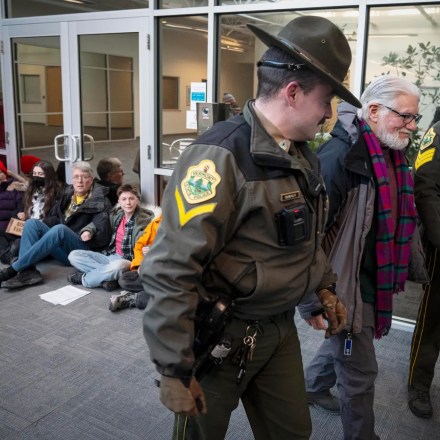
Zephyr’s efforts to speak from the gallery in the state capital were repeatedly rebuffed in the days that followed. On Monday, hundreds of protesters converged on Helena. “Let her speak,” they chanted. Capitol police in riot gear were deployed. Seven people were arrested on trespassing charges, including two of Medrano’s staffers.
Among Zephyr’s constituents, a combination of frustration, fear, and outrage had been building from the moment the legislative session began, Medrano said; the protest was a form of release.
“I think that all sort of came out,” he said. “After over 80 days of not only the jokes, not only the questions, but also the policy, and then now, where we’re actually targeting, harassing, being retaliatory toward individuals from those communities.”
For Medrano, there is a throughline that binds Indigenous rights, trans rights, and reproductive rights: three areas where the Republican Party has directed much of its attention this session.
“Every single one of those individuals practices their own sort of body sovereignty and autonomy,” he said. “The Montana Republicans, the Freedom Caucus, they’re all afraid of these people, and so they legislate to extinguish their existence and/or to make their existences not palatable and not a part of what Montana is.”
“We’re seeing — across age, across race, and even really, across political belief — a real movement being started here to push back and to respond.”
Silenced by her Republican colleagues, Zephyr now sits on a bench outside the Capitol gallery, voting on bills and staying connected with her constituents on her laptop.
“It casts a pall over that building,” Medrano said. “There are lots of awful things that happened there, but there are truly new lows being explored by the supermajority.” At the same time, he added, “I think it speaks to her perseverance, her courage, and bravery.”
Medrano believes the Republican Party’s actions in Montana may, in the end, expand the movement it has sought to control.
“I think this is the moment. I’ve never seen such a groundswell and such camaraderie amongst people,” he said. “We’re seeing — across age, across race, and even really, across political belief — a real movement being started here to push back and to respond.”
IT’S EVEN WORSE THAN WE THOUGHT.
What we’re seeing right now from Donald Trump is a full-on authoritarian takeover of the U.S. government.
This is not hyperbole.
Court orders are being ignored. MAGA loyalists have been put in charge of the military and federal law enforcement agencies. The Department of Government Efficiency has stripped Congress of its power of the purse. News outlets that challenge Trump have been banished or put under investigation.
Yet far too many are still covering Trump’s assault on democracy like politics as usual, with flattering headlines describing Trump as “unconventional,” “testing the boundaries,” and “aggressively flexing power.”
The Intercept has long covered authoritarian governments, billionaire oligarchs, and backsliding democracies around the world. We understand the challenge we face in Trump and the vital importance of press freedom in defending democracy.
We’re independent of corporate interests. Will you help us?
IT’S BEEN A DEVASTATING year for journalism — the worst in modern U.S. history.
We have a president with utter contempt for truth aggressively using the government’s full powers to dismantle the free press. Corporate news outlets have cowered, becoming accessories in Trump’s project to create a post-truth America. Right-wing billionaires have pounced, buying up media organizations and rebuilding the information environment to their liking.
In this most perilous moment for democracy, The Intercept is fighting back. But to do so effectively, we need to grow.
That’s where you come in. Will you help us expand our reporting capacity in time to hit the ground running in 2026?
We’re independent of corporate interests. Will you help us?

I’M BEN MUESSIG, The Intercept’s editor-in-chief. It’s been a devastating year for journalism — the worst in modern U.S. history.
We have a president with utter contempt for truth aggressively using the government’s full powers to dismantle the free press. Corporate news outlets have cowered, becoming accessories in Trump’s project to create a post-truth America. Right-wing billionaires have pounced, buying up media organizations and rebuilding the information environment to their liking.
In this most perilous moment for democracy, The Intercept is fighting back. But to do so effectively, we need to grow.
That’s where you come in. Will you help us expand our reporting capacity in time to hit the ground running in 2026?
We’re independent of corporate interests. Will you help us?
Contact the author:

Related


Latest Stories

Israel’s War on Gaza
A C-Section in Shackles: A Palestinian Woman’s Harrowing Birth in Israeli Detention
Dana Joudeh was denied proper food and medical care throughout her pregnancy in an Israeli prison. She gave birth to a premature baby surrounded by armed guards.

ICE Shooting in NYC Inflames Mamdani’s Policing Problem
After ICE shot a young father in Manhattan, New Yorkers asked the mayor to protect them from his police department and federal agents alike.

Where Are the Iran War Protests?
Despite a wildly unpopular war with Iran, a mass protest movement for peace hasn’t materialized — at least in the ways we’ve been taught to recognize.