

The House passed a $1.15 trillion defense authorization bill Wednesday with a controversial provision expanding U.S.-Israel military technology cooperation intact, despite a bipartisan effort to remove it and warnings from Rep. Thomas Massie, R-Ky., that the measure could compromise American sovereignty and national security.
The 216–212 vote on the fiscal year 2027 National Defense Authorization Act passed mostly along party lines after lawmakers were denied a separate vote to remove Section 219, which would create a permanent initiative to merge U.S. and Israeli defense tech.
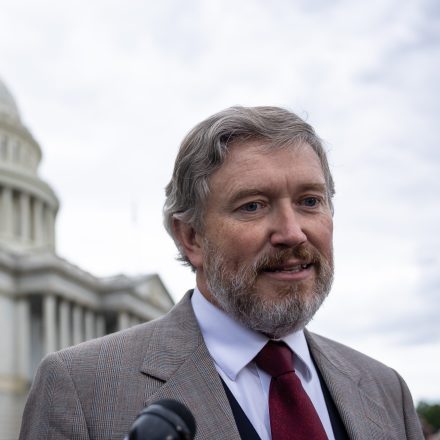
“Codifying the integration of our military technology and supply chains with those of any other country is dangerous,” said Massie, one of seven Republicans to buck party lines and vote against the NDAA. He was joined by Reps. Josh Brecheen of Oklahoma; Tim Burchett of Tennessee; Eli Crane of Arizona; Harriet Hageman of Wyoming; Anna Paulina Luna of Florida; and Chip Roy of Texas.
Six Democrats voted for it: Reps. Henry Cuellar of Texas; Don Davis of North Carolina; Jared Golden of Maine; Vicente Gonzalez of Texas; Adam Gray of California; and Marie Gluesenkamp Perez of Washington.
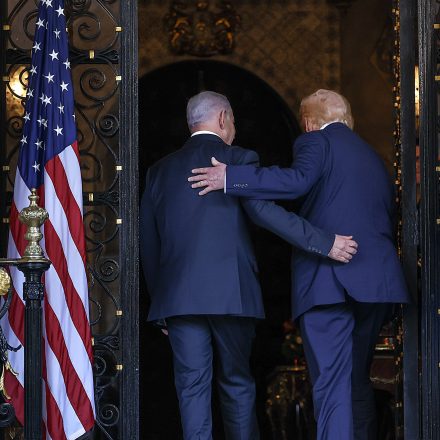
Section 219 would establish a United States–Israel Defense Technology Cooperation Initiative and require the defense secretary to designate a Pentagon executive agent responsible for coordinating bilateral defense research, development, testing, evaluation, and industrial cooperation.



Massie, who sought to remove the provision alongside Rep. Ro Khanna, D-Calif., told The Intercept ahead of the vote that institutionalizing the relationship would create long-term national security risks.
Doing so with Israel would create “a lopsided arrangement” in which American national security is unnecessarily compromised, he added. Rep. Alexandria Ocasio-Cortez, D-N.Y., similarly referred to the provision as “an existential threat to American sovereignty and democracy,” in a statement on social media.
Massie also pointed out that codifying the initiative would make it more difficult for future presidents to withdraw from the arrangement.
“Enshrining this broad agreement and the permanent position it creates in legislation removes the flexibility of future Presidents to withdraw from such an arrangement,” Massie said. He further argued that it “requires a treaty to effect, not an amendment buried in a law as presented here.”
The provision, previously numbered Section 224, has generated controversy since The Intercept reported on it in June. The Intercept found that it closely resembled the U.S.–Israel FUTURES Act, introduced by Reps. Ronny Jackson, R-Texas, and Davis, with companion legislation from Sens. Ted Budd, R-N.C., and Kirsten Gillibrand, D-N.Y. All four lawmakers have received substantial campaign support from the American Israel Public Affairs Committee and other pro-Israel groups, while the FUTURES Act itself received public backing from AIPAC and the neoconservative foreign policy think tank FDD Action. Massie lost his primary for reelection to his Kentucky House seat in the spring, after President Donald Trump and AIPAC both backed his opponent.
The standalone FUTURES Act did not advance, but many of its core concepts subsequently appeared in the NDAA.
Massie and Khanna later led an amendment to strike Section 219, joined by Democratic Reps. Jim McGovern of Massachusetts; Jesús “Chuy” García of Illinois; Rashida Tlaib of Michigan; Don Beyer of Virginia; Jill Tokuda of Hawaii; Derek Tran of California; and Joe Courtney of Connecticut. The amendment was not made eligible for floor consideration. Luna, the Florida Republican, separately sought to strike Section 219, but her amendment was also denied a vote.
Rep. Marlin Stutzman, R-Ind., rejected Massie’s sovereignty concerns.
“There is no world that the United States government gives away our most elite military weaponry or technology to our allies, including Israel,” Stutzman told The Intercept. “Just because we are collaborating with our allies to work towards a common goal of safe citizens doesn’t mean we are giving away American sovereignty.”
Stutzman’s office previously told this reporter that Section 219, then numbered Section 224, originated with Jackson’s office. Stutzman separately told Responsible Statecraft that his own proposal to replace direct U.S. military assistance to Israel with trade and defense cooperation grew out of conversations with Israeli contacts.
Also on Wednesday, House Republicans passed a $95 billion budget plan to fund the war on Iran and impose new restrictions on elections.
House passage does not make Section 219 law. The Senate’s version of the NDAA, which has yet to pass, contains its own version of the defense technology initiative, leaving the proposal’s ultimate fate dependent on further Senate action and negotiations between the chambers.
IT’S EVEN WORSE THAN WE THOUGHT.
What we’re seeing right now from Donald Trump is a full-on authoritarian takeover of the U.S. government.
This is not hyperbole.
Court orders are being ignored. MAGA loyalists have been put in charge of the military and federal law enforcement agencies. The Department of Government Efficiency has stripped Congress of its power of the purse. News outlets that challenge Trump have been banished or put under investigation.
Yet far too many are still covering Trump’s assault on democracy like politics as usual, with flattering headlines describing Trump as “unconventional,” “testing the boundaries,” and “aggressively flexing power.”
The Intercept has long covered authoritarian governments, billionaire oligarchs, and backsliding democracies around the world. We understand the challenge we face in Trump and the vital importance of press freedom in defending democracy.
We’re independent of corporate interests. Will you help us?
IT’S BEEN A DEVASTATING year for journalism — the worst in modern U.S. history.
We have a president with utter contempt for truth aggressively using the government’s full powers to dismantle the free press. Corporate news outlets have cowered, becoming accessories in Trump’s project to create a post-truth America. Right-wing billionaires have pounced, buying up media organizations and rebuilding the information environment to their liking.
In this most perilous moment for democracy, The Intercept is fighting back. But to do so effectively, we need to grow.
That’s where you come in. Will you help us expand our reporting capacity in time to hit the ground running in 2026?
We’re independent of corporate interests. Will you help us?

I’M BEN MUESSIG, The Intercept’s editor-in-chief. It’s been a devastating year for journalism — the worst in modern U.S. history.
We have a president with utter contempt for truth aggressively using the government’s full powers to dismantle the free press. Corporate news outlets have cowered, becoming accessories in Trump’s project to create a post-truth America. Right-wing billionaires have pounced, buying up media organizations and rebuilding the information environment to their liking.
In this most perilous moment for democracy, The Intercept is fighting back. But to do so effectively, we need to grow.
That’s where you come in. Will you help us expand our reporting capacity in time to hit the ground running in 2026?
We’re independent of corporate interests. Will you help us?
Contact the author:
Related

William Lawrence Is Running in a Purple Michigan District — on His Pro-Palestine Credentials

Armed Israeli Settlers Detained Ro Khanna. He Wants Their Illegal Outposts Demolished.
Thomas Massie Loses His Seat in a Win for Trump — and AIPAC

They Exposed an Israeli Spyware Firm. Now the Company Is Badgering Them in Court.
Latest Stories

Israel’s War on Gaza
A C-Section in Shackles: A Palestinian Woman’s Harrowing Birth in Israeli Detention
Dana Joudeh was denied proper food and medical care throughout her pregnancy in an Israeli prison. She gave birth to a premature baby surrounded by armed guards.

ICE Shooting in NYC Inflames Mamdani’s Policing Problem
After ICE shot a young father in Manhattan, New Yorkers asked the mayor to protect them from his police department and federal agents alike.

Where Are the Iran War Protests?
Despite a wildly unpopular war with Iran, a mass protest movement for peace hasn’t materialized — at least in the ways we’ve been taught to recognize.