
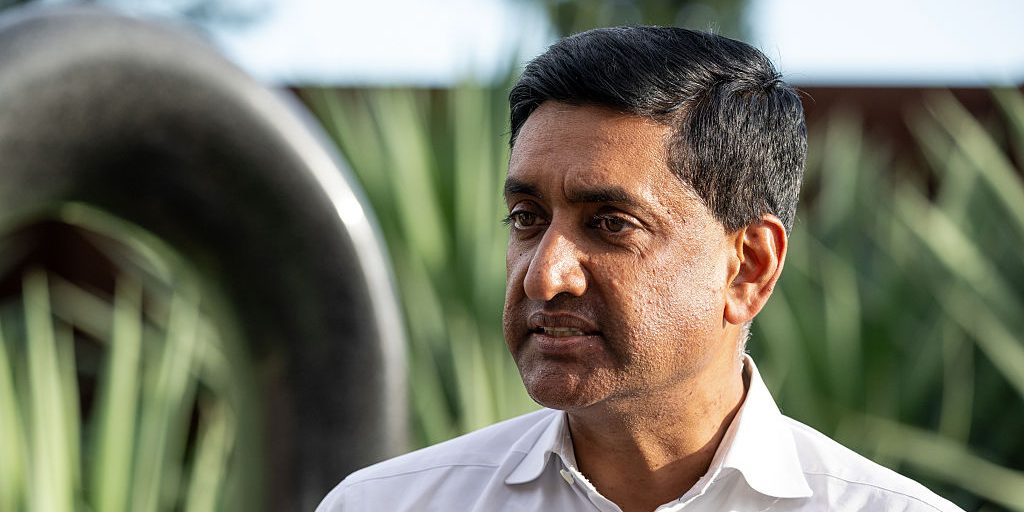
On a hot Wednesday afternoon in the Palestinian village of Zanuta, California Rep. Ro Khanna walked through the ruins of a Palestinian school demolished by Israeli settlers several years earlier.
In 2023, Israeli settlers took firearms and bulldozers to the village, destroying the school and other buildings and displacing dozens of Bedouin Palestinian residents from their homes.
While standing amid the rubble, one of Khanna’s staffers spotted an Israeli settler wearing a large smile on his face with an assault rifle draped around his shoulder, peering at the group through a broken window.
Khanna and his small delegation of his staffer Cameron Kasky, their driver, and a security guard hurried back into their van, Khanna and Kasky, a Parkland school shooting survivor and former congressional candidate, said in interviews with The Intercept.
Settlers had parked their car directly in front of them, blocking their exit along a narrow dirt road that juts from Highway 60 with rocky slopes and dry grass on both sides.
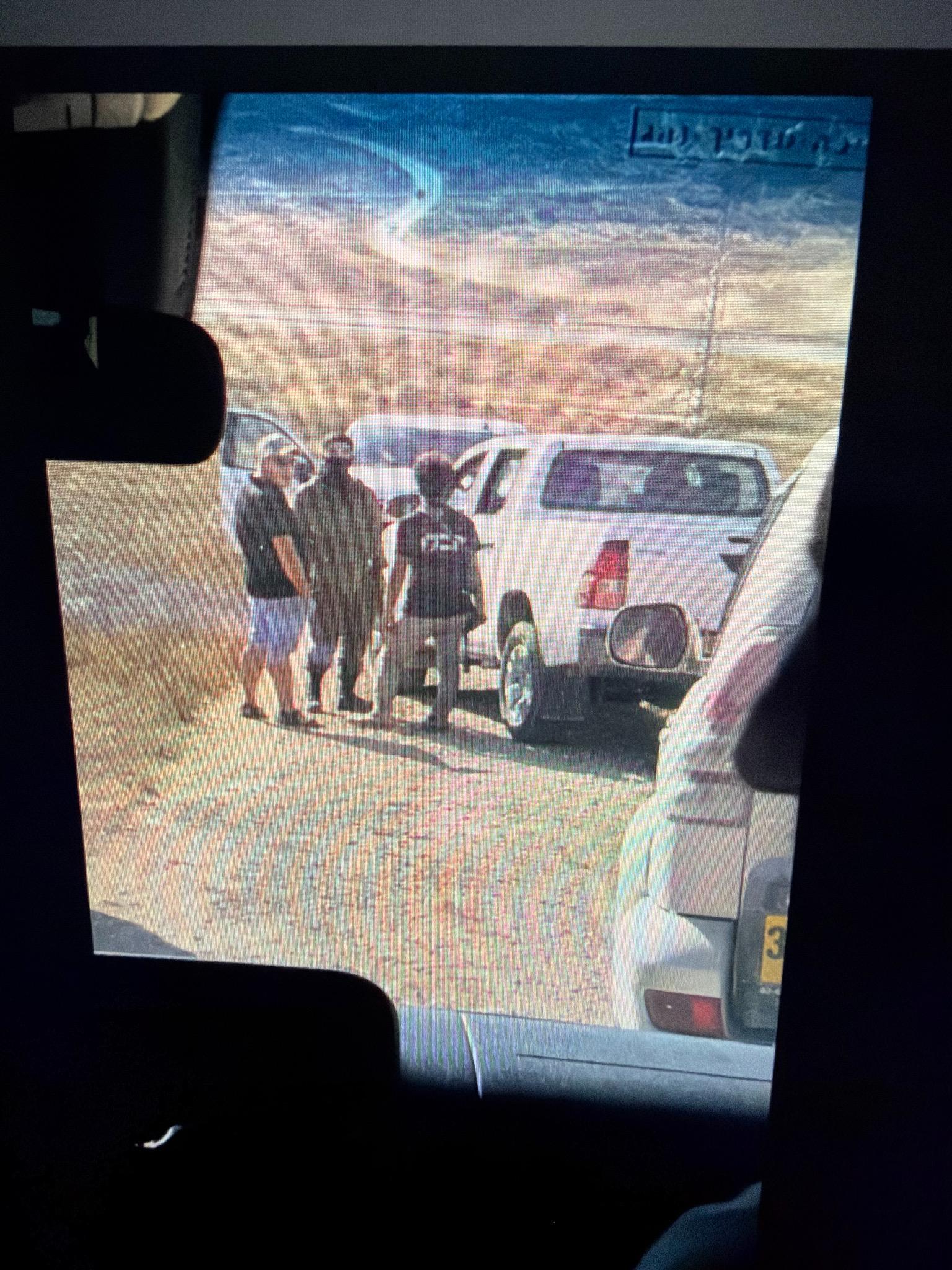
Over the next 75 to 90 minutes, Israeli settlers, who carried what appeared to be M4 assault rifles, intimidated and harassed Khanna and his group, who felt their fear rising from inside the van. The settlers proceeded to menace the Americans: They prevented the group from leaving the village, brandished their rifles, laughed and yelled taunts at the group, kicked the van’s tires, and wiped down the windows with their hands to gawk inside, recording the group and snapping photos. Khanna and Kasky said their security aide identified the men as members of the Hilltop Youth, an extremist settler group with a history of violent raids, which prompted more concern among the delegation.
“It’s the most powerless I have felt,” Khanna told The Intercept. “They paraded around the van, laughing, smiling, brandishing the M4s. I have not been treated that way in any other country I’ve traveled to, including China. In any place that I have traveled, it’s the most arrogant and humiliating treatment of American citizens I have endured — I was quite shocked.”
“It’s the most powerless I have felt.”
Two white pickup trucks later pulled up and out stepped more armed settlers, according to video and footage reviewed by The Intercept. Later, another vehicle arrived carrying a group of four men and women dressed in green military uniforms, which their security aide identified as Israeli military, Khanna and Kasky recalled. Rather than attempting to resolve the situation, the soldiers joined the group, laughing and talking with the settlers, and at one point, smoking cigarettes together, they said.
Even after the security aide identified the group as an American delegation with a member of Congress, the settlers and soldiers did not budge. “The security person said this is the most concerned he’s ever been, and he’s done tours for decades,” Khanna recalled.
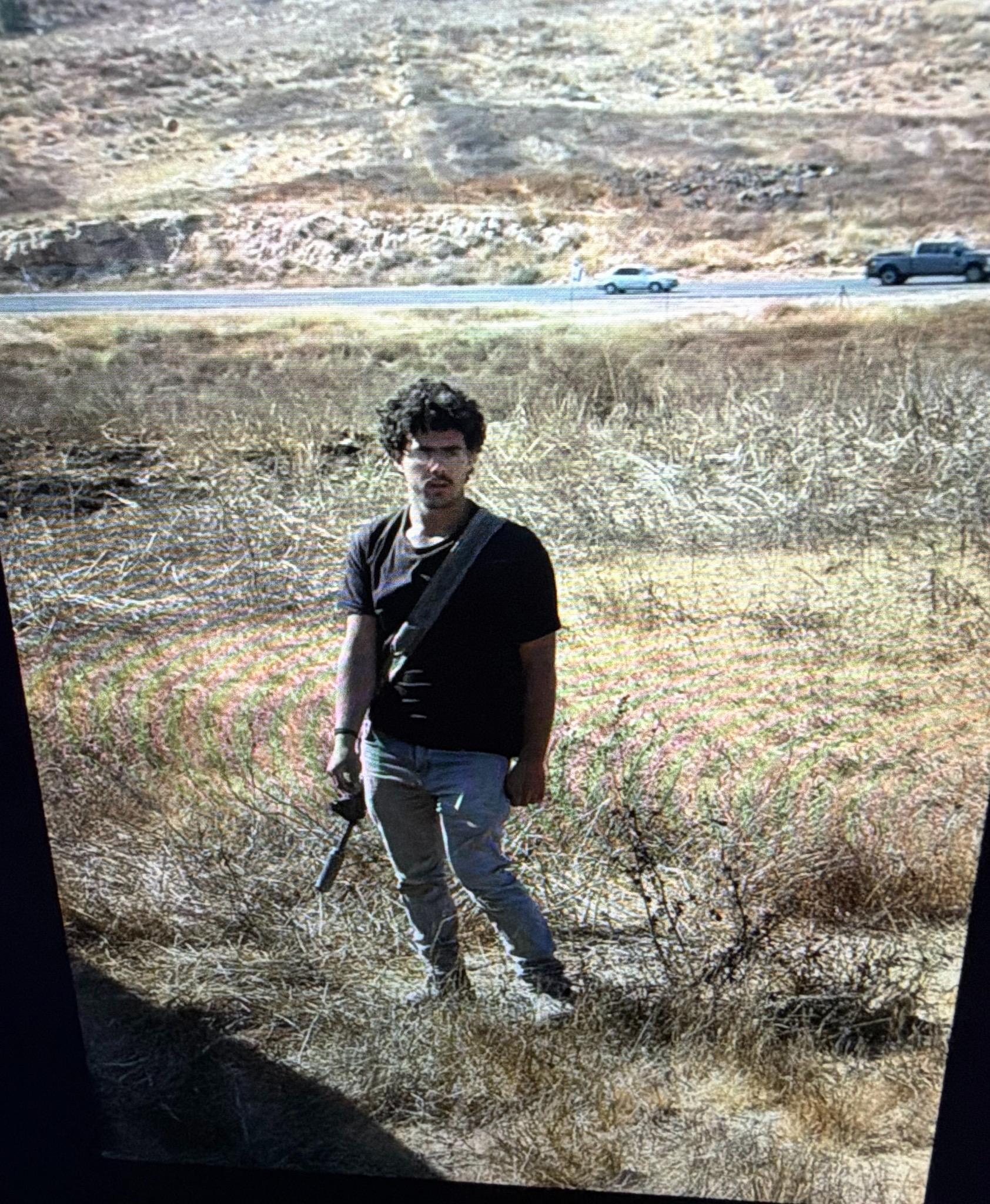
In response to a request for comment by The Intercept, the Israeli military acknowledged that “a report was received regarding Israeli civilians who were unlawfully blocking the vehicles of foreign nationals and members of the media.” The statement directly contradicted Khanna’s and Kasky’s account, with the military claiming soldiers had helped clear the group of settlers.
“Upon receiving the report, IDF troops were dispatched to the scene, quickly dispersed the Israeli civilians, and reopened the blocked road. The IDF soldiers operating in the area did not take part in blocking the road,” the military said, adding, “The identity of the armed individual is currently under review.”
“I’m a Jewish school shooting survivor, and I’m sitting here looking at Jewish kids who have the eyes of a school shooter.”
Kasky, who joined Khanna’s office in January following his own visit to the West Bank and has been working with Khanna on his Israel and Palestine policy, said he was afraid the incident would turn more violent, recalling accounts of settler attacks.
“I was sitting there like, ‘Are the Hilltop Youth about to blow a bunch of holes in our vehicle?’” Kasky remembered saying to himself. “I’m a Jewish school shooting survivor, and I’m sitting here looking at Jewish kids who have the eyes of a school shooter. So it was a very surreal experience for me.”
Harassment from Israeli settlers and military has long been a regular occurrence for Palestinians in the West Bank, who face severe restrictions on daily movement throughout the territory. Palestinians are subject to a military court system where the accused lack due process rights and thousands are imprisoned indefinitely, oftentimes without charge. Israeli forces and settlers have killed more than 1,100 Palestinians in the West Bank since October 7, 2023. That figure includes a growing number of Palestinian Americans and other American citizens.

Harassment of foreign delegations in the West Bank is more rare. In September 2023, European Union diplomats reported harassment by Israeli settlers during a visit. In May 2025, Israeli soldiers fired warning shots toward a delegation of diplomats visiting Jenin, which included officials from the United Kingdom, France, Canada, and Ireland. The last reported instance of harassment toward an American delegation was in 2015, when settlers hurled rocks at diplomats investigating reports of settler attacks in the area.
Members of Congress have visited the West Bank in the past, but Khanna’s run-in with settlers is the first known instance of direct harassment by Israeli settlers toward a sitting U.S. lawmaker.
“Imagine what life is like for ordinary Palestinians who do not have a national platform.”
During the incident, Khanna said he phoned an official in the U.S. Embassy, which urged the group not to escalate the situation. After more than an hour, the group of settlers and soldiers suddenly drove off. Shortly after, Israeli police arrived and instructed the group not to return under threat of arrest.
“I thought to myself, if they can do this to an American member of Congress and to American citizens, imagine what life is like for ordinary Palestinians who do not have a national platform, who can’t just pick up the phone and call the American embassy,” Khanna said.
The recent trip wasn’t Khanna’s first visit to the West Bank. In 2022, Khanna joined a delegation of lawmakers, led by Rep. Nancy Pelosi, D-Calif., and visited with leaders in Israel and Palestinian leaders in Ramallah. Khanna’s remarks praising Israel’s tech industry drew criticism from pro-Palestine advocates, who at the time accused the lawmaker of using the visit as a “photo op” to “whitewash Israeli apartheid.”
Khanna had long branded himself as an anti-war figure. In 2004, he ran an unsuccessful bid for Congress centered around his opposition to the Iraq War. And after being elected to Congress in 2016, Khanna would help spearhead an effort to halt U.S. military support to Saudi-led military intervention in Yemen’s civil war.
Israel, however, remained a blindspot. But since the October 7 Hamas attacks and the start of Israel’s genocide in Gaza, Khanna has evolved from a pro-Israel Democrat who regularly voted to send military aid to Israel into one of its staunchest opponents, especially as he gears up for a potential 2028 presidential run.
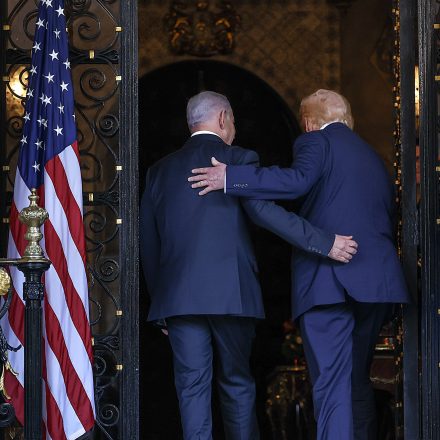
Khanna is a co-sponsor to the Block the Bombs bill and in April said he opposes the transfer of all U.S. arms — both offensive and so-called defensive weapons — to Israel. Last month, he attempted to strike a portion of the National Defense Authorization Act that seeks to codify Israel’s joint development of weapons with the U.S. and said he would also urge senators to oppose the pro-Israel proposal. Khanna is also a co-sponsor on the West Bank Violence Prevention Act, which seeks to codify sanctions on Israeli settlers, and in January, introduced a resolution opposing the expansion of settlements. In his war powers resolution against the Iran war, he said in June 2025, “U.S. involvement in Israel’s war with Iran is a red line.”
After the run-in with Israeli settlers, the congressman put a finer point on the need to stop arming Israel.
“We’re supplying them the M4s that they’re using to detain American citizens,” he said. “We’re supplying them the weapons that they’re using to kill Palestinian Americans. We’re supplying them the weapons that they’re using to commit terror on the Palestinian population in the West Bank. It is simply inhumane, and the United States needs to not just sanction these extremist settlers — we need to demand that the IDF start to demolish the outposts in the West Bank.”
“We’re supplying them the weapons that they’re using to kill Palestinian Americans.”
Khanna said he still differentiates between settler outposts and larger, long-standing Israeli settlement communities that function as suburban neighborhoods. While he believes outposts should be dismantled, he said the larger settlements should be subject to a land swap with Palestinians as part of a broader political deal to grant Palestinians sovereignty. Yet he still opposed the expansion of the larger settlements and said U.S. funds should not be used to construct such developments.
As Congress took its summer recess, Khanna took the three-day visit to the West Bank this week at Kasky’s urging. The American journalist Jasper Nathaniel, who extensively covers the West Bank and facilitated Kasky’s previous visit, had invited Khanna to visit and connected the group with local Palestinian residents, businesses, activists, and leaders.
When Khanna and Kasky landed in Tel Aviv on Tuesday, Kasky said Israeli airport security took him to a back office where officers questioned him for 40 minutes while showing him a printed screenshot of his Twitter profile where he had previously written in his bio “Stop funding genocide” and a separate printout of a tweet by a pro-Israel user who had spotted Kasky at Tel Aviv’s Ben Gurion Airport in December 2025. The officials continued to hold Kasky despite Khanna identifying him as a part of his office.
After his release, Kasky said he received notification that the Israeli government had revoked his travel visa.
“I’m probably never going to get into the country again,” he said.
During the wide-ranging trip, the delegation spoke with Palestinian shopkeepers in Hebron, who reported harassment from neighboring Israelis who from the upper floors hurled rotten vegetables and acid, and urinated on their stores below. Mayors of Bethlehem, Beit Sahour, and Beit Jala told Khanna of water shortages and the Israeli military-imposed restrictions on Palestinians from drilling new wells, while Israeli settlers enjoy unfettered access to water. Khanna met with the relatives of Amer Mohammad Saada Rabee, the 14-year-old Palestinian American from New Jersey who was shot and killed by Israeli soldiers in April. Other Palestinian residents, including American citizens, spoke of settlers destroying their cars and raiding their homes. The brother of Awdah Hathaleen, who was shot dead by the Israeli settler Yinon Levi in July 2025, told Khanna how he still sees Levi roam free as Israeli prosecutors mull whether to charge him.
On Wednesday, the same day of the incident with Israeli settlers, Khanna’s group had been held up for more than an hour by Israeli officials in Masafer Yatta, where the Israeli government constructed a large metal gate on the only road in and out of the area. Khanna, who is Hindu and of Indian descent, said he has never been more acutely aware of his identity as when he was in Palestine, with Israeli guards constantly asking about his race and religion.
Khanna — who is a ranking member of the House Armed Services subcommittee on Cybersecurity, Innovation Technology, and Information Systems — urged other members of Congress, especially other ranking members in foreign policy committees, to also visit the West Bank in Palestinian-led visits.
He said he would raise the issue of the settler incident with the State Department and his colleagues in Congress.
“I am convinced that the most pro-Israel candidate — who may dispute my characterization of genocide by legal means, who may disagree with me in my belief of a Palestinian state, who may argue with me about Israel taking preventive measures, in their view, to minimize civilian casualties — even such a person, if they spent one day in the West Bank,” Khanna said, “if they visited the Palestinians side of Hebron, if they visited Um al-Khair, if they visited Palestinian towns and villages in Areas A and B, if they saw the settler’s outpost, they would conclude that it is apartheid, that it is unjust, that it is a perversion of Judaism in any form of civilized human existence.”
IT’S EVEN WORSE THAN WE THOUGHT.
What we’re seeing right now from Donald Trump is a full-on authoritarian takeover of the U.S. government.
This is not hyperbole.
Court orders are being ignored. MAGA loyalists have been put in charge of the military and federal law enforcement agencies. The Department of Government Efficiency has stripped Congress of its power of the purse. News outlets that challenge Trump have been banished or put under investigation.
Yet far too many are still covering Trump’s assault on democracy like politics as usual, with flattering headlines describing Trump as “unconventional,” “testing the boundaries,” and “aggressively flexing power.”
The Intercept has long covered authoritarian governments, billionaire oligarchs, and backsliding democracies around the world. We understand the challenge we face in Trump and the vital importance of press freedom in defending democracy.
We’re independent of corporate interests. Will you help us?
IT’S BEEN A DEVASTATING year for journalism — the worst in modern U.S. history.
We have a president with utter contempt for truth aggressively using the government’s full powers to dismantle the free press. Corporate news outlets have cowered, becoming accessories in Trump’s project to create a post-truth America. Right-wing billionaires have pounced, buying up media organizations and rebuilding the information environment to their liking.
In this most perilous moment for democracy, The Intercept is fighting back. But to do so effectively, we need to grow.
That’s where you come in. Will you help us expand our reporting capacity in time to hit the ground running in 2026?
We’re independent of corporate interests. Will you help us?

I’M BEN MUESSIG, The Intercept’s editor-in-chief. It’s been a devastating year for journalism — the worst in modern U.S. history.
We have a president with utter contempt for truth aggressively using the government’s full powers to dismantle the free press. Corporate news outlets have cowered, becoming accessories in Trump’s project to create a post-truth America. Right-wing billionaires have pounced, buying up media organizations and rebuilding the information environment to their liking.
In this most perilous moment for democracy, The Intercept is fighting back. But to do so effectively, we need to grow.
That’s where you come in. Will you help us expand our reporting capacity in time to hit the ground running in 2026?
We’re independent of corporate interests. Will you help us?
Contact the author:

Related


Latest Stories

Kohen Wiley’s Family Says Investigators Didn’t Contact Them Before Concluding Cops Did No Wrong
Mississippi has yet to release any support for its claim that a “thorough and impartial” review showed the shooting was “justified.”

Targeting Iran
Yemenis Unable to Reach Hospital Are Part of the Iran War Death Toll
At least 10 patients with kidney failure near Taiz, a city under a Houthi siege, died because they were unable to get to their dialysis treatments.

Midterms 2026
Mike Rogers Spent $100K on Private Jets and Luxury Travel Last Quarter
The Republican running for Senate in Michigan is directing campaign funds toward chartered flights, a Miami car service, and BMW repairs.