

An Iranian couple seeking refuge in the U.S. has been separated for nearly two years after separate immigration judges issued sharply diverging rulings on their nearly identical asylum applications.
Mohammadjamal Azizi and Hannaneh Alikaram requested asylum after arriving in the United States in late 2024, for fear of the persecution they would likely face as Christian converts in Iran, where they had twice been arrested due to their faith.
Since arriving in the U.S., they have faced sharply different versions of American justice, the result of a process advocates refer to bitterly as “immigration roulette”: Azizi — who goes by the name Liam — has been free for more than a year, after his asylum claim was granted, while Alikaram has suffered 21 months in detention, more than a year of that coming after her claim was rejected.
Until recently, it is likely that Alikaram would not have spent nearly as much time in detention as she has. But amid the twin agendas of mass detention and mass deportation, the Trump administration has swept aside years of precedent by locking up people who would previously have been allowed to fight their cases from outside detention, while going after communities formerly protected from deportation due to the likelihood of persecution back home.

Iranians have found themselves the crosshairs. Last year, amid the so-called 12-Day War between the U.S.–Israel and Iran, senior officials with Immigration and Customs Enforcement launched a scheme to begin deportations to Iran, a plan that resulted in three planes full of Iranian deportees being sent back to Iran on charter flights.
Those flights were suspended earlier this year after the U.S. and Israel launched the ongoing war on Iran, but multiple Iranians with final orders of removal have been deported to countries where they have no ties, including Panama and the Central African Republic. With so-called third-country flights leaving every month or so, Azizi and his wife live in constant fear that Alikaram might be put on a plane to a country where she knows no one and from which she has little hope of escaping.
Leaving detention after seven months, Azizi headed to the Iranian American hub of Los Angeles, where he has spent the past year working any job he can find to raise money for legal bills and fighting for his wife’s release. By the logic of the U.S. immigration system, that should be a simple prospect: As the spouse of an asylee, Alikaram is eligible for a status known as derivative asylum, a process intended to ensure family unification and act as a backstop against situations like the one in which Azizi and Alikaram find themselves, according to Carmen Maria Rey Caldas, a former immigration judge fired by the Trump administration last year.
“This is your money and my money that are being wasted in detaining this woman who is unquestionably eligible for asylum.”
“The person gets to have derivative asylum because family unity is a central tenet of our immigration system,” said Rey Caldas. “This is your money and my money that are being wasted in detaining this woman who is unquestionably eligible for asylum as the spouse of an individual that has been granted asylum.”
The couple currently has a petition for derivative asylum before U.S. Citizenship and Immigration Services and have filed a petition for habeas corpus seeking to secure Alikaram’s release on the basis of prolonged detention. Amid the uncertainty, with no end in sight to his wife’s detention, Azizi said their separation — and his feeling of helplessness in the face of bureaucratic cruelty — weighs on him daily.
“Being separated from Hananneh is unbearable,” Azizi wrote in a statement to the court filed earlier this year. “Every night I go to sleep wondering if she is safe in detention. Every day I wake up with anxiety that she might be taken away from me and sent back to a country where she could be imprisoned, tortured, or even killed just because she sought freedom.”

Azizi and Alikaram married in 2018 and lived together in Isfahan, Iran, where both had gone to university. Azizi worked as a software engineer, while Alikaram ran a greenhouse business, cultivating plants and posting playful videos to YouTube in which she coached plant lovers on topics ranging from prepping plants for autumn to guarding against pests. In the videos, which include jokey, spliced-in clips from “Lord of the Rings” and Miyazaki films, Alikaram comes across as a happy young woman enamored with the natural world.
The couple found their way to Christianity first through friends, members of Isfahan’s sizable minority of Armenian Christians. Christians have lived in Iran for more than a millennium, and Iran’s constitution affords protections allowing ethnoreligious communities, most notably Armenians and Assyrians, to practice their faith and organize their families and communities accordingly.
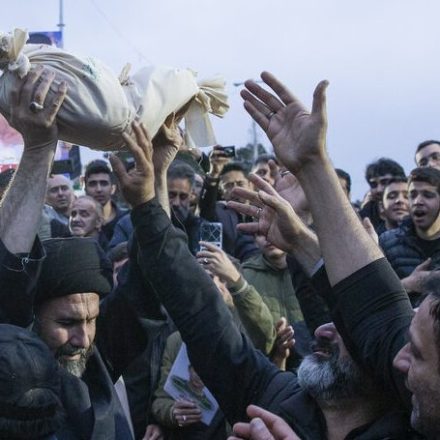
But the situation is very different for converts like Azizi and Alikaram, who are considered by Iran’s theocratic government to be apostates, and are subject to harsh punishments — up to and including execution. As a result, converts must worship in secret, in an underground network of so-called home churches.
It was in these home churches that the couple began exploring Christianity and where, in January 2024, they were baptized into the Anglican church. But it was also in a home church where the two met with their first experience of state terror, Azizi and Alikaram told The Intercept in telephone interviews and related in court documents. On March 5, 2024, they were worshipping with a handful of others in a home church in Isfahan when members of the pro-government Basij militia burst in, having been informed of the gathering by neighbors. Alikaram and Azizi, along with others, were taken into custody. Alikaram was beaten so badly she passed out and had to be hospitalized.
On June 9, 2024, after relocating for their own safety to the capital of Tehran, Alikaram and Azizi were arrested again on charges of practicing a foreign religion and inviting others to practice Christianity. She was held for two days, and he for four. After that ordeal, they decided it was time to leave. They secured a visa to enter Brazil, and left Iran on November 3, 2024. Five days later, a court in Tehran issued warrants for their arrest, according to court documents.

Azizi and Alikaram entered the United States on December 26, 2024, after an arduous trip overland from Brazil that took them through more than half a dozen countries. En route, they traveled through the infamous Darién Gap and spent two days as captives of a criminal group in Tapachula, Mexico, an ordeal that ended only after paying thousands of dollars for their release.
In Mexico, they registered for CBP One, the mobile app designed by the Biden administration as the only method by which potential asylees could file a claim. Due to the danger in Mexico, including threats from a smuggler, Alikaram and Azizi said smugglers forced them to join a group of migrants from India, Iran, and a number of African countries in crossing the border wall separating Tijuana and San Diego.
“They told us, ‘You have to cross the border, you cannot stay in Mexico,’” Azizi recalled the smugglers saying. “It was out of our hands.”
On the other side, they soon found themselves in the custody of the U.S. Border Patrol, who searched the migrants and separated the men from the women.
“We told them we are married, we showed them our marriage certificate,” Azizi told The Intercept. “But they didn’t care. They separated us.”
In early January 2025, Alikaram was sent to Richwood Correctional Center in Monroe, Louisiana, while Azizi was sent to another facility in Louisiana before ending up at a detention center in Houston, Texas.
They have been apart ever since.
Alikaram went before Judge Jennifer A. May for her asylum hearing on July 2, 2025. May, who was appointed in 2018 under the first Trump administration, appears to be in line with the policy objectives of the current administration. Between 2021 and the end of 2025, she denied asylum in 91.8 percent of the cases she heard, according to data from Transactional Records Access Clearinghouse, which collects data on immigration judges.
The hearing took place at a time in which judges were under ever greater pressure to deny claims, according to Rey Caldas, the former immigration judge, who was fired last year amid a purge of the immigration court system by the Trump administration.
“It was evident to me when I was on the bench, and it’s certainly evident to me now that they are exerting massive pressure so that judges deny all applications,” Rey Caldas said.
“They are exerting massive pressure so that judges deny all applications.”
In the hearing, which was conducted over Webex, May drilled into Alikaram’s claim, asking for details about her baptism, whether or not she had owned a Bible, and her reasons for converting to Christianity. Alikaram, clearly nervous, stumbled over her words at times, and at others gave answers that clashed with evidence provided to court. Some details also appeared to get lost in translation. At one point, a reference by Alikaram to the Basij, the paramilitary arm of the Islamic Revolutionary Guard Corps, was transcribed as “a siege.”
May did not find Alikaram to be credible. In her decision denying Alikaram’s asylum case, May focused mostly on what she described as inconsistencies in Alikaram’s testimony, including how long she’d been attending home churches and details of her arrest — inconsistencies that Alikaram and Azizi later blamed on her nerves while testifying. But May also tried to downplay the likelihood that Alikaram would face persecution if she returned to Iran.
“I find there is no independent evidence to show that the respondent would likely be tortured in Iran,” May wrote. “[T]his court is aware that Christians have been arrested and sent to jail for some period of time. But looking at the amount of people in Iran, the amount of people who are converts to Christianity, I cannot find that that percentage would be more than likely or not torture or persecution [sic] for this respondent.”
Six days later, Azizi who at the time was being held at a detention facility in Texas, went before Judge Nimmo Bhagat, fully expecting that his claim would be denied as well. To his shock, however, the judge approved his claim for asylum, and just two weeks later he was a free man.
“I was shocked,” Azizi said. “I thought if my wife couldn’t get asylum that I’d have no chance. But they gave me asylum.”
A spokesperson for the Executive Office of Immigration Review, the branch of the Justice Department that oversees immigration courts, declined to comment. Neither ICE nor USCIS responded to requests for comment.
In light of his wife’s asylum denial, Azizi’s successful claim was a godsend for them both. Despite May’s decision, Alikaram should now be eligible for derivative asylum, upon which her own claim and its denial has no bearing.

The couple filed for derivative asylum in December, after the Board of Immigration Appeals denied Alikaram’s appeal of May’s decision. USCIS issued a notice of receipt, and even scheduled an appointment in Jackson, Mississippi, for a biometrics appointment. But ICE failed to produce Alikaram for the appointment, and the derivative asylum process now appears to be languishing in limbo.
In April, Alikaram’s attorney, Emily Trostle, filed a petition for habeas corpus in an attempt to secure Alikaram’s release from detention. That case, too, has stalled, forcing Trostle to file a petition last week to expedite the process.
In detention, meanwhile, Alikaram is suffering from poor nutrition, failing eyesight, and severe anxiety and depression.
“I can’t bear it anymore,” she told The Intercept in a telephone interview. “I know God has a plan for me, but sometimes now I say, ‘Just kill me so my husband and my family can move on with their lives.’”
IT’S EVEN WORSE THAN WE THOUGHT.
What we’re seeing right now from Donald Trump is a full-on authoritarian takeover of the U.S. government.
This is not hyperbole.
Court orders are being ignored. MAGA loyalists have been put in charge of the military and federal law enforcement agencies. The Department of Government Efficiency has stripped Congress of its power of the purse. News outlets that challenge Trump have been banished or put under investigation.
Yet far too many are still covering Trump’s assault on democracy like politics as usual, with flattering headlines describing Trump as “unconventional,” “testing the boundaries,” and “aggressively flexing power.”
The Intercept has long covered authoritarian governments, billionaire oligarchs, and backsliding democracies around the world. We understand the challenge we face in Trump and the vital importance of press freedom in defending democracy.
We’re independent of corporate interests. Will you help us?
IT’S BEEN A DEVASTATING year for journalism — the worst in modern U.S. history.
We have a president with utter contempt for truth aggressively using the government’s full powers to dismantle the free press. Corporate news outlets have cowered, becoming accessories in Trump’s project to create a post-truth America. Right-wing billionaires have pounced, buying up media organizations and rebuilding the information environment to their liking.
In this most perilous moment for democracy, The Intercept is fighting back. But to do so effectively, we need to grow.
That’s where you come in. Will you help us expand our reporting capacity in time to hit the ground running in 2026?
We’re independent of corporate interests. Will you help us?

I’M BEN MUESSIG, The Intercept’s editor-in-chief. It’s been a devastating year for journalism — the worst in modern U.S. history.
We have a president with utter contempt for truth aggressively using the government’s full powers to dismantle the free press. Corporate news outlets have cowered, becoming accessories in Trump’s project to create a post-truth America. Right-wing billionaires have pounced, buying up media organizations and rebuilding the information environment to their liking.
In this most perilous moment for democracy, The Intercept is fighting back. But to do so effectively, we need to grow.
That’s where you come in. Will you help us expand our reporting capacity in time to hit the ground running in 2026?
We’re independent of corporate interests. Will you help us?
Contact the author:

Related



Latest Stories

Israel’s War on Gaza
A C-Section in Shackles: A Palestinian Woman’s Harrowing Birth in Israeli Detention
Dana Joudeh was denied proper food and medical care throughout her pregnancy in an Israeli prison. She gave birth to a premature baby surrounded by armed guards.

ICE Shooting in NYC Inflames Mamdani’s Policing Problem
After ICE shot a young father in Manhattan, New Yorkers asked the mayor to protect them from his police department and federal agents alike.

Where Are the Iran War Protests?
Despite a wildly unpopular war with Iran, a mass protest movement for peace hasn’t materialized — at least in the ways we’ve been taught to recognize.