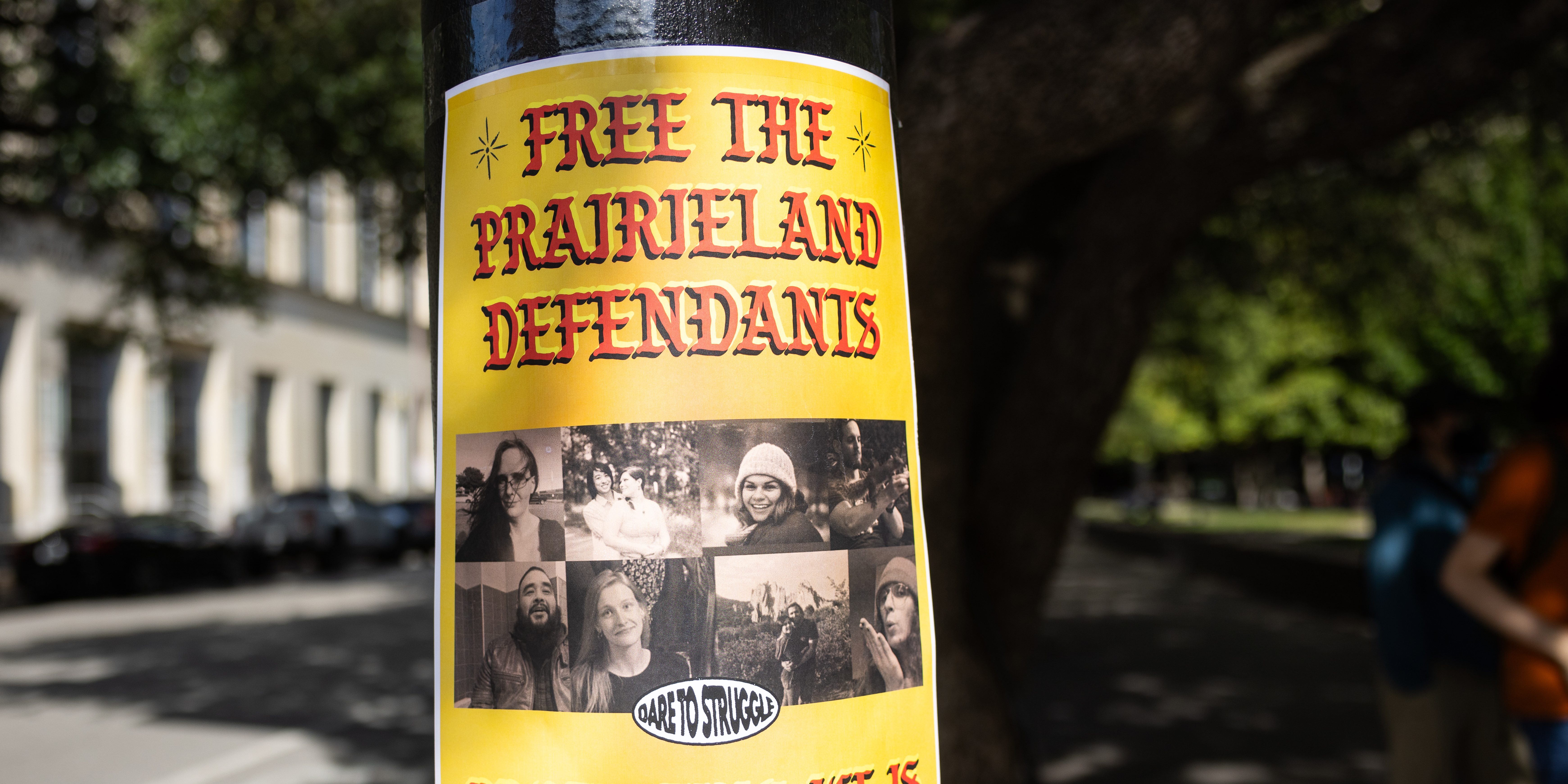
On the last day of the Prairieland trial, in which nine Texas protesters were accused of crimes including providing material support to terrorists, the attorney for activist Benjamin Song presented a novel argument that, if true, would have upended the federal government’s case.
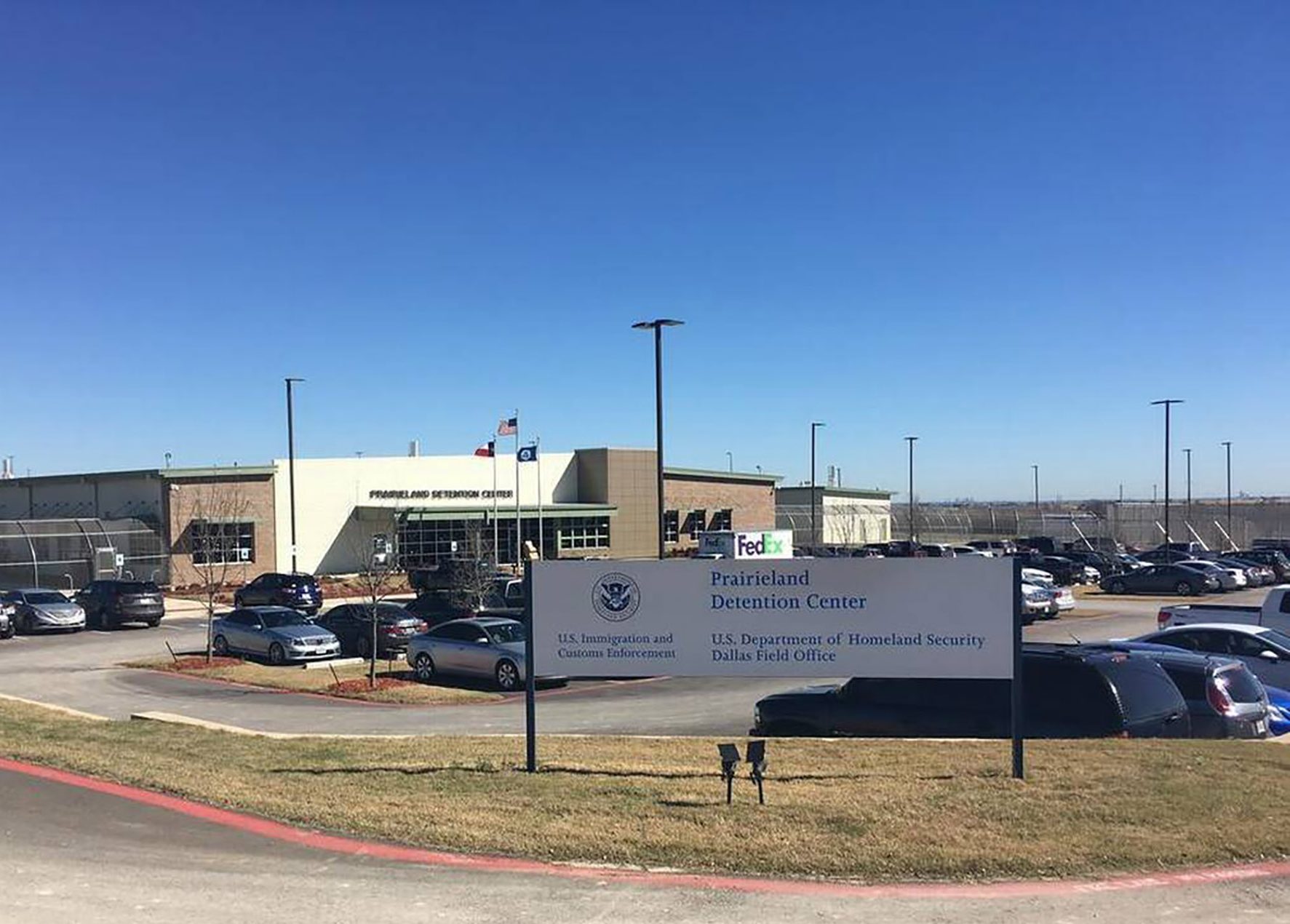
Song had been charged with attempted murder for allegedly firing a gun at the first police officer who arrived on the scene after a noise demonstration outside U.S. Immigration and Customs Enforcement’s Prairieland Detention Center in Alvarado on July 4, 2025.
The defense — more than a dozen attorneys representing clients with varying degrees of involvement in the protest — had rested their argument without calling a single expert witness, owing to what they thought was the weakness of the government’s case.
“Attempted murder requires that you intend to kill. And if the government can’t prove that intent, that’s a not guilty — period.”
During closing arguments, however, Phillip Hayes, Song’s attorney, raised what he said was a major flaw in the government’s depiction of what happened: Song never aimed his weapon at the police officer. Relying on evidence introduced by the prosecution — a photograph of the bullet, witness testimony, and CCTV footage of the incident — Hayes said his client never intended to shoot Alvarado Police Department Lt. Thomas Gross.
Rather, Hayes said, Song fired his weapon at the ground and the bullet ricocheted off a hard surface before striking the officer just below the neck. That would explain the plumes of dust that were visible in the video. According to Hayes, the only photo of the bullet, which appears severely bent and with several missing fragments, backs up the theory.
“Attempted murder requires that you intend to kill,” Hayes, a lanky, soft-spoken criminal defense attorney, told the jury on March 11. “And if the government can’t prove that intent, that’s a not guilty — period.”
The jury didn’t bite. Instead of being acquitted, Song was convicted and sentenced to 100 years in prison.
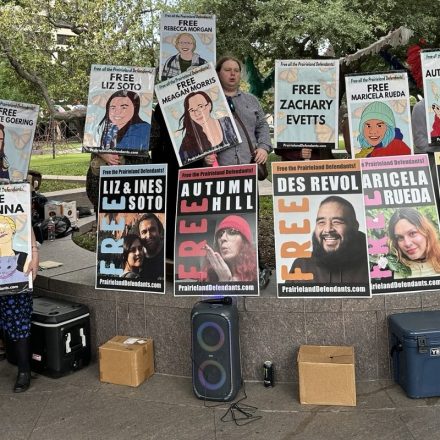
One reason the ricochet theory didn’t play a bigger role in the trial was that the federal government prevented it from being fully aired. Key details about the shooting, and the officer’s actions, were only revealed during the trial itself. Prosecution motions and favorable rulings by the judge, a Trump appointee, made it difficult for Song’s lawyers to fully vet the idea or argue that he had acted in self-defense.
And an independent ballistics expert hired by Song’s defense team before the trial was denied access to the defendant in federal prison. As a routine part of any case about a murder or a shooting involving a police officer, said Daryl Parker, the former Marine Corps officer and criminal defense investigator hired by Song’s team, a ballistics expert will meet with an alleged shooter to collect information. Nothing about the Prairieland case, however, was turning out to be routine.
It was the first time in his 25-year career that the forensics expert had been denied access to a client in a federal facility.
In emails reviewed by The Intercept, Parker and Hayes repeatedly wrote to Federal Medical Center Fort Worth, the federal detention center where Song was held before and during the trial, asking to visit the defendant. All the requests went unanswered. (FMC Fort Worth declined to respond to a request for comment.)
Parker never got a response from the jail official in charge of Song’s detention, let alone visitation rights.
“We sent him everything he asked for,” Parker, speaking publicly for the first time about the case, told The Intercept. “But approval never came.”
It was the first time in his 25-year career that the forensics expert had been denied access to a client in a federal facility.
In the end, members of the jury never received a full airing of the argument nor the multiple pieces of evidence that support it.
The ricochet theory, though, may yet be part of Song’s appeal and the basis of a new trial, according to two lawyers on Song’s defense team in his state-level case. New evidence, including material revealed for the first time in this Intercept investigation, shows that Song, a former Marine reservist and expert marksman, may have never intended to shoot the police officer.
New Evidence
The Prairieland case was touted by the Trump administration as the government’s first prosecution of an “antifa cell,” moving from indictment to trial in the Northern District of Texas in just a few months. For such a complex high-profile case, there wasn’t much time to prepare. And key pieces of information were hidden within or even omitted from discovery.

Buried within the tens of thousands of pages of evidence provided to the defense team was a grainy photograph: the government’s only image of the bullet that struck the police officer. According to two ballistics experts interviewed for this story, the photo is of such poor quality that it is difficult to conclude anything from the image alone.
Shaun Jaikissoon, a former firearms examiner with the New York City Police Department for 10 years who now has his own consulting firm, said the photo of the fragment provided by the prosecution tells us almost nothing and may even be deemed “unsuitable,” meaning it lacks value for a forensic analysis.
Parker, the independent ballistics expert hired by the defense team, said he agreed the photo was of little value.
“It is sparse,” he said. “You should have images of the end of the bullet — 360 degrees — so you can properly evaluate it.”
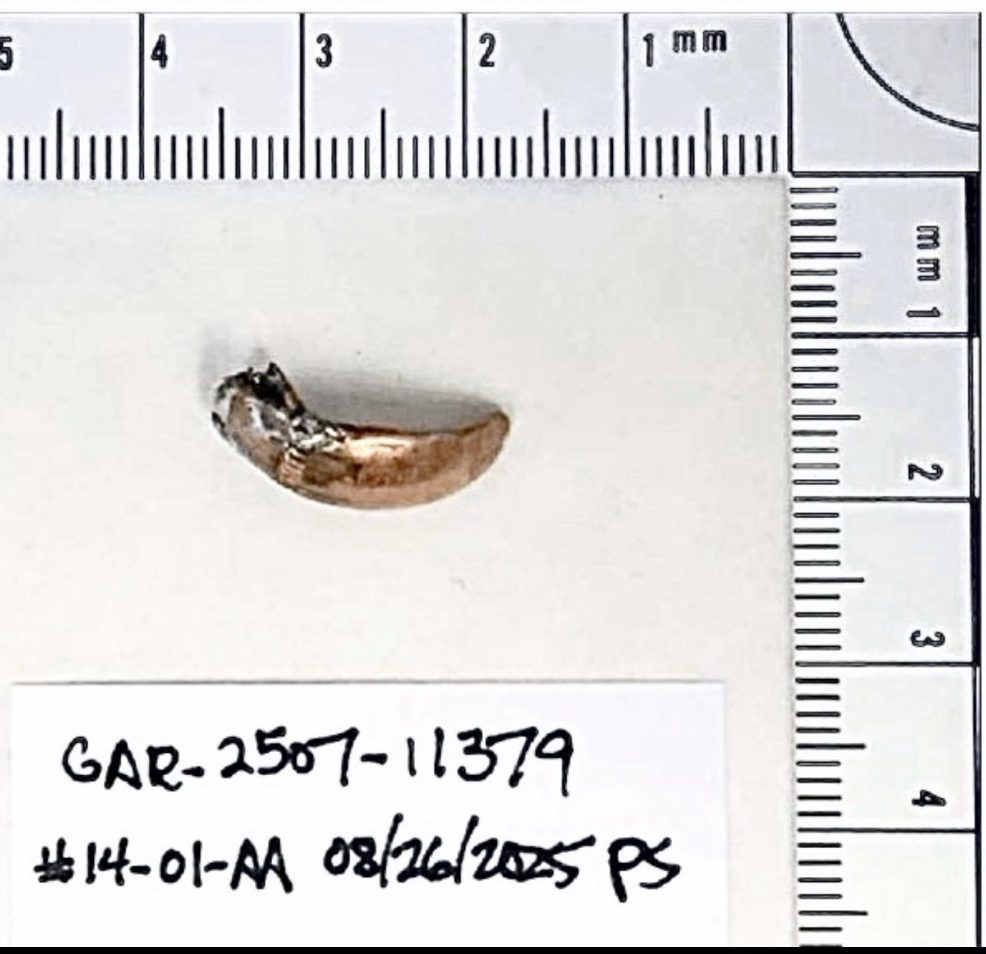
Despite the photograph’s limitations, it does reveal that the bullet was severely deformed, indicating a possible ricochet.
“It’s a copper banana,” said Parker. “It obviously struck something.”
The opinion is shared by one of the government’s own witnesses. During the trial, Philip Stout, a forensic scientist for the Texas Department of Public Safety, described the extreme curvature of the bullet as characteristic of a projectile fired into a water tank.
“When you’re dealing with higher velocity bullets, they slow down very quickly, so it gets that curved — I refer to it as a banana shape, but it’s more of a semicircle shape,” said Stout. “What that tells me is that bullet struck something and slowed down very quickly.”
Other questions arose from the shooting and investigation, Parker said. Perhaps most important is the fact that Gross’s bulletproof vest — level III soft body armor — would not have been able to withstand the force of a bullet fired from an AR-15-style rifle at such close range. Even the label on the vest, introduced into evidence by the government, says: “This is NOT intended to protect against rifle fire.”
According to Parker, if the bullet had struck Gross directly — without first hitting another surface or object — it would have ripped through him “like Swiss cheese” and almost certainly killed him. Instead, the bullet came to rest inside Gross’s vest, with Gross sustaining minor injuries. He was released from the hospital a few hours later.
“The standard body armor that police officers wear is not rated for rifles,” Parker said. “It’s only rated for handguns. It’s not even rated for knives.”
“The fact that the officer is not dead, to me, is a big red flag that Song wasn’t aiming at him.”
Another clue that points to a ricochet, according to Parker, is Song’s skill as a marksman, especially given the short distance between the two shooters and Song’s previous training as a Marine.
“The fact that the officer is not dead, to me, is a big red flag that Song wasn’t aiming at him,” Parker told The Intercept.
Together, this new evidence of a ricochet matches the information that became apparent only during the trial when Gross testified that he drew his weapon first and aimed at a fleeing protester. Drawing on this testimony, along with video evidence, Song recounted the same version of events in a statement he read during sentencing.
“When I saw Lieutenant Thomas Gross stop pursuing and point his gun at the back of a running, unarmed protester, like he testified, I was terrified,” Song said. “As a firearms instructor and a United States Marine Corps veteran, I understood what I was seeing. As the evidence shows, I did not want to hurt anyone.”
Shots Fired
That Gross drew first and aimed at a protester’s back were among the facts that, according to Song’s lawyers, were not revealed to the defense until the trial itself. Also missing from the pre-trial discovery was evidence indicating that bullets fired at the scene struck the ground. The marks in the pavement were not documented as part of the investigation.
Given these late-breaking revelations, Song’s lawyers had to scramble in the middle of the trial to put together their argument. Song’s defense team, in a motion for a new trial filed in April, said that the failure to disclose evidence of the bullet strikes sooner deprived them of the ability to make their case that Song never intended to shoot officer Gross.
The existence of bullet strikes was only revealed during the second week of the trial, when evidence from the investigation, headed up by the Texas Rangers, an elite unit within the state’s Department of Public Safety, was divulged in court. Texas Ranger Billy James Hill Jr., responsible for photographing the scene, admitted during cross-examination to finding “recent looking defects in the concrete surface.”
Tailim Song, Benjamin Song’s father and a civil attorney who was part of his son’s defense team, said the ricochet theory only began to take shape when they learned about the deformations in the road.
“It really didn’t come home until the Rangers said there were fresh bullet strikes in the concrete.”
“In my mind,” Tailim Song said, “it really didn’t come home until the Rangers said there were fresh bullet strikes in the concrete.”
The photographs from the scene, however, didn’t include shots of the ground. When asked during the trial whether he had taken any photos of what he believed to be bullet strikes, Hill, the Texas Ranger, responded that it “wasn’t part of my responsibility.”
Hill had taken photographs using a high-tech camera system called a Leica RTC360 Digital Crime Scene Scanner, which creates reconstructions of the alleged events. The reconstruction, however, omitted photographs and chemical swabs of where the bullets had struck the pavement as well as the crucial trajectory analysis and shooter-position determinations. (The Texas Department of Public Safety and the Department of Justice did not respond to questions about the investigation or crime scene reconstruction.)
Ryan Rider, a crime scene reconstruction expert and former Texas police officer who teaches classes on the Leica device at Tarleton State University, said the technology, if used properly, can provide precise measurements — down to the millimeter — of the bullet’s pathway in relation to the shooter.
“It does tell you a story,” he said.
Rider also said shootings involving officers are potentially chaotic environments with multiple agencies involved in collecting evidence, interviewing witnesses, and securing the crime scene. In the Prairieland case, Alvarado Police Department; the Johnson County, Texas, Sheriff’s Office; the Department of Homeland Security; the Bureau of Alcohol, Tobacco, Firearms, and Explosives; and the FBI; in addition to the Texas Rangers; were all present. Not documenting the bullet strikes — especially if the Rangers knew they were there, as Hill acknowledged in court — is hard to explain, Rider added.
“A trooper shouldn’t be up on the stand saying, ‘That wasn’t my responsibility,’” Rider said. “If they’re on the scene, people are going to expect them to be the ones to say, ‘Hey, get pictures of this.’”
“A trooper shouldn’t be up on the stand saying, ‘That wasn’t my responsibility.’”
With the gaps in the forensic evidence and crucial facts withheld until the middle of the three-week trial, defense attorneys couldn’t pull together a coherent, countervailing version of events quickly enough. Even when they tried, as evidence undermining the government’s claims trickled out, the lawyers faced new hurdles.
Gross gave his testimony early in the trial about drawing his gun first, information that was left off a police report and not included in discovery. Then the judge granted a prosecutors’ motion barring Song’s lawyers from using a self-defense argument, which became a frequent point of contention.
At one point, during his closing argument, Hayes, Song’s defense attorney, suggested that Gross may not have been justified in pulling his weapon so quickly. The judge, a member of the conservative Federalist Society, admonished Hayes for treading too close to a rationale for self-defense.
Appealing for His Life
The Prairieland trial unfolded as Trump escalated his crackdown on anti-ICE protests across the country. The verdicts were celebrated by the Trump administration as its first successful prosecution of a violent “antifa cell,” and the first eight defendants were sentenced to more than 450 years in prison altogether.
“These guilty verdicts and convictions rightly reflect the vicious, armed attack that these Antifa cell members planned and executed against law enforcement and detention center officers on the night of July 4 last year,” a top Department of Justice official said after the convictions were handed down.
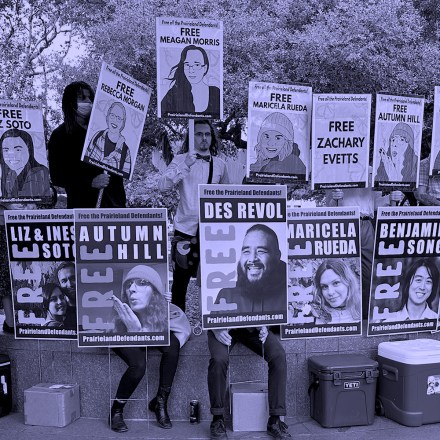
The government’s narrative rested on the premise that the noise demonstration was an organized ambush of law enforcement officers and that Song’s intent from the outset was to kill a police officer. But this version of events relies on an incomplete picture of what transpired that night.
Whether information that came to light during the trial is adjudicated as part of the appeals process will be decided by the 5th U.S. Circuit Court of Appeals, one of the most conservative courts in the country and one that Trump’s Justice Department has used to secure favorable rulings.
Patrick McLain, an attorney representing another Prairieland defendant, said it would likely be several months before any appeals are filed; it is still unclear what the focus will be and if the defendants will mount a coordinated effort.
“My hope is that we’re going to have nine solid briefs that are mutually supporting and not contradictory,” McLain said.
The 5th Circuit has not issued a briefing notice. Once it does, defense teams will have 40 days to submit their documents, according to John Kuchera, Song’s court-appointed appellate lawyer. Kuchera, reached by phone, said he has not yet had time to review the record and has not met with Song. He declined to comment on whether the theory about the bullet would be included in the appeal.
“What my opinions are about anything will show up in my brief,” he said. “Whatever issues that I think need to be addressed will be in that.”
Ultimately, the 5th Circuit will decide if evidence in the Prairieland case, including the bullet that struck Gross, can be reexamined and if Song, who now faces the prospect of spending the rest of his life in prison, will be granted a new trial.
IT’S EVEN WORSE THAN WE THOUGHT.
What we’re seeing right now from Donald Trump is a full-on authoritarian takeover of the U.S. government.
This is not hyperbole.
Court orders are being ignored. MAGA loyalists have been put in charge of the military and federal law enforcement agencies. The Department of Government Efficiency has stripped Congress of its power of the purse. News outlets that challenge Trump have been banished or put under investigation.
Yet far too many are still covering Trump’s assault on democracy like politics as usual, with flattering headlines describing Trump as “unconventional,” “testing the boundaries,” and “aggressively flexing power.”
The Intercept has long covered authoritarian governments, billionaire oligarchs, and backsliding democracies around the world. We understand the challenge we face in Trump and the vital importance of press freedom in defending democracy.
We’re independent of corporate interests. Will you help us?
IT’S BEEN A DEVASTATING year for journalism — the worst in modern U.S. history.
We have a president with utter contempt for truth aggressively using the government’s full powers to dismantle the free press. Corporate news outlets have cowered, becoming accessories in Trump’s project to create a post-truth America. Right-wing billionaires have pounced, buying up media organizations and rebuilding the information environment to their liking.
In this most perilous moment for democracy, The Intercept is fighting back. But to do so effectively, we need to grow.
That’s where you come in. Will you help us expand our reporting capacity in time to hit the ground running in 2026?
We’re independent of corporate interests. Will you help us?

I’M BEN MUESSIG, The Intercept’s editor-in-chief. It’s been a devastating year for journalism — the worst in modern U.S. history.
We have a president with utter contempt for truth aggressively using the government’s full powers to dismantle the free press. Corporate news outlets have cowered, becoming accessories in Trump’s project to create a post-truth America. Right-wing billionaires have pounced, buying up media organizations and rebuilding the information environment to their liking.
In this most perilous moment for democracy, The Intercept is fighting back. But to do so effectively, we need to grow.
That’s where you come in. Will you help us expand our reporting capacity in time to hit the ground running in 2026?
We’re independent of corporate interests. Will you help us?
Contact the author:
Related
Trump Goes After Anonymous Email Provider in Italy. The Real Target Is Free Speech in the U.S.
ICE Shot a Journalist and Threw Him in Detention. He’s Approaching 300 Days Behind Bars With a Festering Wound.
How Local Cops Are Running With Trump’s NSPM-7 Attacks on Antifa
Trump’s Spaghetti-Against-the-Wall Indictment Against ICE Protesters — and How to Fight It
Latest Stories

Voices
The Backlash to “NAZA” Shows How Little Israeli Citizenship Really Means
By threatening the filmmakers, Netanyahu lays bare how fragile the notion of what it means to be Israeli is in the age of its genocide in Gaza.

The Intercept Briefing
The Blueprint for Democrats to Win Back Voters
After suffering major losses last election cycle, Justice Democrats resurrected itself, helping put democratic socialism on the map. So what changed?

Flock Wants the Most Detailed Map of Its Surveillance Cameras Taken Offline
A security researcher’s map revealed more locations of Flock devices than any other. Flock is trying to take it down.