
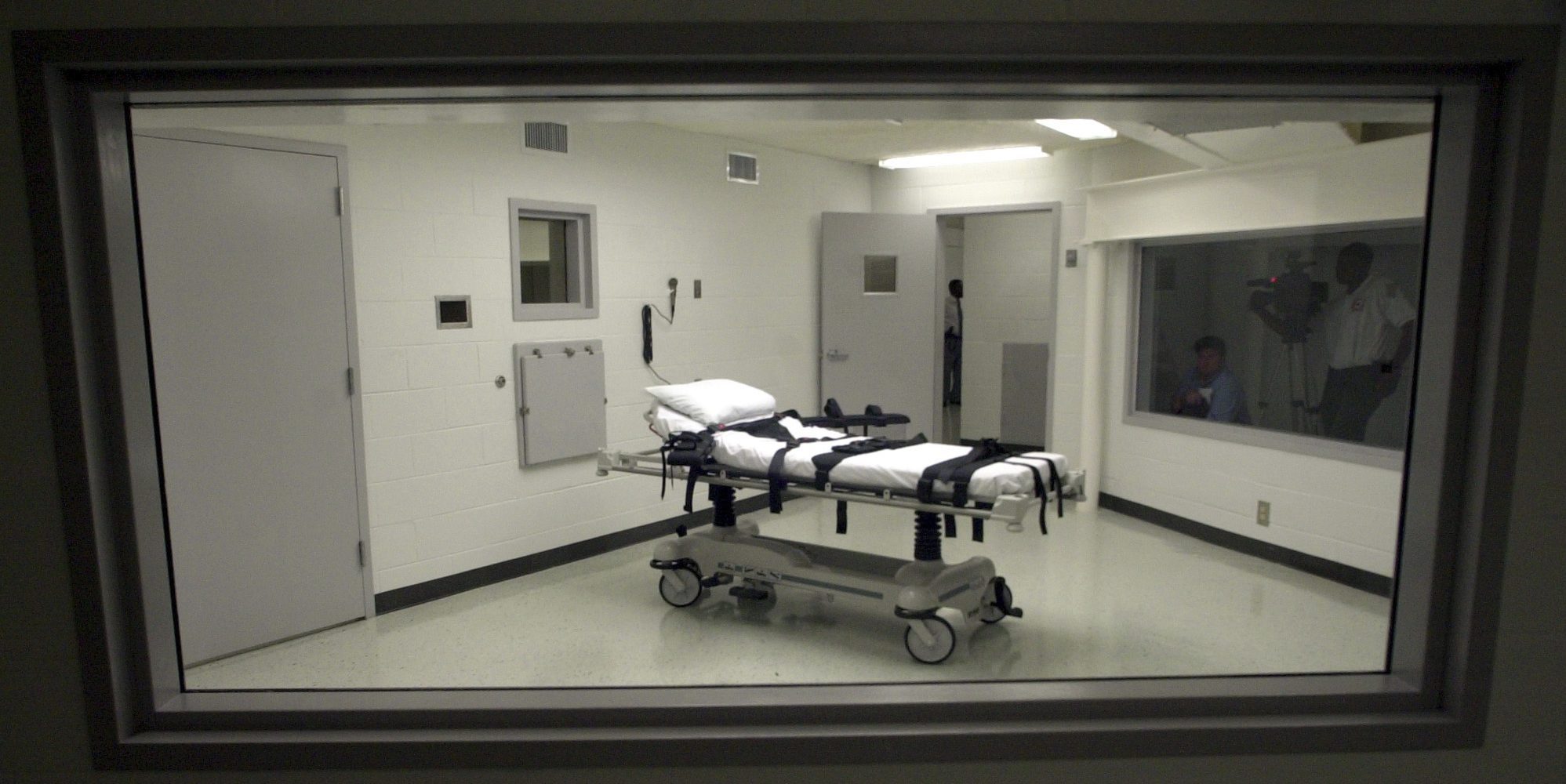
Grace Hanna was preparing to drive from Tallahassee to the Florida State Prison in Raiford when she got an email sharing momentous news from across the country: California Gov. Gavin Newsom had announced he would commute the sentences of everyone under a death sentence in his state, sparing the lives of 548 people — roughly a quarter of the nation’s death row population.
It was Thursday, November 5, just hours before Florida was scheduled to kill 63-year-old Jesse Guardado, the 19th person put to death in the state’s death chamber this year. Hanna was going to stand outside the prison for the execution night vigil, as she has done repeatedly since becoming executive director of Floridians for Alternatives to the Death Penalty.
News of the commutations capped off what Hanna called “a complicated week.” The “blue tsunami” that transformed the electoral map across the country just two days earlier stopped short of the Sunshine State, where gubernatorial candidate Byron Donalds, who supports the death penalty, narrowly beat a Democrat who backed a moratorium on executions. In a number of other active death penalty states, voters elected new governors and flipped legislatures, opening new pathways toward curbing the death penalty that seemed previously beyond reach. Even Texas, the death row capital of the country, was now about to be in the hands of a Democratic governor on record as opposing executions.
“It’s a hard night to be on death row in Florida right now,” Hanna later told vigil attendees after Guardado was declared dead at 6:13 p.m. The disconnect between Florida’s assembly-line executions and the week’s events made the prospect of progress seem painfully elusive.
Florida was not alone in this regard. Guardado’s execution was one of three carried out in the U.S. on November 5. Just after midnight, Indiana killed Jeffrey Weisheit at the state penitentiary in Michigan City, the fourth person put to death since the state resumed executions in December 2024. And within an hour of Guardado’s execution, Alabama killed Michael Taylor, with Republican Gov. Kay Ivey releasing a pointed statement aimed at Newsom. “California may let their criminals escape justice, but not Alabama,” she said. “Here, we enforce the law and always will.”
“My focus really that day was making sure that the world was aware that there were three executions going on.”
The executions were largely overlooked amid the frenzy of the midterms. Most Americans ignore the death penalty “except when something happens that’s big enough to get attention,” said Abe Bonowitz, head of Death Penalty Action. A veteran organizer who has steered successful legislative campaigns to abolish the death penalty in five different states, Bonowitz was driving back home from Indiana after leading a vigil during Weisheit’s execution when he got a text notification about Newsom’s commutations. “My focus really that day was making sure that the world was aware that there were three executions going on,” he said. The commutations cut through news coverage of the midterms in a way the executions had not.


The commutations also offered an important counternarrative to what has seemed like an American reembrace of capital punishment in the last several years. After a steady downward slide since a peak in 1999, when 98 people were put to death across the U.S., executions reached a historic low of 11 in 2021. In the following years, executions creeped back upward. Then the number of people put to death nearly doubled, jumping from 25 in 2024 to 47 in 2025. Although the total for 2026 will be lower, with 37 executions carried out so far, two more people are set to die tonight — and at least three additional executions are scheduled to be carried out before the end of the year.
The recent jump in executions can be largely traced to Florida, which accounts for more than half of the people put to death this year. Republican Gov. Ron DeSantis restarted executions in 2023, just before his failed presidential bid; Florida gives the governor far more power to set execution dates than other states. As death penalty lawyer Maria DeLiberato told me last year, “He just picks somebody, and then 30 days later they’re dead.”
DeSantis’s ongoing killing spree paints a distorted picture of the death penalty as a whole. Florida is an outlier, not an emblem, of the state of capital punishment, argues veteran attorney Robert Dunham, who has tracked death penalty trends for decades. In his view, Newsom’s commutations, coupled with the “seismic change in the political landscape in the midterm elections,” should empower other politicians to take more decisive actions that reflect this reality.
“The Trump administration and other vocal extremists have created this smokescreen suggesting that capital punishment is on the rise,” Dunham said. “Sometimes seismic explosions create more smoke, and sometimes they clear it away. And I think the elections may have cleared away that smokescreen.”

Indeed, last week a new Gallup poll found support for the death penalty below 50 percent, a drop from recent surveys. Conducted immediately after Tennessee’s botched lethal injection of Christa Pike — which was followed by backlash to Trump’s now-cancelled plans to livestream a military execution — the new poll was almost certainly shaped by the controversies. But such high-profile events can have lasting impacts. “Once something reaches the public consciousness, and it reaches it in a way that is so devastating, it’s hard to undo that,” Dunham said.
Viewed from afar, Newsom’s commutations seemed instantly emblematic of a new era, in which Democratic leaders might take bold actions that might have been previously unthinkable. While a campaign urging him to grant commutations had been underway for years, to critics, Newsom’s announcement was seen as plainly political — a maneuver designed to suit his presidential ambitions.
The idea that granting clemency to hundreds of people on death row might help, not hurt, a political campaign is itself a break from conventional wisdom, however. Since Bill Clinton famously witnessed the 1992 execution of Ricky Ray Rector in Arkansas while on the campaign trail, Democrats have either embraced capital punishment or run away from the issue. Although the party’s 2016 platform declared that “we will abolish the death penalty, which has proven to be a cruel and unusual form of punishment,” the Democrats’ 2024 platform eliminated any mention of capital punishment.

Until recently, the most significant mass commutation was carried out by a Republican: Illinois Gov. George Ryan, who in 2003 spared the lives of 167 people on death row and granted pardons to four. It would take more than two decades for anything remotely equivalent. In 2024, outgoing president Joe Biden commuted the sentences of 37 people on federal death row, leaving three people facing execution. Soon afterward, Democratic North Carolina Gov. Roy Cooper commuted 15 death sentences on his final day in office (a relative fraction of the state’s condemned population). And in Oregon in 2025, Democratic Gov. Kate Brown commuted the sentences of 17 people in the state.
The commutations by Cooper and Brown came out of states in which executions had not been carried out in many years. Likewise, Newsom’s actions were undoubtedly made easier by the fact that California has not executed anyone since 2006. Although the governor has a long history of opposing the death penalty — and imposed an official moratorium in 2019 — his actions certainly took electoral politics into account. “The governor has made no secret that he’s thinking about running for president,” said veteran activist Natasha Minsker, the head of the California Anti-Death Penalty Coalition, which spearheaded the campaign for commutations.
The result was both monumental — the single largest commutation in U.S. history — while also cementing the status quo. In a state where the death chamber itself was dismantled nearly eight years ago, even the term “death row” is a misnomer in California. Over the last few years, condemned men and women have been moved out of the housing units that once kept them separated from the rest of the prison population and into the general population.
Still, Newsom’s commutations are not yet a done deal. Under the state constitution, the governor cannot unilaterally grant clemency to people with multiple felony convictions. Two-thirds of the commutations must be approved by the state Supreme Court. Dueling press conferences over the past two weeks have featured victims’ family members speaking to both sides of the issue, while many of California’s elected district attorneys have decried the commutations.
But the reality is that many people — inside and outside California — are likely only vaguely aware of the significance of Newsom’s actions. “If you were to just ask the person on the street, they would say we don’t have the death penalty,” said Minsker. “I have had numerous legislators say to me, ‘But we don’t have the death penalty in California.’ Some of them even think Governor Newsom already got rid of it.”
The sense that capital punishment exists more in theory than in reality is prevalent in much of the rest of the country. While the death penalty remains the law of the land in 27 states, many have not carried out executions for years. Some of these include places with the largest death row populations. In Pennsylvania, for example, where the last execution took place in 1999, the Department of Corrections counts nearly 100 people still on death row.
In theory, a governor like Pennsylvania’s Josh Shapiro should be an ideal candidate to follow in Newsom’s footsteps. Shapiro, a Democrat who is also rumored to be considering a presidential run, extended a moratorium imposed by his predecessor and has repeatedly expressed opposition to the death penalty, including during his reelection race. But his powers are limited. Pennsylvania governors can only grant clemency with the unanimous support of the state’s five-member Board of Pardons, which includes a standing slot for the state attorney general. The current attorney general, who came into office in 2025, supports the death penalty. “So you have the chief prosecuting officer of the commonwealth holding veto power over commutations,” said Dunham. It is no coincidence that “there has never been a commutation of a death row prisoner’s sentence in the modern history of Pennsylvania’s death penalty.”
By contrast, in Ohio, where more than 100 people remain on death row, Republican Gov. Mike DeWine has made clear that he plans to commute at least some death sentences before leaving office. Once the state’s attorney general, DeWine took office in 2019, less than a year after the botched execution attempt of an elderly man named Alva Campbell — the second time Ohio tried and failed to set an IV to carry out lethal injection. In February 2019, DeWine stopped an execution after a federal judge expressed concerns over evidence that condemned people were being tortured to death as a result of the state’s lethal injection protocol. After that, DeWine repeatedly exercised his clemency power, granting temporary reprieves to every person with a scheduled execution date. This had kept executions on hold for the entirety of his eight years in office. In June, he announced that he no longer supports the death penalty at all.
DeWine has fairly wide latitude to grant commutations. While he can technically only act after a recommendation by state Parole Board, the board’s decisions are not binding. Earlier this week, DeWine confirmed that he’s in the process of carefully reviewing death penalty convictions, telling the Ohio Capital Journal that he might be willing to act in cases where condemned people have been unfairly blocked from relief in the courts. “The governor has additional authority to look at that and maybe see something else that is in there,” he said, “that maybe the jury legally couldn’t have looked at or the judge legally couldn’t have looked at.”

Until recently, a governor also enjoyed latitude to grant clemency in Kentucky, where, despite ongoing attempts by the attorney general to resume lethal injections, no one has been put to death since 2008. Local anti-death penalty activists have long planned to pressure Democratic Gov. Andy Beshear, another possible presidential candidate who is leaving office at the end of 2027, to commute the sentences of all 23 people on death row. But a new amendment passed as part of the midterm elections could complicate things.
The amendment was authored in response to a major scandal, after Beshear’s predecessor handed out more than 400 commutations and pardons before leaving office in 2019, including to relatives of campaign donors. Bipartisan backlash led to efforts to constrain executive clemency power; under the new amendment, Beshear is forbidden from granting commutations within 60 days of a gubernatorial election — or for 35 days afterward. The change sharply narrows the window for him to act. “It definitely gives us a sense of urgency,” the head of the Kentucky Coalition to Abolish the Death Penalty told Bolts last week.
Activist campaigns are also underway in states with smaller death penalty populations, like Kansas, which has not put anyone to death since 1965. “Kansas has not been plagued by crime despite conducting no executions over the past 61 years,” a former secretary of corrections wrote in an op-ed calling for Democratic Gov. Laura Kelly to commute the death sentences of all nine people on the state’s death row. Such an action “would simply acknowledge the reality we have lived with for decades.”
Campaigns for commutations are not limited to states the Democrats recently flipped. In Alabama, one of the country’s leading death penalty states, a new coalition is calling on outgoing Gov. Kay Ivey to grant clemency to people sentenced to death through judicial override, in which a trial judge disregards jurors’ vote for mercy to send someone to death row. Although it may seem like a long shot, Ivey herself signed legislation banning judicial override almost a decade ago — and this year she commuted the sentences of two men, sparing the life of Sonny Burton just days before he was set to die.

Still, the potential for change is perhaps even more compelling in a place like Georgia, where Democrat Keisha Lance Bottoms, a Black woman who has been critical of capital punishment, will now preside over an active death penalty state. Although Georgia’s pardon and parole board is uniquely powerful — one of a handful of state clemency boards with the sole authority to grant commutations — its five members are appointed to seven-year terms by the governor. As of now, the earliest vacancy will not be until the end of 2027, which means it will be a long time before Bottoms can choose new members who might be more inclined to show mercy to people facing execution.
“The death penalty cannot sustain itself the way it’s going right now.”
But there is no state where such a change could be more transformative than in Texas, long known as the belly of the beast of capital punishment. Gov.-elect Gina Hinojosa, a former civil rights attorney, has long said she is against the death penalty — a shattering change in itself. While Hinojosa can’t act unilaterally to grant commutations, she, too, can appoint members of the board of pardons and paroles, a body that until recently was little more than a rubber stamp for executions. Of the seven-member board, three people’s terms are set to expire in 2027, giving her the power to remake the body in a way that could turn the death penalty on its head.
For Reinaldo Dennes, who faces execution in Texas tonight, any such change will be too little too late, however. The same is true for Thomas Overton, who is set to die tonight in Florida. He will become the 20th person executed this year — a new record for the state.
Although Gov.-elect Donalds says he supports executions, abolitionists hope that he will, at the very least, slow down the pace set by DeSantis. Like people all over the country, Grace Hanna points out, Floridians are turning away from capital punishment more generally — and, as in all death penalty states, new death sentences are rare compared to what they used to be. “The reality is that juries in Florida are not sentencing people to death at nearly the rate that they were historically,” Hanna said. “The death penalty cannot sustain itself the way it’s going right now.”
IT’S EVEN WORSE THAN WE THOUGHT.
What we’re seeing right now from Donald Trump is a full-on authoritarian takeover of the U.S. government.
This is not hyperbole.
Court orders are being ignored. MAGA loyalists have been put in charge of the military and federal law enforcement agencies. The Department of Government Efficiency has stripped Congress of its power of the purse. News outlets that challenge Trump have been banished or put under investigation.
Yet far too many are still covering Trump’s assault on democracy like politics as usual, with flattering headlines describing Trump as “unconventional,” “testing the boundaries,” and “aggressively flexing power.”
The Intercept has long covered authoritarian governments, billionaire oligarchs, and backsliding democracies around the world. We understand the challenge we face in Trump and the vital importance of press freedom in defending democracy.
We’re independent of corporate interests. Will you help us?
IT’S BEEN A DEVASTATING year for journalism — the worst in modern U.S. history.
We have a president with utter contempt for truth aggressively using the government’s full powers to dismantle the free press. Corporate news outlets have cowered, becoming accessories in Trump’s project to create a post-truth America. Right-wing billionaires have pounced, buying up media organizations and rebuilding the information environment to their liking.
In this most perilous moment for democracy, The Intercept is fighting back. But to do so effectively, we need to grow.
That’s where you come in. Will you help us expand our reporting capacity in time to hit the ground running in 2026?
We’re independent of corporate interests. Will you help us?

I’M BEN MUESSIG, The Intercept’s editor-in-chief. It’s been a devastating year for journalism — the worst in modern U.S. history.
We have a president with utter contempt for truth aggressively using the government’s full powers to dismantle the free press. Corporate news outlets have cowered, becoming accessories in Trump’s project to create a post-truth America. Right-wing billionaires have pounced, buying up media organizations and rebuilding the information environment to their liking.
In this most perilous moment for democracy, The Intercept is fighting back. But to do so effectively, we need to grow.
That’s where you come in. Will you help us expand our reporting capacity in time to hit the ground running in 2026?
We’re independent of corporate interests. Will you help us?
Contact the author:

Related


Latest Stories

ICE Spreads Misinformation About Securing Your iPhone. Here’s How to Really Do It.
No, your iPhone isn’t acting as a covert microphone by default — but there are steps you can take to secure your device.

Voices
Everyone’s Talking About Air Travel. No One’s Talking About How ICE Flights Make It Less Safe.
Trump’s immigration crackdown is fueling a safety crisis that’s gone relatively unnoticed in the public panic over flying.

U.S. Drug War in Mexico Fueled More Murders, Violence, and Drug Deaths
A new report by the World Peace Foundation and Costs of War argues that the Trump administration’s militarized Mexico policy is destined to fail.