


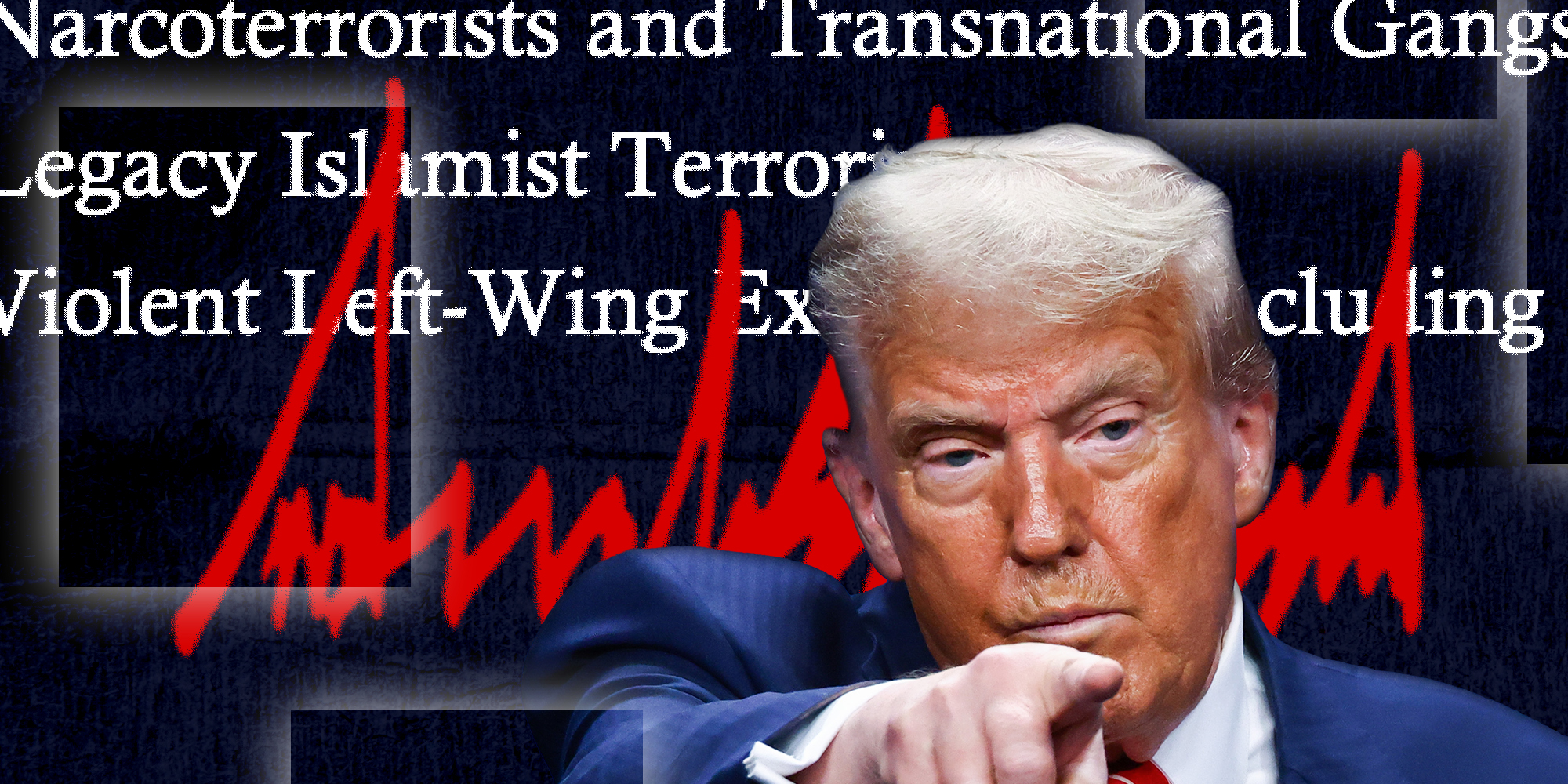
the Trump administration last week unveiled its “2026 Counterterrorism Strategy,” a 16-page collection of threats, grievances, hyperbole, and lies. The memo is a truly foundational document and a striking distillation of Trumpism as an ideology, movement, and system of governance. It also serves as a new declaration of war on the Trump administration’s enemies — foreign and domestic, real and imagined.
The brainchild of National Security Council official Sebastian Gorka, the “Counterterrorism Strategy” weaves together Trump’s war on the wider world — which stretches from interventions and wars in Yemen and Iran to Nigeria and Somalia to Venezuela and the Caribbean Sea — with the administration’s war on dissent at home, which has targeted immigrants, legal observers, activists, protesters, and the press.
Under the guise of protecting America, it takes aim at wide swaths of Americans, putting targets on the backs of the most vulnerable.
The “Counterterrorism Strategy” formalizes a drastic shift in focus for counterterror efforts. Now, according to the Trump administration, the nation is battling three major types of terror groups: “Legacy Islamist Terrorists,” the long-standing focus of America’s counter-terror efforts; “Narcoterrorists and Transnational Gangs”; and “Violent Left-Wing Extremists, including Anarchists and Anti-Fascists.”
This last group is defined in the document as people the administration deems to be “anti-American, radically pro-transgender, and anarchist.” This puts antifa — a fictional foe that is actually a collection of ideas and not an organization — on par with actual terrorist groups like Al Qaeda and the Islamic State group, and drug-trafficking syndicates such as the Sinaloa Cartel and Jalisco New Generation Cartel.
The memo makes no mention of right-wing extremist groups, despite rafts of research, from the U.S. government and others, demonstrating that such groups have been responsible for the majority of violent attacks in America in recent years.
Following 9/11, the George W. Bush administration published the first official National Strategy for Combating Terrorism. The 2003 document purported to set “the course for winning the War on Terror,” with a focus on “destroying the larger al-Qaida network,” by defining the threat and laying out big-picture goals and objectives. New strategies have been issued numerous times, over multiple presidencies, since.
“The Trump administration has repurposed the ‘terrorism’ framing and applied it to new boogeymen.”
Explaining the 2026 strategy last week, Gorka leaned into the lies which permeate the Trump administration’s document. “Very simply, it’s common-sense counterterrorism based on reality not fake threats,” he explained. “In the president’s foreword and in chapter one, we make it very clear we will not permit the use of the most powerful national security tools in the world including the counterterrorism enterprise to be used as political weapons.”
Rep. Valerie Foushee, D-N.C., had a very different interpretation, calling the strategy “a plan on how they’re going to attack people on the left,” noting that antifascists are “not a real terrorism threat in the United States.” She added that the effort is “completely corrupt.”
To contextualize the U.S. government’s radical new approach to counterterrorism, The Intercept analyzed the document, highlighting revelatory passages that show how the Trump administration is bringing the war on terror home.
“We Will Kill You”
History ultimately judges presidents by their priorities, both deeds and words.
While calling out slavery as the cause of the Civil War, President Abraham Lincoln still focused his second inaugural address on reconciliation over retribution. “With malice toward none; with charity for all; with firmness in the right, as God gives us to see the right, let us strive on to finish the work we are in; to bind up the nation’s wounds; to care for him who shall have borne the battle, and for his widow, and his orphan—to do all which may achieve and cherish a just, and a lasting peace, among ourselves, and with all nations,” he pronounced.
On the eve of World War II, as the threat of fascism loomed over the world, President Franklin D. Roosevelt readied a nation for war, not with ferocious rhetoric but by envisioning a new world founded upon the freedom of speech and expression, freedom of worship, freedom from want, and freedom from fear. “That is no vision of a distant millennium,” he told Congress on January 6, 1941. “It is a definite basis for a kind of world attainable in our own time and generation. That kind of world is the very antithesis of the so-called new order of tyranny which the dictators seek to create with the crash of a bomb.”
These presidents were deeply flawed. Both committed grave injustices, were responsible for immense harm, and neither lived up to their most laudable words. But those words survived for a reason and are now part of the American canon.
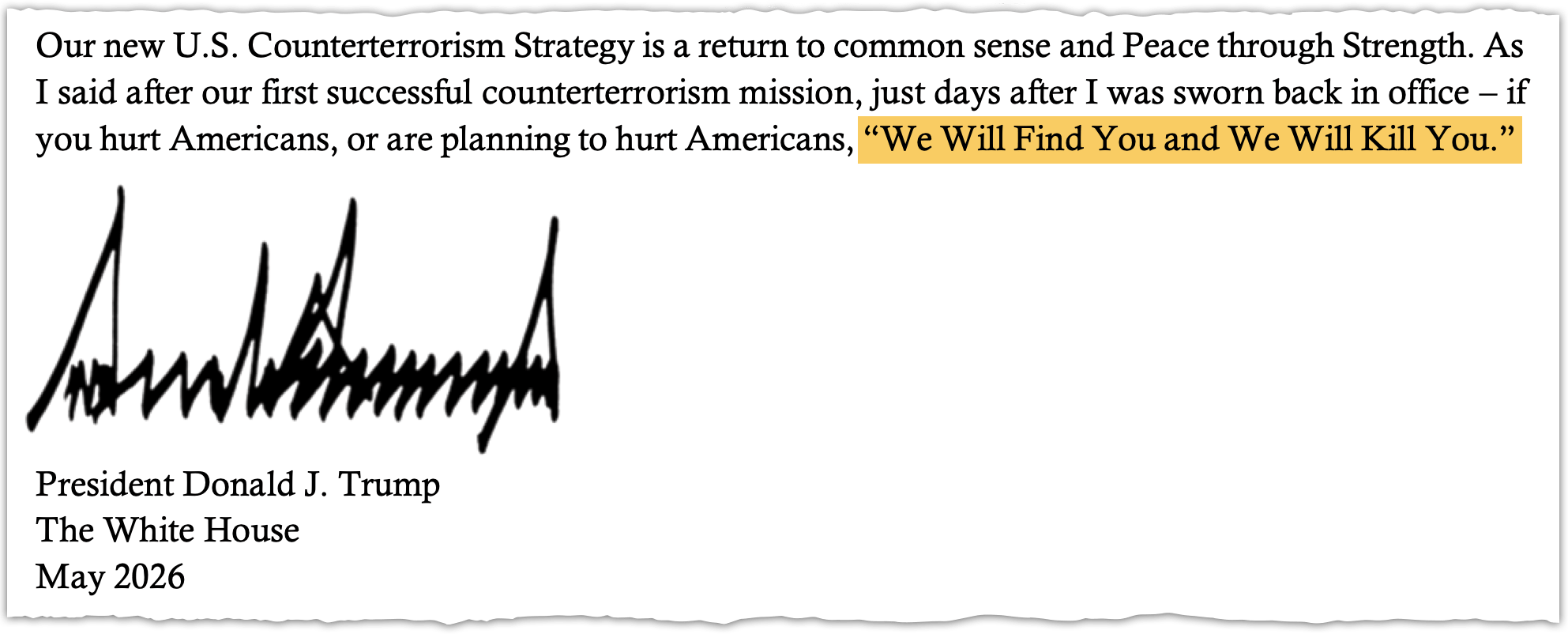
For President Donald Trump, the “2026 Counterterrorism Strategy” is as good as any collection of words in defining him. Nothing better illustrates his vision of America’s role in the world than Trump’s capstone quote. He concludes the foreword with words that ring true from the streets of Minneapolis, where federal agents killed U.S. citizens Renee Good and Alex Pretti during anti-ICE resistance; to a school building in Minab, Iran, where more than 100 children were killed in a U.S. airstrike; to the Eastern Pacific Ocean and Caribbean Sea, where close to 200 civilians have been killed in attacks on alleged drug boats; and should follow him forever: “We Will Find You and We Will Kill You.”
Treating Americans as Terrorists
Under U.S. law, the government can designate “foreign terrorist organizations,” a process that typically entails a formal declaration by the secretary of state at the direction of the president, allowing the Treasury Department to impose financial penalties and the Justice Department to prosecute people for providing “material support” to such groups. Congress has not passed any law creating a domestic terrorism designation, nor is there a standalone crime of “domestic terrorism.”
This has not stopped Trump from aiming the counterterror apparatus at domestic targets in his second term. Under National Security Presidential Memorandum 7, or NSPM-7, which Trump issued last September, vaguely defined enemies are not only typified by “support for the overthrow of the United States Government,” but also advocacy of opinions clearly protected by the First Amendment including “anti-Americanism, anti-capitalism, and anti-Christianity” as well as “hostility towards those who hold traditional American views on family, religion, and morality.”
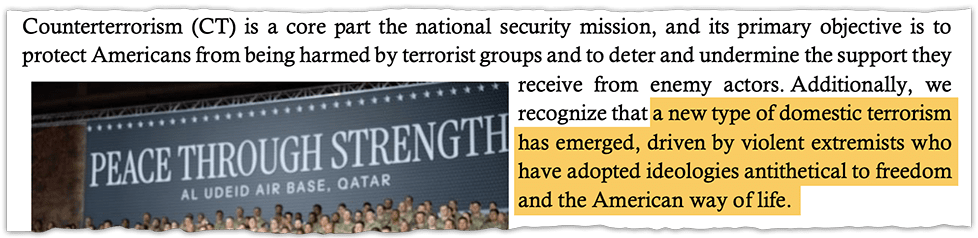
In this document, the Trump administration makes clear it considers any American who it believes has “adopted ideologies antithetical to freedom and the American way of life” to be a terror threat.
“The Trump administration has repurposed the ‘terrorism’ framing and applied it to new boogeymen, like alleged narcos as well as a caricature of their domestic political opposition,” Brian Finucane, a senior adviser for the U.S. Program at the International Crisis Group, told The Intercept.
White-Washing Right-Wing Terror
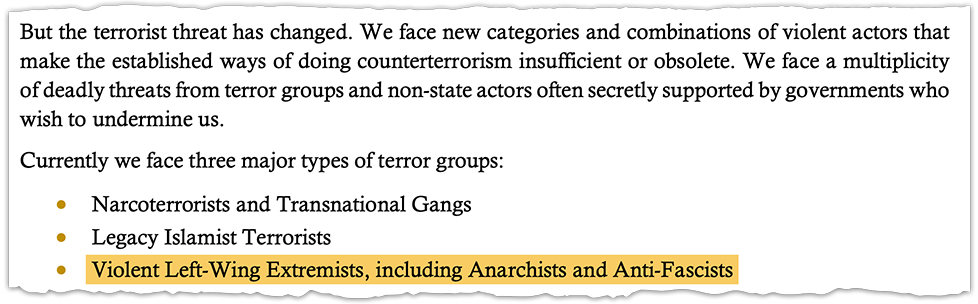
What’s notable here isn’t just the “major terror groups” included — it’s the type of groups the Trump administration omitted.
“Absurdly, the document incorrectly labels drug cartels, ‘legacy Islamist terrorists,’ and violent left-wing extremists as the top counterterrorism threats — despite years of data proving that right-wing extremism has presented the most persistent and deadly threats to Americans for decades,” said Rep. Bennie G. Thompson, D-Miss., ranking member of the House Committee on Homeland Security.
In fact, a 2025 analysis conducted by the nonpartisan Center for Strategic and International Studies found that, over the past decade, right-wing extremists carried out 152 attacks in the United States and killed 112 people, compared with 35 attacks and 13 deaths attributed to left-wing militants. Islamist jihadist-inspired attacks resulted in 82 deaths over the same span.
“Radical Ideologies”
The new “Counterterrorism Strategy” signals a jarring shift in the priorities of the national security apparatus. Instead of having the security state primarily focus on foreign actors and those domestic threats responsible for the most violence in recent years — like white supremacists and violent militias — the president is effectively siccing them on anyone who dares to disagree with him or his supporters.
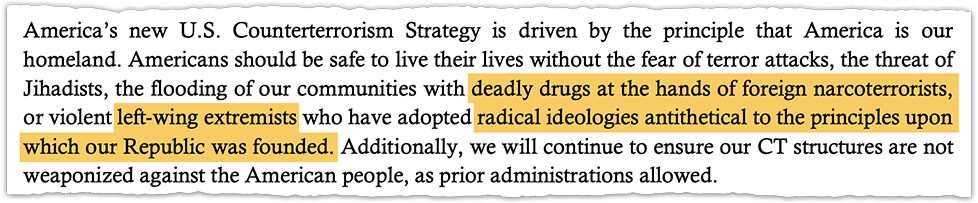
“This is a very severe degradation of freedom of thought [and] freedom of speech in the country, and it should be raising alarm bells,” said Robert P. Jones, president and founder of Public Religion Research Institute.
“It does look like a very straight blueprint drawn from white evangelical Protestant Christian circles,” said Jones, the author of the forthcoming book “Backslide: Reclaiming a Faith and a Nation After the Christian Turn Against Democracy.”“What they call radical ideology is essentially anything that differs from that conservative, white evangelical Protestant worldview.”
The Narcoterrorist Boogeymen
By labeling drug-trafficking networks as terrorists, Trump is operating in a long tradition of using the rhetoric of war to refer to an issue that is rooted in public health. The terrorism framing is simply the logical next step in the decadeslong war on drugs that is, more often than not, used as a cudgel by U.S. policymakers to keep Latin American countries in line, said Alexander Aviña, a historian at Arizona State University.

“They’re using drug war counterterrorism as a cover,” Aviña said. “They’re effectively maintaining control over the region through a bunch of proxy right-wing governments, but it’s being framed as counterterrorism, as an anti-drugs operation. The innovation here is that they’re applying war on terror legislation and laws to drug trafficking organizations”

The problem with labeling drug networks as “terrorists,” however, is that the vast majority of drug traffickers differ from organizations like Al Qaeda and the Islamic State group in that they have no real membership, and they operate for profit, not to achieve an ideological objective.
Legacy Islamist Terrorists
Despite Trump’s boasts of his prowess at fighting terrorism, both Al Qaeda and ISIS were the top threats in his 2018 counterterrorism strategy. They are called out specifically in the new document as well.

In fact, Gorka’s inclusion of ISIS directly contradicts longtime claims by Trump. “We defeated ISIS in record time,” Trump said in his 2024 election-night speech. Last year, at his commencement speech at the U.S. Military Academy at West Point, he said: “I defeated ISIS in three weeks.”
“Politically Motivated” Killings of Christians
The idea that Christians, who make up two-thirds of the U.S. population, are under siege is belied by the data. Hate crimes motivated by anti-Christian bias are far rarer than attacks motivated by racism or xenophobia in the United States, and other religious groups are far more likely to report being the victim of a religiously motivated hate crime than Christians. An analysis of 2023 FBI hate crime data found that less than 10 percent of religiously motivated hate crimes were believed to be motivated by anti-Christian bias.

“There’s really no evidence-based reason why a report focused on the domestic front would disproportionately feature violence against Christians. There’s just no evidence that that is the most pressing problem facing us in the United States today,” said PRRI’s Jones.
In the wake of Charlie Kirk’s killing, right-wing influencers and media outlets rapidly spread misinformation about the shooter’s gender identity and supposed “pro-transgender” ideology based on unverified claims about the bullet casings used in the shooting. Trans people are far more likely to be victims of gun violence than perpetrators. In mass shootings carried out between 1966 and 2025, less than 1 percent of the shooters were transgender, according to the Violence Prevention Project. The overwhelming majority of shooters were cisgender men.
“In the immediate aftermath of Charlie Kirk’s murder, news outlets and people with large platforms online raced to share unconfirmed reports that wrongfully tied the LGBTQ+ community to the shooter,” Human Rights Campaign national press secretary Brandon Wolf told The Washington Blade. “Jumping to those conclusions was reckless, irresponsible, and led to a wave of threats against the trans community from right wing influencers, and a wave of terror for the community that is already living scared.”
“Neutralization” of Adversaries
While Trump has frequently threatened his political opponents in public, experts in extremism told The Intercept that “this kind of language” in a national security document should raise alarm bells. It’s one thing when the president rants about “radical gender ideology” at a rally, said Jones. “But when it gets put into a national presidential security memo, when it gets put into a report that’s led by a task force at the U.S. Department of Justice, and when it’s put into a counterterrorism document … these are laying the legal framework for prosecution.”

This language of “neutralization” in this new strategy harkens back to the FBI’s analogous and infamous COINTELPRO program, which was employed in the 1960s and 1970s to target the civil rights movement, the New Left, and anti-Vietnam War protesters, among other domestic groups and individuals and, according to a 1976 Senate Select Committee report on U.S. intelligence activities, “turn[ed] a law enforcement agency into a law violator.” The FBI, the committee found, “went beyond the collection of intelligence to secret action designed to ‘disrupt’ and ‘neutralize’ target groups and individuals,” using “wartime counterintelligence” techniques that “would be intolerable in a democratic society even if all of the targets had been involved in violent activity,” which they were not.
A 1967 FBI memo notes that purpose of this type of “counterintelligence endeavor is to expose, disrupt, misdirect, discredit, or otherwise neutralize” African American groups and leaders. Efforts included “sending anonymous poison-pen letters intended to break up marriages,” “encouraging gang warfare,” “falsely labeling members of a violent group as police informers,” and other means to “cause serious physical, emotional, or economic damage to the targets,” according to the committee. Their investigation found that civil rights leader “Martin Luther King, Jr. was, for instance, the target of an intensive campaign by the Federal Bureau of Investigation to ‘neutralize’ him” and that “the man in charge of the FBI’s ‘war’ against Dr. King” said they used the same methods employed against Soviet agents.
An Antifa Obsession
Antifa, short for antifascist, is a decentralized, leftist ideology, a collection of related ideas and political concepts much like feminism or environmentalism. Over the last decade, however, Republicans have used it as an omnibus term for left-wing activists — as if it were an organization with members and a command structure. They have increasingly blamed antifa for terrorist violence.

In 2019, during his first term, Trump floated the idea of declaring antifa “a major Organization of Terror,” likening it to the group MS-13, an international criminal gang that originated in the U.S. and that the administration added to the foreign terrorist organization list last year. “The United States of America will be designating ANTIFA as a Terrorist Organization,” Trump tweeted in 2020, during protests after the police killing of George Floyd.
Then-FBI Director Christopher Wray said, however, that antifa was “not a group or an organization” but a “movement or an ideology.” Trump lashed out, calling antifa “well funded ANARCHISTS & THUGS who are protected because the … FBI is simply unable, or unwilling, to find their funding source.” After Trump supporters stormed the U.S. Capitol on January 6, 2021, in an effort to overturn his 2020 election loss to Joe Biden, Trump blamed “antifa people” for inciting violence.

Finally, last September, Trump signed an executive order designating antifa as a “domestic terror organization.” He followed it by issuing NSPM-7, which directs the Justice Department and elements of the Intelligence Community and national security establishment to target “anti-fascism … movements” and “domestic terrorist organizations.”

On his press tour touting the new strategy, Gorka said “left-wing violent radicals like antifa and the anarchists” were the “most ascendant” terror group and — without evidence — claimed they were “the people who killed our friend Charlie Kirk.” He said these leftists are “people who think that if you don’t agree with them politically, they get to kill you.”
Locking Up Trump’s Enemies
The new document detours to discuss the wrongful detention of Americans abroad. Ironically, the Trump administration has unlawfully detained thousands of people residing in the United States, including those with legal status, targeting everyone from perceived political dissidents to racial and ethnic minorities.

Last year, the Trump administration detained Tufts University student Rümeysa Öztürk for writing an op-ed, as revealed by legal documents unsealed as a result of litigation from The Intercept and other parties.
Also in 2025, the administration sent Kilmar Ábrego García, a Salvadoran national with an order preventing his deportation to his country of origin, to CECOT, a prison in El Salvador notorious for human rights abuses. He has since been released to his home in Maryland, but the administration has continued to target him, including with criminal prosecution.
The Monroe Doctrine
Issued by President James Monroe, the Monroe Doctrine is a foundational principle of U.S. foreign policy opposing any foreign interference in the Western Hemisphere — except by Washington. It’s seen by American nationalists and by modern “America First” Trump ideologues as marking a “golden age” of U.S. power in the region, according to historian Greg Grandin.
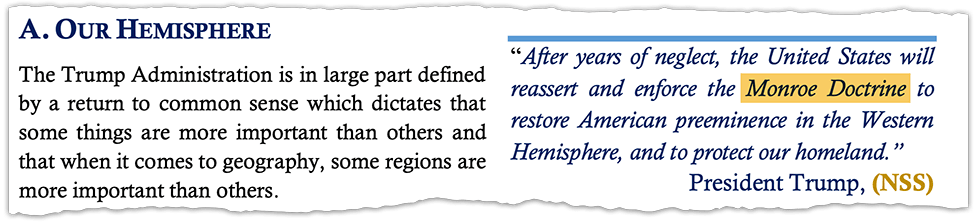
“Going back to World War I and World War II, America First nationalists have liked the Monroe Doctrine because they saw it as an alternative to liberal internationalism,” Grandin said. “They were never isolationists, even though that word is often applied to them, because they’ve long claimed the right to intervene and project power in the Western Hemisphere.”
Now, Trump is using the spectre of terror to justify extrajudicial killings of alleged drug traffickers at sea and the abduction of Venezuelan President Nicolás Maduro.
Boat Strikes and Bogus Stats
The U.S. military has conducted 58 attacks on so-called drug boats in the Caribbean Sea and Eastern Pacific Ocean since September 2025, killing more than 190 civilians.
Experts in the laws of war, as well as members of Congress from both parties, say the strikes are illegal, extrajudicial killings because the military is not permitted to deliberately target civilians — even suspected criminals — who do not pose an imminent threat of violence.

The assertion that this campaign has resulted “in a more than 90% decrease in maritime drug smuggling” into the U.S. slightly tempers similarly outlandish and false figures from Trump, who regularly claims that “drugs entering our country by sea are down 97 percent.” Experts say these claims are meant to deceive the American people. “It wouldn’t be the first time this administration just made up something out of whole cloth,” Sanho Tree, the director of the Drug Policy Project at the Washington-based Institute for Policy Studies, told The Intercept.
Even the Pentagon’s own figures refute Trump’s numbers. “He’s trying to imply that 97 percent of the cocaine that left South America by boat headed to the United States has been stopped,” said Rear Adm. William Baumgartner, the former commander of the Seventh Coast Guard District, who oversaw drug-interdiction operations in the Southeast U.S. and the Caribbean Basin. “That’s not true and is contradicted by the administration’s own statements.” Acting Assistant Secretary of War for Homeland Defense and Americas Security Affairs Joseph Humire, for example, offered completely different numbers to Congress, telling the House Armed Services Committee in March that there “has been a 20 percent reduction of movements of drug vessels in the Caribbean and an additional 25 percent reduction in the Eastern Pacific.”
The “Trump Corollary”
This isn’t the first time we’ve seen an attempt by the administration to enshrine a “Trump Corollary” to the Monroe Doctrine, with the term also appearing in the administration’s national security strategy document in December. But it’s not entirely clear what, precisely, this corollary means, said Aviña, the historian.
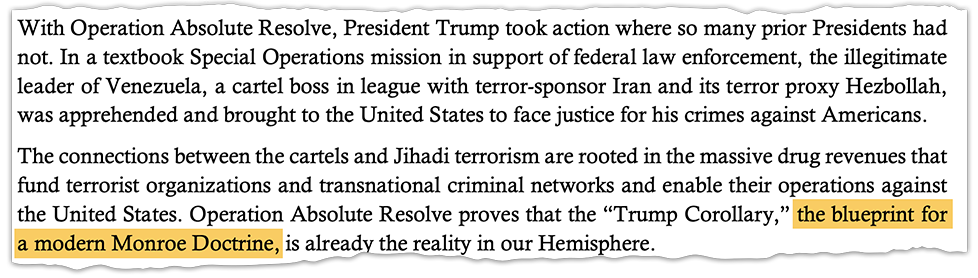
“It’s supposed to be an addition to the Monroe Doctrine, but we don’t get a very precise definition of what that is,” said Aviña. “It harkens back to the Roosevelt Corollary, but Teddy Roosevelt was very clear about what his addition was: international police power.” Trump makes no claim to a new power. “So Trump is working in that tradition, but in a weird and imprecise way.”
Loosened Rules and Civilian Deaths
The loosened rules of engagement during Trump’s first term had a profound effect across the Middle East and Africa. Attacks in Somalia tripled after Trump relaxed targeting principles, while U.S. military and independent estimates of civilian casualties across U.S. war zones spiked. The U.S. conducted 219 declared attacks in Somalia during Trump’s single term in the White House, a more than 329 percent increase over the eight years of the Obama presidency. Trump is already on the cusp of eclipsing those numbers in less than a year and half. Since taking office last year, Trump has overseen at least 190 attacks in Somalia.

A review of Trump-era rules by the Biden administration found that, in some countries, “operating principles,” including a “near certainty” that civilians would “not be injured or killed in the course of operations,” were reportedly enforced only for women and children, while a lower standard applied to civilian adult men. All military-age males were considered legitimate targets if they were observed with suspected al-Shabab members in the group’s territory, Donald Bolduc, who led Special Operations Command Africa at the time, told The Intercept.
A 2023 investigation by The Intercept found that Trump’s directive contributed to a particularly disastrous attack in Somalia that killed at least three — and possibly five — civilians, including 22-year-old Luul Dahir Mohamed and her 4-year-old daughter, Mariam Shilow Muse. The mother and child survived the initial strike but were killed by a double-tap attack as they fled for their lives. “They know innocent people were killed, but they’ve never told us a reason or apologized,” said Abdi Dahir Mohamed, one of Luul’s brothers. “No one has been held accountable.”
Using Europe to Promote Bigotry
The document employs its section on Europe to shamelessly promote racism, white nationalism, and Christian supremacy employing a stilted worldview that ignores the U.S. role in the immigration it rails against.

“Trump officials are clearly weaponizing anti-Muslim bigotry in their campaign to heap pressure on Europe. They are baselessly insinuating that European policies that welcomed migrants — who largely fled their home countries due to the impact of U.S. backed wars and regime changes — created an incubator for terrorism,” Erik Sperling, the executive director of Just Foreign Policy, told The Intercept. “At the same time, however, the White House continues to implement the exact kind of violent, interventionist policies that drove mass migration and generated extremism in the first place.”

“There is this kind of praising of Western culture and values, the denigration of ‘alien cultures,’” said Jones. “What’s behind those is really a sense of European superiority, and that gets translated into the U.S. in racial terms. So it really is a white Christian worldview here that’s being projected and protected.”
A Bid to “Protect Christians”
Experts on white supremacy and Christian nationalism told The Intercept that the Trump administration is spreading misinformation about a Christian genocide in Africa in order to stoke white Christian nationalist and anti-immigrant sentiments at home. “In Nigeria, it’s genocide against Christians, and in South Africa, it’s the supposed genocide against these white Afrikaners,” Christine Reyna, a professor of psychology at DePaul University, told The Intercept. “And so in absence of an actual genocide in the United States against either of these two groups, you can keep that narrative of that existential fear of extermination and genocide and oppression that is alive and well within a certain subset of white Americans.”

In addition to using the conflicts in Africa to spread propaganda domestically, experts on Christian nationalism tell The Intercept that Secretary of Defense Pete Hegseth believes in waging war to achieve Christian supremacy abroad, without respect to international laws or norms. “Hegseth believes that he is carrying out a spiritual and actual war to vanquish a Christian nation’s enemies and protect and promote a Christian nation,” Sarah Posner, an investigative journalist covering the Christian right, said on The Intercept Briefing podcast. “For Hegseth, biblical law is the only law he feels obligated to obey. The law of war, international law governing military conflicts, and human rights and civilian rights in war — he believes don’t apply to him.”
Trump’s Holy War in Nigeria
While Christians have been the victims of violence in Nigeria, they have not been the primary target, and experts overwhelmingly reject the idea that a Christian genocide is occurring in that country. Research from the Armed Conflict Location and Event Data, an independent global monitor of conflict and protest data, found that of the 1,923 attacks on civilians in Nigeria that occurred as of November of last year; 50 of those attacks targeted Christians because of their religion. According to experts, the majority of the violence has focused on land disputes.

Trump’s Christmas Day attack was another in a long string of failed and futile U.S. counterterrorism efforts in Africa documented by The Intercept over the last decade This includes blowback from U.S. operations and failed secret wars, civilians killed in drone strikes, coups by U.S. trained officers, increases in the reach of terror groups, surging fatalities from militant violence, human rights abuses by allies, massacres of civilians by partner forces, and a catalogue of other fiascos.
Doubling Down on Failures in Africa
The document casts Trump’s strategy as a departure from the failed forever war interventions of Presidents George W. Bush, Barack Obama, and Joe Biden. But Sarah Harrison — who served as an associate general counsel at the Pentagon’s Office of General Counsel, International Affairs, where she oversaw the Africa portfolio, and as counsel to the deputy assistant secretary of defense for African affairs — sees little difference. “Setting aside the bombast about protecting Christians, the fundamentals of Trump’s Africa CT policy isn’t that distinct from his predecessors: a light military footprint to facilitate intel sharing and drone strikes with an emphasis on supporting the partner nation. These policies fail because they ignore the drivers of conflict and refuse to acknowledge the need for a political solution,” she told The Intercept.

The U.S. government’s own statistics bear out this record of futility and failure. Throughout all of Africa, the State Department counted 23 deaths from terrorist violence in 2002 and 2003, as U.S. counterterrorism efforts began to ramp up on the continent in the wake of 9/11. Last year, there were 22,307 fatalities from militant Islamist violence in Africa, according to the Africa Center for Strategic Studies, a Pentagon research institution. This represents an almost 97,000 percent increase since the early 2000s, with the areas of greatest U.S. involvement — Somalia and the West African Sahel — suffering the worst outcomes.
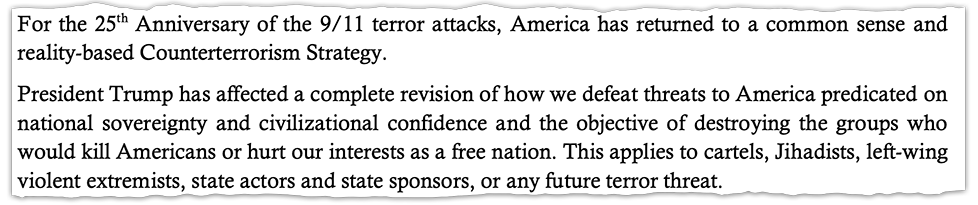
“Reality-Based” Counterterrorism
The document ends as it began, with unserious bombast that reads like little more than AI slop fashioned from administration talking points. Evoking the administration’s 2025 National Security Strategy, which called for a restoration of “Europe’s civilizational self-confidence and Western identity,” the Trump administration appears to be making up for its own insecurities with claims that the president has restored America’s “civilizational confidence” through a baptism of fire. In reality, the document projects a heady blend of weakness and anxiety and espouses a counterterrorism strategy akin to a 12-year-old boy’s vision of foreign policy: boasts about killing one’s way to victory.
In a post-release media tour where he spoke with MAGA outlets and administration sycophants, Gorka expressed amazement at how little negative reporting there was about the new counterterrorism strategy. “Even the left, they’re so on their heels. I did a kind of press call when we released the strategy,” said Gorka. “Fifty articles were written. … Only one of them … was even slightly negative.” (The Intercept’s invite must have been lost in the mail.) He continued: “We are moving so fast, they just can’t keep up with us — which is delicious.” His interviewer, Dean Cain, best known for playing second fiddle in “Lois & Clark: The New Adventures of Superman,” responded, “That’s wonderful.”

“If the U.S. government counterterrorism enterprise hadn’t jumped the shark before, it certainly has now,” said Finucane. “The administration has repurposed the terrorism framing and applied it not only to alleged narcos but also perceived domestic political opponents — as we saw with the way the administration baselessly smeared Renee Good and Alex Pretti as ‘terrorists’ after gunning them down. The whole situation would be much funnier if the Trump administration wasn’t currently engaged in a lawless killing spree under the guise of ‘counterterrorism.’”
IT’S EVEN WORSE THAN WE THOUGHT.
What we’re seeing right now from Donald Trump is a full-on authoritarian takeover of the U.S. government.
This is not hyperbole.
Court orders are being ignored. MAGA loyalists have been put in charge of the military and federal law enforcement agencies. The Department of Government Efficiency has stripped Congress of its power of the purse. News outlets that challenge Trump have been banished or put under investigation.
Yet far too many are still covering Trump’s assault on democracy like politics as usual, with flattering headlines describing Trump as “unconventional,” “testing the boundaries,” and “aggressively flexing power.”
The Intercept has long covered authoritarian governments, billionaire oligarchs, and backsliding democracies around the world. We understand the challenge we face in Trump and the vital importance of press freedom in defending democracy.
We’re independent of corporate interests. Will you help us?
IT’S BEEN A DEVASTATING year for journalism — the worst in modern U.S. history.
We have a president with utter contempt for truth aggressively using the government’s full powers to dismantle the free press. Corporate news outlets have cowered, becoming accessories in Trump’s project to create a post-truth America. Right-wing billionaires have pounced, buying up media organizations and rebuilding the information environment to their liking.
In this most perilous moment for democracy, The Intercept is fighting back. But to do so effectively, we need to grow.
That’s where you come in. Will you help us expand our reporting capacity in time to hit the ground running in 2026?
We’re independent of corporate interests. Will you help us?

I’M BEN MUESSIG, The Intercept’s editor-in-chief. It’s been a devastating year for journalism — the worst in modern U.S. history.
We have a president with utter contempt for truth aggressively using the government’s full powers to dismantle the free press. Corporate news outlets have cowered, becoming accessories in Trump’s project to create a post-truth America. Right-wing billionaires have pounced, buying up media organizations and rebuilding the information environment to their liking.
In this most perilous moment for democracy, The Intercept is fighting back. But to do so effectively, we need to grow.
That’s where you come in. Will you help us expand our reporting capacity in time to hit the ground running in 2026?
We’re independent of corporate interests. Will you help us?
Contact the author:


Related

Pam Bondi Admits DOJ Has a Secret Domestic Terrorist List

FBI Counterterrorism Agents Spent Weeks Seeking a Climate Activist — Then Showed Up at His Door

Trump Calls His Enemies Terrorists. Does That Mean He Can Just Kill Them?

How a Movement That Never Killed Anyone Became the FBI’s No. 1 Domestic Terrorism Threat
Latest Stories

Israel’s War on Gaza
A C-Section in Shackles: A Palestinian Woman’s Harrowing Birth in Israeli Detention
Dana Joudeh was denied proper food and medical care throughout her pregnancy in an Israeli prison. She gave birth to a premature baby surrounded by armed guards.

ICE Shooting in NYC Inflames Mamdani’s Policing Problem
After ICE shot a young father in Manhattan, New Yorkers asked the mayor to protect them from his police department and federal agents alike.

Where Are the Iran War Protests?
Despite a wildly unpopular war with Iran, a mass protest movement for peace hasn’t materialized — at least in the ways we’ve been taught to recognize.