
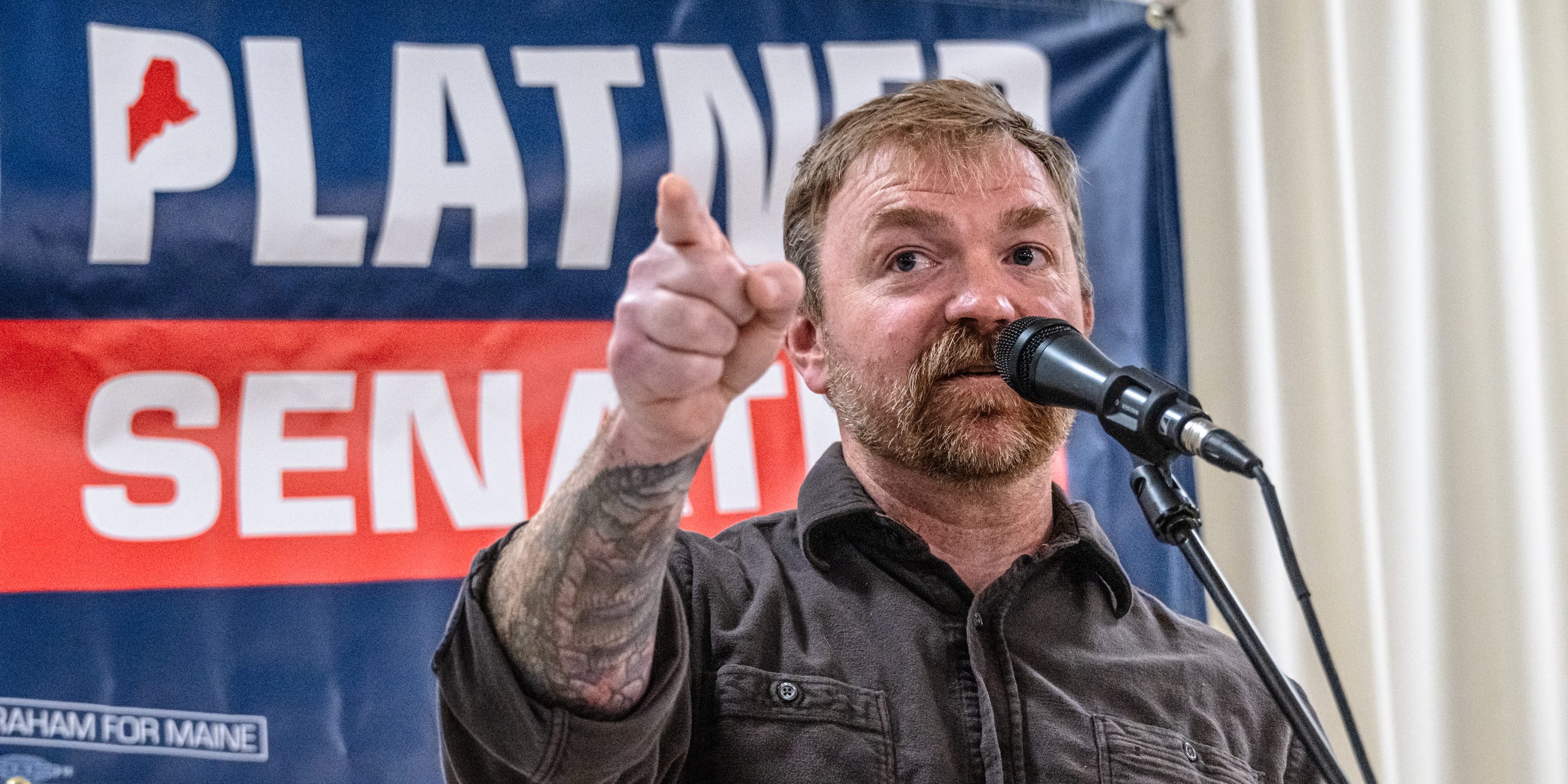
Political newcomer Graham Platner won a bruising primary fight for the state’s Democratic Senate nomination Tuesday night, when voters easily picked him to take on Republican Susan Collins in November despite damage from stories delving into his past.
Plainspoken populism won the oyster farmer and Marine Corps veteran support among fed-up Mainers, who nominated him in a landslide that The Associated Press called with just 8 percent of the vote in.
“Over the last nine months I have seen Mainers come together behind a vision to take back our power from corporations and billionaires,” Platner said in his acceptance speech Tuesday. “I love every single one of you. Everyone who has shown up at a town hall, who has knocked on a door, who cast their vote — not for me but for a vision of a life in Maine that you can afford; a life of dignity and a government that actually serves its people.”
Platner’s appeal seemed unshaken amid months of negative press stemming from his inflammatory comments on Reddit and an ill-advised tattoo resembling a Nazi symbol. But a recent series of damaging stories in national media, including revelations in the Wall Street Journal about extramarital sexting and allegations in the New York Times of abusive behavior in past relationships, have given some voters and political observers pause. Others say that in Maine, a fiercely independent state where residents nurse a healthy suspicion of influence “from away,” Platner supporters have dismissed those stories as meddling from an establishment fearful of a political maverick.
“From what I can tell, I don’t think the Times piece moved the needle much,” said Shay Stewart-Bouley, a longtime Maine resident who has written both critically and supportively of Platner on her blog, Black Girl in Maine. “I heard some women say it made them uneasy, but I haven’t heard anyone say it changed how they’re going to vote.”


In other cases, the coverage appears to have cemented Platner’s status as an outsider to an establishment embodied by Collins, who has represented Maine in the Senate since 1997. Like many incumbents nationwide, the Republican senator will have to run amid a shrinking job market and rising costs, points that Platner has seized on throughout his campaign. And Collins’s association with the establishment could prove a major liability, even among onetime supporters of President Donald Trump, according to Charles Pray, a former state senator and veteran figure in Maine Democratic politics.
“Part of Trump’s rise was a total frustration with incumbents and people in power, and a lot of people who were Trump supporters who hoped he was going to address rising grocery prices and stuff now see him saying that affordability is not an issue,” said Pray. “Well, affordability is a big issue in Maine, and I think that hurts Collins.”
Platner faced a nominal challenge in Tuesday’s primary from Maine Gov. Janet Mills, who suspended her campaign in April but remained on the ballot, and from David Costello, a former Democratic nominee in the 2024 Senate race who was little more than an afterthought in the latest contest.

Just days before the primary, the Times reported disturbing allegations about Platner, including that an ex-girlfriend accused him of drunkenly locking her in a room during a fight and physically restraining her at times. (Platner has acknowledged the relationship with the accuser, a longtime Republican operative in Washington, but denies he engaged in violent behavior.)
Pray said that among people he’s spoken with, the allegations, while concerning, are undercut by Collins’s support for the nomination of Supreme Court Justice Brett Kavanaugh despite the sexual assault accusations against him, and by her support of Trump despite the many accusations against him and his consistently hostile behavior toward women interviewers.
“I think people aren’t buying the double standard. She confirmed Kavanaugh, she supports Trump despite his behavior,” Pray said, pointing to the president’s recent outburst on NBC News. “I spoke to three women, including Republicans, who were very upset by that and who said ‘Susan just goes along with that.’”
To Platner’s most ardent supporters, the revelations look like meddling by an establishment that never wanted him to be the candidate, said Andy O’Brien, a former state senator who writes about politics in the state and supports Platner. (O’Brien works for the AFL-CIO of Maine, which has endorsed Platner, but did not speak to The Intercept on behalf of his employer).

“So many people know Graham, and they listen to what he says, they don’t listen to all the crap coming from Washington and New York and California,” said O’Brien. “They like Graham because he speaks to them, and they believe him and trust him. They know he had a messy personal life. I think that there’s a lot of grace that they’re showing him, partly because of his post-traumatic stress from combat and also because there’s this sense that Trump has already lowered the bar so much.”
Mostly, however, Mainers are weary of the national attention the primary brought to their state — with little hope in sight of a let-up, Stewart-Bouley said.
“The general mood is people are really tired of this primary,” she said before Platner’s Tuesday night victory. “But if Platner wins, I suspect we’re not going to be out of the woods.”
In his remarks Tuesday, Platner acknowledged errors in his past and thanked the people of Maine for putting their trust in him despite them.
“Redemption is not just some simple or easy destination. It’s a journey. I’ve made mistakes in my life. Mistakes that I regret, that I live with and that I continue to learn from. And I’m still far from perfect. But every day I wake up and I try to be a little bit better and a little bit kinder than I was before,” Platner said. “And if you give me the chance, I will be a senator for the people who cannot afford to buy a senator.”
Update: June 9, 2026, 9:39 p.m. ET
This story has been updated with news of Platner’s victory in the Maine primary.
IT’S EVEN WORSE THAN WE THOUGHT.
What we’re seeing right now from Donald Trump is a full-on authoritarian takeover of the U.S. government.
This is not hyperbole.
Court orders are being ignored. MAGA loyalists have been put in charge of the military and federal law enforcement agencies. The Department of Government Efficiency has stripped Congress of its power of the purse. News outlets that challenge Trump have been banished or put under investigation.
Yet far too many are still covering Trump’s assault on democracy like politics as usual, with flattering headlines describing Trump as “unconventional,” “testing the boundaries,” and “aggressively flexing power.”
The Intercept has long covered authoritarian governments, billionaire oligarchs, and backsliding democracies around the world. We understand the challenge we face in Trump and the vital importance of press freedom in defending democracy.
We’re independent of corporate interests. Will you help us?
IT’S BEEN A DEVASTATING year for journalism — the worst in modern U.S. history.
We have a president with utter contempt for truth aggressively using the government’s full powers to dismantle the free press. Corporate news outlets have cowered, becoming accessories in Trump’s project to create a post-truth America. Right-wing billionaires have pounced, buying up media organizations and rebuilding the information environment to their liking.
In this most perilous moment for democracy, The Intercept is fighting back. But to do so effectively, we need to grow.
That’s where you come in. Will you help us expand our reporting capacity in time to hit the ground running in 2026?
We’re independent of corporate interests. Will you help us?

I’M BEN MUESSIG, The Intercept’s editor-in-chief. It’s been a devastating year for journalism — the worst in modern U.S. history.
We have a president with utter contempt for truth aggressively using the government’s full powers to dismantle the free press. Corporate news outlets have cowered, becoming accessories in Trump’s project to create a post-truth America. Right-wing billionaires have pounced, buying up media organizations and rebuilding the information environment to their liking.
In this most perilous moment for democracy, The Intercept is fighting back. But to do so effectively, we need to grow.
That’s where you come in. Will you help us expand our reporting capacity in time to hit the ground running in 2026?
We’re independent of corporate interests. Will you help us?
Contact the author:

Related




Latest Stories

Israel’s War on Gaza
A C-Section in Shackles: A Palestinian Woman’s Harrowing Birth in Israeli Detention
Dana Joudeh was denied proper food and medical care throughout her pregnancy in an Israeli prison. She gave birth to a premature baby surrounded by armed guards.

ICE Shooting in NYC Inflames Mamdani’s Policing Problem
After ICE shot a young father in Manhattan, New Yorkers asked the mayor to protect them from his police department and federal agents alike.

Where Are the Iran War Protests?
Despite a wildly unpopular war with Iran, a mass protest movement for peace hasn’t materialized — at least in the ways we’ve been taught to recognize.