
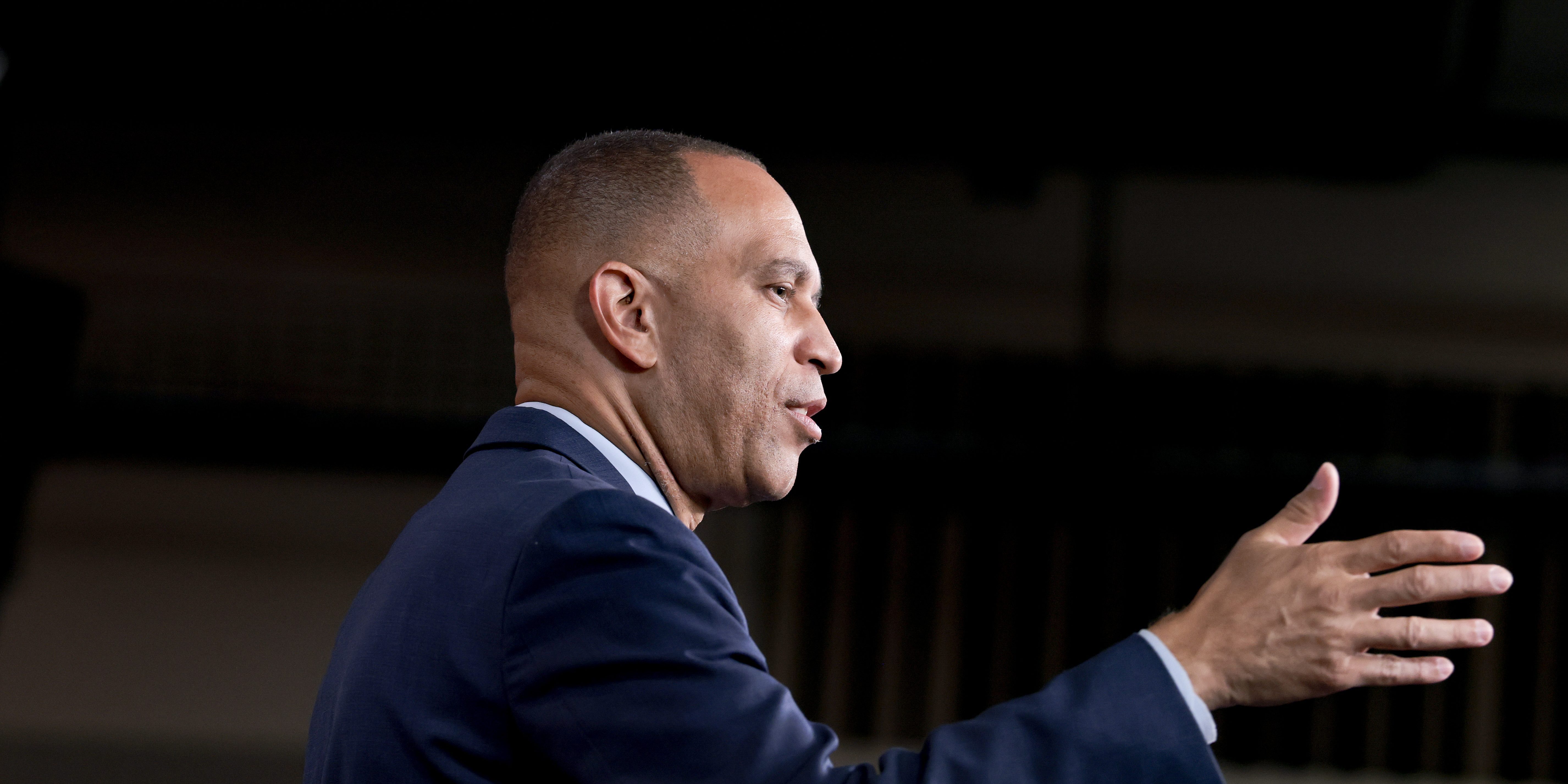
For months, Democrats have forced Republicans to take vote after vote on President Donald Trump’s unpopular war on Iran. Now those votes could help Democrats retake Congress — and they will immediately have opportunities to follow through on their anti-war rhetoric.
Democratic leaders like House Minority Leader Hakeem Jeffries of New York have been cagey about their strategy on Iran for the lame-duck period before the next Congress is sworn in on January 3. So far, months of Capitol Hill maneuvering have produced few concrete results. And one path to potential progress for ending the war is laden with risk: threatening a government shutdown.
Opponents of the war say that, with Democrats pushing for support based on their efforts to end to the war, they owe it to voters to put government spending on the line.
“It will certainly demonstrate whether Democrats are willing to stretch themselves and put up a fight and get uncomfortable,” said Hannah Morris, the vice president of government affairs for the liberal, pro-Israel group J Street, which opposes the conflict. “So much of the rhetoric has been about the Iran war.”

In the months since the conflict began on February 28, Democrats and the handful of Republicans opposed to the war have poured most of their energy into votes based on the 1973 War Powers Resolution, which limits the president’s power to wage war without congressional approval. In June, they succeeded in securing House and Senate passage of a war powers resolution, but the Trump administration has ignored the vote, arguing the law is unconstitutional.



Advocates still believe the Trump administration should be bound by the June resolution, but they concede that other paths may have more teeth.
If they really want to stop the war, Democrats will have to confront questions of timing, divisions within their own caucus, and the risk of a government shutdown.
One prime opportunity could be the December 11 expiration of a spending bill called the continuing resolution that has been funding the government since the last shutdown. Democrats could attempt to attach a rider to the bill prohibiting the use of any of its funds for the Iran war. If that bill does not pass both chambers, the government shuts down.
The process will provide Democrats with rare leverage before the next Congress is sworn in.
Congressional Democratic leaders have not said whether they are willing to risk a shutdown, however. Jeffries did not tip his hand when he was asked during a recent interview with CNN.
“Listen, we’ll deal with the appropriations process when we deal with the appropriations process,” he said. “Right now, the mechanism that is in front of us will be to aggressively move war powers resolutions until we end this war in the best interest of the American people.”
Some Democratic candidates in hotly contested races have gone much further than Jeffries, zeroing in on the appropriations issue. Rep. Tom Barrett, of Michigan’s 7th Congressional District, was one of the few Republicans to vote for an Iran war powers resolution. But environmental activist Will Lawrence still attacked him at a recent debate on the issue of war funding.
Morris, who is part of a coalition of groups that have called on Congress to cut off funding for the war, said she is not sure how aggressively Democrats will be willing to pursue the issue during the lame-duck period.
“Will they be willing to shut down the government over this? I don’t have real answers. I think there are a lot of variables here,” she said.

Another option supported by many advocates is the pending debate over the National Defense Authorization Act, the annual Pentagon budget and policy bill. Critics of the war argue that Congress could attempt to insert a provision into the law cutting off authorization for the conflict.
Democrats should be willing to block the bill if it does not include “meaningful restrictions” on the administration’s ability to wage the war, said Hassan El-Tayyab, legislative director for Middle East Policy at the Friends Committee on National Legislation.
“That’s the mandate we’re seeing from the American people,” he said. “They shouldn’t pass a massive defense bill while leaving the administration free to pursue yet another open-ended war in the Middle East.”
The defense bill is generally considered “must-pass” legislation on Capitol Hill, providing leverage for Senate Democrats who could block it with a filibuster. The office of Sen. Jack Reed, D-R.I., who plays a key role in the process as the top Democrat on the Senate Armed Services Committee, did not respond to a request for comment.
Falling short of either of those paths, Democrats could continue to try to pass more war powers resolutions. With their party poised for a dramatic shift in its favor in the midterm elections, Democrats could even try to exert pressure on Republican legislators to vote in favor of the resolutions, some opponents of the war believe.
Democrats could also wait until January, when they are widely predicted to retake control of one or both chambers of Congress. Holding the gavel in the House or Senate will give them vastly expanded powers to set military spending and launch investigations into the conduct of the war.
One key Democrat, Rep. Adam Smith of Washington, told The Intercept in a statement he was willing to pursue multiple paths to stopping the war, but all of them face obstacles until the next Congress.

“I am open to exploring options for using the NDAA or appropriations bills as a way to end the war,” said Smith, the ranking member of the House Armed Services Committee. “That effort would most likely require bipartisan support. Unfortunately, I am not confident that there is sufficient Republican will or support for such legislative efforts or to override an inevitable veto.”
Whether in this Congress or the next, cutting off spending for the war appears to be the best way for Democrats to force the Trump administration to negotiate with Iran, according to Brian Finucane, a former State Department official who serves as a senior adviser at the nonprofit International Crisis Group.
“If they are serious,” he said, “they should be willing to play hardball, and that would require using the power of the purse.”
IT’S EVEN WORSE THAN WE THOUGHT.
What we’re seeing right now from Donald Trump is a full-on authoritarian takeover of the U.S. government.
This is not hyperbole.
Court orders are being ignored. MAGA loyalists have been put in charge of the military and federal law enforcement agencies. The Department of Government Efficiency has stripped Congress of its power of the purse. News outlets that challenge Trump have been banished or put under investigation.
Yet far too many are still covering Trump’s assault on democracy like politics as usual, with flattering headlines describing Trump as “unconventional,” “testing the boundaries,” and “aggressively flexing power.”
The Intercept has long covered authoritarian governments, billionaire oligarchs, and backsliding democracies around the world. We understand the challenge we face in Trump and the vital importance of press freedom in defending democracy.
We’re independent of corporate interests. Will you help us?
IT’S BEEN A DEVASTATING year for journalism — the worst in modern U.S. history.
We have a president with utter contempt for truth aggressively using the government’s full powers to dismantle the free press. Corporate news outlets have cowered, becoming accessories in Trump’s project to create a post-truth America. Right-wing billionaires have pounced, buying up media organizations and rebuilding the information environment to their liking.
In this most perilous moment for democracy, The Intercept is fighting back. But to do so effectively, we need to grow.
That’s where you come in. Will you help us expand our reporting capacity in time to hit the ground running in 2026?
We’re independent of corporate interests. Will you help us?

I’M BEN MUESSIG, The Intercept’s editor-in-chief. It’s been a devastating year for journalism — the worst in modern U.S. history.
We have a president with utter contempt for truth aggressively using the government’s full powers to dismantle the free press. Corporate news outlets have cowered, becoming accessories in Trump’s project to create a post-truth America. Right-wing billionaires have pounced, buying up media organizations and rebuilding the information environment to their liking.
In this most perilous moment for democracy, The Intercept is fighting back. But to do so effectively, we need to grow.
That’s where you come in. Will you help us expand our reporting capacity in time to hit the ground running in 2026?
We’re independent of corporate interests. Will you help us?
Contact the author:

Related




Latest Stories

DHS Was Designed as a Weapon
Rep. Delia Ramirez and writers Rozina Ali and Will Sommer discuss the ICE raid on Ilhan Omar and the years of “counterterror” surveillance that paved the way for the Trump administration’s abuses.

Long After the Maui Fires, Toxic Metals Linger in Residents’ Bodies
The toxic exposures didn’t begin with the flames. Researchers are examining how fires affected a community already harmed by plantation agriculture, development, and colonialism.

Midterms 2026
Lockheed Martin Showered Susan Collins With Cash as F-35 Program Hit Turbulence
Collins received tens of thousands from Lockheed during a two-month period surrounding a critical 2023 watchdog report.