
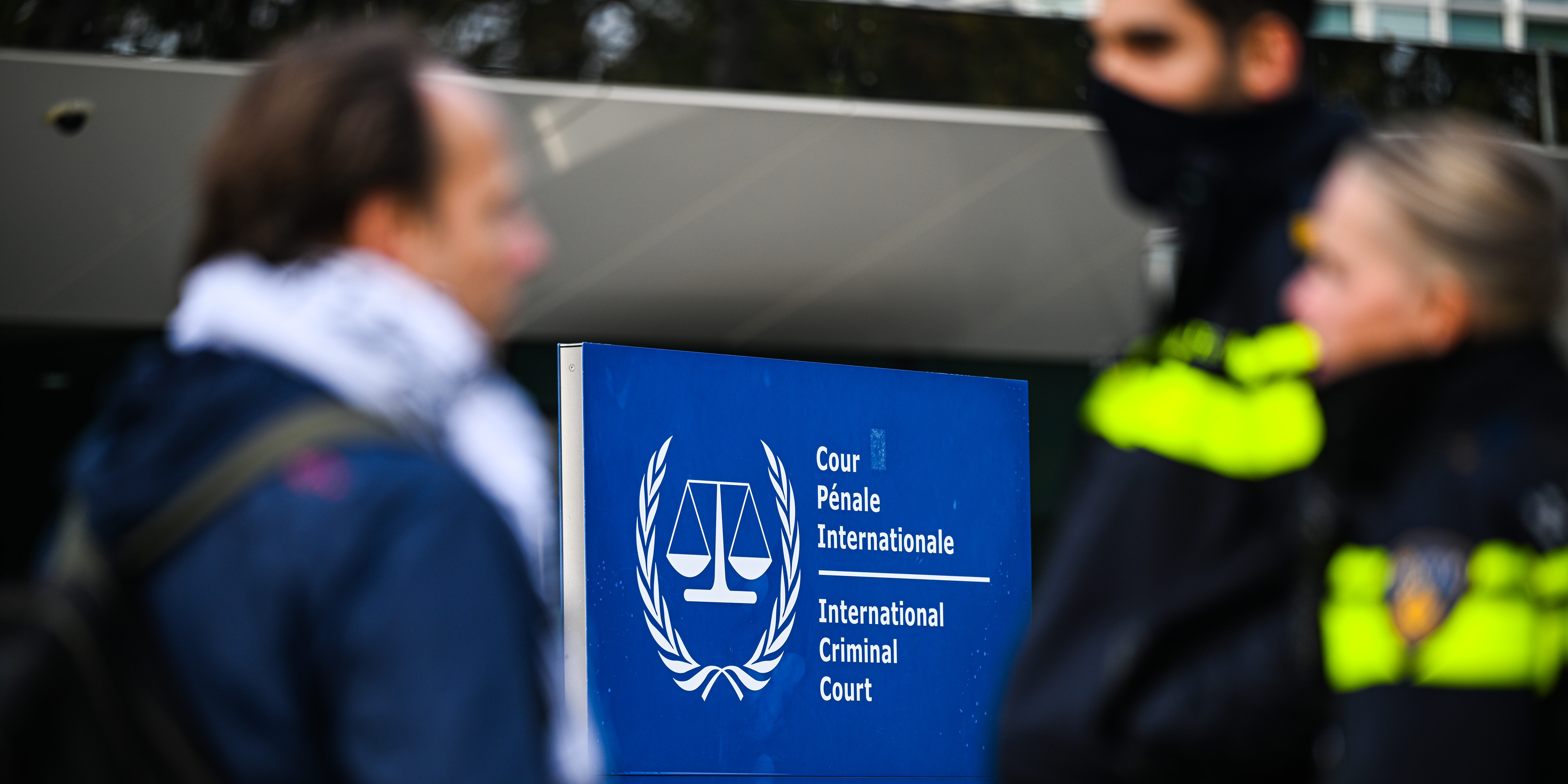
A federal judge on Monday ruled that the Trump administration may not punish Americans for sharing evidence of Israeli war crimes with the International Criminal Court. The ruling also blocked the administration from meting out punishments for sharing information with three sanctioned Palestinian human rights groups and a prominent United Nations official.
The Monday ruling is the broadest challenge yet to an executive order issued by President Donald Trump in the early days of his second term that has been used by U.S. officials to issue sanctions against the ICC; the Palestinian groups al-Haq, al-Mezan, and the Palestinian Center for Human Rights; and U.N. special rapporteur Francesca Albanese.
“It was kind of expected that they would make the preliminary injunction permanent, but the universal part is huge.”
The order, which came as a result of a lawsuit filed in July by Democracy for the Arab World Now, or DAWN, and the Taxpayer Alliance Against Genocide, is the latest setback to efforts by the Trump administration to undermine the efforts by the ICC, Albanese, and others to hold Israel accountable for crimes against humanity.
“This landmark ruling dismantles a core part of Trump’s ICC draconian sanctions regime,” said Omar Shakir, executive director at DAWN. “The court has affirmed that every American has the constitutional right to advocate for justice on Palestine without fear of reprisal.”


While previous rulings against Trump’s executive order applied more narrowly — including an October preliminary injunction in the ICC case that prevented punishments against the plaintiffs — this is the first ruling against the sanctions that protects all Americans.
“The main difference is that this was expanded to be universal, meaning it doesn’t just protect the people who filed the lawsuit in the first place,” Michael Schaeffer Omer-Man, the Israel-Palestine director for DAWN, told The Intercept. “It was kind of expected that they would make the preliminary injunction permanent, but the universal part is huge.”

A spokesperson for the White House did not immediately respond to a request for comment, but in a legal filing earlier this month, attorneys for Trump argued that his original executive order did not represent a restriction on free speech.
Another previous ruling that applied narrowly came in a case brought by a pair of university professors who challenged the administration’s prohibition on working with the ICC. Joseph Pace, a lawyer for DAWN and the Taxpayer Alliance Against Genocide, said this ruling also helped overcome some of the limitations in the professors’ successful case.
“It didn’t stop the administration from enforcing the sanctions against anyone else,” he said, of the decision in the professors’ case. “Nor did that decision say anything about the Palestinian NGOs or Albanese” — neither of which had been sanctioned yet at the time of the ruling.
“The permanent injunction, though, is what’s called a ‘universal injunction,’” Pace told The Intercept. “That means the government can’t penalize anyone for providing (or receiving) First Amendment-protected services to or from ICC, Albanese, and the NGOs.”
“Challenging These Crimes”
In his ruling, U.S. District Judge Jesse Furman found that the so-called services provision of Trump’s order — which threatened penalties for anyone “providing services” to the ICC, Albanese, or the three Palestinian NGOs — was unconstitutional because it undermined the First Amendment rights of people seeking to provide non-financial services to human rights advocates.
In a statement, Taxpayer Alliance Against Genocide co-founder Anna Marie Stenberg said the ruling by Furman provided immediate clearance for her organization and others to resume work with the ICC, Albanese, and the three Palestinian organizations.
“We challenged Trump’s Executive Order on the ICC because we refused to let his regime intimidate us into silence while it used our tax dollars to fund crimes against humanity,” Stenberg said. “This victory means that others can join us in challenging these crimes without fear of punishment for exercising their First Amendment rights. Ordinary people have a right to seek justice, and our government cannot take that right away.”
Trump’s Executive Order 14203, issued in February 2025, called for financial penalties against the ICC under the International Emergency Economic Powers Act. It barred Americans from providing financial assistance or services to further the court’s activities. Trump’s order explicitly cited the court’s investigations into Israel as a justification for the sanctions.
The order led to sanctions by the Trump administration against Albanese, who has consistently drawn the ire of pro-Israel officials for pursuing investigations into Israeli war crimes. The sanctions barred her from entry to the U.S. and froze her assets in the country. Albanese challenged the sanctions and a judge threw them out in May, but they were reinstated later that month.
IT’S EVEN WORSE THAN WE THOUGHT.
What we’re seeing right now from Donald Trump is a full-on authoritarian takeover of the U.S. government.
This is not hyperbole.
Court orders are being ignored. MAGA loyalists have been put in charge of the military and federal law enforcement agencies. The Department of Government Efficiency has stripped Congress of its power of the purse. News outlets that challenge Trump have been banished or put under investigation.
Yet far too many are still covering Trump’s assault on democracy like politics as usual, with flattering headlines describing Trump as “unconventional,” “testing the boundaries,” and “aggressively flexing power.”
The Intercept has long covered authoritarian governments, billionaire oligarchs, and backsliding democracies around the world. We understand the challenge we face in Trump and the vital importance of press freedom in defending democracy.
We’re independent of corporate interests. Will you help us?
IT’S BEEN A DEVASTATING year for journalism — the worst in modern U.S. history.
We have a president with utter contempt for truth aggressively using the government’s full powers to dismantle the free press. Corporate news outlets have cowered, becoming accessories in Trump’s project to create a post-truth America. Right-wing billionaires have pounced, buying up media organizations and rebuilding the information environment to their liking.
In this most perilous moment for democracy, The Intercept is fighting back. But to do so effectively, we need to grow.
That’s where you come in. Will you help us expand our reporting capacity in time to hit the ground running in 2026?
We’re independent of corporate interests. Will you help us?

I’M BEN MUESSIG, The Intercept’s editor-in-chief. It’s been a devastating year for journalism — the worst in modern U.S. history.
We have a president with utter contempt for truth aggressively using the government’s full powers to dismantle the free press. Corporate news outlets have cowered, becoming accessories in Trump’s project to create a post-truth America. Right-wing billionaires have pounced, buying up media organizations and rebuilding the information environment to their liking.
In this most perilous moment for democracy, The Intercept is fighting back. But to do so effectively, we need to grow.
That’s where you come in. Will you help us expand our reporting capacity in time to hit the ground running in 2026?
We’re independent of corporate interests. Will you help us?
Contact the author:

Related

“They Want People Scared”: Former Palestine Action Member Blasts Trump’s Terror Sanctions

What American Doctors Saw in Gaza

YouTube Quietly Erased More Than 700 Videos Documenting Israeli Human Rights Violations

EU President Should Be Investigated for Complicity in Israel’s War Crimes, Says Top U.N. Expert on Palestine
Latest Stories

Hakeem Jeffries Can Live With “Medicare for More”
As progressives push for Medicare for All, the likely next House speaker has signed off on a first step.

The War on Immigrants
Private Prison Told ICE Its Jail Was Worth $67 Million. ICE Bought It for Nearly Half a Billion.
GEO Group made a windfall after ICE bought a jail for nearly seven times the private prison giant’s own appraisal, documents reveal.

Losing to the Mud: Feds Drag Their Feet as an Alaskan Village Sinks
As communities seek relocation spurred by climate change, the Yup’ik people in the remote village of Nunapitchuk have struggled to get help moving a mile uphill.